
Palantir Technologies(PLTR)

Search documents
Michael Burry's Warning to Wall Street Just Rang Out Loud and Clear. Should You Listen?
The Motley Fool· 2025-11-17 09:15
Core Viewpoint - Investors are increasingly concerned about stock valuations, particularly in the context of artificial intelligence (AI) stocks, as highlighted by Michael Burry's recent actions against Nvidia and Palantir Technologies [2][3][11]. Group 1: Michael Burry's Actions - Michael Burry, known for his successful bet against the U.S. housing market, has shifted focus to AI stocks, specifically betting against Nvidia and Palantir in Q3 of this year [2][3]. - Burry's fund, Scion Asset Management, is closing down, a move attributed to rising valuations in the market [3][9]. - In his communication to investors, Burry expressed that his valuation estimates are not aligned with current market conditions, indicating a bearish outlook on certain stocks [10]. Group 2: AI Market Dynamics - The AI sector has attracted significant investment over the past few years, with expectations that it could revolutionize industries, similar to the internet and the printing press [5]. - Companies like Nvidia and Palantir have seen their stock prices increase over 1,000% in the past three years, contributing to the overall rise of the S&P 500 [6]. - The S&P 500 Shiller CAPE ratio has reached 40, a historically high level, reflecting increased valuations in the market [8]. Group 3: Investment Considerations - Burry's actions suggest that current valuations pose risks for investors, particularly in high-flying AI stocks [11]. - Despite valuation concerns, some AI companies, including Palantir and Alphabet, reported strong growth and high market demand, indicating that the AI growth narrative remains robust [12]. - Long-term investment strategies in AI and growth stocks may still yield positive results, emphasizing the importance of identifying reasonably priced stocks and holding them for extended periods [13].


Could This AI Stock Hit a $1 Trillion Valuation Before 2030?
The Motley Fool· 2025-11-17 09:15
Core Insights - Palantir Technologies, currently valued at $410 billion, faces the challenge of significantly increasing its valuation to reach the $1 trillion mark by 2030, which would require more than doubling its current worth [2][12] - The company has experienced substantial growth, with a stock increase of nearly 2,000% over the past three years, indicating its potential for rapid valuation changes [2][12] Business Performance - Palantir's revenue has shown impressive growth, generating $1.2 billion in the third quarter, marking a 63% year-over-year increase, and achieving a record total contract value of $2.8 billion, up 151% year over year [5] - The U.S. government remains Palantir's largest revenue source, contributing $486 million in Q3, while U.S. commercial revenue grew by 121% year over year to $397 million [7] Valuation Concerns - Despite strong earnings, Palantir's market cap leads to a high valuation, trading at 113 times trailing sales and 407 times trailing earnings, which is significantly higher than other tech companies like Nvidia, Microsoft, and Alphabet [8][9] - The sustainability of Palantir's current valuation is questioned, as growth becomes more challenging with increasing company size, and a more reasonable valuation is anticipated in the future [12][13] Future Outlook - Achieving a $1 trillion valuation by 2030 is deemed unlikely, as Palantir would need to increase its net income from $1.1 billion to $20 billion within three years, a significant leap that is possible but not probable [13][14] - While reaching the $1 trillion mark may be a long shot, Palantir can still perform well without hitting that target, indicating a high-risk, high-reward investment profile [14]

大摩Q3大举减持明星AI股,科技巨头仅加仓微软(MSFT.US)与亚马逊(AMZN.US)
智通财经网· 2025-11-17 08:58
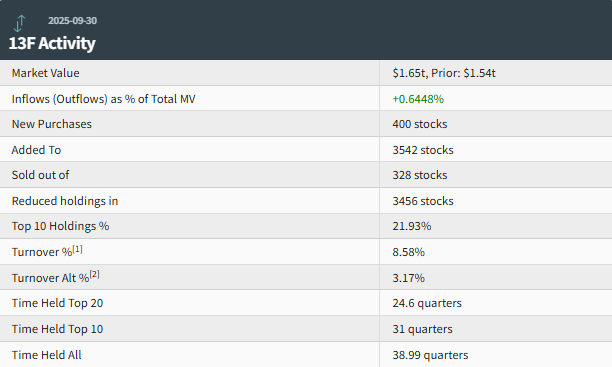
Core Insights - Morgan Stanley's total market value of holdings reached $1.65 trillion for Q3 2025, up 7.1% from $1.54 trillion in the previous quarter [1][2] - The firm added 400 new stocks, increased holdings in 3,542 stocks, reduced holdings in 3,456 stocks, and completely sold out of 328 stocks during the quarter [1][2] - The top ten holdings accounted for 21.93% of the total market value [1][2] Holdings Overview - The top five holdings included Microsoft (MSFT) with 120.24 million shares valued at approximately $62.28 billion (3.77% of the portfolio), Nvidia (NVDA) with 323 million shares valued at $60.26 billion (3.65%), Apple (AAPL) with 229 million shares valued at $58.34 billion (3.53%), Amazon (AMZN) with 163 million shares valued at $35.76 billion (2.16%), and Google (GOOGL) with 122 million shares valued at $29.64 billion (1.79%) [3][4] Trading Activity - The top five purchases by percentage change in the portfolio were Invesco QQQ Trust (QQQ), SPDR S&P 500 ETF (SPY), Invesco MSCI USA ETF (PBUS), Vanguard S&P 500 ETF (VOO), and Johnson & Johnson (JNJ) [5][6] - The top five sales included Visa (V), Meta Platforms (META), Accenture (ACN), Costco (COST), and Salesforce (CRM) [5][6] Sector Movements - Morgan Stanley increased its positions in major energy companies ExxonMobil (XOM) and Chevron (CVX) during Q3, despite concerns over supply surplus [7]



X @Bloomberg
Bloomberg· 2025-11-17 08:06
Geopolitical Landscape - The era of American unipolarity has ended [1] - Global power dynamics are shifting [1] Technological Advancement - Defense technology is evolving at an unprecedented rate [1] - AI is reshaping every domain [1] Company Focus - Palantir's UK head, Louis Mosley, discusses these changes [1]
Michael Burry's Ominous Warning Hints That AI Investment Boom Is Rivaling Dot-Com, Housing Bubble Peaks - NVIDIA (NASDAQ:NVDA)
Benzinga· 2025-11-17 07:13
Core Viewpoint - Michael Burry warns that the current "Cloud then AI Buildout" has created a capital expenditure bubble comparable to the DotCom and Housing peaks [1][4]. Group 1: Market Analysis - Burry's analysis includes a chart showing that the ratio of net capital expenditures to nominal U.S. GDP is at its highest during bubbles, indicating a significant investment spike driven by AI [4]. - The current investment levels surpass those seen during the 2000 DotCom boom and the 2007 Housing bubble, suggesting a potential market correction [4][6]. Group 2: Investor Sentiment - Burry uses a meme to illustrate that investors are ignoring the evident risks, comparing their behavior to those who would overlook the dangers of the "One Ring" in "Lord of the Rings" [2][4]. - His commentary implies that the market is euphoric and blind to the looming threats, despite clear indicators of a bubble [6]. Group 3: Fund Management - Burry has de-registered his hedge fund, Scion Asset Management, with the SEC, indicating a significant shift in his investment strategy [5]. - He plans to liquidate the fund by the end of the year, citing a disconnect between market behavior and his value assessments [5]. Group 4: Specific Stock Positions - Burry's final filings reveal substantial bearish positions against AI-related stocks, particularly Nvidia and Palantir, reinforcing his bearish outlook on the sector [6]. - The mention of a "Nov 25th" tease suggests that Burry may have further insights or actions planned regarding his investment strategy [7].

AI and Warfare: Palantir's UK Head Mosley on the New Era of Defense Technology
Youtube· 2025-11-17 06:23
Geopolitical and Technological Shifts - The world is experiencing a fundamental geopolitical shift with the end of American unipolarity, as adversaries like China emerge as near-peer competitors [1][2] - Concurrently, a revolution in artificial intelligence technology is anticipated to transform various aspects of life, including defense and military applications [2][3] Impact of AI on Defense - The changes brought by AI are expected to unfold over a short period, potentially within 5 to 10 years, comparable in scale to the industrial revolution [3] - The future of defense software will likely involve significant automation, raising questions about the necessity of human oversight in military processes [4][5] Investment and Growth Opportunities - The UK is positioned as a key player in defense technology development, boasting high-quality engineering talent essential for software development [6][7] - The company has already established a significant presence in London, with plans to expand its workforce significantly over the next five years, recognizing the UK's role as a premier military power in Europe [7][8]

Palantir Stock 50% Drop Possible?
Forbes· 2025-11-16 16:10
Core Insights - Palantir Technologies stock has surged over 2.3 times this year, reaching approximately $175 per share, driven by interest in generative AI and new government contracts following Donald Trump's re-election [2] - The company reported Q3 revenue of $1.18 billion, a 63% year-over-year increase, and raised its full-year revenue forecast to a midpoint of around $4.4 billion, indicating a 53% rise from 2024 [2] Financial Performance - Revenue growth in the latest quarter increased to 63%, up from 30% in the same quarter last year, with adjusted operating margins improving to 51% from 38% [3] - Palantir's U.S. government segment saw a 52% year-over-year revenue increase to $486 million last quarter [7] - U.S. commercial sales increased by 121% in the latest quarter, highlighting growth potential in the commercial sector [9] Valuation Concerns - Palantir's high valuation stands at approximately 240 times forward earnings, making it vulnerable to significant declines [5][12] - The stock's performance history shows it can experience dramatic downturns, as evidenced by a 70% drop in 2022 [10][12] Market Risks - Broader macroeconomic challenges persist, including moderate growth, softening labor market conditions, and inflationary pressures [4] - The reliance on government contracts introduces political risks, as changes in government priorities or budget reductions could impact revenue [8] Long-term Growth Challenges - Palantir's long-term growth is contingent on expanding its Foundry platform beyond large organizations, which may require a different go-to-market strategy [9] - The company's complex and costly implementation process may hinder scalability with smaller and medium-sized enterprises [9]

2 Overvalued Stocks to Consider Selling Before It's Too Late
The Motley Fool· 2025-11-16 15:49
Core Insights - The stock market has seen a positive trend in 2025, with the S&P 500 index up by 16% year to date, but individual stocks like Palantir Technologies and Quantum Computing Inc. have shown significant volatility and may warrant profit-taking considerations [1][2]. Palantir Technologies - Palantir Technologies has experienced a remarkable 153% increase in share price year to date, benefiting from the rise of large language models (LLMs) and maintaining strong connections in defense and law enforcement sectors [3][5]. - The company's market capitalization has reached $461 billion, making it larger than any public company in Europe or Japan, and the 19th largest in the U.S. [5]. - Despite its growth, Palantir's valuation is high, trading at a forward price-to-earnings (P/E) multiple of 262, which is significantly higher than other AI-related stocks [6]. - Third-quarter revenues increased by 63% year over year to $1.2 billion, but high market expectations may overshadow even strong performance [8]. Quantum Computing Inc. - Quantum Computing Inc. has seen a sharp decline since early October, erasing its 2025 gains and leaving it down approximately 40% year to date, despite a 600% increase over the last 12 months [9][10]. - The company operates in the quantum computing hardware market, where valuations are driven more by hype than by actual revenues or profits [9]. - Analysts suggest that commercially viable quantum computers may not be available until 2040, with significant technical challenges remaining [11]. - In the second quarter, Quantum Computing Inc. reported a 66% drop in revenue to $61,000, while losses nearly doubled to $10.2 million, raising concerns about its financial sustainability [13].


2 stocks to hit $500 billion by 2026
Finbold· 2025-11-16 15:12
Core Insights - Global markets are evolving, enabling a select group of tech companies to transition from emerging players to market-cap giants, particularly in the context of AI and new business models in media and advertising [1] Company Summaries Netflix (NASDAQ: NFLX) - Netflix's current market capitalization is approximately $471.26 billion, with shares trading around $1,112.17 [2] - To achieve a $500 billion valuation, Netflix needs to increase its market value by about $28.74 billion, which is roughly a 6.10% increase, implying a target stock price of approximately $1,180 [2] - The company is diversifying its revenue streams, particularly through the expansion of its ad-supported tier, which is starting to convert signups into a monetization engine [4] - Investments in exclusive original content, international offerings, and gaming initiatives are enhancing user engagement and retention, providing multiple avenues for revenue growth [4] Palantir (NASDAQ: PLTR) - Palantir has a market capitalization of about $414.74 billion, with shares trading near $174.01 [5] - To reach a $500 billion valuation, Palantir must increase its market value by approximately $85.26 billion, representing a gain of about 20.56%, which would require a share price near $209.78 [5] - The company's growth potential is linked to the rapid adoption of AI in enterprises and government sectors, leveraging its data-analytics platform and AI-powered applications [7] - Key factors that could accelerate Palantir's valuation include the expansion of long-term government contracts, strong growth in U.S. commercial revenue, and improved recurring revenue and margins as software economics scale [8]


Michael Burry Bets Against Nvidia and Palantir. But It's Not What You Think.
The Motley Fool· 2025-11-16 10:45
Core Viewpoint - Michael Burry, known for his shorting strategy during the 2008 mortgage crisis, has taken a significant position against Nvidia and Palantir Technologies, purchasing $1.1 billion in put options, which may have influenced the recent decline in these stocks [2][9]. Group 1: Burry's Investment Strategy - Burry's fund, Scion Asset Management, manages nearly $1.4 billion in assets and is required to report holdings quarterly, providing a snapshot of a potentially dynamic portfolio [4][6]. - The nature of hedge funds allows for rapid changes in positions, and Burry's current holdings include put options in Nvidia and Palantir, alongside call options in Pfizer and Halliburton [7][9]. - Burry's strategy may not indicate a long-term bearish outlook on Nvidia and Palantir, but rather a tactical move to capitalize on perceived overvaluation or short-term price declines [10][13]. Group 2: Market Context and Stock Performance - Nvidia's current market capitalization stands at $4621 billion, with a recent price change of +1.68%, while Palantir's market cap is $415 billion, with a +1.00% change [8][12]. - Both stocks have experienced price declines recently, which may align with Burry's expectations of market pressure on these high-value stocks [9][13]. - The retail investor's perspective differs from institutional investors like Burry, who operate with distinct goals and strategies [12][14].
