Banco Santander(SAN)

Search documents
Santander sells 3.5% stake in Polish unit for $473m
Yahoo Finance· 2025-12-03 11:52
Core Insights - Santander is planning to sell approximately a 3.5% stake in its Polish subsidiary, Santander Polska, valued at up to $473 million through an accelerated bookbuild process [1] - This follows a previous agreement to sell a 49% stake in Santander Polska to Erste Group Bank for up to €6.8 billion ($7.90 billion), leaving Santander with around 13% ownership post-transaction [1] - After the stake sale, Santander will retain about a 9.7% stake in Santander Polska and will continue its operations in Poland through Santander Consumer Bank [2] Stake Sale Details - The accelerated placement involves 3,576,626 ordinary shares priced at 482 zlotys ($132.33) per share [2] - The remaining shares will be subject to a 90-day post-closing lock-up period [2] - Citigroup Global Markets Europe and Goldman Sachs Bank Europe are acting as joint global coordinators and bookrunners for the transaction [2] Strategic Cooperation - Santander and Erste have announced a strategic cooperation to leverage each other's strengths in corporate and investment banking [3] - As part of this partnership, Erste will gain access to Santander's global payments platforms [3] Other Recent Developments - In June, Santander signed an agreement to divest seven branches in Pennsylvania, USA, to Community Financial System's subsidiary, Community Bank, as part of its transformation into a national, digital-first bank [4] - In October, Santander announced the merger of its Santander Consumer Finance with Openbank to create a single legal entity operating under the Openbank brand [4] - Openbank and Santander Consumer Finance are part of Santander's Digital Consumer Bank global business, aiming to streamline consumer finance operations in Europe [5]

Italy's doValue renews new bad loan management contract with Santander
Reuters· 2025-12-03 07:45
Core Insights - doValue Group has signed a contract with Banco Santander to manage new flows of impaired loans starting in January, indicating a strategic partnership aimed at enhancing loan recovery efforts [1] Company Summary - doValue Group is an Italian debt recovery firm that specializes in managing impaired loans, showcasing its expertise in the financial services sector [1] - The new agreement with Banco Santander replaces a previous contract, suggesting a shift in the management of impaired loans and potentially improving operational efficiency for both companies [1] Industry Summary - The partnership between doValue Group and Banco Santander reflects ongoing trends in the financial services industry, particularly in the management of non-performing loans, which is critical for maintaining financial stability [1] - The move may signal a broader industry shift towards outsourcing debt recovery processes to specialized firms, enhancing recovery rates and reducing operational burdens for banks [1]


Santander to Sell Stake in Polish Subsidiary for Around $473 Million After Erste Group Deal
WSJ· 2025-12-02 07:08
Group 1 - The bank completed the placement of 3.58 million ordinary shares [1] - The shares represent approximately 3.5% of Santander Bank Polska's share capital [1]

Santander to sell 3.5% stake in its Polish unit for around $480 mln, bookrunner says
Reuters· 2025-12-01 17:56
Group 1 - Santander plans to sell approximately 3.5% stake in its Polish subsidiary Santander Polska [1] - The sale is expected to raise around $480 million [1] - The transaction will be conducted through an accelerated bookbuild [1]
Press Release: Sanofi and Regeneron’s Dupixent approved as the first targeted medicine in the EU in over a decade for chronic spontaneous urticaria
Globenewswire· 2025-11-25 06:00
Core Insights - The European Commission has approved Dupixent (dupilumab) as the first targeted treatment for moderate-to-severe chronic spontaneous urticaria (CSU) in over a decade, providing a new option for patients aged 12 and older who have not responded adequately to antihistamines [1][4][5] Company Overview - Dupixent is developed jointly by Sanofi and Regeneron, targeting type 2 inflammation by inhibiting interleukin-4 (IL4) and interleukin-13 (IL13) pathways, which are key drivers of CSU [10][12] - The approval is based on the LIBERTY-CUPID phase 3 clinical studies, which demonstrated significant efficacy in reducing itch and hives compared to placebo [2][7][8] Clinical Study Findings - Two phase 3 studies (Study A and Study C) involved 284 patients aged 12 years and older, showing Dupixent significantly reduced urticaria activity and increased the percentage of patients achieving well-controlled disease at 24 weeks [2][7][8] - Study B provided additional safety data for patients who were inadequate responders or intolerant to anti-IgE therapy, confirming Dupixent's efficacy in this subgroup [2][3][7] Market Potential - Approximately 270,000 adults and adolescents in the EU suffer from CSU that remains symptomatic despite standard antihistamine treatment, indicating a significant market opportunity for Dupixent [5][6] - Dupixent is already approved for several chronic inflammatory diseases in over 60 countries, with more than 1.3 million patients treated globally [11][12]



Larry Summers resigns from Santander's advisory board, spokesperson says
Reuters· 2025-11-19 20:41
Core Insights - Former U.S. Treasury Secretary Larry Summers has resigned from Santander's international advisory board, which he chaired [1] Company Summary - Santander has confirmed the resignation of Larry Summers from its international advisory board [1]

Santander's Exposure to First Brands Founder Patrick James Reaches $300 Million
PYMNTS.com· 2025-11-19 18:31
Core Insights - Santander's exposure to First Brands Group, founded by Patrick James, has increased to $300 million due to loan defaults [1][2] - First Brands filed for voluntary Chapter 11 bankruptcy, with expectations of continued global operations during the proceedings [3] - Allegations surfaced regarding the company's financial practices, including the sale of receivables more than once, leading to scrutiny of its financing methods [3][4] Financial Implications - First Brands reportedly borrowed approximately $11 billion in loans and invoice financing prior to its bankruptcy, leading to anticipated heavy losses for banks and financial firms [6] - A creditor of First Brands alleged that stakeholders lost track of $2.3 billion in complex financing vehicles, raising concerns about the company's financial transparency [4] Industry Response - Following the bankruptcies of First Brands and Tricolor Holdings, banks are tightening lending practices, increasing due diligence, and requiring more extensive financial histories from borrowers [5]

Santander Exposure to First Brands Rises to Around $300 Million
WSJ· 2025-11-19 14:05
Core Insights - A loan default involving French auto parts maker Novares has increased the debts owed to a Spanish bank [1] Company Summary - Novares, a French auto parts manufacturer, is currently facing a loan default situation [1] - The default has significant implications for the financial obligations of Novares, particularly in relation to its debts to a Spanish bank [1] Industry Summary - The incident highlights potential vulnerabilities within the auto parts manufacturing sector, especially regarding financial stability and debt management [1]

隔离规定小放松?英国银行想动储户钱,央行说“不行!”
智通财经网· 2025-11-18 08:58
Core Viewpoint - The Bank of England is preparing to relax certain aspects of the UK's ring-fencing regulations while opposing significant reforms sought by banks, aiming to retain core protective measures during the review process by the government [1][2]. Group 1: Regulatory Changes - The ring-fencing regulations require banks to separate their retail operations from investment banking activities to protect depositors and taxpayers in times of crisis [1]. - The regulations apply to banks with retail deposits exceeding £35 billion (approximately $46.1 billion), including Lloyds Banking Group, NatWest, HSBC, Barclays, and Santander UK [1]. - Critics argue that these regulations hinder the UK's international competitiveness and that their removal could free up capital for lending [1]. Group 2: Bank Perspectives - Some banks have lobbied the UK Treasury, which has the final say on significant changes, to allow them to use a portion of the £35 billion from non-ring-fenced banks for investment banking activities [1]. - An anonymous source indicated that the Prudential Regulation Authority (PRA) opposes such proposals, viewing them as dismantling the ring-fencing framework [2]. - The PRA is more open to smaller changes, such as allowing shared back-office functions between entities and permitting certain activities within the ring-fenced entity [2]. Group 3: Future Outlook - The UK Chancellor, Rachel Reeves, has promised "meaningful" reforms to the ring-fencing regulations as part of efforts to reduce red tape and promote economic growth [1][3]. - The PRA plans to propose its reform plan in early 2026, with the current CEO, Sam Woods, having been involved in designing the existing regulations that took effect in 2019 [3]. - Barclays is noted as the only major UK bank supporting the current regulations, having established independent service departments for both its retail and investment banking operations [3].




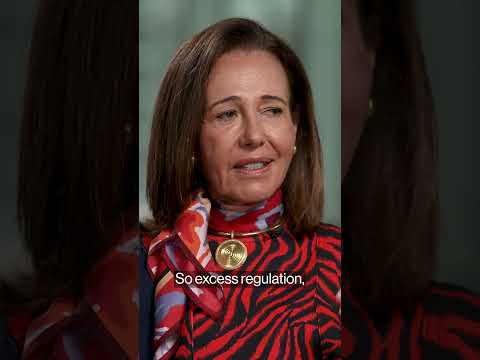
Banking rules hold Europe back, says Santander’s Botín#shorts #banks #santander #banking
Bloomberg Television· 2025-11-17 15:56
what is our ambition for growth. Uh Mario Draghi gave us a diagnosis. How much have we executed.Not more than 10% in one year. So we have to have a much greater ambition on delivering on those recommendations. Um I've said it publicly, you know, if taxes every euro we make in Europe, 58 cents go to the government.Every dollar we make in the United States, 42. That's not a small number, but it's, you know, significantly lower. So, excess regulation, excess taxation actually is a tax on the economy and growth ...