
Tyson Foods(TSN)

Search documents
Tyson Foods (TSN) Expected to Beat Earnings Estimates: What to Know Ahead of Q1 Release
ZACKS· 2026-01-26 16:00
Core Viewpoint - The market anticipates a year-over-year decline in Tyson Foods' earnings despite an increase in revenues when it reports its results for the quarter ended December 2025 [1][3]. Earnings Expectations - Tyson Foods is expected to report quarterly earnings of $1.01 per share, reflecting an 11.4% decrease year-over-year [3]. - Revenue projections stand at $14.12 billion, indicating a 3.7% increase from the same quarter last year [3]. Estimate Revisions - The consensus EPS estimate has been revised 0.49% higher in the last 30 days, suggesting a slight bullish sentiment among analysts [4]. - The Most Accurate Estimate for Tyson is higher than the Zacks Consensus Estimate, resulting in an Earnings ESP of +1.49%, indicating a likelihood of beating the consensus EPS estimate [12]. Earnings Surprise History - In the last reported quarter, Tyson exceeded expectations by posting earnings of $1.15 per share against an expected $0.85, achieving a surprise of +35.29% [13]. - Over the past four quarters, Tyson has consistently beaten consensus EPS estimates [14]. Predictive Indicators - A positive Earnings ESP is a strong predictor of an earnings beat, especially when combined with a Zacks Rank of 1, 2, or 3 [10]. - Tyson currently holds a Zacks Rank of 3, which, along with the positive Earnings ESP, suggests a high probability of exceeding earnings expectations [12].


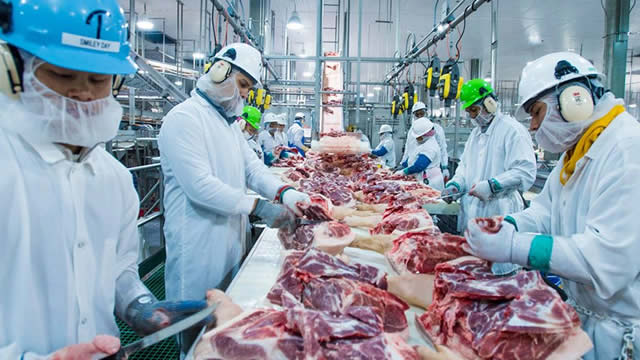
Can Tyson Foods' Chicken Segment Drive Consistent Profit Growth?
ZACKS· 2026-01-13 15:55
Core Insights - Tyson Foods' chicken segment has become its most reliable profit driver in fiscal 2025, raising questions about the sustainability of this momentum over time [1] Financial Performance - In Q4 of fiscal 2025, the chicken segment achieved adjusted operating income of $457 million, an increase from $356 million year-over-year, with adjusted margins rising to 10.4% from 8.4% [2] - For the full fiscal year, adjusted operating income in the chicken segment reached $1.48 billion, with margin expansion to 8.8% from 6.2% in fiscal 2024 [2] Operational Drivers - The improvement in the chicken segment was primarily due to better execution rather than pricing, with higher volumes, improved operating efficiency, and lower feed costs being the main contributors [3] - Fiscal 2025 marked the fourth consecutive quarter of year-over-year volume growth in the chicken business, indicating steady demand and improved supply-chain operations [3] - Growth in value-added products has enhanced the sales mix, reducing exposure to short-term volatility in commodity chicken pricing [3] Future Outlook - For fiscal 2026, Tyson Foods anticipates the chicken segment to continue being a significant profitability contributor, with projected adjusted operating income between $1.25 billion and $1.5 billion [4] - The company is focusing on controllable areas to maintain steady performance [4] Market Sensitivity - The chicken business remains sensitive to fluctuations in commodity costs and increased marketing or promotional spending, making the sustainability of recent gains dependent on operational discipline and adaptability to the broader protein market [5] Stock Performance - Tyson Foods shares have increased by 15.1% over the past three months, outperforming the broader Consumer Staples sector and the S&P 500 index [6]
Tyson Foods: Protein Powerhouse Set To Benefit From The New Food‑Pyramid Shift (NYSE:TSN)
Seeking Alpha· 2026-01-12 20:10
Core Insights - The food sector is experiencing a shift towards healthier, protein-rich foods, influenced by the recent update in the U.S. government's nutrition guide [1] Group 1: Market Trends - There is a growing consumer preference for healthier food options, particularly those high in protein [1] - The updated nutrition guidelines from the U.S. government are expected to further accelerate this trend [1] Group 2: Investment Approach - The focus is on identifying mispriced assets within the food sector that may have been overlooked by the market [1] - A fundamentals-first investment strategy is emphasized, despite the current market's inclination towards sentiment and technical analysis [1]
Tyson Foods: Protein Powerhouse Set To Benefit From The New Food‑Pyramid Shift
Seeking Alpha· 2026-01-12 20:10
Core Insights - The food sector is experiencing a shift towards healthier, protein-rich foods, influenced by the recent update in the U.S. government's nutrition guide [1] Group 1: Market Trends - There is a growing consumer preference for healthier food options, particularly those high in protein [1] - The updated nutrition guidelines from the U.S. government are expected to further accelerate this trend [1] Group 2: Investment Strategy - The focus is on identifying mispriced assets within the food sector that may have been overlooked by the market [1] - A fundamentals-first approach is emphasized, despite the current market environment being heavily influenced by sentiment and technical factors [1]
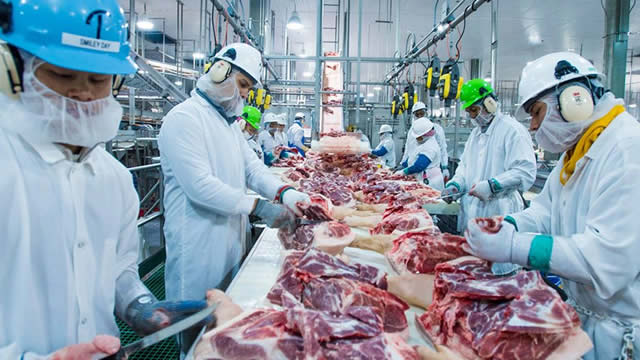
Tyson Foods’ Q1 FY2026 Earnings: What to Expect
Yahoo Finance· 2026-01-05 13:29
Core Insights - Tyson Foods, Inc. is a global leader in protein production, offering a range of raw meat products and prepared foods to consumers worldwide [1] - The company has a market capitalization of $20.49 billion and manages its entire supply chain through vertical integration [2] Financial Performance - Tyson Foods is expected to report a profit of $0.98 per diluted share for Q1 of fiscal 2026, reflecting a 14% year-over-year decline [3] - For the full fiscal year 2026, analysts predict a 6.3% annual drop in diluted EPS to $3.86, followed by a 20.2% year-over-year improvement to $4.64 in the next fiscal year [4] Stock Performance - Over the past 52 weeks, Tyson Foods' stock has dropped marginally, while it has risen by 1% over the past six months, underperforming the S&P 500 Index, which increased by 16.9% and 10.1% during the same periods [5] - Despite this, Tyson Foods has outperformed the State Street Consumer Staples Select Sector SPDR ETF, which declined marginally over the past 52 weeks and by 5.5% over the past six months [6] Strategic Decisions - The company is downsizing its operations by closing its beef plant in Lexington, Nebraska, as part of efforts to "right-size" its beef business amid low cattle production [7] - In its fourth-quarter release for fiscal 2025, Tyson reported a 2.2% year-over-year growth in sales to $13.86 billion, although a 2% year-over-year decline in domestic beef production is expected in fiscal 2026, leading to an anticipated adjusted operating loss of $600 million to $400 million from this segment [8]
5 Relatively Secure And Cheap Dividend Stocks, Yields Up To 8% (January 2026)
Seeking Alpha· 2026-01-03 13:00
Core Insights - The "High Income DIY Portfolios" service aims to provide high income with low risk and capital preservation for DIY investors, particularly targeting income investors such as retirees [1] - The service offers a total of 10 model portfolios, including various strategies for income generation and risk management, with a focus on sustainable yields [2] Group 1: Portfolio Strategies - The service includes seven portfolios: three buy-and-hold, three rotational portfolios, and a conservative NPP strategy portfolio designed for low drawdowns and high growth [1] - The investment approach emphasizes dividend-growing stocks and aims for a 30% reduction in drawdowns while targeting a 6% current income [2] Group 2: Additional Features - The service provides buy and sell alerts, live chat, and strategies for portfolio management and asset allocation to help investors achieve stable, long-term passive income [2]



US Food Giants Sending $87,500,000 to Customers to Settle Accusations of Scheming and Colluding to Charge Higher Prices
The Daily Hodl· 2026-01-03 12:45
Core Viewpoint - Major US meat processors have agreed to pay a total of $87.5 million to settle claims of price inflation through unlawful coordination in the beef market [1][2][3] Group 1: Settlement Details - Tyson Foods, Inc. and Tyson Fresh Meats, Inc. will contribute $55 million, while Cargill, Inc. and Cargill Meat Solutions Corporation will pay $32.5 million [1] - The payments are intended to compensate consumers who allegedly paid higher prices for beef products due to the companies' conduct [2] Group 2: Legal Context - The case is an antitrust class action lawsuit accusing major beef processors, including Tyson, Cargill, JBS, and National Beef, of entering into a market allocation agreement [3] - The lawsuit claims that these companies coordinated to limit competition, restraining supply and maintaining higher profit margins at the expense of consumers [3][4] Group 3: Non-Monetary Relief and Ongoing Litigation - In addition to monetary payments, Tyson and Cargill have agreed to provide non-monetary relief, which includes cooperation with ongoing litigation and compliance commitments [5] - The lawsuit continues against other defendants, JBS and National Beef, who have opted to proceed through the judicial process [5] Group 4: Claims Process for Consumers - Customers who purchased beef products during the eligible period may qualify to submit claims for a portion of the settlement funds [6] - A dedicated website has been established by the settlement administrator to provide information on eligibility, deadlines, and the claims submission process [6]

Tyson Foods (TSN) is Doing All It Can to Make Money, Says Jim Cramer
Yahoo Finance· 2026-01-01 06:10
Core Viewpoint - Tyson Foods Inc. is facing challenges due to high beef prices and legal issues, but it has received a positive outlook from S&P and Fitch due to debt reduction and profitability improvements in chicken production [2][3]. Company Overview - Tyson Foods Inc. is one of the largest packaged food companies in America [2]. - The company's shares have remained flat year-to-date [2]. Legal and Regulatory Issues - The company is under investigation for price fixing as demanded by President Trump [2]. - Tyson Foods paid $85 million in October to consumers following a lawsuit related to similar allegations [2]. Financial Outlook - S&P has changed its outlook for Tyson Foods to Positive and Stable, affirming a BBB credit rating [2]. - Fitch also reiterated the BBB rating and Stable outlook in December, noting potential beef losses of up to $500 million in fiscal year 2026 [2]. Market Conditions - Beef prices are at record highs due to low cattle herd numbers, which are the lowest in 50 years [3]. - Beef prices have increased by 21% for the year and 7% for the month [3]. - Tyson Foods is rationalizing its workforce to improve profitability amidst these challenges [3].
Price Over Earnings Overview: Tyson Foods - Tyson Foods (NYSE:TSN)
Benzinga· 2025-12-31 17:00
Core Viewpoint - Tyson Foods Inc. is experiencing a modest increase in stock price, with a 3.76% rise over the past month and a 1.32% increase over the past year, leading to optimism among long-term shareholders, while concerns about potential overvaluation arise from the price-to-earnings (P/E) ratio [1][3]. Group 1: Stock Performance - The current trading price of Tyson Foods is $59.53, reflecting a 0.59% increase in the current session [1]. - Over the past month, Tyson Foods' stock has increased by 3.76%, and over the past year, it has risen by 1.32% [1]. Group 2: P/E Ratio Analysis - The P/E ratio of Tyson Foods is 44.5, which is significantly higher than the aggregate P/E ratio of 17.7 for the Food Products industry, suggesting that Tyson Foods may be expected to perform better than its industry peers [4]. - A higher P/E ratio indicates that investors may expect better future performance from Tyson Foods, but it also raises concerns about potential overvaluation [3][4]. Group 3: Investment Considerations - The P/E ratio is a useful metric for evaluating market performance, but it should be used cautiously as it can indicate both undervaluation and weak growth prospects [6]. - Investors should consider the P/E ratio alongside other financial metrics, industry trends, and qualitative factors to make informed investment decisions [6].

X @The Wall Street Journal
The Wall Street Journal· 2025-12-23 21:10
Company Impact - Tyson Foods is closing its Lexington, Nebraska meatpacking plant [1] - The plant closure will impact over 3,000 workers [1] Industry/Local Economy - Lexington, Nebraska will be significantly affected by the plant closure [1]