
Uber(UBER)

Search documents
5 Reasons to Buy Uber Technologies Stock Like There's No Tomorrow
The Motley Fool· 2025-11-11 09:15
Core Viewpoint - Uber Technologies has seen a 20% increase in stock value over the past year, despite concerns regarding competition from autonomous ride-hailing services like Waymo and Tesla's Robotaxi [1][2]. Group 1: Market Position - Uber holds an estimated 75% market share in the U.S. ride-hailing sector and approximately 25% globally, making it a dominant player in the industry [3]. - The brand name "Uber" has become synonymous with ride-hailing, similar to how "Kleenex" is associated with facial tissue, providing a significant competitive advantage [4]. Group 2: Network Effects - Uber's large user base creates a strong network effect, where more users attract more drivers, leading to shorter wait times and better market coverage [5]. - The company has expanded its services beyond ride-hailing to include food delivery, advertising, grocery delivery, parcel courier services, rental cars, and a subscription program, enhancing its revenue streams [6][13]. Group 3: Financial Performance - Uber is transitioning from a cash-burning phase to becoming a cash cow, with management converting over $0.17 of each revenue dollar into free cash flow [7][9]. - The company has begun share repurchases, which can drive per-share profits higher as the share count decreases [9]. Group 4: Autonomous Driving Strategy - Uber is actively pursuing opportunities in autonomous driving, having partnered with Nvidia to develop level-4 autonomous vehicle technology, aiming to build a fleet of 100,000 vehicles by 2027 [10][11]. - While competitors like Waymo and Tesla have established autonomous technology, Uber's existing user network and data from billions of trips provide a significant advantage in scaling its autonomous capabilities [12][14]. Group 5: Valuation - Despite recent stock gains, Uber is trading at a free cash flow yield of about 4.4%, the highest since going public, making it an attractive investment compared to other tech stocks [16][17].



Final Trade: UBER, CRWV, GPCR, DIS
CNBC Television· 2025-11-10 23:21
Time for the final trade. Tim Seymour >> Disney. Everyone's shopping.Tim doesn't have a lot to say about it. All right, I'll be brief. I like Uber.It was up a little today, but I still like it. >> I mean, you don't have that much time. >> I have something left to get.>> All right. Core weave. I wouldn't be out there.>> This dip. If Sati Nadella is telling you they can't get enough power and this CEO is telling you they got enough power, I think I'm going to go with Satia. guy rock and roll fans.John Allayia ...

Trade Tracker: Bill Baruch buys more Amazon and Uber
Youtube· 2025-11-10 20:09
Core Insights - The market has seen significant declines in the market capitalization of major AI-related companies, presenting potential buying opportunities, particularly for Amazon, which is down 5.5% from its 52-week high [1] Amazon - Amazon is viewed as a breakout story, especially with its AWS segment showing a 20% reacceleration in growth, surpassing previous expectations [3][6] - The stock has recently pulled back but remains supported by its February record high, trading at a forward P/E of 26.6%, which is lower than its historical average [3][8] - The company is expected to benefit from productivity gains through robotics and cost management in its retail operations, particularly during peak seasons [7][6] - Amazon's valuation reflects its AWS growth potential, which is a key driver for the company's future performance [9][10] Uber - Uber is identified as a free cash flow story, with a 45% increase in free cash flow per share on a trailing 12-month basis, despite the stock experiencing a pullback [11][12] - The stock is seen as having strong support around the $93 to $95 range, indicating potential for recovery [13] - The overall market pullback is viewed as an opportunity to invest in companies like Uber that have shown strong earnings [14]


美股异动丨优步盘前涨超1% 绩后获多家机构上调目标价
Ge Long Hui A P P· 2025-11-10 09:29
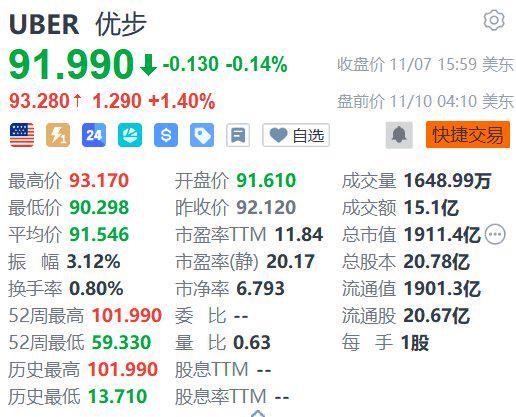
Core Insights - Uber's Q3 2025 revenue reached $13.47 billion, exceeding market expectations of $13.275 billion [1] - Total bookings amounted to $49.74 billion, surpassing the anticipated $48.96 billion [1] - The company projects total bookings for Q4 to be between $52.25 billion and $53.75 billion [1] - By the end of 2026, Uber plans to deploy autonomous vehicles in at least 10 cities [1] Financial Performance - The stock price increased by 1.4% to $93.28 in pre-market trading [1] - The previous closing price was $91.99, with a trading volume of 16.49 million shares [1] - The market capitalization stands at $191.14 billion [1] Analyst Ratings - TD Cowen raised Uber's target price from $108 to $114 [1] - Dominion Securities increased the target price from $102 to $108 [1]
Uber, Lyft, and DoorDash say self-driving tech is the future — and they'll need to spend big to make it happen
Yahoo Finance· 2025-11-09 18:25
Core Insights - The rollout of self-driving robotaxis and delivery robots in the U.S. requires substantial investment from companies like Uber, Lyft, and DoorDash [1][7] Company Summaries - DoorDash plans to increase its investment in autonomous delivery technology by "several hundred million dollars more" than previously planned for 2026, including the deployment of its Dot delivery robot [2][3] - DoorDash's stock experienced a significant decline of 17% following the announcement of its spending plan, marking the largest one-day drop in its history [3] - Lyft is investing between $10 million and $15 million to build a depot in Nashville for servicing and storing self-driving cars, emphasizing the need for physical infrastructure to support autonomous operations [4] - Uber's CEO stated that self-driving cars are currently a money-losing venture, but the company plans to invest in expanding driverless car availability to increase rider demand over time [5][6]

What We’re Reading (Week Ending 09 November 2025) : The Good Investors %
The Good Investors· 2025-11-09 01:00
Group 1: Return on Invested Capital (ROIC) - High ROIC alone is insufficient for strong long-term investment returns; companies must also reinvest capital effectively to grow revenue and earnings [3][4] - A small percentage of companies achieve very high ROICs, with only ~5.5% having >20% ROIC and ~1.5% having >40% ROIC [9] - Revenue growth that translates into earnings growth is crucial for rising stock prices, and companies must consistently earn returns on capital that exceed their cost of capital [6][11] Group 2: Labor and Capital Decoupling - Companies like Alphabet and Microsoft have significantly reduced the number of employees needed to achieve $100 billion in revenue over time, indicating a trend of decoupling labor from capital [12][13] - Walmart has maintained a stable headcount while increasing revenue, suggesting efficiency improvements in operations [14] Group 3: Mergers and Acquisitions - The acquisition of Metsera by Pfizer faced competition from a higher bid by Novo Nordisk, leading to a significant increase in Metsera's stock price [14][15] - Historical examples illustrate that boards often prefer lower offers with more deal certainty over higher bids with regulatory risks, which can lead to bidding wars [21][22] Group 4: Nuclear Power Industry - Oklo Inc., a nuclear startup, has faced regulatory challenges but has a market value of around $20 billion, indicating investor interest despite setbacks [19][20] - The NRC denied Oklo's reactor design application due to safety concerns, highlighting the regulatory hurdles in the nuclear industry [26][24] Group 5: AI and Economic Impact - AI-related stocks have accounted for 75% of S&P 500 returns since the launch of ChatGPT, indicating a significant impact on the economy [31] - The construction of AI data centers is increasingly financed by borrowing, suggesting a shift in funding dynamics compared to historical railroad projects [32][33]

Earnings live: Earnings remain solid with peak reporting weeks in the rearview mirror, Disney results ahead
Yahoo Finance· 2025-11-07 22:19
Core Insights - The third quarter earnings season has shown a positive trend, with 91% of S&P 500 companies reporting results and an expected 13.1% increase in earnings per share, marking the fourth consecutive quarter of double-digit growth [2][7] Earnings Reports Overview - Major tech and AI companies such as Palantir, AMD, and Supermicro have reported their earnings, contributing to the overall positive sentiment in the market [1][4] - Constellation Energy reported a GAAP earnings per share of $2.97, missing estimates of $3.05, but its revenue of $6.57 billion exceeded expectations [10][11] - Wendy's reported a revenue of $549 million, a 3% decline year-over-year, but earnings per share of $0.24 beat estimates of $0.20 [13][14] - Block's shares fell 15% after reporting earnings that missed expectations, with earnings per share of $0.54 on revenue of $6.11 billion, below estimates [16][20] - Sweetgreen reported a net loss of $0.31 on revenue of $172.3 million, missing expectations, attributed to a slowdown in consumer spending [18][19] Company-Specific Highlights - Airbnb's stock rose 5% as international bookings supported a 9% increase in nights booked, with significant growth in Latin America and Asia Pacific [29][30] - Moderna reported a smaller-than-expected loss of $0.51 per share, with revenue of $1 billion, a 45% decrease from the previous year, driven by declining COVID vaccine sales [38][39] - Under Armour posted a net loss of $0.04 per share on revenue of $1.33 billion, with a forecast of declining revenue for the fiscal year [31][32] - ConocoPhillips raised its full-year production forecast and reported adjusted earnings per share of $1.61, beating estimates [36][37] - E.l.f. Beauty's stock fell over 21% after a disappointing fiscal year outlook, expecting net sales between $1.55 billion and $1.57 billion, below expectations [43][44]




Uber Stock To Drop 40%?
Forbes· 2025-11-07 15:00
Core Insights - Uber Technologies has transitioned from a cash-burning startup to a profitable technology platform, with stock surging 55% this year due to strong earnings and improved operational efficiency [2][3] - The company generated approximately $8.5 billion in free cash flow over the trailing twelve months, with adjusted EBITDA increasing in the low-30% range annually, marking a significant turnaround from previous losses [3] - Uber's stock is currently trading at about 24 times its free cash flow, which is considered high given the cyclical risks it faces, including potential declines in ride volume and increased competition [3][4] Financial Performance - Free cash flow increased from $3.3 billion in 2023 to nearly $6.9 billion in 2024, more than doubling within a year [3] - Gross bookings are growing in the high-teens, and the company has managed to control costs despite inflationary pressures [3] - The company has a robust balance sheet and has initiated stock buybacks, providing a financial buffer that was previously lacking [6] Market Position and Competition - Competition from Lyft, DoorDash, and emerging regional ride-hailing apps poses a risk to Uber's market share [4] - Uber's advertising and freight segments are still in early stages and may face fluctuations in a sluggish economy [4] Valuation and Risk Assessment - A potential decline of 30-40% in stock price could occur if growth slows and the market adjusts Uber's valuation to a more reasonable level [5] - The current stock price reflects expectations of continuous growth, and any signs of weakness could undermine investor confidence [3][5] - The risk-reward dynamic appears extended at current prices, with a significant drop not indicating failure but rather a realignment of expectations [7]

优步(UBER):业绩点评:Uber 联合英伟达加速 L4 Robotaxi 部署
GUOTAI HAITONG SECURITIES· 2025-11-07 09:21
Investment Rating - The report maintains a "Buy" rating for Uber [6][10]. Core Insights - Uber continues to show strong revenue and profit growth, with a diversified business model and a partnership with Nvidia to accelerate the deployment of autonomous driving networks [3][10]. - The company has adjusted its revenue forecasts for FY2025E-FY2027E to $51.9 billion, $60.1 billion, and $68.5 billion respectively, with corresponding adjusted EBITDA of $8.7 billion, $11.3 billion, and $14 billion [10][11]. Financial Summary - **Revenue (in million USD)**: - 2023: 37,281 - 2024: 43,978 - 2025E: 51,948 - 2026E: 60,069 - 2027E: 68,481 - Growth rates: 2023 (+17.0%), 2024 (+18.0%), 2025E (+18.1%), 2026E (+15.6%), 2027E (+14.0%) [5][11]. - **Operating Profit (in million USD)**: - 2023: 1,110 - 2024: 2,799 - 2025E: 5,399 - 2026E: 7,897 - 2027E: 10,371 - Growth rates: 2023 (+160.6%), 2024 (+152.2%), 2025E (+92.9%), 2026E (+46.3%), 2027E (+31.3%) [5][11]. - **GAAP Net Profit (in million USD)**: - 2023: 1,887 - 2024: 9,856 - 2025E: 11,180 - 2026E: 7,085 - 2027E: 8,938 [5][11]. - **Adjusted EBITDA (in million USD)**: - 2023: 4,052 - 2024: 6,484 - 2025E: 8,684 - 2026E: 11,271 - 2027E: 14,033 [5][11]. Business Diversification - Uber's business model is increasingly diversified, with significant growth in both ride-hailing and food delivery services. The company is leveraging a "barbell" structure in its ride-hailing business, balancing low-cost services with high-margin offerings [10]. - The grocery and retail segments of the food delivery business are growing rapidly, with annualized gross bookings nearing $12 billion, significantly outpacing traditional food delivery growth [10]. Strategic Partnerships - Uber has partnered with Nvidia to enhance its L4 autonomous driving capabilities, utilizing Nvidia's full-stack platform to improve training quality and system reliability [10].
Jim Cramer on Uber: “I’d Be a Buyer Into Weakness”
Yahoo Finance· 2025-11-06 19:20
Core Insights - Uber Technologies, Inc. is focused on growing its market share in ride-sharing and delivery services while enhancing customer engagement through cross-selling initiatives [1][2] - The company aims to expand its Uber One Membership program, which offers significant benefits to users, with a goal of achieving profitability in these efforts [1] Company Overview - Uber operates technology platforms that facilitate mobility, delivery, and freight services, including ridesharing, food and retail delivery, and digital freight logistics [2]