Walmart(WMT)
Search documents
Is Stock Market Open Today? What's Open And What's Closed On Martin Luther King Jr. Day - Bank of America (NYSE:BAC), Costco Wholesale (NASDAQ:COST)
Benzinga· 2026-01-19 07:27
Financial Markets And Banking - Wall Street will be closed on January 19 for Martin Luther King Jr. Day, with both the New York Stock Exchange (NYSE) and Nasdaq suspending trading, resuming normal hours on January 20 [2] - The Federal Reserve will also be closed, leading to the closure of most commercial banks, including major institutions like JPMorgan Chase & Co., Bank of America Corp., and Wells Fargo & Co., although ATMs and mobile banking will remain operational [3] Mail Delivery And Government Offices - The United States Postal Service (USPS) will suspend regular mail deliveries and close retail post office locations nationwide on January 19, while private couriers like UPS will not provide pickup or delivery service [4] - Non-essential federal, state, and local government offices, including the DMV and public courts, will be closed, and most public schools will dismiss classes for the day [5] Retail And Grocery Stores - Major retailers such as Walmart Inc., Target Corp., and Costco Wholesale Corp. are expected to remain open, although hours may vary by location [6] - Grocery chains like Publix and Whole Foods are likely to maintain standard operating hours, with customers advised to confirm specific times with local branches [7] Market Performance - On the last trading day before the holiday, the SPDR S&P 500 ETF Trust closed down 0.084% at $691.66, while the Invesco QQQ Trust ETF declined 0.12% to $621.06 [8] - Year-to-date performance shows the Nasdaq 100 index has advanced by 1.28%, while the S&P 500 and Dow Jones indices have risen by 1.19% and 2.02%, respectively [8]
中产为什么还没放弃山姆?
创业邦· 2026-01-19 04:34
Core Viewpoint - The competition in the domestic food delivery market is showing signs of cooling, with a focus on broader instant retail rather than just food delivery, driven by major players like Meituan, Taobao Shanguo, and JD [6][7]. Group 1: Market Dynamics - The State Administration for Market Regulation is investigating the competitive landscape of food delivery platforms, indicating a regulatory focus on the sector [6]. - Instant retail, which encompasses a larger market than traditional food delivery, is becoming a battleground for major players, including Walmart's Sam's Club [6][7]. Group 2: Sam's Club Performance - Sam's Club in China has shown strong growth, with double-digit increases in transaction volume in Q2 and Q3 of 2025, and the total number of stores reaching 63 after opening 10 new locations [7]. - Despite facing negative publicity, such as product quality issues and management changes, Sam's Club continues to see rising sales and membership renewal rates, indicating strong brand loyalty among consumers [10][20]. Group 3: Consumer Trust and Brand Positioning - The brand's ability to maintain consumer trust is crucial, as evidenced by the willingness of consumers to pay membership fees for perceived quality and value [12][14]. - Sam's Club's pricing strategy, such as offering a down-market down jacket at a competitive price, has resonated with middle-class consumers, reinforcing its position as a preferred shopping destination [12][20]. Group 4: Competitive Landscape - Current competitors in the retail space, such as Dingdong Maicai and Hema, focus on different consumer segments and do not effectively meet the needs of Sam's Club's core demographic [22][29]. - Other international brands like Costco and Aldi have not been able to replicate Sam's Club's scale and market penetration in China, further solidifying Sam's Club's unique position [26][29]. Group 5: Expansion Strategy and Challenges - Sam's Club has accelerated its expansion since 2016, with a significant increase in new store openings, but this rapid growth has led to quality control issues [30][34]. - The company is navigating the challenges of maintaining product quality while expanding its footprint, particularly as it seeks to enter lower-tier cities with high-income consumers [37].
Tiger Global’s tax ruling casts pall on India’s buyout sector
The Economic Times· 2026-01-19 04:18
Core Viewpoint - The Indian Supreme Court's ruling mandates that Tiger Global must pay capital gains taxes on its sale of Flipkart shares, which could significantly affect private equity firms utilizing offshore entities for investments in India [1][12]. Group 1: Legal and Tax Implications - The ruling has major implications for private equity funds that have established shell entities in offshore havens like Mauritius to channel investments into India, including firms like Blackstone, KKR, and Warburg Pincus [1][12]. - Investors may now need to demonstrate more substance and control within the same jurisdiction to claim treaty benefits, reversing over two decades of tax policy that allowed firms to use Mauritius for tax advantages [1][6]. - The Supreme Court's decision signals the end of the "Mauritius route" as a guaranteed tax shield, impacting private equity investments made before April 2017 that are approaching exits [8][9]. Group 2: Financial Impact - Tiger Global will incur taxes on gains exceeding 145 billion rupees ($1.6 billion) from the Flipkart sales, which were executed in a series of transactions, the latest being in 2023 [4][12]. - Private equity funds injected nearly $50 billion into India over the first 11 months of 2025, indicating strong foreign investment interest despite the new tax challenges [5][12]. Group 3: Future Considerations - Firms will need to reassess existing structures and evaluate risks in light of the ruling, as tax authorities can now challenge the substance of offshore entities [6][10]. - The ruling may also affect Blackstone, which is currently involved in a dispute regarding its use of a tax treaty with Singapore to exempt itself from capital gains [9][12].
主题 Alpha:推出美洲主题焦点清单-Thematic Alpha-Introducing the Americas Thematic Focus List
2026-01-19 02:32
Summary of the Americas Thematic Focus List Conference Call Industry and Company Overview - **Industry**: The thematic focus is on various sectors across North America and Latin America, particularly in technology, energy, healthcare, and education. - **Companies Featured**: The focus list includes notable companies such as Amazon, Microsoft, NVIDIA, Eli Lilly, and Walmart, among others. Key Themes for 2026 1. **Tech Diffusion**: Emphasizes the rapid adoption of AI technologies across various sectors, with significant implications for productivity and competitive dynamics [12][14]. 2. **The Future of Energy**: Focuses on the increasing demand for energy driven by AI infrastructure and the transition to renewable energy sources [12][17]. 3. **The Multipolar World**: Highlights the shift towards localized supply chains and national economic security, impacting multinational corporations [12][13]. 4. **Societal Shifts**: Explores the implications of demographic changes, AI-driven employment disruption, and evolving consumer preferences [12][18]. Americas Thematic Focus List - **List Composition**: The focus list includes 18 high-conviction stock ideas, with a target holding period of 12-18 months [9][20]. - **Key Companies on the List**: - **Amazon (AMZN)**: Positioned as a leader in AI infrastructure, with a projected 32% upside to a price target of $238.18 [23]. - **Microsoft (MSFT)**: Expected to capture significant AI spending, with a 42% upside to a price target of $456.66 [23]. - **Eli Lilly (LLY)**: A leader in the GLP-1 market, with a 25% upside to a price target of $1,032.97 [23]. - **Walmart (WMT)**: Leveraging AI for operational efficiency, with a 13% upside to a price target of $119.20 [23]. Methodology and Specifications - **Focus List Size**: 15-20 stocks, with equal weighting upon construction [21]. - **Sector Weights**: No fixed sector weights, aiming for diversification [21][22]. - **Regional Weights**: Targeting 80-85% in the USA and 15-20% in Latin America [28]. Important Insights and Data - **Amazon's Growth**: Amazon's custom silicon strategy has grown 150% sequentially, indicating strong demand for its AI capabilities [29]. - **Eli Lilly's Market Potential**: The global diabesity market is projected to exceed $150 billion by the early 2030s, with significant growth opportunities for Eli Lilly [39]. - **NVIDIA's Dominance**: NVIDIA is positioned to capture a significant share of the projected $3-4 trillion in annual AI infrastructure spending by the end of the decade [53]. - **Walmart's AI Strategy**: Walmart's AI initiatives have led to a 50% automation rate in its supply chain, significantly reducing delivery costs [68]. Conclusion The Americas Thematic Focus List presents a strategic overview of high-conviction investment opportunities across key sectors, driven by transformative themes such as technology diffusion and energy transition. The insights provided highlight the potential for significant growth and the evolving landscape of investment in the Americas.
Amazon’s secret move to challenge Walmart’s strength
Yahoo Finance· 2026-01-18 23:22
Core Insights - Walmart has a significant advantage over Amazon due to its extensive store network, with approximately 90% of the U.S. population living within 10 miles of a Walmart or Sam's Club, making it easier for customers to access physical stores [2][4] - Amazon is planning to open its first Supercenter, a 229,000-square-foot store in Orland Park, Illinois, which is larger than the typical Walmart Supercenter of about 170,000 square feet [4][5] - Amazon's approach to retail has been more discreet compared to its usual publicity, with local media discovering its mega-store plans rather than an official announcement [3] Walmart's Competitive Edge - The physical shopping experience at Walmart encourages unplanned purchases, as customers may encounter various unrelated products while browsing, unlike Amazon's online recommendation engine [1][2] - The convenience of Walmart's store locations presents a challenge for Amazon to replicate, highlighting the importance of physical presence in retail [2] Amazon's Retail Strategy - Amazon aims to enhance customer experience by creating a grocery store designed for safety and pleasant shopping, indicating a shift towards more physical retail spaces [4] - The company has previously experimented with different retail formats, such as 4-Star stores and curated bookstores, showing its willingness to innovate in the physical retail space [6]
Walmart's stock dividend may surge due to India, China
Yahoo Finance· 2026-01-18 20:33
Core Insights - Walmart's international operations are becoming a significant driver for shareholder payouts, with international sales growth of 11.4% in constant currency and adjusted operating income increasing by 16.9% in Q3 [1][2] - The growth rate of Walmart's international operations is nearly double that of its U.S. operations, indicating a fundamental shift in the contribution of international markets to the company's overall performance [2] International Operations - Walmart is optimistic about international sales, particularly in China and India, with significant investments in platforms like Flipkart and PhonePe [3][5] - The China business has reached a milestone that few U.S. retailers have achieved, serving as a testing ground for innovations that can be implemented globally [4] - In China, digital sales are crucial, with nearly 80% of digital orders being delivered in under an hour, providing a competitive advantage [5] Market Position and Strategy - Walmart's operations in India highlight the company's platform strategy, with digital sales accounting for 50% of total revenue and e-commerce growing by over 30% in the last quarter [5] - Both Flipkart and PhonePe hold the largest market share in their respective categories, benefiting from network effects that increase their value with each additional user [6]
Walmart Taps Veteran Exec Latriece Watkins As CEO Of Sam’s Club
Yahoo Finance· 2026-01-18 20:00
Core Insights - Walmart has appointed Latrice Watkins as the CEO of Sam's Club, marking a significant step for diversity in leadership within the retail sector [1][6] - Watkins has been with Walmart for 20 years, previously serving as Chief Merchant, where she was responsible for product selection and supporting growing businesses [2][3] - Her new role aims to enhance Sam's Club's competitiveness against Costco by promoting private-label brands, particularly Member's Mark, which currently generates a third of Sam's Club's revenue [4][5] Company Overview - Sam's Club is positioned as a more exclusive shopping option for Walmart customers, catering to families with larger budgets [3] - The membership-based model of Sam's Club is similar to that of Costco, and Walmart aims to increase its market share by enhancing its private-label offerings [5] Leadership and Diversity - Watkins' promotion is significant as it adds representation of Black women in executive roles within the retail industry, where they have historically been underrepresented [6][7] - The retail sector has seen only 1.7% of executive roles filled by Black women, highlighting the importance of Watkins' appointment [6]
Consumer Staples ETFs: XLP Focuses on Domestic Stocks, While KXI Offers International Exposure
Yahoo Finance· 2026-01-17 20:03
Core Insights - The article compares two ETFs in the consumer staples sector: State Street Consumer Staples Select Sector SPDR ETF (XLP) and iShares Global Consumer Staples ETF (KXI), highlighting their differences in focus, cost, performance, and holdings [1][5]. Group 1: ETF Overview - XLP consists of 36 U.S. consumer defensive stocks, including major companies like Walmart, Costco, and Procter & Gamble, providing targeted exposure to established U.S. staples [2]. - KXI, with a portfolio of 96 companies, offers global exposure, with 59% in U.S. stocks, 29% in European stocks, and 7% in Asian stocks, featuring both U.S. giants and international leaders like Nestle and Unilever [3][7]. Group 2: Performance and Fees - XLP has a lower expense ratio of 0.08% and a higher dividend yield of 2.7%, compared to KXI's expense ratio of 0.39% and dividend yield of 2.3%, making it more appealing for income-focused investors [4][8]. - Over the last five years, XLP generated a total return of 36.2% (CAGR of 6.4%), outperforming KXI, which had a total return of 28.1% (CAGR of 5.1%), although both funds lagged behind the S&P 500's CAGR of 14.6% [8]. Group 3: Investment Considerations - XLP is recommended for investors seeking exposure to the U.S. consumer staples market due to its better performance, yield, and fees, while KXI offers regional diversification as its main advantage [9].
What 'Agentic Commerce' Means—And How a Walmart Exec Thinks AI Could Help You Shop
Investopedia· 2026-01-17 10:30
Core Insights - The rush to leverage artificial intelligence has led to the development of numerous "agentic commerce" tools, but many lack consumer appeal and do not align with customer needs [1][2] AI in E-commerce - AI is increasingly significant in e-commerce, accounting for approximately 16% of total retail spending last quarter, with about one-third of shoppers utilizing AI assistants [3] - Shoppers using AI on merchant websites are more likely to make purchases and tend to spend more [3] Retailer Strategies - Retailers are eager to engage big spenders and are exploring how AI can enhance the shopping experience [4] - Promising applications of AI include personalized apparel displays and anticipating consumer needs based on past purchases [5][6][7] Consumer Assistance - AI tools like Walmart's Sparky aim to assist consumers with their shopping lists, helping them consolidate trips for groceries, prescriptions, and services [8]
Amazon vs. Walmart: Which Retail Powerhouse Belongs in a Long-Term Portfolio?
The Motley Fool· 2026-01-17 09:15
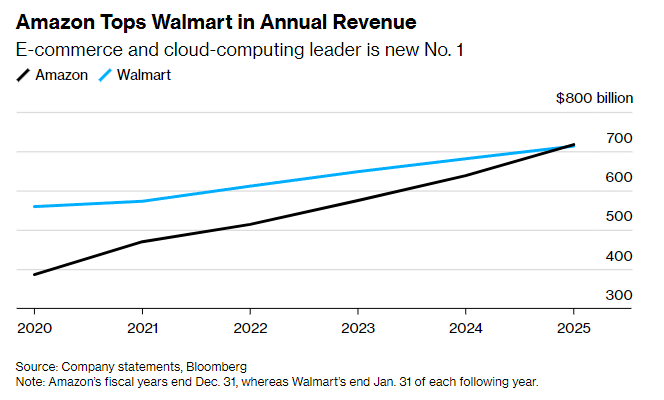
Core Viewpoint - Amazon and Walmart are leading retail stocks, but Amazon is positioned as the stronger long-term growth option due to its faster revenue growth and diversification into multiple industries [1][6][13] Company Overview - Walmart operates over 10,000 retail stores, primarily focusing on physical locations, while Amazon started with e-commerce and has expanded into physical stores, but still relies heavily on online sales [2][5] - Amazon's market cap is approximately $2.6 trillion, while Walmart's market cap is around $954 billion [4][7] Logistics and Operations - Walmart excels in logistics with its extensive network of stores acting as shipping centers, enabling same-day delivery and free shipping for customers [3] - Amazon has over 1,300 shipping facilities, but this is less effective compared to Walmart's logistics capabilities [5] Revenue Growth - Amazon's online store sales grew by 10% year over year, while Walmart's overall revenue growth was 5.8% [6] - Walmart is expected to reach a $1 trillion market cap this year, but Amazon is growing faster in terms of overall revenue [6][8] Diversification and Profit Margins - Amazon's revenue is bolstered by its ventures into cloud computing, online advertising, and AI, contributing to higher profit margins [8][9] - Amazon Web Services revenue increased by 20% year over year, and online ad sales rose by 24% year over year, showcasing its diversified revenue streams [9] - Walmart's advertising segment, while growing at 53% year over year, still represents less than 1% of its total sales, limiting its impact on overall profit margins [10][11] Future Outlook - Although Walmart has performed well in the past five years, Amazon is expected to outperform and provide better returns for investors in 2026 [13]