Gucci

Search documents
X @Bloomberg
Bloomberg· 2025-09-15 19:33
Data Breach Incident - Kering, a luxury goods company, experienced a data breach discovered in June [1] - The breach is part of a series of attacks targeting the consumer goods sector [1]
Hackers steal client data from Kering's Gucci, Balenciaga and McQueen, BBC says
Reuters· 2025-09-15 15:24
Group 1 - Hackers have stolen private details of potentially millions of customers from luxury brands Gucci, Balenciaga, and Alexander McQueen [1] - The attack targeted the French parent company Kering, which oversees these luxury labels [1] - This incident raises concerns about data security within the luxury goods sector [1]


Francesca Bellettini Expected to Take Helm of Gucci: Sources
Yahoo Finance· 2025-09-14 12:53
Kering is zeroing in on a contract to make Francesca Bellettini, one of its most high-profile and accomplished executives, the next chief executive officer at Gucci, WWD has learned. According to multiple industry sources, Bellettini will succeed Stefano Cantino and Cantino will exit the Italian fashion house after only about nine months in the role, during which there has been significant change. More from WWD It is understood an announcement could come as early as this week. Officials at Gucci and Ker ...
Shuffle Board: Dick Exec Heads Foot Locker, Depop Exec Returns to Etsy
Yahoo Finance· 2025-09-12 20:30
Brands - Ethical luxury label Stella McCartney has appointed Tom Mendenhall as CEO, who has extensive experience in the fashion industry, including roles at Ralph Lauren and Tom Ford [1] Retail - Asos has named Ben Blake as executive vice president, customer and commercial, a newly-created role where he will oversee global commercial and trading, reporting directly to José Antonio Ramos [2] - Blake has a strong background in digital and consumer brands, having previously served as chief commercial officer at World of Books and held senior roles at Expedia Group [2] Sporting Goods - Dick's Sporting Goods has updated its leadership structure following its acquisition of Foot Locker, with Ed Stack as executive chairman overseeing global Foot Locker businesses [4] - Ann Freeman, a former Nike executive, has been appointed as president of Foot Locker North America, while the appointment of a president for international operations is forthcoming [4] - Peter Scaturro has been named senior vice president and chief financial officer for Foot Locker North America, previously serving as SVP of strategic planning and growth at the company [5]

X @Bloomberg
Bloomberg· 2025-09-05 04:15
Company Performance - Kering, owner of Gucci, is at one of the lowest points in its history [1] - Francois-Henri Pinault's two-decade-long reign at Kering is ending [1]
X @Bloomberg
Bloomberg· 2025-09-04 15:50
Giorgio Armani fought for decades to keep the fashion empire he founded independent, as Italian icons like Gucci and Fendi were snapped up by larger luxury chains. It will be his heirs who decide what the future will hold https://t.co/XwzDEYF8gk ...
产业循环增长中,但尚未形成规模——科尔尼2025循环时尚指数报告
科尔尼管理咨询· 2025-09-04 10:47
Core Insights - The fifth edition of the Kearney Circular Fashion Index (CFX 2025) tracks the industry's journey towards sustainability, reflecting the growing importance of circularity in global business [1][3] - CFX 2025 provides the most comprehensive view to date, covering 246 brands across 18 countries and five core product categories [1][3] - The report highlights the need for brands to transition from symbolic gestures to systemic changes in their operations [13][17] Summary by Sections Expansion and Methodology - The expanded scope of CFX reflects the increasing significance of circularity and the diversification of brand strategies across regions and segments [3] - CFX evaluates performance across seven dimensions throughout the product lifecycle, distinguishing between primary and secondary market initiatives [6][12] Progress and Trends - Overall progress in circularity appears to be stabilizing rather than accelerating, indicating market maturity [6][7] - Average and median scores increased by 0.20 points, reaching 3.40 and 3.20 respectively, but this is lower than the previous year's growth rate [7][9] - Only 5 brands scored above 7.0, and less than 20% exceeded 5.0, highlighting a widening gap between top performers and the broader market [9][10] Regulatory Environment - Regulatory pressures are intensifying, with new laws in the EU and the US mandating sustainability practices [12][33] - The EU's upcoming regulations will require products to be durable, contain recycled components, and be repairable, pushing brands towards compliance [12][33] Drivers of Change - Leading brands are shifting from symbolic actions to systemic transformations, particularly in circular design and closed-loop initiatives [13][15] - Innovations in materials and design are driving progress, with brands increasingly focusing on lifecycle assessments and sustainable sourcing [15][17] Challenges and Gaps - Despite intentions, execution remains lagging, with many brands stuck in a "medium" maturity state [18][20] - Only 3% to 5% of brands have achieved widespread implementation of circular practices, indicating significant conversion gaps [20][21] - Barriers include limited integration of circular practices into core operations and a lack of clear business cases for investment [26][27] Category-Specific Insights - Different product categories show varying levels of progress, with some segments accelerating while others stagnate [24][25] - High-end and luxury brands are improving overall scores but still face challenges in implementing after-sales services [25][27] Regional Performance - Regional differences in circularity performance are becoming more pronounced, influenced by consumer sentiment and regulatory pressures [31][32] - Europe leads with an average score of 3.6, while North America and Asia-Pacific follow with scores of 3.4 and 2.7 respectively [32][33] Future Directions - The industry must view circularity as a growth lever rather than merely a compliance task, integrating it into design, procurement, and sales processes [35][37] - The next phase of progress will depend on brands' ability to bridge the gap between strategy and execution at scale [36][38]

X @Token Terminal 📊
Token Terminal 📊· 2025-08-30 17:09
Market Trends - $ETH tokenized assets are at all-time high [1]
奢侈品的七夕困局:同质营销难破圈,调性业绩两为难
Xin Lang Cai Jing· 2025-08-30 16:35
Core Insights - Luxury brands face significant challenges in their marketing strategies for the Qixi Festival, struggling to balance high-end branding with the need for effective sales tactics in a competitive market [1][12][13] - The industry is experiencing a trend of homogenized marketing approaches, leading to a dilution of brand identity and consumer engagement [5][6][9] Group 1: Industry Challenges - Despite substantial investments in Qixi marketing, luxury brands continue to rely on traditional methods such as "poster campaigns + celebrity short films + limited products," resulting in a lack of creativity [2][5] - The overuse of similar celebrity-driven marketing strategies has led to decreased consumer attention and engagement, with static ads seeing lower reach and video completion rates [6][9] - The pressure to maintain a high-end image while pursuing aggressive sales tactics has created a conflict for many luxury brands, as evidenced by declining profits and revenues across major companies like LVMH and Kering [12][13] Group 2: Marketing Innovations - In response to these challenges, luxury brands are exploring new marketing strategies, including engaging with younger consumers through fan economy and social media interactions [15][17] - Brands are shifting towards short-form content, such as mini-dramas, to capture consumer interest and differentiate themselves from traditional advertising formats [18][20] - There is a growing emphasis on cultural sensitivity, with brands moving away from superficial representations of Chinese culture to more universally relatable emotional themes [20][21] Group 3: Consumer Engagement Strategies - Luxury brands are increasingly inviting consumer participation in marketing campaigns, fostering a sense of community and shared experience [27] - The trend of "de-festivalization" in product design aims to create items that can be appreciated year-round, reducing the risk of excess inventory post-holiday [24][25] - Collaborations with local artists and creatives are being utilized to enhance cultural relevance and reduce the risk of misinterpretation in marketing messages [23]

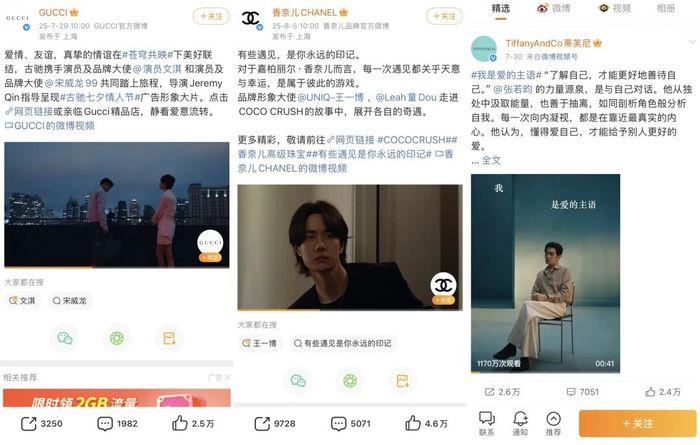
奢侈品七夕营销新挑战:同质化与业绩调性的双重考验
Sou Hu Cai Jing· 2025-08-30 04:52
Core Insights - Luxury brands face challenges in effectively marketing during the Qixi Festival, struggling to resonate with Chinese culture while maintaining a high-end image [1][3] - The industry is experiencing a high degree of homogenization in marketing strategies, with many brands relying on traditional methods that lack creativity [1][3] - Brands are under pressure to balance maintaining their luxury status with achieving short-term sales performance, leading to aggressive marketing tactics that may dilute brand value [3][4] Marketing Strategies - Major brands like LOEWE, Gucci, and Dior are experimenting with new marketing approaches, such as leveraging short dramas and engaging male celebrities to attract attention [1][4] - Despite significant investment in marketing, many luxury brands continue to follow a conventional model of "posters + celebrity videos + limited products," which has resulted in a lack of innovative storytelling [1][3] - Some brands are shifting towards user-generated content and interactive experiences, moving from one-way brand communication to more collaborative approaches with consumers [4][6] Consumer Engagement - The effectiveness of static posters and celebrity videos is declining, with low engagement rates unless supported by algorithms or active fan participation [3] - Brands are attempting to create emotional connections by exploring universal themes rather than relying solely on overt cultural elements [4][6] - Initiatives like Gucci's campaign encouraging users to share moments with loved ones and Prada's photo collection activity reflect a trend towards more inclusive and participatory marketing [6] Product Innovation - To extend the lifecycle of limited edition products, brands are innovating by removing explicit romantic themes and creating collectible IP products, such as Loro Piana's panda doll series [6] - The luxury sector is navigating a complex landscape where the pursuit of brand prestige must align with the evolving preferences of rational consumers [4][6]