Replit

Search documents
AI 的「成本」,正在把所有人都拖下水
3 6 Ke· 2025-08-05 09:52
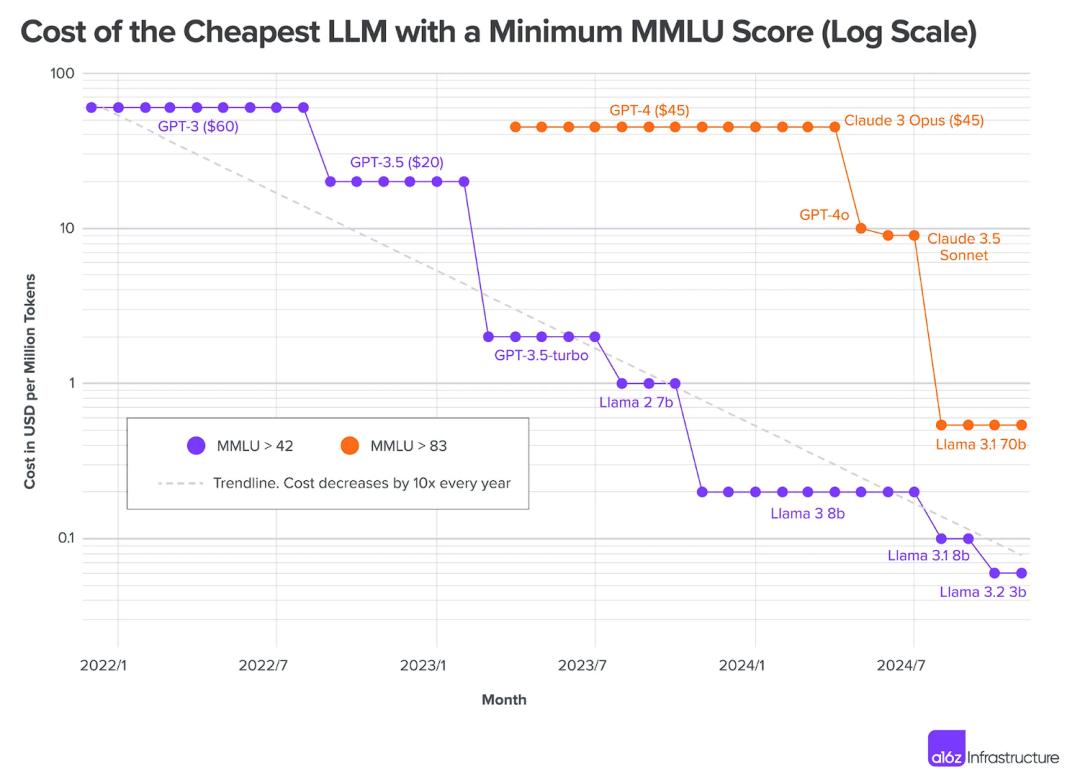
Core Insights - The article discusses the challenges faced by AI companies in maintaining profitability despite decreasing model costs, highlighting a significant disconnect between user expectations and the economic realities of AI service delivery [1][4][30]. Group 1: Market Dynamics - AI companies initially believed that as model costs decreased, profitability would follow, but many are still operating at a loss [4][15]. - The demand for the latest models is overwhelming, with users gravitating towards the most advanced options regardless of price, leading to a situation where older models, despite being cheaper, are less desirable [5][9]. - The pricing history of leading models shows that even with significant price drops, the latest models attract users, indicating a preference for cutting-edge technology [7][8]. Group 2: Cost Structure and Consumption - Although the cost per token has decreased, the consumption of tokens has increased dramatically, leading to higher overall costs for users [10][11]. - The evolution of AI capabilities has resulted in tasks requiring exponentially more tokens, which could lead to unsustainable costs for subscription models [14][15]. - The fixed monthly subscription model is becoming increasingly untenable as usage patterns evolve, pushing companies towards a cost trap [15][21]. Group 3: Competitive Landscape - Companies are caught in a "prisoner's dilemma," where they must choose between offering competitive pricing to attract users or maintaining sustainable pricing models that could limit growth [21][22]. - The article suggests that many AI companies are prioritizing market share over profitability, relying on venture capital to sustain their operations despite poor unit economics [22][30]. - The failure of Anthropic's unlimited subscription model illustrates the challenges of fixed pricing in a rapidly evolving market [16][20]. Group 4: Potential Solutions - Companies are encouraged to adopt usage-based pricing from the outset to create a more sustainable economic model [24]. - High switching costs can help retain customers and ensure profitability, as seen in partnerships with large firms [25]. - Vertical integration, where AI services are bundled with other offerings, may provide a pathway to profitability despite losses on token consumption [26][28]. Group 5: Future Outlook - The expectation that model costs will continue to decrease does not align with user expectations for performance, creating a challenging environment for AI companies [29][30]. - The article concludes that the landscape for AI companies is shifting, and those relying on outdated business models may face significant challenges ahead [32][34].

AI 的「成本」,正在把所有人都拖下水
AI科技大本营· 2025-08-05 08:49
Core Viewpoint - The expectation that the cost of large models will decrease by tenfold annually does not guarantee profitability for AI subscription services, as user demand and consumption patterns are evolving in ways that challenge traditional pricing models [1][4][51]. Group 1: Cost Dynamics - The cost of large models has indeed decreased significantly, with GPT-3.5's price dropping to one-tenth of its original cost, yet companies are still facing negative profit margins [7][15]. - The consumption of computational resources (tokens) has increased dramatically, with tasks that previously required fewer tokens now consuming exponentially more due to the models' enhanced capabilities [18][21]. Group 2: Market Demand and User Expectations - Users are primarily attracted to the latest and most powerful models, leading to a situation where even if older models become cheaper, the demand shifts to the newest offerings, which maintain high price points [10][15]. - The expectation from users is that as model costs decrease, the quality and capabilities will also improve, leading to a demand for higher performance that outpaces the cost reductions [46][47]. Group 3: Subscription Models and Business Challenges - Fixed monthly subscription models are becoming unsustainable as they cannot accommodate the increasing computational demands of users, leading to a "cost trap" for companies [22][30]. - Companies are caught in a "prisoner's dilemma," where they must choose between competitive pricing strategies that could lead to unsustainable losses or risk losing customers to competitors offering unlimited usage at lower prices [32][34]. Group 4: Potential Solutions - Companies may need to adopt usage-based pricing from the outset to create a sustainable economic model, although this approach may deter consumer adoption due to a preference for fixed-rate subscriptions [36]. - High switching costs can be leveraged to lock in customers and ensure profitability, as once integrated into a client's operations, the cost sensitivity decreases significantly [39]. - Vertical integration, where companies bundle AI services with other offerings, can provide a pathway to profitability despite losses on token consumption [40][42].

全球最赚钱 20 家 AI Agent 公司是这几个
Founder Park· 2025-08-01 11:11
Core Insights - The article discusses a recent ranking by CB Insights of the top 20 AI Agent startups based on actual revenue, highlighting the commercial viability of AI in various sectors [4][5]. - It identifies two main trends: AI Agents are evolving from mere tools to "digital employees" capable of autonomously completing tasks, and revenue is becoming a new benchmark for assessing the competitiveness of AI startups [6]. Company Summaries - **Cursor**: An AI programming assistant with an ARR of $500 million, serving over 360,000 paid users and generating billions of lines of code daily [8][9]. - **Glean**: An enterprise search agent with an ARR of $100 million, facilitating natural language interactions across multiple SaaS applications [10]. - **Mercor**: An AI-driven recruitment platform with an ARR of $100 million, streamlining the hiring process through automated resume screening and candidate matching [11]. - **Replit**: An AI programming agent allowing app development via natural language, achieving an ARR of $100 million in just six months [12][13]. - **Lovable**: A rapidly growing AI startup that reached an ARR of $100 million in eight months, enabling users to create web applications without coding [14]. - **Crescendo**: An AI customer service agent with an ARR of $91 million, integrating AI and human support for enhanced customer experience [15][16]. - **Harvey**: An AI legal assistant with an ARR of $75 million, automating legal research and document drafting [17]. - **StackBlitz**: A browser-based IDE with an ARR of $40 million, allowing developers to build applications directly from their web browsers [18]. - **Clay**: A sales agent with an ARR of $30 million, optimizing lead generation through AI capabilities [19][20]. - **Torq**: An AI security agent with an ARR of $20 million, automating security operations for enterprises [21]. - **Sierra**: An AI customer service agent with an ARR of $20 million, focusing on personalized customer interactions [22]. - **Sana**: An enterprise AI assistant with an ARR of $20 million, automating workflows and information retrieval [23][24]. - **Nabla**: A healthcare AI assistant with an ARR of $16 million, streamlining clinical workflows for healthcare professionals [25][26]. - **Hebbia**: An AI knowledge work assistant with an ARR of $13 million, providing advanced search capabilities for financial and legal sectors [27][28]. - **Decagon**: An AI customer service agent with an ARR of $10 million, enhancing customer support through generative AI [29]. - **Robin**: A legal contract assistant with an ARR of $10 million, automating contract management processes [30][31]. - **11xAI**: An AI digital employee with an ARR of $10 million, rapidly growing through task-based pricing models [33][34]. - **Fyxer**: An AI executive assistant with an ARR of $9 million, automating email and meeting management for professionals [35][36]. - **Legartis**: A multilingual contract review agent with an ARR of $5 million, improving contract compliance and efficiency [37]. - **Artisan**: An AI virtual sales representative with an ARR of $5 million, automating sales processes for businesses [39].

全球最赚钱20家AI Agent公司出炉,最高爆赚5亿美元,两个趋势值得关注
3 6 Ke· 2025-07-29 12:03
Core Insights - The article highlights the "Top 20 AI Agent Startups by Revenue" published by CB Insights, which ranks companies based on actual revenue rather than funding or valuation, providing a direct view of the commercial viability of AI agents [1][2] - Two clear trends are identified: AI agents are evolving from mere tools to "digital employees" capable of autonomously completing tasks and taking responsibility for outcomes, and revenue is becoming a new benchmark for measuring the competitiveness of AI startups [1] Company Summaries - **Cursor**: An AI programming agent with an ARR of $500 million, serving over 360,000 paid users, including major clients like Stripe and OpenAI [3] - **Glean**: An enterprise search agent with an ARR of $100 million, facilitating over a billion agent operations for internal process optimization [4] - **Mercor**: An AI-driven recruitment platform with an ARR of $100 million, streamlining the hiring process through automated resume screening and candidate matching [5] - **Replit**: An AI programming agent that allows app development through natural language, achieving an ARR of $100 million and a rapid growth in valuation [6][7] - **Lovable**: The fastest-growing AI startup, reaching an ARR of $100 million in just 8 months, enabling users to create web applications without coding [8] - **Crescendo**: An AI customer service agent with an ARR of $91 million, integrating AI and human support for enhanced customer experience [9] - **Harvey**: An AI legal assistant with an ARR of $75 million, automating legal research and document drafting [10][11] - **StackBlitz**: An AI programming agent with an ARR of $40 million, providing a browser-based IDE for web application development [12] - **Clay**: A sales agent with an ARR of $30 million, optimizing lead generation through AI capabilities [13] - **Torq**: An AI security agent with an ARR of $20 million, automating security operations for enterprises [14] - **Sierra**: An AI customer service agent with an ARR of $20 million, enhancing customer interactions through advanced AI models [15][16] - **Sana**: An enterprise AI assistant with an ARR of $20 million, automating workflows and knowledge management [17] - **Nabla**: A medical AI assistant with an ARR of $16 million, supporting clinical workflows and patient interactions [18] - **Hebbia**: An AI knowledge work assistant with an ARR of $13 million, providing advanced search capabilities for financial and legal sectors [19][20] - **Decagon**: An AI customer support agent with an ARR of $10 million, utilizing generative AI for personalized customer interactions [21] - **Robin**: A contract management AI platform with an ARR of $10 million, streamlining the contract lifecycle for legal teams [22] - **11xAI**: An AI digital employee with an ARR of $10 million, rapidly growing through task-based pricing models [23] - **Fyxer.ai**: An AI executive assistant with an ARR of $9 million, automating email and meeting management for professionals [24][25] - **Legartis**: A multilingual contract review agent with an ARR of $5 million, enhancing contract compliance and efficiency [27][28] - **Artisan**: An AI virtual sales representative with an ARR of $5 million, automating the sales development process for businesses [29]
AI 算命 3 个月做到月入 100 万美金,又 3 个 AI Coding 突破 1 亿美金 ARR
投资实习所· 2025-07-24 05:48
Core Insights - The AI coding industry is experiencing rapid growth, with Lovable recently announcing a $200 million funding round and achieving over $100 million in ARR within just 8 months, showcasing the speed of innovation in the AI era [1] - Lovable has introduced Lovable Agent, which reportedly reduces error rates by 91% and enhances workflow capabilities, allowing for more complex tasks such as code reading and debugging [1] - The competitive landscape is intensifying, with Lovable entering the enterprise market and Replit also making significant moves, including the acquisition of Cognition [2] Group 1: Lovable and Replit - Lovable's new Business version targets larger B2B clients by adding collaboration, security, and privacy features [2] - Replit has also shown impressive growth, with its ARR increasing from $10 million to $100 million in just 6 months, and Cognition's overall ARR estimated to be around $150 million [2] Group 2: Other Players in AI Coding - Anthropic's Claude Code is reportedly nearing $200 million in ARR, indicating strong market reception and potential for further growth [3] - Augment Code has experienced explosive growth, achieving a 5x increase in the last 3 months and securing multiple million-dollar deals with enterprise clients [3] Group 3: Newsletter and Creator Economy - Substack has raised $100 million at an $11 billion valuation, while Beehiiv has surpassed $30 million in annual revenue [4] - The platform Every has achieved over $1 million in ARR, focusing more on content compared to Substack and Beehiiv [4]

Monetizing AI — Alvaro Morales, Orb
AI Engineer· 2025-07-23 19:45
AI Monetization Challenges - Traditional SaaS pricing models are ineffective for AI-powered products due to unique complexities like fluctuating usage and variable compute costs [1] - Overlooked monetization aspect of AI is critical for businesses [1] Adaptive Pricing Strategies - Adaptive pricing models can drive cost savings, enhance customer experience, and reduce operational bottlenecks [1] - Usage-based, tiered, and hybrid pricing models can maximize revenue potential [1] - Real-time data can be leveraged to test, adjust, and optimize pricing strategies [1] Revenue Simulation and Risk Reduction - Revenue simulations enable companies to test and refine pricing before implementing, reducing risk and boosting adoption [1] - Orb enabled Replit to make pricing changes up to the last minute and provided usage alerts [1] Key Takeaways - Companies should avoid common pricing pitfalls that can lead to revenue leakage and customer churn [1] - Session is designed for AI executives, product leaders, and engineering teams looking for actionable strategies to build adaptive, scalable pricing models [1]