Google Cloud

Search documents
Oracle and Google Cloud Announce Industry-First Partner Program and Powerful New Capabilities for Oracle Database@Google Cloud
Prnewswire· 2025-04-09 12:00
Core Insights - Oracle and Google Cloud are launching an industry-first partner program to offer Oracle Database@Google Cloud, enhancing their collaboration and expanding service capabilities [1][2][3] - The Oracle Base Database Service will soon be available in limited preview, providing automated database lifecycle management and scalable resources with pay-as-you-go pricing [2][8] - New regions are planned for Oracle Database@Google Cloud to meet increasing customer demand, including Melbourne, Sydney, and Turin, among others [6][8] Partner Program - The new partner program allows Google Cloud and Oracle partners to purchase and resell Oracle Database@Google Cloud through the Google Cloud Marketplace [3][4] - This program is aimed at organizations looking to leverage multicloud solutions and will be available to partners in both the Google Cloud Partner Advantage program and Oracle PartnerNetwork [3][4] Customer Benefits - The collaboration between Oracle and Google Cloud focuses on delivering enhanced services and personalized experiences to customers, utilizing Oracle's database security and performance alongside Google Cloud's analytics and AI tools [2][5] - The upcoming reseller program is designed to help organizations identify valuable use cases for Oracle Database@Google Cloud [4] New Capabilities and Regions - Oracle Exadata X11M support is now available, offering significant performance improvements for AI, analytics, and online transaction processing [8] - Oracle Interconnect for Google Cloud is available for U.S. Government customers, enabling high-bandwidth connectivity between Oracle and Google Cloud [8] - Planned regional expansions include multiple locations across Asia, Australia, Europe, and North America, with datacenter capacity set to double in key regions [8]



Arm Holdings Aims for 50% Data Center Market Share
MarketBeat· 2025-04-04 11:36
Core Insights - Arm Holdings aims to capture 50% of the data center CPU market by the end of 2025, up from an estimated 15% in 2024, marking a significant strategic shift [1][2][18] Market Dynamics - This initiative directly challenges the dominance of Intel and AMD in the high-margin data center CPU market, driven by increasing demand for AI [2][9] - Arm's architecture is noted for its power efficiency, which is crucial for managing the energy demands of AI workloads, providing a competitive edge over traditional x86 architectures [3][4] Adoption and Ecosystem - Major tech companies, including NVIDIA, AWS, Google Cloud, and Microsoft, are increasingly adopting Arm's technology, indicating strong momentum in the hyperscaler segment [5][6][7] - The software ecosystem is shifting towards prioritizing Arm platforms, which is essential for broader adoption in data centers and allows Arm to charge higher royalty rates [8] Competitive Landscape - If successful, Arm's market share growth could significantly impact Intel and AMD, potentially forcing them to adapt their strategies in product development and pricing [10][11] - Arm's growth may also lead to a more diverse AI hardware ecosystem, influencing the strategies of chip designers and cloud service providers [11] Challenges Ahead - Despite its ambitions, Arm faces substantial challenges, including competition from established x86 infrastructure and the need for comprehensive software compatibility [12][13] - Regulatory and legal challenges could introduce uncertainties that may affect Arm's operations and partnerships [13] Financial Outlook - Arm's stock is currently trading at $97.72, with a 12-month price target of $163.41, suggesting a potential upside of approximately 67.22% [14][17] - The stock's high valuation multiples indicate market expectations for significant future growth, making success in the data center market critical to justifying these metrics [15][16]


Lockheed Martin and Google Cloud Announce Collaboration to Advance Generative AI For National Security
Prnewswire· 2025-03-27 18:14
Core Insights - Lockheed Martin and Google Public Sector are collaborating to integrate Google's generative AI into Lockheed Martin's AI Factory ecosystem, enhancing decision-making and innovation in national security, aerospace, and scientific applications [1][2][3] Group 1: Collaboration Details - The integration aims to improve Lockheed Martin's capabilities in training, deploying, and sustaining high-performance AI models, leveraging both open-source and proprietary AI models [2][4] - Google Cloud's AI technologies will complement Lockheed Martin's approach, providing tools for advanced intelligence analysis, real-time decision-making, predictive aerospace maintenance, and more [3][4] Group 2: Strategic Vision - Both companies share a vision to drive innovation in the industry through AI, with a focus on delivering reliable solutions that meet demanding challenges [3][4] - The collaboration emphasizes a commitment to trustworthy and secure AI deployment, adhering to high standards of security and reliability [4]



Kroger's 2025 Digital Strategy Revealed: How Kroger is Reinventing Retail Through Innovation
GlobeNewswire News Room· 2025-03-27 10:04
Core Insights - The report titled "Enterprise Tech Ecosystem Series: The Kroger Co. - 2025" provides an overview of Kroger's technology activities, including digital transformation strategies, innovation programs, technology initiatives, investments, and acquisitions [1][4]. Company Overview - Kroger operates 2,722 supermarkets across the US as of February 3, 2024, with 2,257 having pharmacy outlets and 1,655 featuring fuel centers [2]. - The company utilizes various store formats, including multi-department stores, combination food and drug stores, price impact warehouses, and marketplace stores [3]. Technology Activities - The report covers insights into Kroger's digital transformation strategies and innovation programs [6]. - It provides an overview of technology initiatives, including partnerships, product launches, investments, and acquisitions [6]. - Detailed insights on each technology initiative are included, focusing on technology themes, objectives, and benefits [6]. Financial Insights - The report includes details on estimated ICT budgets and major ICT contracts [6]. Key Partnerships and Collaborations - The report highlights key partnerships and collaborations with major technology companies such as Google Cloud, Nvidia, Microsoft, and IBM [6].


速递|Meta被曝与云巨头密签Llama分成协议,开源模型的寄生式盈利
Z Potentials· 2025-03-23 05:10
图片来源: Unsplash 在 2024 年七月的一篇博客文章中, Meta CEO 马克·扎克伯格表示,"出售访问权限"给 Meta 公开可用的 Llama AI 模型"不是 Meta 的商业模式。" 然而,根据一份新解封的法庭文件, Meta 确实通过收入分成协议从 Llama 中赚取了一些收入。 "如果你是像微软、亚马逊或谷歌这样的公司,并且你基本上要转售这些服务,我们认为我们应该从中获得一部分收入," 扎克伯格说。"所以这些是我们打 算达成的交易,我们已经开始在这方面做了一些工作。" 最近,扎克伯格断言, Meta 从 Llama 中获得的大部分价值来自 AI 研究社区对模型的改进。 Meta 使用 Llama 模型为其平台和资产中的多个产品提供支 持,包括 Meta 的 AI 助手 Meta AI 。 "我认为以开放的方式做这件事对我们来说是好的业务,"扎克伯格在 Meta 2024 年第三季度财报电话会议上说。"它让我们的产品变得更好,而不是我们只 是在一个孤岛上构建一个没有人在行业中标准化的模型。" Meta 可能以相当直接的方式从 Llama 中产生收入这一事实非常重要,因为 Kadrey ...


Meta has revenue sharing agreements with Llama AI model hosts, filing reveals
TechCrunch· 2025-03-21 20:40
Core Insights - Meta's CEO Mark Zuckerberg previously stated that selling access to Llama AI models is not the company's business model, yet recent court filings reveal that Meta does earn revenue through revenue-sharing agreements related to Llama [1][2] Revenue Generation - Meta shares a percentage of the revenue generated by companies hosting its Llama models, although specific hosts are not disclosed in the filings [2][3] - Notable partners that host Llama models include AWS, Nvidia, Databricks, Groq, Dell, Azure, Google Cloud, and Snowflake [3] Business Strategy - Zuckerberg has mentioned the potential for licensing access to Llama models and monetizing them through business messaging services and advertisements in AI interactions, although no specifics were provided [4] - The majority of the value derived from Llama is attributed to improvements made by the AI research community, which enhances various Meta products, including Meta's AI assistant [5][6] Capital Expenditures - Meta plans to significantly increase its capital expenditures, estimating $60 billion to $80 billion for 2025, primarily for data centers and AI development teams, which is roughly double the CapEx for 2024 [7] - To help offset these costs, Meta is reportedly considering launching a subscription service for Meta AI that would add unspecified capabilities [7]

速递|孙正义复刻ARM,软银65亿美元现金吞并Ampere,凯雷单笔套现40亿美元
Z Finance· 2025-03-21 07:11
图片来源: Ampere 软银集团 3 月 19 日宣布,将通过一笔全现金交易,以 65 亿美元收购由前英特尔高管 Renee James 创立的芯片设计公司 Ampere Computing , 此举旨在扩大其在人工智能基础设施领域的投资。交易 完成后, Ampere 将作为软银的全资子公司运营,预计交易将在 2025 年下半年完成。 凯雷集团和甲骨文公司,作为 Ampere 的主要投资者,将出售他们在加州圣克拉拉这家初创公司的股 份。 根据软银的声明,凯雷持有 59.65% 的股份,而甲骨文持有 32.27% 。 这家初创公司雇佣了 1000 名 半导体工程师。 据彭博社报道, 2021 年,软银曾考虑收购 Ampere 的少数股权,当时其估值达 80 亿美元。 软银是 Arm Holdings 的最大股东,而 Ampere 基于 ARM 计算平台开发了服务器芯片,这使两家公司 成为强有力的合作伙伴。 图片来源:软银 软银于 2016 年以 320 亿美元收购了英国芯片设计公司 Arm ,该公司于 2023 年上市。 Ampere 的客 户包括 Google Cloud 、 Microsoft Azure ...


Generative Artificial Intelligence in Financial Services Strategic Business Report 2025: Global Market to Grow by $16.2 Billion During 2024-2030, Expansion of AI Chatbots Creates New Opportunities
Globenewswire· 2025-03-19 15:03
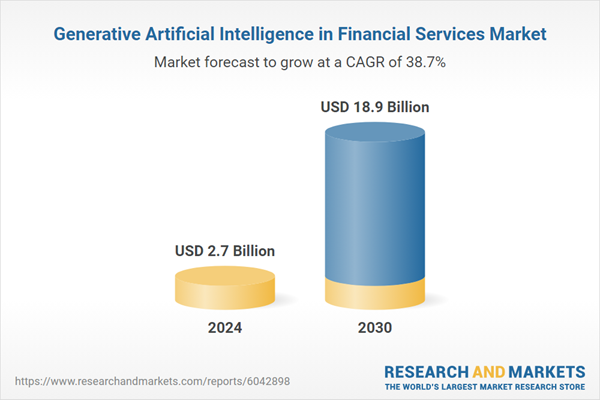
Market Overview - The global market for Generative Artificial Intelligence in Financial Services was valued at US$2.7 Billion in 2024 and is projected to reach US$18.9 Billion by 2030, growing at a CAGR of 38.7% from 2024 to 2030 [3][14]. - The Cloud-based Deployment segment is expected to reach US$13.8 Billion by 2030 with a CAGR of 39.8%, while the On-Premise Deployment segment is set to grow at a CAGR of 35.9% over the analysis period [1]. Key Growth Drivers - The increasing complexity of financial markets necessitates sophisticated tools for analyzing and generating actionable insights from vast amounts of data [6]. - Demand for personalized financial solutions and regulatory compliance pressures are driving institutions to adopt generative AI [7]. - The rise of digital-first banking and integration of AI with blockchain and quantum computing technologies are also significant factors in the market's expansion [8]. Technological Advancements - Innovations in deep learning architectures, such as transformer models and generative adversarial networks (GANs), have enabled the generation of complex outputs like dynamic risk models and predictive analytics [9]. - Cloud computing has democratized access to AI technologies, allowing financial institutions of all sizes to deploy AI-driven solutions [9]. - Advancements in natural language processing (NLP) empower AI to interpret regulatory documents and engage in customer communication with human-like fluency [10]. Market Segmentation - The report covers various segments including deployment types (Cloud-based and On-Premise), applications (Risk Management, Fraud Detection, Credit Scoring, Forecasting & Reporting, Customer Service & Chatbots), and end-use sectors (Retail Banking, Corporate Banking, Insurance Companies, Investment Firms, Hedge Funds, FinTech Companies) [12][13]. Regional Insights - The U.S. market is valued at $700.7 Million in 2024, while China is forecasted to grow at an impressive 36.6% CAGR to reach $2.8 Billion by 2030 [1]. - Other key regions include Japan, Canada, Germany, and the Asia-Pacific, which are also expected to show significant growth trends [1]. Competitive Landscape - The report features key players in the market such as Alphasense Inc., Amazon Web Services, Inc., DataRobot, Inc., Ernst & Young Global Ltd., and Google Cloud [12][19]. - The competitive market presence is categorized into strong, active, niche, and trivial players worldwide [19].
T Stock Trading Near 52-Week High: Is There More Upside Potential?
ZACKS· 2025-03-17 13:10
Core Viewpoint - AT&T Inc. has shown strong stock performance, gaining 53.6% over the past year, outperforming its peers in the telecommunications industry, although it still lags behind T-Mobile US, Inc. [1] Group 1: Business Model and Strategy - AT&T's customer-centric business model is expected to benefit from increased mid-band spectrum deployment and fiber densification, enhancing broadband connectivity for both enterprise and consumer markets [2] - The company is committed to modernizing its 5G wireless network using Open RAN technology, aiming to cover over 300 million people with mid-band 5G spectrum by the end of 2026 [5] - AT&T's edge computing services, particularly through its Multi-access Edge Compute (MEC) solution, are designed to provide low-latency, high-bandwidth applications, enhancing data processing capabilities [6] Group 2: Infrastructure and Connectivity - Continuous investments in network infrastructure, including 5G and fiber networks, position AT&T for long-term growth and improved service access across the nation [4] - By 2029, AT&T plans to reach over 50 million locations with fiber, which includes 45 million through organic deployments and over 5 million through Gigapower [5] - The partnership with Google Cloud aims to enhance customer experiences by providing end-to-end solutions that leverage edge computing capabilities [7] Group 3: Financial Performance and Challenges - Despite growth in wireless services, AT&T faces challenges from declining legacy services and competitive pressures, particularly in its wireline division [8] - Earnings estimates for 2025 and 2026 have been revised down by 7% each, indicating bearish sentiments regarding the stock's future performance [10] - The competitive and saturated U.S. wireless market, along with spectrum management issues, poses significant challenges to AT&T's profitability [8][14]


AI+集运:不破不立,开辟集运新天地!
雪球· 2025-03-16 02:36
Core Viewpoint - The future of the container shipping industry must transition towards data-driven decision-making due to the reliance on low-quality data leading to significant financial losses [2][3]. Data Challenges - The container shipping industry suffers from outdated data collection systems that require manual input, resulting in inefficiencies and errors [4]. - Many companies fail to fully utilize advanced data collection systems due to cost considerations and lack of integration with modern software [4]. - A shortage of skilled professionals and inadequate training prevents companies from maximizing the capabilities of modern data systems [4]. - The existence of data silos within the industry hampers effective monitoring and analysis of data [5]. AI Integration - The advent of AI, particularly intelligent agents, offers substantial support for data collection, insights, and analysis in container shipping [6]. - The global maritime operations AI market is valued at $4.13 billion, with companies using AI to optimize fuel consumption, speed, and detect performance anomalies [8]. - Companies like COSCO Shipping are integrating AI with IoT, blockchain, and 5G technologies to enhance service capabilities and customer insights [8]. - Maersk has made significant acquisitions to integrate shipping and logistics into a unified platform, necessitating strong digitalization and intelligence [9]. AI Applications - AI can enhance maritime safety through obstacle detection, collision avoidance, and automated docking assistance [11]. - AI-driven solutions can optimize vessel performance and identify risks before they lead to accidents, improving operational efficiency and reducing emissions [11]. - AI monitoring systems facilitate real-time interaction between vessels and ports, enhancing safety and operational oversight [11]. - AI technologies can transform port decision-making processes and improve berth planning and forecasting [12][13][14]. Industry Sentiment and Future Outlook - Despite the promising applications of AI, many industry professionals feel overwhelmed due to reliance on inconsistent and inaccurate data [15]. - The traditional practices in the industry may resist AI adoption, as some professionals fear losing their roles to AI-driven solutions [15]. - The trend of AI integration in container shipping is inevitable, with the timeline for widespread adoption being the primary question [16]. - Early adopters of AI in the shipping industry are likely to gain a competitive advantage in future developments [17]. - The ultimate goal of AI is not to replace human jobs but to enhance efficiency and decision-making capabilities [18].