
南京银行

Search documents
国研平台召开数字金融业务专题研讨会
Xin Hua Cai Jing· 2025-08-30 06:50
Group 1 - The seminar on digital financial services aimed to help financial institutions understand policy directions and share practical experiences, focusing on the "Five Major Articles" in finance [1] - The National Wealth Development Research Cooperation Platform emphasized the importance of digital finance in driving innovation and high-quality financial development [1][2] - The city of Rizhao is advancing its digital economy by promoting digital industrialization and reducing financing costs for enterprises, supporting high-quality development [2] Group 2 - The transformation to digitalization is seen as a core driver for the high-quality development of small and medium-sized banks, with a focus on creating a service system that includes digital industry finance and inclusive finance [2][4] - Experts highlighted the role of AI and digital technologies in reshaping cash flow management and supply chain finance, emphasizing the need for banks to adopt these technologies for better service efficiency [3] - The "Five Major Articles" serve as a strategic guide for financial institutions to differentiate their services and avoid homogeneous competition, with digital finance being foundational for various sectors [3][4] Group 3 - Discussions among various banks focused on the challenges and pathways for digital financial innovation, with suggestions for building a collaborative digital financial ecosystem [4] - The former deputy governor of the People's Bank of China stressed the importance of data governance and the integration of digital finance with inclusive and pension finance to enhance service quality [4]
上海大消息!20多家银行宣布:调整
Zhong Guo Ji Jin Bao· 2025-08-30 01:53
Core Viewpoint - Shanghai's new housing policy has led to a reduction in mortgage rates for existing loans and a minimum rate of 3.09% for new second-home loans, aligning them with first-home rates [1][3]. Group 1: New Mortgage Rates - The new policy eliminates the distinction between first and second home mortgage rates in Shanghai, with the specific rate determined by the market rate pricing mechanism and individual bank conditions [2][10]. - The minimum mortgage rate for new second-home loans in Shanghai is set at 3.09%, which is consistent with the first-home loan rate [3][2]. Group 2: Existing Mortgage Adjustments - Existing mortgage rates can be adjusted for eligible borrowers, particularly if their current rate exceeds the national average by more than 30 basis points [4][11]. - For example, a second-home loan with a current rate of 3.45% could potentially be reduced to 3.36% [6][4]. - The adjustment process will not incur any fees and will begin on September 1, 2025 [7][14]. Group 3: Implementation and Communication - Banks in Shanghai, including major institutions like ICBC and Bank of China, have issued announcements regarding the new mortgage rate adjustments [1][9]. - Borrowers can check their eligibility for rate adjustments through their respective banks starting September 1, 2025 [12][13].






上海银行业绩排位再生变数 新帅能否重启资产扩张正循环?
Nan Fang Du Shi Bao· 2025-08-30 01:13
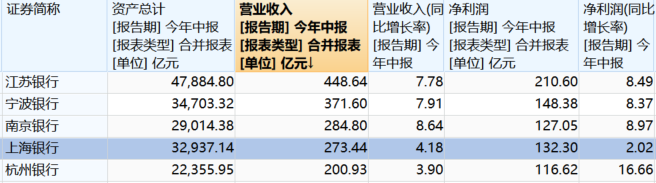
Core Viewpoint - Shanghai Bank's revenue and profit growth lag behind its peers in the Yangtze River Delta region, raising concerns about its competitive position and future growth potential [1][2][7]. Financial Performance - In the first half of 2025, Shanghai Bank achieved revenue of 27.344 billion yuan, a year-on-year increase of 4.18%, but was surpassed by Nanjing Bank, dropping to fourth place among five major city commercial banks in the Yangtze River Delta [1][2]. - The net profit for the same period was 13.23 billion yuan, reflecting a 2.02% year-on-year growth, which is the lowest growth rate among the five banks [2][3]. - The bank's non-performing loan ratio remained stable at 1.18% as of mid-2025, indicating ongoing efforts to manage credit risk [1]. Asset Quality and Capital Adequacy - As of mid-2025, Shanghai Bank's total assets reached 3.29 trillion yuan, with a year-on-year growth rate of only 2.18%, significantly lagging behind its competitors [7]. - The bank's core Tier 1 capital adequacy ratio was the highest among its peers at 10.78%, suggesting a strong capital position to support future growth [7][8]. Business Segmentation - Interest income for the first half of 2025 was 16.453 billion yuan, up 1.72% year-on-year, with a net interest margin of 1.15%, down 2 basis points from the previous year [3][4]. - Non-interest income, particularly from fees and commissions, decreased by 5.96% to 2.06 billion yuan, while other non-interest income grew by 12.05% to 8.831 billion yuan, driven by improved investment returns [5][6]. Strategic Outlook - The appointment of a new chairman, Gu Jianzhong, is seen as a pivotal moment for Shanghai Bank, with expectations for renewed focus on asset expansion and efficiency improvements [8]. - The bank aims to enhance its operational framework by targeting key sectors such as technology, green finance, and manufacturing, which may help in regaining competitive ground [8].

沪上银行集体调整房贷利率 9月1日起可进行线上查询
Huan Qiu Wang· 2025-08-30 00:49
Core Viewpoint - The new housing loan policy in Shanghai aims to optimize the pricing mechanism for commercial personal housing loans, impacting both new and existing loans [1][3] Group 1: Policy Adjustments - The first major adjustment is the elimination of the interest rate difference between first and second home loans, with future rates determined by the market rate pricing self-discipline mechanism in Shanghai [3] - The second adjustment expands the scope for interest rate adjustments on existing housing loans, allowing borrowers to apply for a reduction in the additional interest rate if it exceeds the average new loan rate by 30 basis points [3] Group 2: Implementation Details - The new policy will take effect from September 1, allowing borrowers to check their loan eligibility for interest rate reductions through online banking channels [3] - The People's Bank of China has set a reference benchmark, with the weighted average interest rate for new commercial personal housing loans at 3.09% for the second quarter of 2025 [3]



上海楼市新政银行层面配套执行细则公布
Zhong Guo Jin Rong Xin Xi Wang· 2025-08-30 00:44
Core Viewpoint - Shanghai's new real estate policy, effective from August 25, has led to banks announcing adjustments to their commercial housing loan interest rate pricing mechanisms, aiming to optimize the housing market [1][2]. Group 1: Policy Implementation - Major banks in Shanghai, including ICBC, Bank of China, and others, have released announcements regarding the adjustment of commercial housing loan interest rates [1]. - The new policy eliminates the distinction between first and second home loans, with interest rates determined based on the market rate pricing mechanism and individual bank conditions [2]. Group 2: Interest Rate Adjustments - Existing housing loan interest rates can also be adjusted for eligible borrowers, following the guidelines from last year's notification regarding the pricing mechanism [2]. - The adjustment rules state that if the existing loan interest rate exceeds the average new loan interest rate by more than 30 basis points, borrowers can apply for a rate adjustment [2]. - As of the second quarter of 2025, the weighted average interest rate for new commercial housing loans in China is reported to be 3.09% [2]. Group 3: Borrower Access - Starting September 1, borrowers can check their eligibility for interest rate reductions through the mobile banking channels of the respective banks [3].
上海银行业绩排位再生变数,新帅能否重启资产扩张正循环?
Nan Fang Du Shi Bao· 2025-08-29 22:34
Core Viewpoint - Shanghai Bank's revenue and profit growth lag behind its peers in the Yangtze River Delta region, raising concerns about its competitive position and future growth potential [2][3][9]. Financial Performance - In the first half of 2025, Shanghai Bank reported revenue of 27.344 billion yuan, a year-on-year increase of 4.18%, but was surpassed by Nanjing Bank, dropping to fourth place among five major city commercial banks in the Yangtze River Delta [2][3]. - The net profit for the same period was 13.23 billion yuan, reflecting a 2.02% year-on-year growth, which is the lowest growth rate among the five banks [3][4]. - The bank's non-performing loan ratio remained stable at 1.18%, indicating ongoing efforts to manage credit risk effectively [2][9]. Asset Quality and Capital Adequacy - As of mid-2025, Shanghai Bank's total assets reached 3.29 trillion yuan, with a year-on-year growth rate of only 2.18%, significantly trailing behind its competitors [9][10]. - The bank's core Tier 1 capital adequacy ratio was the highest among its peers at 10.78%, suggesting a strong capital position to support future growth [9][10]. Business Segmentation - Interest income for the first half of 2025 was 16.453 billion yuan, up 1.72% year-on-year, while net interest margin decreased by 2 basis points to 1.15% [5][7]. - Non-interest income, particularly from fees and commissions, decreased by 5.96% to 2.06 billion yuan, although other non-interest income grew by 12.05% to 8.83 billion yuan, driven by improved investment returns [6][8]. Strategic Outlook - The appointment of a new chairman, Gu Jianzhong, is seen as a pivotal moment for Shanghai Bank, with expectations for renewed focus on asset expansion and operational efficiency [10][11]. - The bank aims to enhance its service offerings in key sectors such as technology, green finance, and manufacturing, which could potentially drive future growth [11].

上海,房贷重磅!
Shang Hai Zheng Quan Bao· 2025-08-29 16:00
Core Viewpoint - The implementation details of the new housing policy in Shanghai, announced on August 25, have been released by various banks, focusing on the adjustment of commercial personal housing loan interest rates. Group 1: Policy Implementation - Major banks in Shanghai, including ICBC, Bank of China, Agricultural Bank of China, and others, have issued announcements regarding the optimization of the pricing mechanism for commercial personal housing loans [1][2]. - The new policy eliminates the distinction between first and second home loan interest rates, with rates determined based on the Shanghai market interest rate pricing self-discipline mechanism and individual bank conditions [2]. Group 2: Interest Rate Adjustments - Eligible existing housing loan interest rates can also be adjusted, allowing for a normalization of rates for certain second home loans [2]. - The adjustment rule states that if the existing loan interest rate plus a margin exceeds the average margin of newly issued loans by more than 30 basis points, borrowers can apply for an adjustment [2]. - The weighted average interest rate for newly issued commercial personal housing loans in the second quarter of 2025 is reported to be 3.09% [2]. Group 3: Borrower Actions - Starting from September 1, borrowers can check their eligibility for interest rate reductions through the mobile banking channels of the relevant banks [3].
红包雨来了!8家上市银行拟中期分红超200亿元
Guo Ji Jin Rong Bao· 2025-08-29 15:18
Core Viewpoint - The mid-term dividend plans for listed banks in A-shares for 2025 have been announced, indicating a positive trend in the banking sector's profitability and dividend distribution capacity [1][3][8] Summary by Category Dividend Announcements - As of August 29, 2023, eight A-share listed banks have disclosed their mid-term dividend amounts and ratios, with a total dividend amount exceeding 20 billion yuan [1][3] - China CITIC Bank announced the largest mid-term dividend of 10.461 billion yuan, distributing 1.88 yuan per 10 shares, which accounts for 30.70% of its net profit attributable to ordinary shareholders [3][4] - Shanghai Bank and Huaxia Bank have also increased their dividend ratios compared to last year, with Shanghai Bank at 32.22% and a total dividend of approximately 4.263 billion yuan, while Huaxia Bank plans to distribute 1.591 billion yuan at a ratio of 15.18% [3][4] First-Time Dividends - Four banks, including Changshu Bank, Ningbo Bank, Su Nong Bank, and Zhangjiagang Bank, are implementing their first mid-term dividends [1][3] - Changshu Bank will distribute 0.15 yuan per share, totaling 0.497 billion yuan, which is 25.27% of its net profit [4] - Ningbo Bank plans to distribute 3 yuan per 10 shares, amounting to 1.981 billion yuan, representing 13.41% of its net profit [4] Future Dividend Trends - Experts suggest that the ongoing economic recovery will enhance the overall operating environment for banks, potentially leading to increased profitability and higher dividends in the future [1][7] - Regulatory emphasis on improving dividend levels is expected to support this trend, particularly for state-owned banks, which can bolster market confidence through substantial dividends [7][8] - Long-term dividend sustainability appears strong, as banks are improving their profitability and asset quality, reducing reliance on external financing for capital [8]





中小银行积极入场!35家银行发行2266亿元科创债
Guo Ji Jin Rong Bao· 2025-08-29 14:16
Core Insights - The issuance of technology innovation bonds (科创债) is gaining traction among commercial banks, particularly among small and medium-sized banks, which are increasingly participating in this market [1][3][4]. Group 1: Market Dynamics - As of August 29, 35 banks have issued a total of 226.6 billion yuan in technology innovation bonds, with interest rates primarily ranging from 1.65% to 1.95% [3]. - State-owned banks dominate the issuance, accounting for over half of the total volume with 115 billion yuan, while six joint-stock banks have issued 55 billion yuan [3]. - A notable increase in participation from local banks has been observed, with 23 institutions collectively issuing 56.6 billion yuan [3]. Group 2: Benefits of Issuing Technology Innovation Bonds - Issuing technology innovation bonds helps small and medium-sized banks innovate their business models, optimize financing costs, and provide targeted support for grassroots technological innovation [4][7]. - These banks are more familiar with local technology parks and specialized small and medium enterprises, allowing them to offer flexible loan solutions that enhance the efficiency of technology funding [4]. Group 3: Regional Economic Advantages - Shanghai Bank and Guangdong Huaxing Bank are leveraging their regional advantages to support local technology enterprises and enhance the technology financial ecosystem [6]. - The establishment of a standard basket for technology innovation bonds has been initiated, with several banks participating as market makers to facilitate trading [6]. Group 4: Future Outlook - The technology innovation bond market is expected to continue expanding in terms of issuance scale and diversity of issuers, with increased market activity anticipated [7]. - There is a need for small and medium-sized banks to develop credit assessment models tailored to the unique characteristics of technology enterprises, which often exhibit high growth and risk [7].
上海多家银行房贷细则落地,新增二套房利率最低3.09%
2 1 Shi Ji Jing Ji Bao Dao· 2025-08-29 13:27
Core Viewpoint - Shanghai's housing market has introduced new mortgage interest rate pricing mechanisms, eliminating the distinction between first and second home loans, aiming to optimize the real estate policy and stimulate market activity [2][3]. Group 1: New Mortgage Policies - Multiple banks in Shanghai have released announcements regarding the optimization of commercial personal housing loan interest rate pricing mechanisms, aligning with the recent government notification [2]. - The new policy states that the specific interest rate for each customer's commercial personal housing loan will be determined based on the Shanghai market interest rate pricing self-discipline mechanism, along with the bank's operational status and customer risk profile [2][4]. Group 2: Existing Loan Adjustments - For existing loans, banks will continue to follow the previous year's guidelines, allowing adjustments for certain second home loans that exceed the average interest rate of newly issued loans by more than 30 basis points [3]. - The weighted average interest rate for newly issued commercial personal housing loans in China was reported at 3.09% for Q2 2025, a decrease of 2 basis points from Q1, indicating potential for lower rates for second home loans in Shanghai [3][4]. Group 3: Regulatory Framework - The central bank's adjustments include four main points, notably the removal of the distinction between first and second home loan interest rates and the emphasis on banks to adhere to market conditions and government regulations [3][4]. - Banks are required to ensure compliance with the new policies, providing adequate communication and support to borrowers regarding their rights and the implications of the new interest rate structures [4].

