KB Home

Search documents
Consumer economy is weak and getting weaker due to high rates, says Jim Cramer
Youtube· 2025-09-26 00:21
Economic Overview - There are two contrasting economies: a thriving AI economy and a struggling consumer economy, with the latter deteriorating daily [2][19] - AI-related stocks have significantly contributed to market performance, accounting for 75% of S&P's returns and 80% of earnings growth since late 2022 [18] AI Economy - Intel, a semiconductor company, is reportedly seeking funds from Apple to re-enter the AI market, although this has not been confirmed [4][5] - Corewave has expanded its agreement with OpenAI, increasing its total contract value to $22.4 billion, highlighting the robust activity in the AI sector [8] - Meta is constructing a $10 billion data center in Louisiana, which will require significant energy resources, raising concerns about the impact on local consumers [9][10] Consumer Economy - CarMax reported disappointing results, with sales 6% below expectations, leading to a 20% stock plunge; the company may benefit from lower interest rates [12][13] - KB Home is reducing its home construction due to high interest rates, which are critical for the housing market [14][15] - Starbucks announced layoffs of 900 corporate workers and a 1% reduction in North American store count as part of a restructuring plan to improve profitability [16][17] Market Dynamics - The consumer-oriented part of the economy is weak, and without rate cuts, the situation is expected to worsen [19][23] - High interest rates are not a concern for AI companies, which often have substantial cash reserves [23] - Retailers are struggling with excess workforce and store counts, with only large players like Walmart able to compete effectively [21][22]


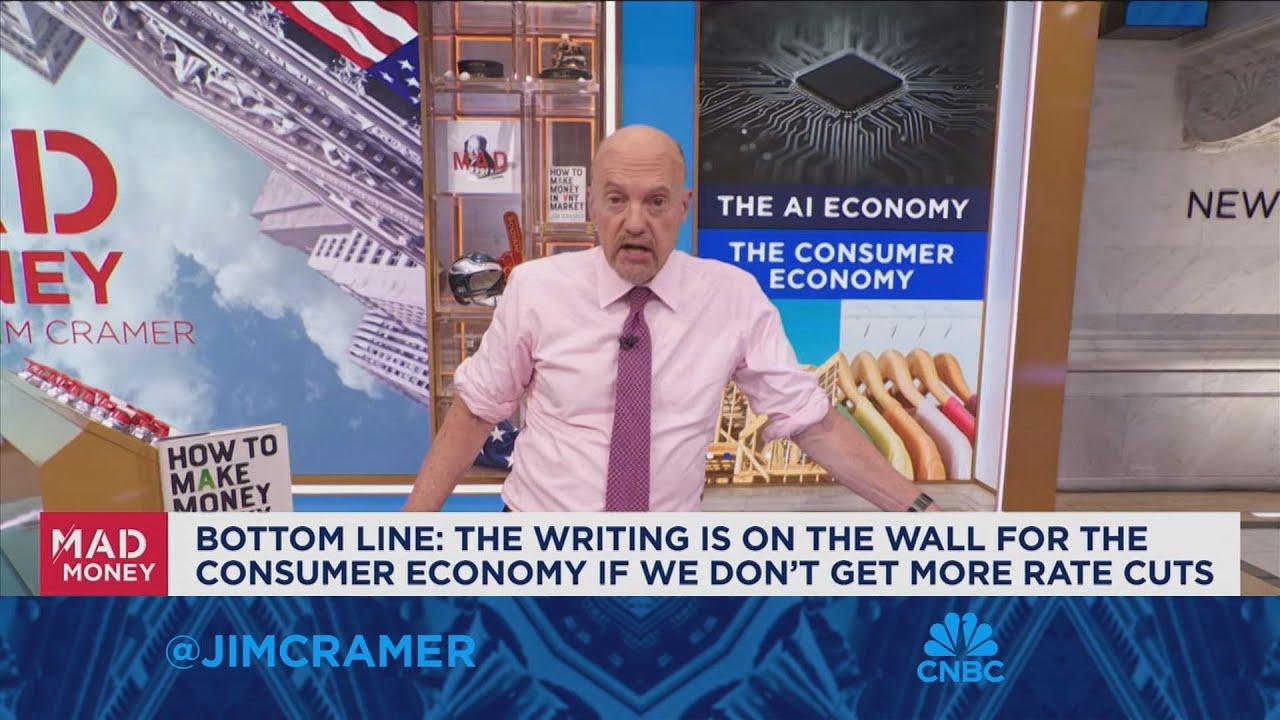
Jim Cramer points out a stark divide in the economy
CNBC· 2025-09-26 00:05
Economic Overview - The current economy is divided into two segments: a strong AI-driven sector and a weaker consumer segment that requires interest rate cuts for improvement [1][2] - The AI economy is largely unaffected by interest rates, with companies in this sector often relying on equity sales to well-funded partners rather than traditional financing [2] AI Sector Developments - Major events are driving the AI-centric economy, such as CoreWeave's $6.5 billion investment with OpenAI, raising their total contracts to $22.4 billion [3] - Meta is investing $10 billion in a new data center, which poses potential risks to the local energy grid due to its high energy demands [3] Consumer Sector Challenges - Consumer-oriented companies are struggling to meet earnings estimates, as evidenced by disappointing reports from CarMax and KB Home [4] - Starbucks announced a 1% reduction in store count and plans to lay off approximately 900 non-retail employees, indicating challenges in the retail sector [4] Economic Foundations - The automotive, housing, and retail sectors are considered foundational to the economy, yet they are not performing well despite a strong GDP growth of 3.8% [5][6] - The gains in GDP are largely attributed to the performance of AI-related companies, highlighting a disconnect between tech advancements and everyday workforce experiences [6]

Jim Cramer says to take a 'wait and see' approach to homebuilders as interest rate cuts fail to bring down mortgage rates
CNBC· 2025-09-25 22:45
Core Insights - The Federal Reserve's recent rate cuts may not effectively lower mortgage rates, raising concerns for homebuilders [1] - Lennar reported disappointing quarterly earnings, with management indicating that lower mortgage rates have not yet led to increased sales [2] - KB Home's performance was slightly better, but the company also cut its full-year forecast and noted a lack of order increases despite changing mortgage rates [3] Group 1: Federal Reserve Impact - The Fed's 0.25% rate cut did not lead to a decline in longer-term yields, including mortgage rates, which actually rose [1] - There is skepticism about whether the Fed's actions will positively impact the housing market, as seen in previous instances where rate cuts did not yield expected results [1] Group 2: Company Performance - Lennar's quarterly earnings were soft, with management lowering earnings estimates and indicating that sales incentives negatively impacted margins [2] - KB Home's report showed some key metrics better than expected, but the company significantly reduced its full-year forecast [3] - Both companies expressed optimism about future rate reductions and improved business conditions, but current sales volumes have not increased meaningfully due to mortgage rates [4]


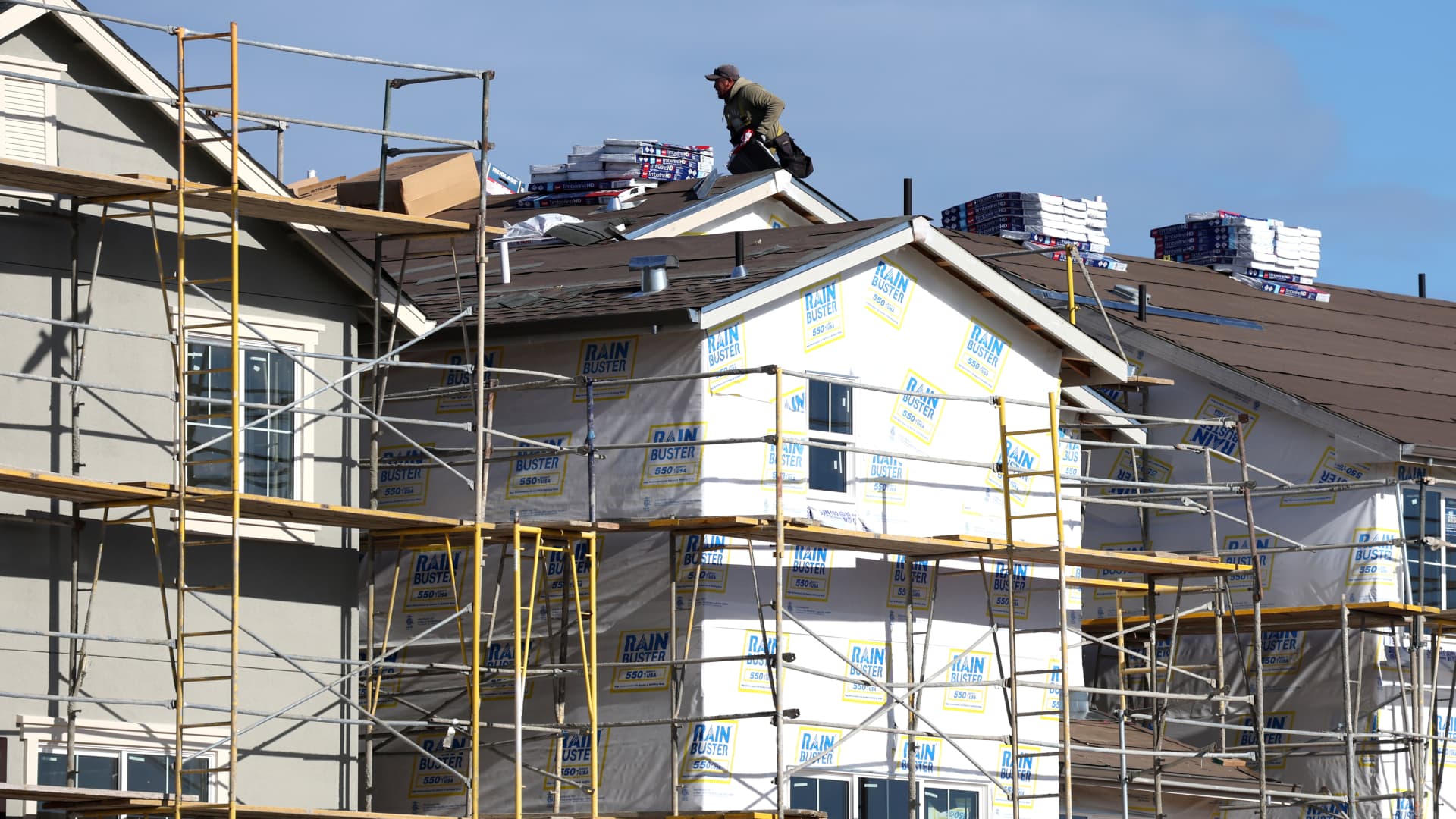
S&P 500 has longest losing streak for over a month as Wall Street stumbles to third straight loss
Fortune· 2025-09-25 22:07
Market Overview - U.S. stocks experienced a third consecutive loss, with the S&P 500 falling 0.5%, marking its longest losing streak in over a month. The Dow Jones Industrial Average dropped 173 points (0.4%), and the Nasdaq composite also sank 0.5% [1][13] Economic Indicators - Reports indicated that the U.S. economy may be stronger than previously anticipated, which could reduce the likelihood of the Federal Reserve cutting interest rates multiple times in the coming months [2][4] - A stronger economy could diminish the Fed's urgency to cut rates, especially given the risk of exacerbating already high inflation [4][5] - Recent economic data showed fewer unemployment claims, suggesting a slowdown in layoffs, and the economy grew faster than earlier estimates during the spring [6][7] Company Performance - CarMax's stock plummeted 20.1% after reporting weaker-than-expected profits and a decline in vehicle sales compared to the previous year [8] - Jabil's stock fell 6.7% despite reporting stronger profits driven by AI demand, as it had already seen a significant gain of 56.6% for the year [9] - Oracle's stock decreased by 5.6% after a significant rise earlier in the month due to AI-related contracts [10] - IBM's stock rose 5.2% following a successful quantum computing trial with HSBC, which improved trade prediction accuracy by up to 34% [11] - KB Home's stock fluctuated but ultimately dipped 0.6% after reporting stronger-than-expected profits, with the CEO noting easing mortgage rates could attract more buyers [12][13]

Wall Street Retreats for Third Consecutive Day Amid Strong Economic Data and Divided Fed Outlook
Stock Market News· 2025-09-25 21:07
Market Performance - U.S. stock markets experienced their third consecutive day of declines, with the Nasdaq Composite and S&P 500 both falling by 0.5%, while the Dow Jones Industrial Average dipped by 0.4% [1] - Despite recent losses, all three major indexes remained close to record highs achieved earlier in the week [1] Economic Indicators - The 10-year Treasury yield rose to 4.17% from 4.15%, indicating stronger economic conditions that may make equities less attractive [2] - The final revision of second-quarter GDP showed a robust annual growth rate of 3.8%, up from a previous estimate of 3.3%, raising concerns about the need for continued monetary easing [3] - Weekly jobless claims fell to 218,000 from 232,000, suggesting a tightening labor market [4] Federal Reserve Outlook - Comments from Kansas City Fed President Jeff Schmid indicated that the Federal Reserve may not need to lower interest rates soon, contrasting with earlier market expectations for multiple rate cuts [5] - The upcoming release of the U.S. Core PCE Price Index is anticipated to influence future monetary policy decisions, with forecasts of a 0.2% monthly increase and a 2.8% annual rate [6] Corporate News - CarMax shares plummeted by 20% after missing analysts' estimates for second-quarter results [10] - IBM shares surged over 5% following HSBC's announcement of successful use of IBM's quantum computers for bond trading [11] - Intel's shares climbed over 6.5% due to reports of seeking a substantial investment from Apple [12] - Starbucks announced plans to lay off approximately 900 corporate employees and close some stores, expecting a 1% decline in total store count for 2025 [13] - Lithium Americas shares soared 95.8% on reports of potential U.S. government ownership stake due to its lithium project in Nevada [16]


UBS' John Lovallo: Housing market bottom in sight as builders stabilize
CNBC Television· 2025-09-25 18:33
Welcome back to Squawk on the Street. Real estate one of the worst performing sectors on the year behind just health care and consumer staples. All underperformers.Home wielders across the board remain in correction territory which means they're 10% or more from their 52- week highs. Lenar is the worst of the group. And then watch KB Home shares today reducing fullear sales guidance due to lower prices.The company COO saying on the call they're not seeing the uptick in demand they'd expect given the recent ...
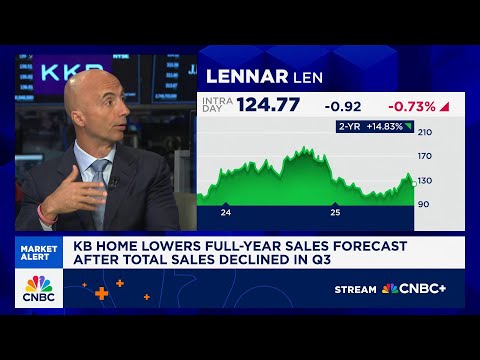
UBS' John Lovallo: Housing market bottom in sight as builders stabilize
Youtube· 2025-09-25 18:33
Core Viewpoint - The real estate sector is currently one of the worst-performing sectors, with homebuilders in correction territory, indicating a decline of 10% or more from their 52-week highs [1][2]. Company Performance - KB Home reported a strong quarter, beating all key performance indicators (KPIs) including deliveries, revenue, gross margin, operating margin, and earnings per share (EPS) [3]. - Despite a slight reduction in their sales forecast, KB Home noted stabilization in the housing market, particularly in key markets like Florida and Texas [4]. - The company is implementing significant incentives to stimulate demand, which has led to a decrease in average selling prices (ASPs) [6]. Market Outlook - There is a belief that the recent cuts in estimates by KB Home and Lenar may be the final adjustments, suggesting a potential bottoming out of the market [4]. - The outlook for 2026 is considered to be much better for housing compared to 2025, with increasing conviction in this perspective [5]. - If mortgage rates stabilize or decline, it could significantly enhance profitability for builders, with a projected 30% upside for KB Home under current rate conditions [7]. Industry Trends - Builders are currently facing pressure to lower prices to stimulate demand, with a noted year-on-year decline of 9% in ASPs for Lenar [5]. - The industry is optimistic about the potential for a strong off-season later in the year, with bullish sentiments across various builders [9].


KBH Q3 Earnings & Revenues Beat Estimates, Both Decline Y/Y, Stock Up
ZACKS· 2025-09-25 18:21
Core Insights - KB Home (KBH) reported third-quarter fiscal 2025 results with earnings and total revenues exceeding Zacks Consensus Estimates but showing a year-over-year decline [1][4][9] Financial Performance - Adjusted earnings per share (EPS) for the quarter were $1.61, beating the consensus estimate of $1.50 by 7.3%, down from $2.04 in the same quarter last year [4][9] - Total revenues reached $1.62 billion, surpassing the consensus mark of $1.6 billion by 1.5%, but decreased by 7.4% year over year [4][9] Market Challenges - The company faces ongoing challenges in a difficult housing market, including pricing pressures and macroeconomic headwinds such as cost inflation and tariffs on construction materials [2][3] - Net orders fell by 4.4% year over year to 2,950 units, with the value of net orders declining to $1.31 billion from $1.54 billion in the previous year [6][9] Operational Adjustments - In response to weaker demand, management revised fiscal 2025 housing revenue guidance downward to a range of $6.1 billion to $6.2 billion, down from previous expectations of $6.3 billion to $6.5 billion [2][13] - The average selling price (ASP) is now estimated at approximately $483,000, compared to the previous range of $480,000 to $490,000 [13] Segment Performance - Homebuilding segment revenues were $1.61 billion, a decline of 7.6% from $1.75 billion in the prior year, with homes delivered decreasing by 6.6% to 3,393 units [5][9] - The housing gross margin contracted by 180 basis points year over year to 18.9%, primarily due to pricing reductions and higher land costs [8][9] Financial Position - As of August 31, 2025, KB Home had cash and cash equivalents of $330.6 million, down from $598 million at the end of fiscal 2024, with total liquidity of $1.16 billion [11] - The debt-to-capital ratio increased to 33.2 from 29.4 at the end of fiscal 2024 [11] Shareholder Returns - The company repurchased approximately 7.8 million shares for $438.5 million, with $261.5 million remaining under the repurchase authorization as of August 31, 2025 [12]
KB Home (NYSE:KBH) Faces Challenges Amid High Mortgage Rates
Financial Modeling Prep· 2025-09-25 18:06
Core Viewpoint - KB Home is facing challenges due to high mortgage rates and affordability issues, impacting demand and profit margins, while RBC Capital maintains a "Sector Perform" rating with a slight increase in price target from $58 to $59 [2][6]. Company Overview - KB Home is a significant player in the homebuilding industry, constructing various homes across the United States, competing with major builders like Lennar and D.R. Horton [1]. - The current stock price of KB Home is $63.69, reflecting a modest increase of 2.09% or $1.31 [3]. Market Conditions - High mortgage rates and affordability issues are particularly affecting first-time buyers, leading to a squeeze in profit margins for KB Home [2][6]. - The company's backlog is shrinking, and it is exposed to weaker geographic markets, raising concerns about its future performance [3]. Financial Performance - KB Home's reduced sales guidance suggests potential performance softness through 2026, with a need for mortgage rates to fall below 6% for significant improvement [3][5]. - The company has a market capitalization of approximately $4.33 billion, with trading volumes reflecting investor interest at 402,730 shares [4]. Strategic Measures - To mitigate the impact of current challenges, KB Home is implementing cost control measures and stock buybacks [4][6]. - Over the past year, KB Home's stock has experienced significant volatility, with a high of $86.73 and a low of $48.90, indicating both challenges and opportunities in the housing market [5].

KB Home Reports Earnings Beat Despite Lower Deliveries And Margin Pressure
Financial Modeling Prep· 2025-09-25 14:23
Core Insights - KB Home reported third-quarter earnings of $1.61 per share, surpassing analyst expectations of $1.50, but net income decreased to $109.8 million from $157.3 million year-over-year [1][2] Financial Performance - Revenue for the quarter was $1.62 billion, exceeding expectations of $1.59 billion but down from $1.75 billion a year earlier [2] - Home deliveries fell by 7% to 3,393 units, while the average selling price decreased to $475,700 [2] - The housing gross profit margin declined to 18.2% from 20.6% a year ago, impacted by price reductions and increased land costs [2] Future Outlook - For the full year 2025, KB Home forecasts revenue between $6.1 billion and $6.2 billion, slightly below analysts' estimate of $6.26 billion [2]