
Fiserv

Search documents
Fiserv, Inc. Investigated for Securities Fraud Violations - Contact the DJS Law Group to Discuss Your Rights - FI
Prnewswire· 2025-10-31 09:25
Core Insights - DJS Law Group is investigating claims against Fiserv, Inc. for potential violations of securities laws [1][2] - Fiserv reported disappointing quarterly earnings and reduced its forward guidance, leading to a significant drop in share price [2] Investigation Details - The investigation centers on whether Fiserv made misleading statements or failed to disclose important information to investors [2] - Following the earnings report, Fiserv's shares fell by more than 43.6% during afternoon trading on October 29, 2025 [2] - CEO Mike Lyons indicated that the company's growth and margin targets need to be reset [2] Legal Context - DJS Law Group specializes in securities class actions and corporate governance litigation, representing large hedge funds and asset managers [4] - The firm emphasizes the importance of respecting and focusing on the litigation claims of its clients [4]



一天蒸发300亿美元!美国金融科技史上罕见“血案”是怎么酿成的
华尔街见闻· 2025-10-31 01:24
Core Viewpoint - Fiserv's stock price collapse is primarily attributed to management failures, including poor pricing strategies, overpromising growth, and a sluggish corporate culture in responding to customer needs [2][3][4]. Financial Performance - The new CEO Mike Lyons revised the adjusted EPS forecast for the year from $10.15-$10.30 to $8.50-$8.60, a reduction of over 16%. Revenue growth expectations were cut by more than half, from 10% to 3.5%-4% [2]. - In Q3, Fiserv's revenue grew only about 1% year-over-year to $4.92 billion, falling short of the expected $5.36 billion by over 8%. The adjusted EPS was $2.04, nearly 23% below the anticipated $2.64 [2]. Management Issues - The crisis reflects a failure of management rather than a technical failure, with the previous CEO setting overly aggressive growth targets and implementing a pricing strategy that led to significant customer attrition [3][9]. - Lyons acknowledged that the challenges faced were largely self-inflicted, stemming from short-term focused initiatives that compromised the company's ability to deliver products to customers [9][10]. Customer Reactions - Customers expressed dissatisfaction with the high fees associated with Clover's payment terminal system, leading many to switch to cheaper alternatives like Square or Toast [7][8]. - Analysts raised concerns about the sustainability of Clover's revenue growth, noting that its revenue growth was outpacing the growth in payment volume, which typically should align [8]. Analyst Reactions - Analysts reacted swiftly to Fiserv's poor performance, with BTIG describing the financial results as "astonishingly bad" and other analysts expressing disbelief at the magnitude of the earnings miss and guidance cut [11]. - Mizuho's analyst maintained a cautiously optimistic outlook, comparing the situation to a medical emergency that could lead to recovery if managed properly [11]. Strategic Changes - Fiserv announced several remedial measures, including reversing pricing changes for Clover, launching a new technology strategy, and making significant leadership adjustments [11][13]. - The company appointed a new CFO and introduced new board members to help steer the organization through this crisis [12][13]. Market Implications - The situation serves as a warning that even entrenched companies in the digital economy can collapse due to management missteps, especially in a competitive landscape with decreasing investor tolerance [4][13].

一天蒸发300亿!美国金融科技史上罕见“血案”是怎么酿成的
美股IPO· 2025-10-30 23:37
Core Viewpoint - Fiserv's stock plummeted 44%, marking the largest single-day drop in nearly 40 years, primarily due to the new CEO's withdrawal of previous earnings guidance, revealing deeper management failures such as pricing strategy missteps and a sluggish response to customer needs [1][3][4]. Financial Performance - The adjusted earnings per share (EPS) forecast was revised down from $10.15-$10.30 to $8.50-$8.60, a reduction of over 16%. Revenue growth expectations were cut by more than half, from 10% to 3.5%-4% [3][5]. - Q3 revenue grew only about 1% year-over-year to $4.92 billion, falling short of the expected $5.36 billion by over 8%. The adjusted EPS was $2.04, nearly 23% below the anticipated $2.64 [5]. Management Issues - The crisis is attributed to management failures rather than technical failures, with the previous CEO setting overly aggressive growth targets and implementing a pricing strategy that led to significant customer attrition [5][6]. - The new CEO, Mike Lyons, acknowledged that the challenges faced were largely self-inflicted, stemming from short-term focused strategies that compromised product delivery capabilities [7]. Customer Response and Pricing Strategy - Customers expressed dissatisfaction with high fees associated with Clover, leading many to switch to cheaper alternatives like Square or Toast. This pricing strategy, initially aimed at boosting revenue, ultimately harmed long-term competitiveness [6][9]. - Analysts noted that Clover's revenue growth was outpacing the growth in payment processing volume, indicating potential issues with the product's value proposition [6]. Analyst Reactions - Analysts reacted swiftly, with BTIG describing the financial results as "astonishingly poor" and William Blair stating that the performance was shocking enough to warrant a reevaluation of recommendations for Fiserv [9]. - Some analysts maintained a cautiously optimistic view, suggesting that recovery is possible if the company can navigate through its current challenges [9]. Leadership Changes - Fiserv announced significant leadership changes, including the appointment of a new COO and CFO, as well as new board members, in an effort to stabilize the company and address the ongoing crisis [10].

Fiserv Shares Drop Again After Wednesday's Cut in Full-Year Outlook
PYMNTS.com· 2025-10-30 22:07
Core Viewpoint - Fiserv's shares experienced a significant decline of 44% on October 29 and an additional 6.7% on October 30 following a reduction in the company's full-year earnings outlook and the announcement of strategic changes [1][2] Financial Impact - The drop in share price resulted in a loss of $30 billion in Fiserv's market capitalization [2] - Fiserv's organic growth fell to 1% in the third quarter, with margins also declining; sales in the Financial Solutions segment decreased by 3% [4] Earnings Outlook - The company's overall organic revenue growth forecast was revised down to 3.5% to 4.5%, a significant reduction from the previous estimate of around 10% [4] - Within the Financial Solutions unit, digital payments revenues decreased by 5%, and banking-related revenues fell by 7% [4] Strategic Changes - In response to customer complaints regarding fees for the Clover point-of-sale system, Fiserv announced it would reverse recent pricing changes and implement a new technology strategy [3][4] - Management changes were also announced, with Takis Georgakopoulos and Dhivya Suryadevara appointed as co-presidents effective December 1, and Paul Todd named as the incoming chief financial officer [5] Leadership Commentary - CEO Mike Lyons expressed that the recent developments were unexpected and highlighted the challenges faced by the company, indicating that the actions taken are part of a necessary reset and revitalization effort [3][6]


Fiserv: Don't Miss The Dip Buying Opportunities Amid The Bloodshed
Seeking Alpha· 2025-10-30 20:17
Core Insights - Fiserv, Inc. is facing a significant market reckoning despite its profitability, indicating potential vulnerabilities in its business model or market conditions [1] Group 1: Company Overview - Fiserv, Inc. is recognized as a profitable company, yet it is experiencing market challenges that could impact its valuation and investor sentiment [1] Group 2: Analyst Perspective - JR Research is identified as an opportunistic investor with a focus on growth investing, emphasizing the importance of identifying attractive risk/reward opportunities [1] - The analyst has been recognized by TipRanks and Seeking Alpha for his performance in technology, software, and internet sectors, indicating a strong track record in identifying high-potential investments [1] - The investment strategy involves a combination of price action analysis and fundamental investing, aiming to capitalize on undervalued stocks with recovery potential [1] Group 3: Investment Strategy - The investing group Ultimate Growth Investing specializes in identifying growth stocks with robust fundamentals and attractive valuations, targeting a 18 to 24 month outlook for investment theses [1] - The focus is on stocks that have strong growth potential and are well-beaten down, suggesting a contrarian approach to investment [1]

一天蒸发300亿!美国金融科技史上罕见“血案”是怎么酿成的
Hua Er Jie Jian Wen· 2025-10-30 18:38
Core Insights - Fiserv experienced a significant stock price drop of approximately 44%, marking the largest single-day decline in nearly 40 years, resulting in a market value loss of about $30 billion [1][3]. Management Issues - The stock collapse was primarily attributed to new CEO Mike Lyons retracting previous earnings guidance, revealing management failures such as poor pricing strategies, overpromising growth, and a sluggish response to customer needs [3]. - Lyons lowered the adjusted EPS forecast for the year from $10.15-$10.30 to $8.50-$8.60, a reduction of over 16%, and cut revenue growth expectations from 10% to 3.5%-4% [3]. - The third-quarter performance was disappointing, with revenue growth of only about 1% to $4.92 billion, falling short of the expected $5.36 billion, and adjusted EPS of $2.04, nearly 23% below the forecast [3][4]. Customer Backlash - Following Lyons' appointment, a customer crisis emerged, with dissatisfaction over high fees associated with the Clover payment terminal leading many merchants to switch to cheaper alternatives like Square or Toast [5]. - Clover, initially a core growth strategy for Fiserv, faced challenges as the company added various "value-added services" fees, which, while boosting short-term revenue, ultimately harmed long-term competitive advantage [5][6]. Financial Performance - The financial solutions division reported a 3% revenue decline in the third quarter, with profit margins dropping to 42.5%, a decrease of about 5 percentage points year-over-year [7]. - Lyons acknowledged that the challenges faced were largely self-inflicted, stemming from short-term focused strategies that compromised product delivery to customers [7]. Analyst Reactions - Analysts reacted swiftly to Fiserv's poor performance, with BTIG describing the financial results as "astonishingly bad" and William Blair stating that the revenue and EPS shortfalls were shocking [8]. - Jefferies and Truist Financial analysts expressed difficulty recalling a similar level of performance shortfall in any covered sub-industry [8]. Strategic Changes - Fiserv announced a series of remedial measures, including reversing pricing changes for Clover, launching a new technology strategy, and implementing significant leadership changes [9]. - Starting in December, Fiserv's COO will co-lead with the former CEO of Optum Financial Services, and a new CFO has been appointed, along with three new board members [9]. Lessons for the Industry - This incident serves as a stark reminder that even industry giants can face catastrophic consequences due to management missteps, especially in a competitive digital payments market with declining investor tolerance [9].
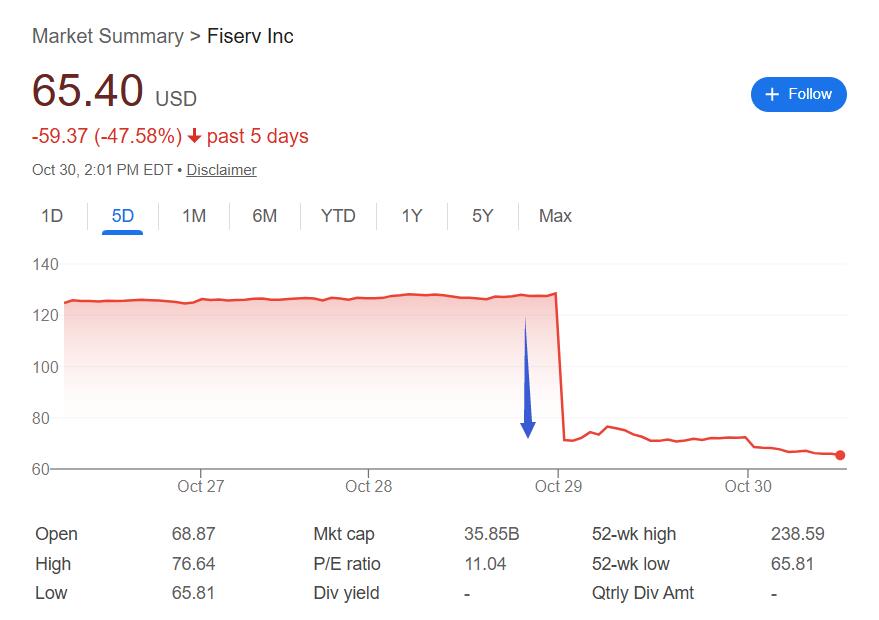
Fiserv, Inc. (FI) Shares Tank Amid "'Abysmal'" Q3 2025 Results -Hagens Berman
Prnewswire· 2025-10-30 12:38
Core Insights - Fiserv, Inc. experienced a significant decline in share price, dropping over $59 (-47%) following the release of disappointing Q3 2025 financial results, which analysts described as "abysmal" [1][5][7] Financial Performance - The company reported a sequential decline in Q3 2025 adjusted revenue and reduced organic revenue growth expectations to 3.5%-4% [5] - Fiserv also lowered its earnings per share (EPS) outlook to $8.50-$8.60 [5] Leadership Changes - Following the financial results, Fiserv announced the departure of its chief financial officer and a shake-up in its board of directors, including the replacement of the non-executive chairman and the head of the audit committee, effective January 1, 2026 [5][6] Market Reaction - The market reacted swiftly, resulting in a loss of $32 billion in shareholder value in a single day, with analysts expressing disbelief at the magnitude of the earnings miss and guidance cut [7] Investigation - Hagens Berman, a national shareholders rights firm, has initiated an investigation into whether Fiserv misled investors regarding its financial performance and growth prospects [2][7]
Buy or Sell Fiserv Stock After Its 44% Crash?
Forbes· 2025-10-30 11:25
Core Insights - Fiserv's stock experienced a significant decline of 44% on October 29, 2025, following disappointing third-quarter earnings and a lowered full-year forecast [2][3] Financial Performance - Adjusted earnings per share were reported at $2.04, missing the analyst consensus of $2.72, while revenue of $5.26 billion fell short of the $5.56 billion forecast [3] - The company revised its full-year earnings guidance down to a range of $8.50-$8.60 per share from a previous outlook of $10.15-$10.30 [3] - Organic revenue growth slowed to just 1% for the quarter, with particularly weak performance in the Merchant Solutions segment [4] - Fiserv's revenues grew 5.2% from $20 billion to $21 billion over the last 12 months, compared to a 5.4% increase for the S&P 500 [14] Operational Challenges - Management cited a slowdown in cyclical growth in Argentina and the impact of interest rates as contributing factors to the weak performance [4] - There was a sudden senior leadership overhaul and ongoing legal concerns regarding alleged inflated growth tied to the Clover platform, adding to investor uncertainty [4] Valuation Metrics - Fiserv's price-to-sales (P/S) ratio stands at 1.8, compared to 3.2 for the S&P 500, indicating a lower valuation relative to the broader market [7] - The company's price-to-earnings (P/E) ratio is 10.9 versus the benchmark's 23.6, suggesting it may be undervalued [7] Profitability and Financial Stability - Fiserv's operating income over the last four quarters was $6.2 billion, with an operating margin of 29%, significantly higher than the S&P 500's 18.7% [14] - The company's balance sheet appears weak, with a debt figure of $30 billion and a high debt-to-equity ratio of 76.5% compared to 21.2% for the S&P 500 [14] Market Resilience - Fiserv stock has shown more resilience compared to the S&P 500 during recent downturns, recovering fully from previous market crises [15]

Fiserv(FISV) - 2025 Q3 - Quarterly Report
2025-10-30 11:07
Acquisitions and Investments - The company acquired Payfare, Inc. for $397 million, enhancing its embedded finance capabilities[142]. - The company expects to acquire StoneCastle for approximately $460 million, which will strengthen its position in institutional deposits[145]. - The company reported an initial cash payment of $453 million from the non-renewal of the Wells Fargo Merchant Services alliance[146]. - The company has expanded its Clover platform through multiple acquisitions, enhancing its merchant services capabilities across various regions[144]. - Acquisitions in the first nine months of 2025 totaled $397 million, including deferred payments, for companies such as Payfare and CCV[192]. - The company expects to acquire StoneCastle for approximately $460 million, with the transaction anticipated to close in the first quarter of 2026[193]. Financial Performance - Total revenue for Q3 2025 was $5,263 million, a 1% increase from $5,215 million in Q3 2024[163]. - Processing and services revenue was $4,273 million, representing 81.2% of total revenue, with a 1% increase from $4,237 million in Q3 2024[163]. - Product revenue increased by 1% to $990 million, accounting for 18.8% of total revenue[163]. - Operating income decreased by 10% to $1,436 million, down from $1,602 million in Q3 2024, resulting in an operating margin of 27.3%[163][165]. - Net income attributable to Fiserv, Inc. rose by 40% to $792 million, compared to $564 million in Q3 2024[163]. - Total revenue for the nine months ended September 30, 2025, was $15,909 million, a 5% increase from $15,205 million in the same period of 2024[164]. - Total revenue increased by $704 million, or 5%, in the first nine months of 2025 compared to 2024, with a 7% growth in the Merchant segment and a 3% growth in the Financial segment[167]. - Operating income increased by $316 million, or 8%, in the first nine months of 2025 compared to 2024, with an operating margin of 28.5%, an increase of 80 basis points[177]. - Revenue in the Merchant segment increased by $470 million, or 7%, in the first nine months of 2025, driven by a 5% contribution from Small Business and a 1% contribution from Enterprise[168]. - Revenue in the Financial segment increased by $226 million, or 3%, in the first nine months of 2025, primarily due to increased data and analytics sales[169]. - Net income attributable to Fiserv, Inc. per share-diluted was $4.83 in the first nine months of 2025, compared to $3.74 in the same period of 2024[186]. Expenses and Cash Flow - The company reported a 6% increase in total expenses to $3,827 million in Q3 2025, compared to $3,613 million in Q3 2024[163]. - Total expenses increased by $388 million, or 4%, in the first nine months of 2025, with total expenses as a percentage of total revenue decreasing by 80 basis points to 71.5%[171]. - Interest expense increased by 29% to $422 million in Q3 2025, up from $326 million in Q3 2024[163]. - Interest expense, net increased by $246 million, or 28%, in the first nine months of 2025 due to debt financing activities, including the issuance of $2.0 billion in senior notes[181]. - Operating cash flow for the first nine months of 2025 was $4.1 billion, a decrease of 7% from $4.4 billion in the same period of 2024[189]. - Selling, general and administrative expenses as a percentage of total revenue decreased to 32.4% in the first nine months of 2025 compared to 32.9% in the same period of 2024[175]. Debt and Liquidity - Total long-term debt increased to $28.876 billion as of September 30, 2025, up from $23.730 billion at the end of 2024[198]. - The company issued $2.0 billion in senior notes in August 2025, with proceeds used for general corporate purposes including share repurchases[198]. - Variable rate debt totaled $3.424 billion as of September 30, 2025, with a weighted-average interest rate of 11.800%[204]. - Cash and cash equivalents stood at $1.1 billion, with available capacity under the revolving credit facility of $3.4 billion as of September 30, 2025[188]. - Cash and cash equivalents totaled $1,068 million as of September 30, 2025, compared to $1,236 million as of December 31, 2024[213]. - The total available cash increased from $665 million in December 2024 to $884 million in September 2025[213]. Market Conditions and Risks - The company actively monitors macroeconomic conditions, including interest rates and inflation, which could adversely impact its financial results[158][159]. - The company actively monitors market risks, particularly from fluctuations in interest rates and foreign currency exchange rates, and utilizes derivative instruments to hedge against these risks[214]. - The major currencies impacting revenues include the Argentine Peso, Brazilian Real, British Pound, Euro, and Indian Rupee[215]. - The Argentine government announced economic policy changes in April 2025, leading to significant devaluation of the Argentine Peso, which affected the company's international operating results[215]. - There were no significant changes to the company's market risk analyses during the nine months ended September 30, 2025[216]. Strategic Initiatives - The company anticipates continued demand for integrated solutions from financial institutions, driven by the shift to digital banking[155]. - The company aims to deepen client relationships with a focus on digital solutions and value-added services[137]. - The company emphasizes the importance of integrating its products and services to provide a unified customer experience[154]. - The company has invested in operational excellence and innovation to drive growth and create value for clients[137]. - The One Fiserv action plan was launched in Q3 2025 to enhance client focus and drive long-term growth through five strategic pillars[160].
Fiserv(FI) - 2025 Q3 - Quarterly Report
2025-10-30 11:07
Acquisitions and Investments - The company acquired Payfare, Inc. for an aggregate purchase price of $397 million, enhancing its embedded finance capabilities[142] - The company expects to acquire StoneCastle for approximately $460 million, which will strengthen its position in institutional deposits[145] - The company received an initial cash payment of $453 million from Wells Fargo upon the expiration of the WFMS joint venture[146] - The company has expanded its Clover platform through multiple acquisitions, enhancing its capabilities in the Merchant segment[144] - The company acquired several businesses for a total of $397 million in the first nine months of 2025, funded through available cash and commercial paper[192] - In September 2025, the company entered into agreements to acquire StoneCastle for approximately $460 million, expected to close in Q1 2026[193] Financial Performance - Total revenue for Q3 2025 was $5,263 million, representing a 1% increase from $5,215 million in Q3 2024[163] - Processing and services revenue was $4,273 million, up 1% from $4,237 million in the previous year, accounting for 81.2% of total revenue[163] - Product revenue increased by 1% to $990 million, making up 18.8% of total revenue[163] - Operating income decreased by 10% to $1,436 million from $1,602 million in Q3 2024, with an operating margin of 27.3%[163] - Net income attributable to Fiserv, Inc. rose by 40% to $792 million compared to $564 million in Q3 2024[163] - For the nine months ended September 30, total revenue was $15,909 million, a 5% increase from $15,205 million in the same period last year[164] - The company reported a 2% increase in processing and services revenue for the nine months ended September 30, totaling $12,622 million[164] - Total revenue increased by $704 million, or 5%, in the first nine months of 2025 compared to 2024, with a 7% growth in the Merchant segment and a 3% growth in the Financial segment[167] - Operating income increased by $316 million, or 8%, in the first nine months of 2025 compared to 2024, while total operating income decreased by $166 million, or 10%, in the third quarter of 2025[177] - Merchant segment revenue grew by $470 million, or 7%, in the first nine months of 2025, driven by a 5% contribution from Small Business and a 1% contribution from Enterprise[168] - Financial segment revenue increased by $226 million, or 3%, in the first nine months of 2025, supported by higher data and analytics sales and license revenue[169] Expenses and Margins - Total expenses increased by $388 million, or 4%, in the first nine months of 2025, with total expenses as a percentage of total revenue decreasing by 80 basis points to 71.5%[171] - Operating margin increased by 80 basis points to 28.5% in the first nine months of 2025, despite a decrease of 340 basis points to 27.3% in the third quarter[177] - Interest expense increased by 29% to $422 million in Q3 2025 from $326 million in Q3 2024[163] - Interest expense, net rose by $246 million, or 28%, in the first nine months of 2025 due to debt financing activities, including the issuance of $2.0 billion in senior notes[181] Cash Flow and Capital Management - Operating cash flow for the first nine months of 2025 was $4.1 billion, a decrease of 7% from $4.4 billion in the same period of 2024[189] - Capital expenditures were approximately 8% of total revenue for both the first nine months of 2025 and 2024, totaling $1.321 billion in 2025, an increase of 13% from $1.170 billion in 2024[190] - The company repurchased 29.1 million shares for $5.4 billion in the first nine months of 2025, compared to 27.8 million shares for $4.3 billion in the same period of 2024[191] - Cash and cash equivalents stood at $1.1 billion, with available capacity under the revolving credit facility of $3.4 billion as of September 30, 2025[188] Debt and Financial Obligations - Total long-term debt increased to $28.876 billion as of September 30, 2025, up from $23.730 billion at the end of 2024[198] - The company completed a public offering of $2.0 billion in senior notes in August 2025, using proceeds for general corporate purposes, including debt repayment and share repurchases[198] - Variable rate debt totaled $3.424 billion as of September 30, 2025, with a weighted-average interest rate of 11.800%[204] - The company maintained compliance with all financial debt covenants during the first nine months of 2025[209] Market Risks and Monitoring - The company actively monitors geopolitical and market conditions that could adversely impact operations and financial results[158] - The company actively monitors market risks, particularly from fluctuations in interest rates and foreign currency exchange rates, and utilizes derivative instruments to hedge against these risks[214] - The major currencies affecting revenues include the Argentine Peso, Brazilian Real, British Pound, Euro, and Indian Rupee, with exposure to currency devaluation risks in certain countries[215] - Foreign currency exchange losses amounted to $53 million and $117 million for the three and nine months ended September 30, 2025, respectively, due to significant volatility in the Argentine Peso[215] Client Relations and Strategic Focus - The company anticipates continued demand for integrated solutions from financial institutions, driven by the shift from traditional to digital banking[155] - The company aims to deepen client relationships by emphasizing digital solutions and value-added services[137] - The One Fiserv action plan was launched in Q3 2025 to enhance client focus and leverage emerging technologies, including AI[160]