ProShares

Search documents
5 Things to Know About 5X ETFs
Yahoo Finance· 2025-10-15 17:49
Core Insights - The SEC Rule 18f-4, adopted five years ago, regulates the use of derivatives in mutual funds and ETFs, requiring a "Derivatives Risk Manager" to calculate Value-at-Risk (VaR) for leverage testing [1][4] - Recent filings by VolatilityShares for 27 new single-stock ETFs with leverage from 3X to 5X indicate a growing trend in the ETF market towards higher leverage products [3][6] - The potential loophole in the rule allows funds to classify cash as derivatives, which could enable them to meet the VaR requirements while maintaining high leverage [5][6] ETF Market Trends - There has been a surge in new 3X ETF filings, with the current wave being distinct from previous attempts at higher leverage products [2][3] - Historical attempts at higher leverage ETFs, such as ForceShares and VelocityShares, faced regulatory challenges and were ultimately shut down [2][3] Regulatory Environment - The current regulatory environment is permissive, with the SEC potentially allowing new filings to go live if not explicitly rejected within 75 days [6][7] - The ongoing government shutdown may impact the SEC's ability to review and respond to these new filings, leading to a lack of oversight [7] Risks and Innovations - The appetite for leveraged products among retail traders remains strong, despite inherent risks such as counterparty risks and hidden financing costs [9][10] - The concept of perpetual futures in the crypto market presents a more efficient alternative to traditional leveraged products, which may influence the future of ETF offerings [10][11]
Are Leveraged ETFs to Blame for Selloffs? JPM Says Yes
Yahoo Finance· 2025-10-15 10:05
Core Viewpoint - Leveraged ETFs are being scrutinized for their potential role in exacerbating market volatility, particularly following a significant stock selloff attributed to external factors like tariff threats from President Trump [2][4]. Group 1: Market Impact - JPMorgan analysts indicated that leveraged ETFs contributed to approximately $26 billion in selloffs, worsening the S&P 500's largest one-day loss since April [2]. - The volatility associated with leveraged ETFs is heightened due to their structure, which often involves swaps that can lead to forced buying and selling, increasing market instability [4]. Group 2: Expert Opinions - While some experts acknowledge the risks posed by leveraged ETFs to individual investors, not all agree on their systemic impact, with some suggesting that they do not create widespread issues [3][4]. - Morningstar's research analyst highlighted a pattern of investor amnesia regarding the risks of leveraged ETFs, suggesting that past failures are often forgotten by investors [5]. Group 3: Industry Context - Leveraged ETFs represent only 1% of the total $12 trillion ETF industry in the US, indicating that their overall market presence is relatively small [6]. - The largest 3x leveraged ETF, ProShares UltraPro QQQ (TQQQ), has around $29 billion in assets under management, suggesting limited systemic risk from these products [4].

TBT: Leveraged Inverse Strategy On The 20+ Year Treasury Notes (NYSEARCA:TBT)
Seeking Alpha· 2025-10-13 15:34
The ProShares UltraShort 20+ Year Treasury ETF (NYSEARCA: TBT ) is a leveraged inverse strategy designed to provide traders -2x the daily performance of the ICE US Treasury 20+ Year Bond Index. The strategy, in short, will provide inverse exposure to the value of the 20+ yearMonte Independent Investment Research: Michael Del Monte is a buy-side equity analyst with over 5 years of industry experience. Prior to working in the investment management industry, Michael spent over a decade in professional services ...


AMD一夜暴涨,3倍做空AMD的ETF“一夜清零”,‘波动率恐慌’再度燃起
美股IPO· 2025-10-10 03:56
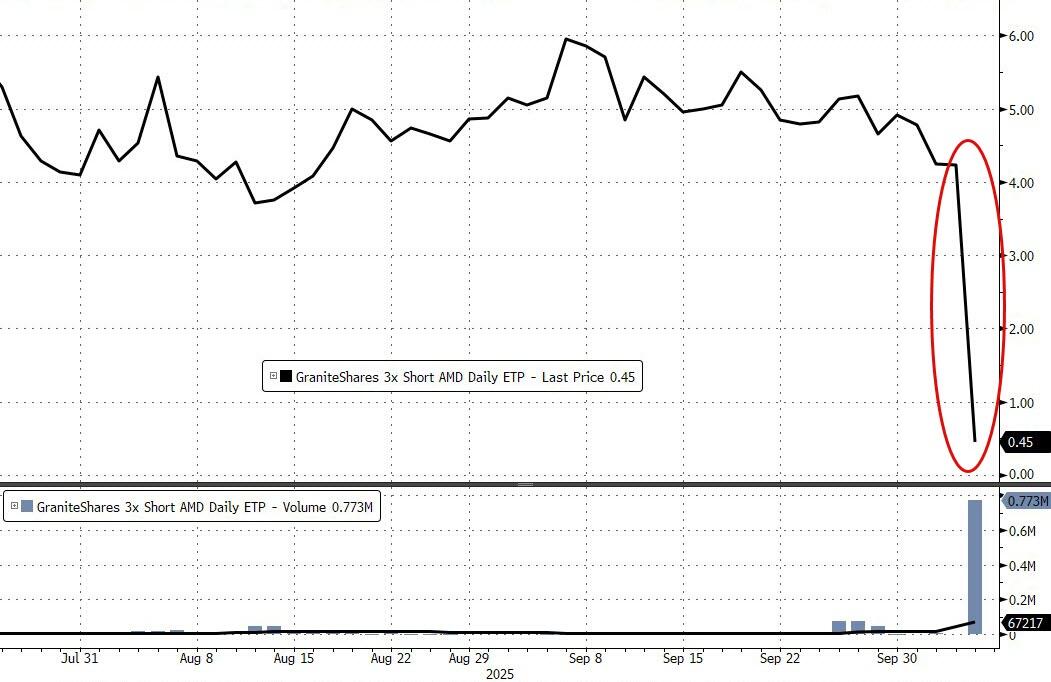
Core Viewpoint - The recent surge in AMD's stock price by 38% led to the complete liquidation of GraniteShares' 3x short AMD ETF, raising concerns about the risks associated with high-leverage ETFs and the potential for a repeat of the 2018 "volatility panic" [1][5][6]. Group 1: ETF Liquidation Event - GraniteShares' 3x short AMD ETF, which aimed to provide three times the inverse return of AMD's stock price, had approximately $3 million in assets before its value dropped to zero, resulting in forced liquidation [2][7]. - The ETF's net asset value (NAV) fell to zero, leading to a suspension of trading and a planned delisting according to exchange procedures [7][2]. - This incident serves as a stark reminder of the risks associated with leveraged products, particularly in a volatile market environment [4][10]. Group 2: Market Implications and Analyst Insights - Analysts, including Bloomberg's Athanasios Psarofagis, highlighted that this event underscores the real risk of liquidation for 3x stock ETFs, suggesting that such occurrences may become more common in the fast-paced market [4][9]. - The current market conditions, characterized by high retail participation in leveraged products, raise concerns about the timing of potential similar events in larger markets, particularly in the U.S. [11][10]. - The recent liquidation coincides with multiple issuers, including GraniteShares and others, submitting applications to the SEC for new 3x leveraged products, indicating a growing interest despite the associated risks [12][15]. Group 3: Historical Context - The event has rekindled fears reminiscent of the 2018 "volatility panic," where short volatility products experienced catastrophic losses, with some losing over 90% in a single day [6][8]. - The comparison to the XIV collapse in 2018 highlights the systemic risks posed by leveraged ETFs, particularly during periods of sudden market volatility [8][11].

AMD一夜暴涨,3倍做空AMD的ETF“一夜清零”,‘波动率恐慌’再度燃起
Hua Er Jie Jian Wen· 2025-10-10 00:23
Core Viewpoint - The significant surge in AMD's stock price, which rose by 38%, led to the complete liquidation of GraniteShares' 3x short AMD ETF, highlighting the risks associated with high-leverage ETFs in the current market environment [1][4][6]. Group 1: ETF Liquidation Event - GraniteShares' 3x short AMD ETF, which aimed to provide three times the inverse return of AMD's stock price, had its net asset value (NAV) drop to zero, resulting in forced liquidation and suspension of trading [1][4]. - The ETF was managing approximately $3 million in assets before its closure, and no redemption payments will be made due to the NAV reaching zero [1][4]. - This incident is reminiscent of the "volatility crash" in 2018, where similar products experienced catastrophic losses [4][5]. Group 2: Market Implications - Analysts, including Bloomberg's Athanasios Psarofagis, have indicated that this event underscores the real risk of liquidation for 3x stock ETFs, especially in a fast-paced market [3][6]. - The current market environment raises concerns about the potential for similar liquidation events in larger markets, particularly in the U.S. [6]. - The recent liquidation has reignited fears of a repeat of the "volatility crash" that occurred in 2018, where volatility spikes led to significant losses for short volatility products [3][5]. Group 3: Regulatory Context - The timing of the ETF's liquidation is notable as it coincides with multiple issuers, including GraniteShares, submitting applications to the SEC for new 3x leveraged single-stock ETFs [7]. - These applications include high-volatility stocks like Tesla and cryptocurrencies, indicating a growing interest in leveraged products despite regulatory challenges [7]. - The SEC's existing volatility rules have limited the trading of such products in the U.S., raising questions about how new applications will comply with these regulations [7].
BITO: Perspectives In ATH
Seeking Alpha· 2025-10-09 11:30
Group 1 - ProShares Bitcoin ETF (NYSEARCA: BITO) provides exposure to bitcoin for average stock market investors [1] - The ETF's objective is to ensure that its return, before commissions and expenses, corresponds to the performance of bitcoin [1]

TQQQ ETF Amplifies Nasdaq's Big Gains
247Wallst· 2025-10-08 15:26
Core Viewpoint - ProShares UltraPro QQQ (NASDAQ:TQQQ) demonstrates that sophisticated trading knowledge is not a prerequisite for gaining leverage in financial markets [1] Group 1 - ProShares UltraPro QQQ offers a means for investors to access leveraged exposure without requiring advanced trading skills [1]
TQQQ: An Alpha Opportunity (NASDAQ:TQQQ)
Seeking Alpha· 2025-10-04 07:07
Core Argument - The article presents two strong arguments for investing in tech-focused leveraged ETFs like ProShares UltraPro QQQ (NASDAQ: TQQQ), emphasizing that AI spending is expected to accelerate in the coming years, benefiting companies in the technology sector [1]. Group 1: Investment Opportunity - AI spending is projected to increase significantly, which will positively impact technology companies [1].

TQQQ: An Alpha Opportunity
Seeking Alpha· 2025-10-04 07:07
Group 1 - The article argues that owning a tech-focused leveraged ETF, such as ProShares UltraPro QQQ (NASDAQ: TQQQ), is beneficial due to the anticipated acceleration in AI spending in the coming years [1] - Companies that are likely to benefit from increased AI spending include major tech firms [1]
Leveraged ETF Watchlist And Focus On SSO’s Decay (NYSEARCA:SSO)
Seeking Alpha· 2025-10-01 14:05
Group 1 - The ProShares Ultra S&P500 ETF (SSO) is identified as a potentially profitable swing trading instrument, but its 2X leverage factor introduces a risk of drift [1] - The article explains the concept of "drift" and reports it for 22 leveraged ETFs, with a specific focus on SSO [1] - The author, Fred Piard, has extensive experience in technology and quantitative analysis, and he shares various investment strategies including market risk indicators and real estate strategies [1]