
Reserve Bank of India

Search documents
SET looks beyond fiction, backs global reality formats for weekday growth
The Economic Times· 2026-01-29 08:32
Core Insights - Sony Entertainment Television (SET) is shifting its programming strategy to focus on international reality formats to build a sustainable weekday audience, particularly targeting male viewers and appealing to premium advertisers seeking faster brand impact [13] - The channel aims to address a clear weekday programming gap and reduce reliance on an increasingly crowded fiction space, as non-fiction shows attract a more balanced male and female viewership [13] Programming Strategy - The programming strategy is centered on interactive formats that work seamlessly across television and mobile screens, emphasizing the importance of cross-platform engagement [5][13] - The execution of this strategy relies on pairing international formats with prominent film star hosts to amplify audience engagement [6][13] Target Audience - SET's weekday programming approach focuses on delivering brand salience and conversion for advertisers, rather than just audience aggregation, with a particular emphasis on reaching an active and engaged male viewership [7][13] - The channel recognizes that cricket is currently the only male-targeted, mass-appeal offering dominating the weekday viewing cycle, highlighting a clear gap for non-fiction programming during weekdays [10][13] Challenges and Opportunities - SET has faced challenges in building a consistent slate of successful fiction shows due to audience fragmentation and competition from established players like Star Plus and Zee TV [9][13] - The channel's strategy to scale up reality formats reflects an attempt to fill the weekday television landscape gap and leverage the success of shows like Kaun Banega Crorepati, which has shown strong male viewership [11][13] Sponsorship and Advertising - The launch of Wheel of Fortune has attracted a diverse mix of sponsors, including Maruti Suzuki and State Bank of India, indicating strong advertiser interest even in a soft advertising market [11][13] - Big-ticket formats are seen as effective in capturing attention and enabling advertisers to build brands at scale [11][13]



亚洲经济-2026 年十大问题-Asia Economics Analyst_ Ten questions for 2026
2026-01-19 02:29
Summary of Key Points from the Conference Call Industry Overview - The report focuses on the Asia-Pacific economic outlook for 2026, with specific emphasis on China, Japan, India, Taiwan, and New Zealand. Core Insights and Arguments 1. **China's GDP Growth**: - Expected real GDP growth of 4.8% in 2026, surpassing consensus expectations of 4.5%-4.6% due to strong export growth and easing fiscal policy [6][5][4] 2. **Housing Market in China**: - The housing market is not expected to bottom out across all indicators; housing starts are down approximately 80% from peak levels in 2020, while construction activity has fallen about 60% [7][4] - Home prices have significantly declined, with expectations that they will remain lower by the end of 2026 [7][4] 3. **China's Trade Surplus**: - Anticipated to increase further, with a record trade surplus of nearly $1.2 trillion in 2025 expected to rise in 2026 due to competitive manufacturing and a focus on exports [13][14][4] 4. **US Tariff Relief**: - Modest tariff relief expected for Asia, particularly benefiting India, as negotiations continue to lower trade barriers [19][4] - Taiwan has signed an agreement to reduce US tariffs in exchange for significant investments in semiconductor and AI production [21][4] 5. **Japan's Fiscal Policy and Yields**: - No significant rise in bond yields expected post-election; fiscal policy may loosen but will be constrained by market pressures [25][26][4] - The yen is expected to strengthen slightly, moving away from the current weak levels [31][4] 6. **Growth Surprises in Asia-Pacific**: - Taiwan and New Zealand are projected to outperform consensus growth expectations, driven by tech exports and recovering economic conditions, respectively [33][4] 7. **Inflation Outlook**: - Inflation pressures are not expected to drive significant policy shifts among Asia-Pacific central banks, with CPI inflation returning to pre-COVID levels [41][4] - China and Thailand are expected to see continued easing in monetary policy due to low inflation [42][4] 8. **Central Bank Policy Rate Expectations**: - Anticipated tightening in Japan, Taiwan, and New Zealand, with the Bank of Japan expected to resume rate hikes [47][48][4] 9. **Asian Currencies Performance**: - Majority of Asian currencies expected to appreciate against the USD in 2026, with the CNY anticipated to strengthen due to strong fundamentals [52][4] Other Important Insights - The report highlights that most themes from the previous year were accurate, with notable surprises including the rise in government bond yields in China and the underperformance of the Indian Rupee [56][4] - The analysis includes a review of past predictions and their outcomes, reinforcing the credibility of the current forecasts [56][4]

RBI's likely to hold interest rates with inflation set to rise
The Economic Times· 2026-01-13 18:34
Economic Outlook - The Reserve Bank of India (RBI) is expected to maintain its repo rate in the upcoming February policy meeting, awaiting new parameters that will influence inflation and growth metrics in the revised base-year series [1][5] - The December consumer inflation rate was recorded at 1.33%, with Q3 inflation averaging 0.8%, which is 20 basis points higher than the RBI's forecast of 0.6% for Q3 [1][5] - Economists anticipate a similar upward adjustment in the RBI's Q4 inflation forecast, currently set at 2.9% [1][5] Monetary Policy and Liquidity - The RBI has cumulatively reduced policy rates by 125 basis points since February 2025, bringing the rate down to 5.25% [1][5] - Economists do not foresee further rate cuts in the near term, predicting inflation could exceed 4% over the next four quarters [1][5] - There is an expectation for the RBI to inject additional liquidity through open market operations (OMO) to maintain systemic liquidity in surplus [1][5] System Liquidity - System liquidity shifted to a deficit in the latter half of December but has averaged a tight surplus of ₹36,869 crore in January [5] - Soumya Kanti Ghosh, chief economic advisor at State Bank of India, forecasts approximately ₹2 lakh crore of OMO for the remainder of FY26, with a similar trend expected in the following fiscal year [5] - Radhika Rao, senior economist at DBS Bank, indicated that additional tranches of OMOs and FX swaps are anticipated to address liquidity drains caused by foreign exchange interventions [5]
India inflation accelerates to 1.33% in December, driven by higher food prices
CNBC· 2026-01-12 10:43
Inflation Overview - India's consumer inflation rose to 1.33% in December, up from 0.71% in the previous month, but below economists' expectations of a 1.5% increase [1] - The increase in inflation was primarily driven by rising prices in personal care, vegetables, meat, fish, eggs, spices, and pulses [2] Sectoral Analysis - Headline inflation increased by 0.76% in the rural sector and 2.03% in urban areas in December, while fuel and light inflation eased to 1.97%, down from 2.32% in November [2] Economic Projections - The Reserve Bank of India revised its consumer inflation forecast to 2% for the fiscal year ending March 2026, down from a previous estimate of 2.6% [3] - The central bank anticipates inflation to rise to 2.9% for the quarter ending March and reach 4.0% for the quarter ending September 2026 [3] - An early estimate projected real GDP growth of 7.4% and nominal GDP growth of 8.0% for fiscal year 2026, significantly lower than the 10.1% nominal GDP growth forecast in the Union Budget [4]

RBI advocates disclosure of NPA, inspection info; banks oppose; matters in CIC
The Economic Times· 2026-01-11 10:53
RBL Bank, RTI applicants Dheeraj Mishra, Vathiraj, Girish Mittal and Radha Raman Tiwari had filed separate applications with the RBI, seeking information, such as the top 100 NPAs, willful defaulters of Yes Bank, the inspection report of the SBI and RBL, and documents relating to a Rs 4.34 crore monetary penalty imposed following statutory inspection findings from the Bank of Baroda, respectively, among others. These banks appealed before the Information Commissioner Khushwant Singh Sethi referred the mat ...
India's Tax Department Echoes Reserve Bank's Concerns on Crypto
Yahoo Finance· 2026-01-08 10:45
Core Insights - India's income tax authorities and the Reserve Bank of India are raising concerns about virtual digital assets, particularly regarding enforcement challenges that hinder the government's ability to track and tax cryptocurrency transactions as the Union Budget approaches [1][2]. Group 1: Enforcement Challenges - Tax authorities highlighted difficulties in tracking crypto transactions due to the technology's features such as borderless transfers and pseudonymous addresses, which create enforcement gaps [2]. - The Finance Ministry aims to curb decentralization and privacy-focused systems, aligning with the Financial Intelligence Unit (FIU) and the Income Tax Department on these issues [2]. Group 2: Regulatory Scrutiny - FIU-registered exchanges will face increased scrutiny due to reports of crypto-laundering, with the Ministry of Home Affairs conducting detailed investigations [3]. - The Tax Department has identified irregularities in centralized exchanges, including misuse of customer funds, extreme leverage, and insider trading [3]. Group 3: Taxation and Budget Plans - Crypto traders in India are subject to a 30% flat tax and a 1% Tax Deducted at Source (TDS), despite the lack of a clear regulatory framework [3]. - The Union Budget for 2026-27 is set to be presented on February 1, 2026, with the Budget Session starting on January 28 [4]. Group 4: Cross-Border Activity - Tax officials noted jurisdictional overlaps in cross-border crypto activities, complicating enforcement, especially for platforms operating overseas or unregistered with the FIU [5]. Group 5: Technological Measures - Last July, authorities announced plans to utilize AI and global data-sharing under the Crypto-Asset Reporting Framework to cross-match TDS data from exchanges with income tax returns, issuing notices for discrepancies exceeding $1,200 (₹1 lakh) [6].
Credit continues to beat deposit growth, PSU banks proforma numbers show
The Economic Times· 2026-01-02 17:58
Core Insights - The banking sector in India is experiencing a significant credit growth, with a notable increase in loans outpacing deposit growth, indicating a persistent credit-deposit gap [10][8]. Group 1: Credit and Deposit Growth - Punjab National Bank reported deposits of ₹15.97 lakh crore, an increase of 8.32% year-on-year, while gross advances grew by 10.15% to ₹11.67 lakh crore [1]. - Bank of India and Indian Bank exhibited double-digit growth in both deposits and advances, with loans increasing by 15.07% and 14.5%, respectively, compared to deposit growth of 12-13% [1]. - The overall credit growth for a coverage universe of 17 banks is projected to rise to 11.8% year-on-year, while deposit growth is expected to be lower at around 10.2% [2]. Group 2: System Credit Trends - The credit cycle has seen a meaningful pickup following GST rate cuts, with system credit growth tracking above 11% in October and November 2025, driven by a consumption-led recovery [5]. - System credit growth is anticipated to remain above 12% year-on-year in FY26 and improve to around 13% in FY27, up from 11-12% in FY25 [6]. - Recent data indicates that for the fortnight ending December 12, bank loans rose by 11.5% year-on-year, while deposits grew at a slower pace of 10.2% [8]. Group 3: Regulatory Environment and Market Dynamics - The Reserve Bank of India (RBI) announced a phased cut in the cash reserve ratio (CRR) by 100 basis points to 3%, which is expected to support credit expansion [7][6]. - Competitive pressure on deposits remains, with banks facing challenges in mobilizing low-cost funding, although ongoing term-deposit repricing may moderate the cost of funds [9]. - The RBI also cut the key repo rate by 25 basis points to 5.25% in December, maintaining a neutral stance to bolster growth amid low inflation [9].
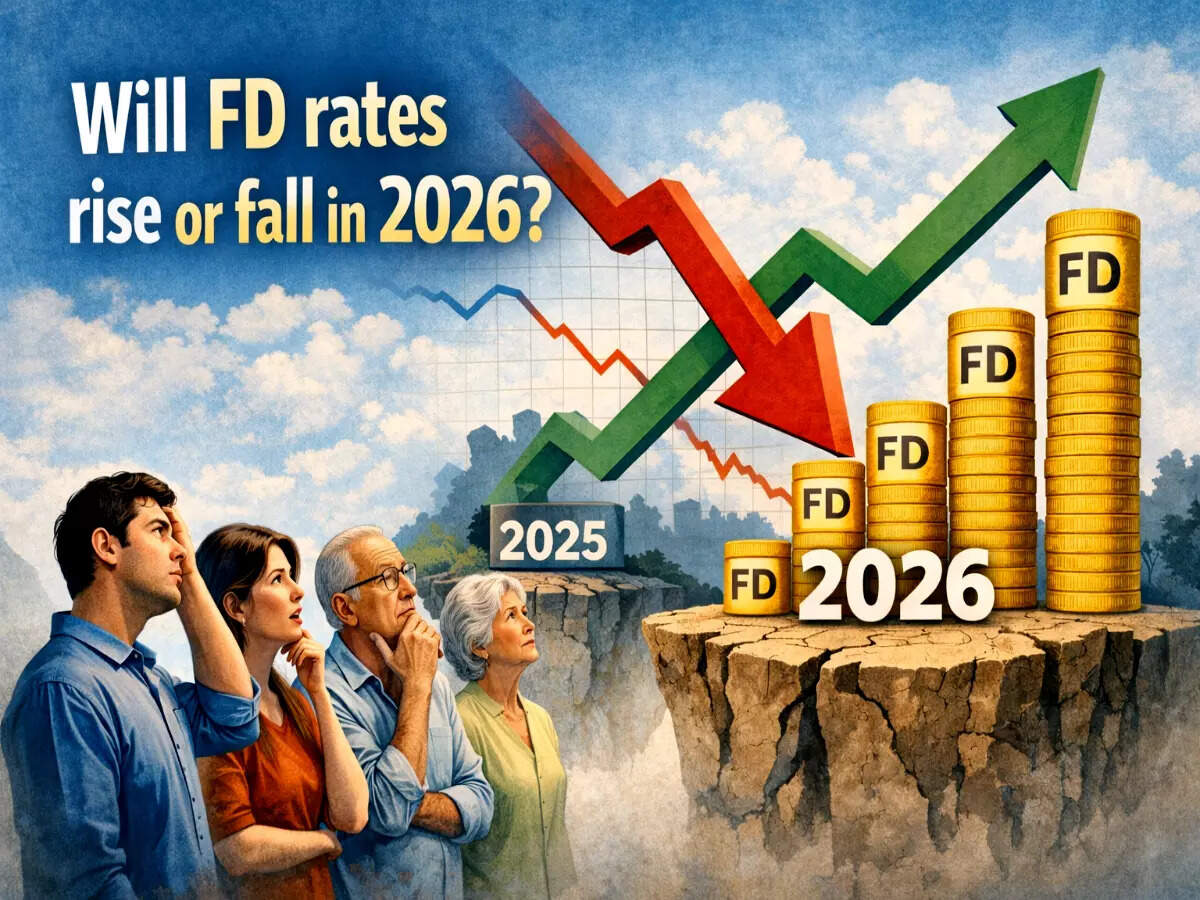
Will FD rates bounce back in 2026 after big fall in 2025? Here’s how you can make the best of FD investment
The Economic Times· 2025-12-31 11:42
Core Viewpoint - The fixed deposit (FD) rates have been reduced significantly due to the Reserve Bank of India's (RBI) repo rate cuts, and the outlook for 2026 suggests that rates may remain stable or trend slightly lower rather than increase sharply [1][5][10] Group 1: FD Rate Changes and Influences - In 2025, banks and small finance banks (SFBs) cut FD interest rates multiple times following a total repo rate cut of 125 basis points by the RBI [9][10] - The last repo rate cut occurred in December 2025, when the RBI reduced the rate by 25 basis points [1][10] - The transmission of these rate cuts into FD rates takes time, and the full impact of previous cuts is still unfolding, which may take months to years [2][10] Group 2: Future Expectations for FD Rates - Swapnil Aggarwal, Director at VSRK Capital, anticipates that FD rates in 2026 are more likely to remain stable or trend slightly lower, contingent on controlled inflation and a more accommodative monetary policy [5][6] - A significant resurgence in inflation or unexpected economic stress is deemed unlikely to lead to a sharp increase in FD rates, suggesting a stable-to-soft outlook for deposit rates [6][10] Group 3: Investment Strategies Amidst Rate Changes - Investors may consider reallocating a portion of their savings to high-quality debt funds if FD rates decline, as these funds can benefit from falling yields [7][8] - Conversely, during rising rate periods, it is advisable to maintain short-term FDs to allow gradual reinvestment at higher rates as they become available [8][9] - Diversification across FDs, debt funds, and hybrid funds is recommended to manage risk while optimizing returns [9][10] Group 4: Current FD Rates at Major Banks - The highest FD rates at major banks include Bandhan Bank at 7.2%, RBL Bank at 7.2%, and IDFC FIRST Bank at 7% for specific tenures [3][4]
X @Bloomberg
Bloomberg· 2025-12-23 14:18
Reserve Bank of India Governor Sanjay Malhotra said India is likely to remain in a prolonged period of low policy rates as long as inflation stays benign and the economy is not hit by a major supply-side shock https://t.co/tmgS4yn2yP ...
X @Bloomberg
Bloomberg· 2025-12-23 08:10
Some lenders have asked India’s central bank to step in to curb a sharp rise in hedging costs, according to people familiar with the matter https://t.co/8N4uPDL5ZG ...