SEB

Search documents
佳音科技由董事长鲁定尧夫妻控制87%表决权,中专学历陈芝波任总助
Sou Hu Cai Jing· 2026-01-23 00:42
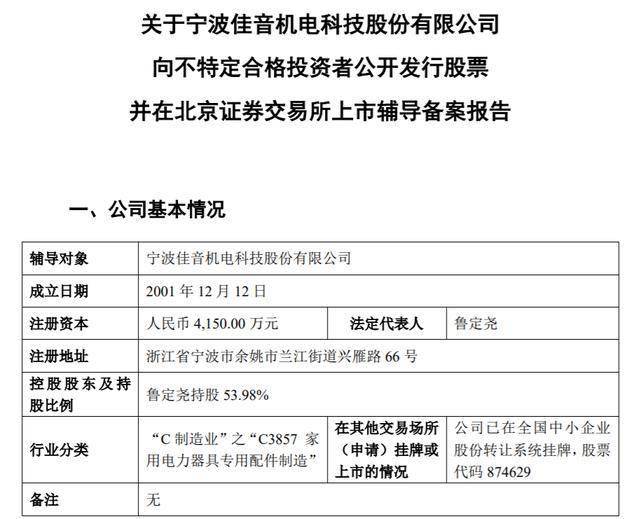
Core Viewpoint - Ningbo Jiayin Electromechanical Technology Co., Ltd. (hereinafter referred to as "Jiayin Technology") is initiating an IPO process to list on the Beijing Stock Exchange, with guidance from GF Securities. The company specializes in the research, manufacturing, and sales of core components for fluid control systems, applicable in various industries such as smart home appliances, automotive, medical, and new energy [1][4]. Company Overview - Jiayin Technology was established on December 12, 2001, with a registered capital of RMB 415 million. The legal representative is Lu Dingyao, who holds a 53.98% stake in the company [1]. - The company is classified under the manufacturing industry, specifically in the production of specialized components for household electric appliances [1]. Business Performance - In 2024, Jiayin Technology reported an operating income of RMB 808 million, representing a year-on-year increase of 51.16%. The net profit attributable to shareholders was RMB 60.94 million, up 23.64% compared to the previous year [3][4]. - For the first half of 2025, the company achieved an operating income of RMB 48.7 million, reflecting a year-on-year growth of 46.93%. However, the net profit attributable to shareholders decreased by 9.23% to RMB 29.53 million [4]. Shareholding Structure - Lu Dingyao directly holds 22.4 million shares (53.98%), while Chen Zhibo holds 10.88 million shares (26.22%). Together, they control 87.03% of the voting rights in the company [4]. - Lu Dingyao serves as the Chairman and General Manager, while Chen Zhibo is the Assistant General Manager [4][5].

鲍威尔遭调查引发多方强烈反应 美联储独立性成核心争议点
证券时报· 2026-01-13 08:06
美国司法部对美联储主席杰罗姆·鲍威尔发起刑事调查一事持续发酵,调查聚焦其对美联储总部翻新工程的处理及相关国会证词。 此举被鲍威尔直指为因降息节奏未达总统特朗普预期而发起的恐吓与报复。周一,该事件引发美国国会议员、华尔街投资机构及美联储和财政部前官员的 广泛关注与强烈反应,美联储独立性问题成为各方争议核心。 美国国会议员:共和党普遍反对调查 少数持观望态度 值得注意的是,鲍威尔的美联储主席任期将持续到今年5月,但他作为美联储理事的任期要到2028年才结束,这为事件后续发展增添了变数。 华尔街:警惕市场不稳定风险 担忧长期利率与美元地位受冲击 从市场表现来看,周一美债收益率虽走高但远低于早盘恐慌性高点,10年期收益率微涨1个基点;美债10年期拍卖获得稳健需求,中标收益率略低于投标 时的市场水平。期货市场显示,交易员仍预计今年仅降息两次,每次25个基点,与上周末预期一致,表明政府施压短期内不太可能影响美联储近期利率决 策。市场暂时保持韧性,但投资机构均强调风险犹存。 华尔街各大投资机构普遍认为,特朗普政府对鲍威尔的刑事调查可能引发市场不稳定,中长期将带来多重风险,尽管短期市场反应相对克制。 管理约9000亿美元资产 ...

策略师:北欧股市料将平开
Xin Lang Cai Jing· 2026-01-07 06:56
北欧市场料将基本平开,IG预测OMXS30指数将在2,902点左右持平。SEB宏观策略师Gustav Helgesson 指出,在美国总统特朗普表示委内瑞拉将向美国炼油厂"移交"3,000万-5,000万桶石油后,今晨油价跌至 略低于每桶60美元。不过,他表示,如今委内瑞拉的产量和出口在全球消费中仅占极小部分,该国要实 现有意义的产量增长还需要相当长的时间。美国股市周二收高,股指期货预示大西洋两岸市场将高开。 ...
Can Stablecoins Become Ubiquitous in 2026?
PYMNTS.com· 2025-12-30 16:35
Core Insights - Stablecoins have made significant progress in 2025, transitioning from being primarily held as reserves to being actively used for transactions, with a market capitalization exceeding $300 billion [3][5] - Major banks, card networks, and FinTechs have launched and integrated stablecoin payment and settlement products, driven by clearer regulatory frameworks [1][6] Market Trends - Stablecoin transaction volumes reached $27 trillion annually, although they still represent less than 1% of global daily money transfers [4] - The circulation of stablecoins doubled over the previous 18 months, indicating a shift towards more mainstream use cases [4] Regulatory Developments - The GENIUS Act established a federal framework for payment stablecoins in the U.S., clarifying reserve requirements and issuer oversight [6] - This regulatory clarity has encouraged major financial institutions to engage with stablecoins, leading to various partnerships and initiatives [5][6] Industry Initiatives - Visa and Bridge launched a card-issuing product allowing stablecoin use at any merchant accepting Visa, while Visa also expanded its stablecoin settlement capabilities [7][8] - Mastercard joined Paxos' Global Dollar Network to enable multiple stablecoins across its network [9] Corporate Engagement - Companies like SoFi, Coinbase, and PayPal have introduced stablecoin products aimed at various sectors, including enterprise solutions and AI-native businesses [10] - Major banks, including JPMorgan Chase and Bank of America, are exploring the launch of a jointly operated stablecoin [11][12] Use Cases - Stablecoins have found a mature use case in cross-border B2B payments and corporate treasury operations, allowing businesses to settle invoices and manage payroll more efficiently [15][17] - Dollar-denominated stablecoins are increasingly used in emerging markets as a hedge against currency volatility [17] Challenges - Despite advancements, consumer adoption of stablecoins remains uneven, particularly in developed markets where existing systems are effective [18] - Issues such as interoperability, transparency, and reliance on a small number of issuers pose ongoing challenges for the stablecoin industry [19]

SEB (OTCPK:SVKE.F) Update / Briefing Transcript
2025-12-17 14:02
SEB Q4 2025 Pre-Close Call Summary Company Overview - **Company**: SEB (OTCPK:SVKE.F) - **Date of Call**: December 17, 2025 - **Speaker**: Paul Wyszyski, Head of Investor Relations Key Points Macro Environment - Average three-month STIBOR is lower in Q4 compared to Q3, with the Swedish central bank lowering the policy rate by 25 basis points effective October 1st [1] - SEB adjusted some lending and deposit rates in Sweden following the rate cuts [1] - The European Central Bank kept the deposit facility rate unchanged, affecting Baltic operations primarily on the deposit side [2] Interest Rate Sensitivity - SEB's equity is approximately SEK 220 billion, with private and corporate transaction accounts and savings accounts totaling around SEK 370 billion, and Baltic transaction accounts around SEK 200 billion, leading to a total of roughly SEK 800 billion sensitive to rate changes [2] - Net interest income (NII) is expected to bottom out three to six months after the last rate cut, influenced by balance sheet dynamics [3] Profit and Loss Overview - The P&L and balance sheet are impacted by FX movements; a stronger SEK results in lower income and costs, while a weaker SEK has the opposite effect [4] - The SEK strengthened marginally against the euro compared to Q3, resulting in a smaller headwind on the P&L [4] - NII increased slightly despite downward trending interest rates due to higher day count, positive FX effects, lower deposit insurance fees, and reduced short-term funding costs [6] Division Performance - Business and retail banking NII declined by around SEK 100 million compared to the previous quarter due to lower interest rates on deposit margins [6] - Baltic division's NII remained largely unchanged as lower rates were offset by higher lending and deposit volumes [6] - Treasury NII benefited from favorable yield curve and funding conditions [7] Net Fee and Commission Income - A significant portion of net fee and commission income is linked to assets under management, which correlates with stock market performance [7] - Advisory and securities-related fees were seasonally softer in Q3, with no larger transactions reported in Q4 [8] Expenses and Credit Losses - Total expenses target for 2025 is SEK 33 billion, with potential for acceleration in cost implementation programs [9] - Net expected credit losses reported at three basis points, with an additional SEK 100 million in portfolio overlays [10] Capital and Risk Exposure - Current share buyback program amounts to SEK 2.5 billion, expected to conclude by January 27, 2026 [10] - CET1 capital ratio is affected by share buybacks, with a dividend payout ratio target of around 50% [11] - Remaining impact from the risk exposure amount (REA) increase in the Baltics is around 70 basis points, expected to phase in over the next three quarters [12] Additional Notes - The call concluded with a reminder of the silent period starting January 1, with the Q4 2025 interim report scheduled for publication on January 29, 2026 [13] Conclusion - SEB is navigating a challenging macro environment with interest rate adjustments and FX movements impacting its financial performance. The bank is focused on managing its capital effectively while preparing for upcoming financial disclosures.
X @Bloomberg
Bloomberg· 2025-12-16 11:24
The European Central Bank has identified significant deficiencies in risk models of top Swedish lenders SEB and Swedbank for their operations in Baltic countries https://t.co/GcGhgfYSbR ...
Banks Push Crypto Infrastructure Despite Policy Gridlocks
PYMNTS.com· 2025-12-03 19:13
Despite uncertainty, banks worldwide are designing stablecoins and tokenized-deposit systems, signaling incumbents’ push to shape the next generation of payments rails.Banks spent 2025 preparing major blockchain products for 2026, but U.S. regulatory movement — including still-unimplemented stablecoin rules under the GENIUS Act — has left institutions in a holding pattern.Global lenders are racing to commercialize digital-asset custody, viewing it as foundational infrastructure for tokenized securities, on- ...

10 EU Banks Unite to Launch Euro Stablecoin by 2026
Yahoo Finance· 2025-12-03 09:03
Core Insights - A consortium of ten major European banks is set to launch a euro-backed stablecoin by mid-2026 to challenge U.S. dollar dominance in the global stablecoin market, which exceeds $300 billion [1][2] - The initiative is a response to European regulators' concerns over the reliance on dollar-denominated tokens, which constitute 99.58% of the market, while euro-pegged alternatives are minimal, with only $649 million in circulation [2] Group 1: Consortium Formation and Leadership - The consortium includes BNP Paribas, ING, UniCredit, CaixaBank, Danske Bank, SEB, Raiffeisen Bank International, Banca Sella, KBC, and DekaBank, and operates through a newly established entity named Qivalis based in Amsterdam [1] - Qivalis has appointed Jan-Oliver Sell as CEO and Floris Lugt as CFO, with Sir Howard Davies as the chair of the Supervisory Board, all pending regulatory approval [3] Group 2: Regulatory and Strategic Implications - The consortium has applied for an electronic money institution license with the Dutch Central Bank, marking a significant step towards regulatory compliance and commercial launch [4] - The initiative aims to enhance monetary autonomy in the digital age and is open to additional banks joining to foster broader industry participation [5] Group 3: Systemic Risks and Market Concerns - The initiative follows warnings from European financial authorities regarding systemic risks associated with dollar-backed stablecoins, with concerns that rapid growth could impact European Central Bank monetary policy [6] - Dutch central bank governor Olaf Sleijpen highlighted that if U.S. stablecoins continue to grow at their current pace, they may become systemically relevant, creating uncertainty for central bank responses [7]
10 European Banks Form Stablecoin Company qivalis
Yahoo Finance· 2025-12-02 14:01
Group 1: Launch of qivalis - A coalition of ten major European banks has launched a new Amsterdam-based company called qivalis to create a euro-pegged stablecoin aimed at countering the dominance of US digital-dollar systems [1] - The consortium includes major banks such as ING, UniCredit, BNP Paribas, and others, with a goal to establish a regulated European alternative to USD-focused tokens like USDT and USDC, which currently have a market cap of $261 billion [1] Group 2: Leadership and Licensing - Jan-Oliver Sell, previously with Coinbase, has been appointed as CEO of qivalis, with Floris Lugt from ING as CFO and Howard Davies as board chair [2] - The company plans to secure an Electronic Money Institution license from the Dutch central bank, a process expected to take six to nine months, aiming to launch the euro-backed stablecoin in early 2026 [2] Group 3: Competitive Landscape - The United States is accelerating its stablecoin expansion under the GENIUS Act, which promotes dollar-backed token issuance to enhance US monetary influence abroad [3] - qivalis aims to reclaim monetary ground for Europe, positioning itself to compete with established players like Tether and Circle [3] Group 4: Systemic Risks of Stablecoins - The Swedish central bank has released a report analyzing systemic risks associated with widespread stablecoin adoption, warning of potential impacts on the traditional banking sector if households shift savings into private digital assets [4] - Concerns include higher funding costs for banks, tighter lending conditions, and upward pressure on mortgage and business loan rates [4] Group 5: Regulatory Environment - The report highlights issues such as fire-sale dynamics during redemption waves, inconsistencies in issuer guarantees, and competition among private currencies that may trade at discounts [5] - Although the MiCA regulation provides a legal framework for stablecoins backed by central-bank reserves, access to settlement accounts remains restricted by the European Central Bank and national central banks [5][6] Group 6: Poland's Regulatory Stance - Poland's President vetoed a crypto bill that would align the country with EU crypto regulations, citing concerns over civil freedoms and the potential negative impact on small businesses due to regulatory fees [7]
Mowi ASA – Green Bond Mandate Announcement and Fixed Income Investor Meetings
Globenewswire· 2025-11-25 06:30
Company Overview - Mowi ASA is one of the world's leading seafood companies and the largest producer of farm-raised Atlantic salmon, with an estimated harvest of 605,000 tonnes in 2026 from seven countries [2][3] - The company is headquartered in Bergen, Norway, employs 12,300 people across 26 countries, and is listed on the Oslo Stock Exchange [3] - Mowi reported a turnover of EUR 5.6 billion in 2024 [3] Sustainability and Market Position - Mowi is recognized as the most sustainable listed animal protein producer globally, according to Coller FAIRR [3] - The company operates under its own MOWI brand, providing high-quality salmon and other seafood to consumers worldwide [3] Financial Activities - Mowi has mandated several banks to arrange a series of fixed income investor meetings, indicating potential future NOK-denominated senior unsecured green bond issues, swapped to EUR, with a minimum tenor of 5 years [1][2] - The issuance of these bonds is subject to market conditions [2]