Stability AI

Search documents
168小时AI狂写300万行代码造出浏览器!Cursor公开数百个智能体自主协作方案
量子位· 2026-01-16 12:20
Core Insights - The article discusses a groundbreaking experiment by Cursor, where hundreds of AI agents collaboratively developed a usable web browser from scratch, producing over 3 million lines of code [2][3]. Group 1: Experiment Overview - The project, codenamed FastRender, resulted in a browser with a rendering engine written in Rust and a custom JavaScript virtual machine [2]. - The browser is described as "barely usable," with performance significantly lagging behind established browsers like Chrome, but it can render Google's homepage correctly [3][4]. Group 2: AI Model Utilization - The success of the experiment relied on OpenAI's GPT-5.2-Codex, which is designed for complex software engineering tasks and can autonomously plan and execute coding tasks [5][6]. - GPT-5.2-Codex incorporates a technique called "Context Compaction," enhancing its ability to maintain logical consistency while handling large codebases [8]. Group 3: Multi-Agent Collaboration - Cursor developed a multi-agent collaboration architecture to enable hundreds of AI agents to work simultaneously without conflicts [12][18]. - Initial attempts at a flat collaboration model led to significant inefficiencies, prompting a shift to a hierarchical structure with planners, workers, and judges to streamline the process [15][18]. Group 4: Insights and Challenges - The experiment revealed that the general GPT-5.2 model outperformed the specialized GPT-5.1-Codex in long-term autonomous tasks, while other models like Claude Opus 4.5 were better suited for interactive scenarios [21]. - The design of prompts was found to be more critical than the model itself, emphasizing the need for extensive trial and error to guide AI agents effectively [22]. Group 5: Future Implications - The experiment sparked significant industry discussion, with predictions that the marginal cost of software development could approach zero as token costs decline [25]. - Despite existing challenges, such as planning responsiveness and agent overactivity, the experiment demonstrated the feasibility of scaling autonomous coding capabilities through increased agent numbers [29].


好莱坞最“烧钱”导演,跻身福布斯亿万富豪行列
3 6 Ke· 2025-12-17 23:58
Core Insights - James Cameron, despite the low pre-sale performance of "Avatar: The Way of Water" in China, has become the world's richest director with an estimated net worth of $1 billion, primarily from his film earnings [2][4][5]. Group 1: Career Achievements - Over a 40-year career, Cameron's films have grossed nearly $9 billion globally, with significant contributions from "Titanic" and the "Avatar" series [2][12]. - Cameron is part of an elite group of Hollywood billionaires, including George Lucas and Steven Spielberg, achieving this wealth primarily through his film successes rather than external business ventures [4][5]. - His films have consistently pushed the boundaries of technology and storytelling, leading to high expectations for box office performance [8][17]. Group 2: Financial Insights - Forbes estimates that Cameron's earnings from the first "Avatar" film alone exceed $350 million, with additional income from merchandise and theme park rights [15]. - If "Avatar: The Way of Water" meets its box office expectations, Cameron could earn at least $200 million in the coming months [5]. - Cameron's financial strategy often involves taking risks, such as investing his own money to ensure high production quality, which has historically paid off with substantial box office returns [12][13]. Group 3: Future Prospects - Cameron has plans for a fourth and fifth "Avatar" film, contingent on the financial success of the third installment [17][18]. - His commitment to innovation in filmmaking continues, as seen in the development of new underwater filming technologies for the "Avatar" sequels [17].


Nano Banana平替悄悄火了,马斯克、Meta争相合作
3 6 Ke· 2025-12-16 02:59
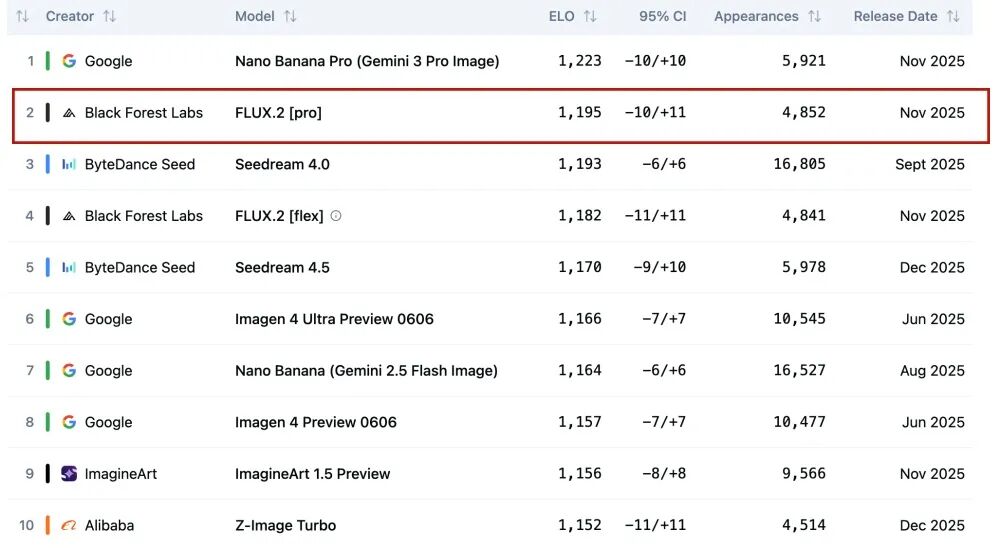
Core Insights - Black Forest Labs, a German AI startup, has gained recognition as "the DeepSeek of AI image generation," with its FLUX.2 model ranking second in the latest Artificial Analysis text-to-image leaderboard, just behind Google's Nano Banana Pro [1][2] - The company has achieved significant financial milestones, raising over $450 million since its inception and reaching a valuation of $3.25 billion within just over a year [7][22] Company Performance - FLUX.2[pro] and FLUX.2[flex] ranked second and fourth respectively in the Artificial Analysis leaderboard, showcasing strong performance against competitors [1][2] - The FLUX.2 model has been downloaded over 225,346 times on Hugging Face, indicating its popularity and acceptance in the developer community [3] Financial Growth - Black Forest Labs completed a Series B funding round, raising $300 million, which tripled its valuation to $3.25 billion [7][22] - The company has secured contracts worth approximately $300 million with major tech firms, including a $140 million deal with Meta [16][19] Strategic Partnerships - Black Forest Labs has established partnerships with industry giants such as Meta, xAI, Adobe, and Canva, enhancing its market presence and credibility [10][19] - The collaboration with Meta includes a multi-year contract with escalating payments, reflecting the company's growing influence in the AI space [16] Technological Innovation - The company is recognized for its innovative approach to AI image generation, with the FLUX.2 model supporting high-resolution outputs and multi-image references [20] - Black Forest Labs' technology is rooted in advanced research, particularly in latent diffusion models, which have been widely cited in academic literature [12][14] Market Positioning - Black Forest Labs aims to carve out a niche in the creative industries, particularly in Hollywood, by building trust and addressing concerns about AI in creative processes [25] - The company emphasizes a commitment to enhancing creators' capabilities rather than replacing existing works, positioning itself as a collaborative partner in the creative ecosystem [25]
德国一家50人AI公司,逼谷歌亮出底牌!成立一年半估值飙到230亿
创业邦· 2025-12-09 03:39
Core Insights - Black Forest Labs (BFL) has achieved a valuation of $3.25 billion after successfully raising $300 million in Series B funding, led by Salesforce Ventures and Anjney Midha [6][22] - The company has developed a new model, FLUX.2, which aims to enhance AI's ability to "think" visually, generating images with up to 4 million pixels and offering pixel-level control and multi-reference image fusion capabilities [6][24] - BFL's rapid growth story is rooted in the departure of top talent from Stability AI, who sought to regain control over their technological vision and entrepreneurial direction [9][12] Company Background - BFL was founded in 2024 in Germany by former researchers from Munich University, who were instrumental in the development of the popular open-source model Stable Diffusion [9][10] - The founding team left Stability AI due to dissatisfaction with the company's direction and financial struggles, leading to the establishment of BFL as a new venture [11][12] Product Development - BFL's first product, FLUX.1, was launched shortly after the company's formation and quickly gained recognition for its superior image generation capabilities, rivaling established models like Midjourney and DALL-E 3 [15][24] - The FLUX series is built on a unique "Flow Matching" architecture, which allows for high-quality image generation and editing, focusing on specific industry needs rather than attempting to be an all-encompassing model [24][25] Market Strategy - BFL has strategically positioned itself by integrating its technology into major platforms, such as xAI's Grok and Mistral AI's Le Chat, allowing it to reach millions of users quickly [21][34] - The company employs a dual business model, utilizing open-source versions to attract developers while monetizing through enterprise-level API services [25][26] Partnerships and Collaborations - BFL has formed significant partnerships with major tech companies, including Adobe, Canva, and Microsoft, which have integrated BFL's FLUX models into their products, expanding its reach to a vast user base [34][36] - Collaborations with hardware manufacturers like NVIDIA and Huawei have further solidified BFL's position in the market, enhancing its technological capabilities and ecosystem integration [36][40] Financial Performance - BFL's rapid ascent in valuation and funding reflects strong investor confidence in its technology and business model, contrasting with the financial struggles faced by larger competitors in the AI space [22][43] - The company has demonstrated that a smaller, agile team can achieve significant success without the need for massive capital investments typical of larger AI firms [41][43]

AI生成内容侵权,平台方要承担何种责任?——中外近期案例对比解读
3 6 Ke· 2025-11-25 12:13
Core Insights - The article discusses the evolving legal landscape surrounding the responsibilities of AI content platforms in relation to copyright infringement, highlighting the need for a balance between protecting creators' rights and encouraging AI innovation [2][10]. Group 1: AI Content Generation and Infringement - AIGC infringement refers to the use of generative AI to create content that infringes on others' intellectual property rights, with two key stages: data training (input) and content generation/distribution (output) [3]. - The legal evaluation of potential infringement risks differs between these two stages, necessitating a clear understanding of the platform's actions in each context [3]. Group 2: Case Studies on AI Platform Responsibilities - The German court case GEMA vs. OpenAI established that unauthorized use of copyrighted lyrics for AI model training constitutes direct infringement, emphasizing that if an AI model can reproduce protected content, it may be deemed as illegal copying [4][5]. - In contrast, the UK case Getty Images vs. Stability AI found that if an AI model does not store or reproduce original images, the training process may not be considered direct infringement, reflecting a more lenient stance towards AI training practices [6]. - In China, the "Medusa" case highlighted that an AI platform can avoid liability if it acts as a neutral intermediary and promptly removes infringing content upon notification, while the "Ultraman" case demonstrated that platforms can be held liable for facilitating infringement if they knowingly allow infringing models to persist [8][9]. Group 3: Future Responsibilities and Challenges for AI Platforms - AI platforms are expected to enhance compliance measures in both input and output stages, ensuring that training data is legally sourced and that content review mechanisms are robust to prevent infringement [11]. - The article suggests that the legal challenges posed by AI-generated content present an opportunity for legal and technological advancement, emphasizing the need for ongoing adaptation to evolving legal standards [11][10].
从理念到执行:用战略企业架构实现 AI 价值创造
3 6 Ke· 2025-11-21 05:42
Core Insights - The article emphasizes that for AI to drive business success, it must be deeply integrated into the organization's mission, talent, processes, and architecture [2][3] - Despite 98% of companies exploring AI, only 4% have seen significant returns on their investments, highlighting a gap between AI hype and actual business value [2][3] Strategic Enterprise Architecture (SEA) - AI projects must align with the Strategic Enterprise Architecture (SEA) to create lasting value, which includes the organization’s mission, strategy, processes, and operational models [7][10] - SEA provides a common language and vision for the organization, facilitating coherent thinking and planning across departments [7][5] Key Components of Business Architecture - Understanding the four interrelated elements of the existing enterprise is crucial for leaders to identify valuable AI projects [9] - **Organizational Purpose and Business Strategy**: AI projects that advance core goals receive stronger support and create greater value [10] - **People and Culture**: Successful AI strategies require the right talent and alignment with organizational values [11] - **Processes and Operational Structure**: The feasibility of AI implementation depends on existing workflows and governance models [12] - **Existing Technology Architecture**: New AI technologies must integrate with current systems and data assets to unlock their potential [13] Misalignment and Alignment - Any inconsistency between technology choices and SEA can lead to AI project failures [17] - Case studies illustrate the consequences of misalignment, such as Stability AI's high operational costs without a scalable business model [18], Samsung's data leak due to poor governance [19], and Sports Illustrated's brand damage from opaque AI usage [20] - Conversely, proper alignment can yield value, as seen with Adobe's use of proprietary images to mitigate legal risks [21] and Bloomberg's tailored AI model enhancing client value [22] AI Alignment Checklist - Organizations should only pursue AI projects that can directly advance strategic priorities and deliver measurable outcomes [23] - Leadership readiness and employee capability must be assessed before advancing AI initiatives [24] - AI projects should seamlessly integrate with existing processes and operational models [25] - Chosen technologies must be compatible with the organization's technology ecosystem and security requirements [26] From Projects to Portfolios - As organizations develop AI project pipelines, long-term alignment between technology and enterprise architecture becomes increasingly complex and important [27] - Portfolio management principles can help systematically evaluate and prioritize multiple AI projects within the evolving SEA framework [27] Conclusion - The fundamental principles for successful AI implementation remain unchanged despite rapid advancements in the field [28] - Leaders who align AI projects with their organization's SEA will outperform those who focus solely on the technology itself [28]

Major Music Labels Strike Deals With New AI Streaming Service
Insurance Journal· 2025-11-20 13:52
Core Insights - The world's largest music companies have licensed their works to Klay, a music startup developing an AI-driven streaming service that allows users to remake songs [1][2] - Klay is the first music AI service to secure agreements with all three major record labels: Universal Music Group, Sony Music, and Warner Music Group [2] - Klay's platform will combine streaming service features with AI technology, enabling users to recreate songs in various styles [3] Company Positioning - Klay positions itself as an ally to the music industry, ensuring that artists and labels maintain control over the usage of their works [4] - The leadership team includes music producer Ary Attie and former executives from Sony Music and Google's DeepMind [4] Industry Context - The music industry is currently navigating challenges with AI companies, having previously filed lawsuits against firms like Suno Inc. and Udio for copyright infringement [5] - Major music services, including Spotify and YouTube, are also developing AI tools, indicating a broader industry trend towards embracing AI technology while managing copyright concerns [6] Recent Developments - The record industry is actively engaging in deal-making related to AI, with Universal Music and Warner Music settling lawsuits against Udio and licensing their works for upcoming products [7] - Stability AI has also entered into agreements with major labels, while Suno, valued at $2.4 billion, remains without a deal with any major label [7]


Warner Music and AI startup Udio settle copyright battle and ink license deal
Yahoo Finance· 2025-11-20 12:56
Core Insights - Warner Music Group has resolved its copyright dispute with Udio and signed a deal to collaborate on an AI music creation service that will enable users to remix songs by established artists [1][3] - The agreement highlights the transformative impact of AI on the music industry, with a surge in AI-generated music and virtual artists gaining popularity on streaming platforms [2] - The partnership aims to create new revenue streams for artists and songwriters while ensuring their intellectual property is protected [4] Company Developments - Warner Music Group represents high-profile artists such as Ed Sheeran and Dua Lipa and has established a framework for Udio's licensed AI music service, set to launch in 2026 [3] - Udio will operate as a "closed-system" and will credit and compensate artists and songwriters whose works are used in remixes or new creations [5] - Warner Music has also announced a collaboration with Stability AI to develop professional-grade tools for musicians, songwriters, and producers [6] Industry Trends - The rise of AI music generators is reshaping the music landscape, allowing users without musical knowledge to create new tunes based on simple prompts [2] - Major record labels, including Universal Music Group, have begun to engage with AI technologies, although Sony Music Entertainment has yet to sign a licensing deal with Udio or Suno [6]
WARNER MUSIC GROUP AND STABILITY AI JOIN FORCES TO BUILD THE NEXT GENERATION OF RESPONSIBLE AI TOOLS FOR MUSIC CREATION
Prnewswire· 2025-11-19 16:00
Core Insights - Warner Music Group (WMG) and Stability AI are collaborating to develop responsible AI tools for music creation, focusing on ethical practices and protecting creators' rights [1][2] - The initiative aims to enhance the creative process for artists, songwriters, and producers by providing professional-grade tools that utilize ethically trained models [1][2] - Stability AI is recognized as a leader in commercially safe generative audio, with its Stable Audio models specifically designed for high-quality music generation [2][4] Company Overview - Warner Music Group operates in over 70 countries and includes a diverse range of renowned labels and a music publishing arm with over one million copyrights [3] - Stability AI is positioned as a creative partner for media generation and editing, having gained recognition for its contributions to the generative AI field, including the release of Stable Diffusion [4][5]

Leonis AI 100:2025 年最具影响力AI初创企业基准报告|Jinqiu Select
锦秋集· 2025-11-08 05:40
Core Insights - The report "Leonis AI 100" outlines the structural trends in AI startups from 2022 to 2025, highlighting the shift towards researcher-founders and the importance of technology over traditional business backgrounds [2][4][20] - AI startups are redefining traditional entrepreneurial models, focusing on computational power and data rather than human resources, with a significant increase in revenue generation expected in 2024 [5][30][35] Group 1: Founder Characteristics - The rise of researcher-founders is evident, with 82% of the AI 100 companies led by technical CEOs, and 86% of founders possessing technical backgrounds [10][11] - The average age of top AI founders is younger, with a median age of 29, compared to 34 in the SaaS era, indicating a shift towards younger, technically proficient entrepreneurs [28] - The educational background of founders is predominantly in technical fields, with over 60% holding degrees from elite institutions, emphasizing the importance of technical expertise in AI [25][26] Group 2: Revenue Growth and Business Model - 2024 is projected to be a turning point for revenue growth in AI startups, with many achieving significant annual recurring revenue (ARR) milestones in record time [34][35] - AI products are expected to provide higher value than traditional software, leading to quicker customer adoption and willingness to pay [35][37] - Despite rapid revenue growth, many AI startups face challenges with low or negative gross margins, highlighting the need for sustainable business models [35][36] Group 3: Team Structure and Efficiency - AI startups are characterized by smaller, more efficient teams, achieving revenue per employee ratios that are 3-10 times higher than traditional SaaS companies [39][41] - The organizational structure of AI companies is flatter, with fewer management layers, allowing for quicker decision-making and product development [42][49] - The use of AI tools within teams enhances productivity, enabling companies to maintain low headcounts while maximizing output [38][41] Group 4: Market Dynamics and Competition - The AI landscape is marked by a "many winners" scenario, where multiple companies can thrive simultaneously in the same market segment, contrasting with previous tech waves dominated by single platforms [58][62] - The emergence of diverse AI applications across various sectors, such as programming, content creation, and healthcare, indicates a broadening of market opportunities [63][64] - The competitive environment is evolving, with companies needing to adapt quickly to technological advancements and market demands to maintain their positions [66][67] Group 5: Transformation and Adaptability - Many AI startups undergo significant pivots within their first year, often redefining their core products in response to emerging technologies [67][68] - The ability to quickly adapt to new model capabilities is crucial for success, with many founders leveraging their technical backgrounds to identify and capitalize on opportunities [71][72] - The flexibility of AI teams allows for rapid shifts in focus, enabling companies to respond to market changes and technological advancements effectively [74][75] Group 6: Market Timing and Execution - The timing of market entry is critical, with successful companies entering the market just before key technological thresholds are crossed [76][79] - Understanding the sequence of market explosions in AI applications is essential for founders and investors to capitalize on emerging opportunities [79][80]