
Toast

Search documents
Toast(TOST) - 2025 Q4 - Earnings Call Transcript
2026-02-12 23:02
Financial Data and Key Metrics Changes - Recurring gross profits increased by 33% in 2025, with adjusted EBITDA margins expanding to 34% [5][26] - Annual recurring revenue (ARR) grew by 26%, reaching over $2 billion, with payment volume hitting $195 billion [26] - GAAP operating income rose to $292 million from $16 million a year ago, driven by strong adjusted EBITDA and effective management of stock-based compensation [27][30] Business Line Data and Key Metrics Changes - SaaS ARR and subscription revenue each grew by 28% year-over-year, with SaaS ARPU in the core growing even faster than total SaaS ARPU [29] - Subscription gross profit increased by 33%, with SaaS gross margin expanding by 300 basis points year-over-year to 80% in Q4 [30] - Payments ARR grew by 24%, while fintech gross profit increased by 25% in Q4 [30] Market Data and Key Metrics Changes - The company added a record 30,000 net locations in 2025, ending the year with 164,000 locations [26] - The net retention rate remained healthy at 109% in 2025, supported by upsell and location expansion from existing customers [30] - The company powers 20% of SMB and mid-market restaurants in the U.S., nearly doubling over the past three years [8] Company Strategy and Development Direction - The company aims to double market share in its core U.S. SMB and mid-market restaurants, while also expanding into new markets [8][12] - Investments will focus on product differentiation, particularly in AI and customer support, to enhance operational efficiency [10][21] - The company plans to launch new products, including a drive-thru solution, to capture additional market segments [14][73] Management's Comments on Operating Environment and Future Outlook - Management expressed confidence in sustaining high growth for the next 5-10 years, driven by strong customer signals and market opportunities [38] - The company anticipates a 20%-22% growth in recurring gross profit streams for 2026, with adjusted EBITDA expected to be between $775 million and $795 million [36] - Management highlighted the importance of disciplined capital allocation while investing in high-priority initiatives [24][35] Other Important Information - The company has repurchased approximately 8 million shares for $235 million since the inception of its buyback authorization in 2024 [35] - The company is experiencing cost pressures from higher memory chip costs, which are expected to impact margins in the second half of 2026 [36][37] Q&A Session Summary Question: SaaS ARR per location and enterprise metrics - Management confirmed confidence in mid-single-digit SaaS ARPU growth for 2026, with core SaaS ARPU growing faster than total company metrics [41][44] - Enterprise sales cycles are different, and management evaluates them on a deal-by-deal basis, focusing on total ARR [44] Question: Net adds and new verticals - Management indicated that net add growth in 2026 is expected to be higher than in 2025, with a similar pattern of growth from core and new towns [48][50] Question: AI disruption and competitive landscape - Management views AI as an opportunity to enhance the platform rather than a threat, emphasizing the unique value Toast provides through its integrated solutions [51][56] Question: R&D investment and margin framework - Management confirmed that the margin framework allows for increased R&D investment to capitalize on AI opportunities while targeting long-term margins of 40% [60][62] Question: Drive-through product rollout - The company plans to launch a drive-through product this year, which will significantly expand its market reach [73][74]

Toast(TOST) - 2025 Q4 - Earnings Call Transcript
2026-02-12 23:02
Financial Data and Key Metrics Changes - Recurring gross profits increased by 33% in 2025, with adjusted EBITDA margins expanding to 34% [5][26] - Annual recurring revenue (ARR) grew by 26%, reaching over $2 billion, while payment volume hit $195 billion [26] - GAAP operating income rose to $292 million from $16 million a year ago, driven by strong adjusted EBITDA and tight management of stock-based compensation [27][30] Business Line Data and Key Metrics Changes - SaaS ARR and subscription revenue each grew by 28% year-over-year, with SaaS ARPU in the core growing even faster than total SaaS ARPU [29] - Subscription gross profit increased by 33%, with SaaS gross margin expanding by 300 basis points year-over-year to 80% in Q4 [30] - Payments ARR grew by 24%, and fintech gross profit increased by 25% in Q4 [30] Market Data and Key Metrics Changes - The company added a record 30,000 net locations in 2025, ending the year with 164,000 locations [26] - The SaaS net retention rate remained healthy at 109% in 2025, supported by upsell and location expansion from existing customers [30] - The company continues to gain market share in its core U.S. SMB and mid-market restaurants, now powering 20% of these restaurants [8][9] Company Strategy and Development Direction - The company aims to double its market share and ARR over time, with a focus on growing market share in its core and demonstrating that new markets will be material growth drivers [8][12] - Investments in product differentiation and AI are prioritized to enhance customer adoption and drive differentiation [18][21] - The company plans to launch new products, including a drive-thru solution, to capture additional market segments [72] Management's Comments on Operating Environment and Future Outlook - Management expressed confidence in sustaining high growth for the next 5-10 years, with a focus on reinvesting in growth initiatives [38] - The company anticipates 20%-22% growth in recurring gross profit streams and adjusted EBITDA of $775 million-$795 million for 2026 [36] - Management highlighted the importance of disciplined capital allocation while expanding margins over time [24][35] Other Important Information - The company has repurchased approximately 8 million shares for $235 million since the inception of its buyback authorization in 2024 [35] - The company is experiencing cost pressures from higher memory chip costs, which are expected to impact margins in the second half of 2026 [36][37] Q&A Session Summary Question: SaaS ARR per location and enterprise metrics - Management confirmed confidence in mid-single-digit SaaS ARPU growth for 2026, with core SaaS ARPU growing faster than total company metrics [41][43] Question: Net adds and new verticals contribution - Management indicated that net add growth in 2026 is expected to be higher than in 2025, with new TAMs contributing significantly to this growth [47][49] Question: AI disruption and competitive landscape - Management views AI as an opportunity to enhance the platform and drive innovation rather than a threat, emphasizing the unique value Toast provides [50][54] Question: R&D investment and margin framework - Management confirmed that the margin framework allows for increased R&D investment to capitalize on AI opportunities while targeting long-term margin goals [58][62] Question: Drive-through product rollout - Management stated that the upcoming drive-through product will open up new market opportunities, particularly in enterprise [72][73]
Toast(TOST) - 2025 Q4 - Earnings Call Transcript
2026-02-12 23:00
Financial Data and Key Metrics Changes - Recurring gross profits increased by 33% in 2025, with adjusted EBITDA margins expanding to 34% [5][26] - The company added over 30,000 net locations, ending the year with 164,000 locations [26] - Annual recurring revenue (ARR) grew by 26%, reaching over $2 billion, with payment volume at $195 billion [26] - Adjusted EBITDA for 2025 was $633 million, with free cash flow of $608 million [27] - GAAP operating income rose to $292 million from $16 million a year ago [27] - Total monetization, measured by recurring gross profit as a percentage of gross payment volume (GPV), hit 98 basis points, a 5 basis point increase year-over-year [28] Business Line Data and Key Metrics Changes - SaaS ARR and subscription revenue each grew by 28% year-over-year [28] - Subscription gross profit increased by 33%, with SaaS gross margin expanding by 300 basis points to 80% in Q4 [29] - Payments ARR grew by 24%, while fintech gross profit increased by 25% in Q4 [29] - Hardware and professional services gross profit was -12% of recurring gross profit streams, impacted by higher tariff costs [31] Market Data and Key Metrics Changes - The company powers 20% of SMB and mid-market restaurants in the U.S., nearly doubling over the past three years [8] - The sales productivity in the top 10 geographies continues to outperform the average, indicating room for further market share gains [9] - New markets, including international expansions, are growing faster than the core market at similar time periods [12] Company Strategy and Development Direction - The company aims to double market share in its core U.S. SMB and mid-market restaurants while expanding into new markets [7][12] - Investments in AI and product enhancements are expected to drive efficiency and customer adoption [20][24] - The company plans to launch a drive-thru product and improve support for non-native English-speaking operators in 2026 [11][17] Management's Comments on Operating Environment and Future Outlook - Management expressed confidence in sustaining high growth for the next 5-10 years, driven by new TAMs and product innovations [38] - The company anticipates a 20%-22% growth in recurring gross profit streams for 2026, with adjusted EBITDA guidance of $775 million-$795 million [36] - Management highlighted the importance of disciplined capital allocation while investing in high-conviction opportunities [24][35] Other Important Information - The company has repurchased approximately 8 million shares for $235 million since the inception of its buyback authorization in 2024 [35] - The dollar-based payback period for the portfolio remained in the mid-teen months, with expectations to improve as new towns mature [33] Q&A Session Summary Question: SaaS ARR per location and enterprise metrics - Management expressed confidence in mid-single-digit SaaS ARR growth for 2026, with core SaaS ARPU growing faster than total company metrics [41][43] Question: Net adds and new verticals contribution - The company expects a similar pattern in net adds for 2026, with incremental growth from new towns and verticals [48][50] Question: AI disruption and competitive landscape - Management views AI as an opportunity to enhance the platform rather than a threat, emphasizing the unique value Toast provides [51][56] Question: R&D investment and margin framework - The company is committed to investing in R&D to sustain long-term growth while targeting 40% margins over time [60][64] Question: Drive-through product rollout - The company plans to launch a drive-thru product this year, which will open up new market opportunities [75] Question: Overall investment strategy and guidance - Management indicated that 2026 reflects a long-term vision for growth, with a balanced approach to guiding expectations [82][84]
Toast Stock Slides On Q4 Earnings: The Details
Benzinga· 2026-02-12 22:24
Core Insights - Toast's stock is currently testing lower boundaries, hitting a new low due to market reactions following its earnings report [1] Financial Performance - Toast reported a Q4 revenue of $1.63 billion, slightly above estimates of $1.62 billion [5] - The company achieved a Q4 EPS of 16 cents, exceeding estimates of 13 cents [5] - The annualized recurring run-rate (ARR) grew by 26% to over $2 billion as of December 31, 2025 [2] - Gross Payment Volume (GPV) increased by 22% year-over-year to $51.4 billion [2] Business Growth - Total locations increased by 22% year-over-year to approximately 164,000, with an addition of 30,000 locations in 2025 [2] - The CEO of Toast, Aman Narang, highlighted momentum across the business, including scaling the core restaurant business and accelerating growth in new markets [3] Future Expectations - For the first quarter, Toast expects gross profit from subscription services and financial technology solutions to be in the range of $505 million to $515 million, representing growth of 22% to 24% [4] - Adjusted EBITDA for the first quarter is anticipated to be between $160 million and $170 million [4] Share Repurchase Program - Toast's board has authorized an increase of $500 million to the company's previously authorized share repurchase program [3] Market Reaction - Following the earnings report, Toast shares fell by 8.11% in after-hours trading, reaching $24.02 [5]


Toast(TOST) - 2025 Q4 - Annual Results
2026-02-12 21:12
Financial Performance - Annualized recurring run-rate (ARR) increased 26% year over year to over $2.0 billion as of December 31, 2025[6] - Fourth quarter net income was $101 million, compared to $33 million in Q4 2024, and Adjusted EBITDA was $163 million, up from $111 million in Q4 2024[6] - For the full year 2025, GAAP net income was $342 million, compared to $19 million in 2024[6] - Net income for the year ended December 31, 2025, was $342 million, significantly higher than $19 million in 2024, marking a year-over-year increase of 1694.7%[23] - Cash flows from operating activities for the year ended December 31, 2025, were $661 million, compared to $360 million in 2024, reflecting an increase of 83.6%[23] - Adjusted EBITDA for Q4 2025 was $163 million, compared to $111 million in Q4 2024, with total Adjusted EBITDA for the year at $633 million, up from $373 million in 2024[34] - Total Annualized Recurring Run-Rate (ARR) reached $2,047 million in 2025, a 26% increase from $1,626 million in 2024[34] Revenue and Profitability - GAAP subscription services and financial technology solutions gross profit was up 29% year over year to $487 million[6] - Subscription services gross profit for Q4 2025 was $189 million, up from $140 million in Q4 2024, with total gross profit for the year at $672 million, compared to $487 million in 2024[37] - Financial technology solutions gross profit for Q4 2025 was $298 million, an increase from $238 million in Q4 2024, with total gross profit for the year at $1,146 million, up from $878 million[38] Growth Metrics - Total locations increased 22% year over year to approximately 164,000[6] - Gross Payment Volume (GPV) increased 22% year over year to $51.4 billion in Q4 2025[6] - Payments Annualized Recurring Run-Rate (ARR) increased to $986 million in 2025, representing a 24% growth from $794 million in 2024, while Subscription ARR grew by 28% to $1,061 million from $832 million[34] - Gross Payment Volume (GPV) for Q4 2025 reached $51.4 billion, a 22% increase from $42.2 billion in Q4 2024, with total GPV for the year at $195.1 billion, up 23% from $159.1 billion in 2024[34] Assets and Equity - Total assets increased to $3,145 million in 2025, up from $2,408 million in 2024, representing a growth of 30.6%[21] - Total stockholders' equity rose to $2,124 million in 2025, up from $1,545 million in 2024, indicating a growth of 37.4%[21] - Cash and cash equivalents at the end of the period were $1,353 million in 2025, compared to $903 million in 2024, an increase of 49.8%[23] - The total cash, cash equivalents, cash held on behalf of customers, and restricted cash at the end of the period was $1,583 million in 2025, compared to $1,085 million in 2024, an increase of 46%[23] - The company’s accumulated deficit decreased to $(1,262) million in 2025 from $(1,604) million in 2024, showing an improvement of 21.4%[21] Expenses and Liabilities - The company reported a total current liabilities of $969 million in 2025, up from $811 million in 2024, which is an increase of 19.5%[21] - The company’s capital expenditures for the year ended December 31, 2025, were $53 million, slightly down from $54 million in 2024[23] - Research and development expenses for Q4 2025 were $97 million, slightly up from $93 million in Q4 2024, with total expenses for the year at $374 million, compared to $351 million in 2024[41] - General and administrative expenses for Q4 2025 were $84 million, compared to $78 million in Q4 2024, with total expenses for the year at $344 million, up from $307 million[42] Strategic Initiatives - Toast's Board of Directors authorized a $500 million increase to the share repurchase program[1] - Toast signed an agreement with MTY Food Group to roll out Toast across more than 1,000 Papa Murphy's US locations, expanding its existing relationship with MTY[12] Cash Flow - Free cash flow for Q4 2025 was $178 million, compared to $134 million in Q4 2024, with total free cash flow for the year at $608 million, up from $306 million[42] - Non-GAAP costs of revenue for Q4 2025 were $1,188 million, compared to $984 million in Q4 2024, with total costs for the year at $4,463 million, up from $3,689 million[36] - Non-GAAP subscription services and financial technology solutions gross profit is expected to be in the range of $505 million to $515 million for Q1 2026, representing 22-24% growth compared to Q1 2025[11]
Toast Is Not A Horse: Why This SaaS Stock Could Outrun The AI Panic
Seeking Alpha· 2026-02-12 16:16
Core Insights - Warren Buffett emphasizes the difficulty in identifying potential winners in emerging industries, suggesting that it is easier to recognize the losers [1] Group 1 - The statement reflects a broader investment philosophy that highlights the unpredictability of new markets and the challenges investors face in making informed decisions [1]

Toast Nears Q4 Earnings Release: Here's What Investors Need to Know
ZACKS· 2026-02-09 14:45
Core Insights - Toast Inc. (TOST) is expected to report fourth-quarter 2025 earnings on February 12, with revenue estimated at $1.62 billion, reflecting a 21% increase year-over-year, and non-GAAP earnings per share projected at 24 cents, indicating a 380% year-over-year growth [1][2] Financial Performance - TOST has beaten the Zacks Consensus Estimate in two of the last four quarters, lagged in one, and matched in another, with an average surprise of -1.81%. The stock has decreased by 33.1% over the past year, compared to a 19.1% decline in the Zacks Internet-Software industry [2] - The fourth-quarter non-GAAP gross profit from subscription services and financial technology solutions is expected to be between $480 million and $490 million, representing a 22-25% year-over-year growth. Adjusted EBITDA is projected to be between $140 million and $150 million [4] Market Dynamics - Toast's fourth-quarter performance is anticipated to be influenced by record highs in Annual Recurring Revenue (ARR), strong revenue momentum, and increased adoption of AI-driven products. The company's ability to expand its total addressable market and leverage AI innovation is expected to enhance its long-term prospects [3][9] - A multi-year global partnership with Uber aims to enhance product innovation and market initiatives for restaurant growth, starting in the U.S. and Canada. This partnership will integrate Toast's POS platform with Uber's delivery network, improving digital ordering and guest experiences [5][8] Customer Growth - Toast added approximately 7,500 net new locations in the third quarter, bringing the total to 156,000 globally, a 23% year-over-year increase. This growth spans across small and medium-sized businesses (SMBs) as well as multi-location and enterprise customers, with ongoing international expansion [6][9] Strategic Initiatives - The company is positioning itself as a comprehensive operating system for restaurants, not just a point-of-sale provider. Recent product launches like Toast IQ and Toast Advertising are part of this strategy, aimed at optimizing operations and creating new revenue streams [9] - Management has indicated near-term challenges, including higher tariff costs and the need to manage payback periods while expanding into new markets. The company has also absorbed $31 million in bad debt and credit-related expenses [10]

软件没有死,但“通用软件”已死
3 6 Ke· 2026-02-09 01:58
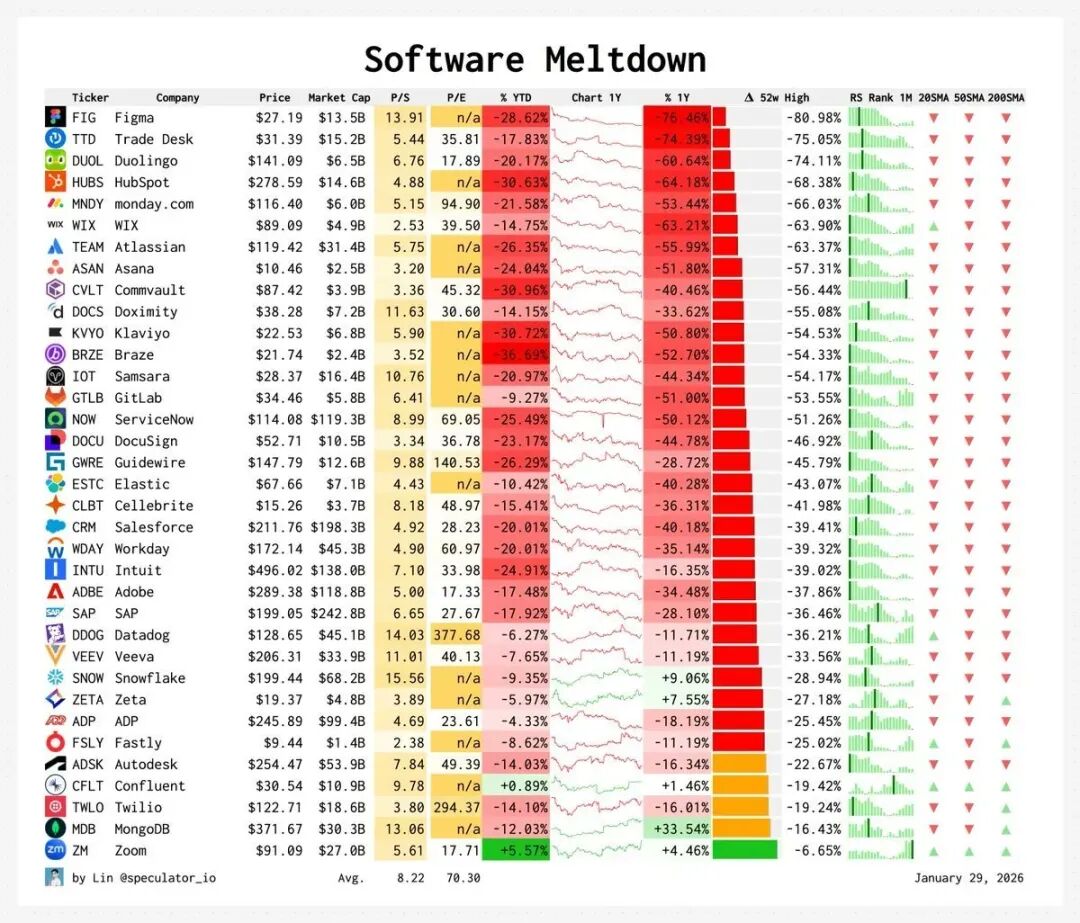
Core Insights - The software sector is experiencing a significant downturn, characterized by a broad sell-off rather than a tactical adjustment, indicating a potential capitulation phase across various software companies [1][4] - The current market sentiment reflects a loss of confidence in the business models of software companies, leading investors to simplify their holdings and view software stocks as a single trading entity rather than a diverse collection of business models [5] Market Performance - A detailed analysis of several software companies reveals substantial declines in stock prices, with many experiencing over 60% drops from their recent highs, indicating severe market distress [2] - Companies like Figma, Trade Desk, and Duolingo have seen year-to-date declines of 80.98%, 75.05%, and 60.64% respectively, highlighting the widespread impact of the downturn [2] Industry Dynamics - The competitive boundaries within the software industry are shifting, with companies like Robinhood expanding their service offerings beyond traditional brokerage functions to include comprehensive financial services [6][8] - The integration of software with financial and professional services is blurring traditional lines, prompting investors to focus on where disruptions may occur and their potential impact on existing profit pools [8] Disruption Framework - A framework for assessing software companies' vulnerability to disruption has been proposed, focusing on five key dimensions: record systems vs. surface tools, seat-based pricing vs. data-based economics, timeless data vs. ephemeral information, deep workflows vs. shallow automation, and durable structural advantages vs. shallow ones [47] - This framework encourages a nuanced understanding of software companies, moving beyond the assumption that all software stocks are equally at risk to a more detailed analysis of their underlying value structures [43][58] Strategic Considerations - Companies with core systems that are deeply embedded in client operations face higher switching costs and risks, while those that are merely supplementary tools may be more easily replaced [45] - The pricing model of a software company can indicate its resilience; those tied to human labor are at greater risk of being undermined by AI advancements, while those linked to long-term data or critical processes may be more secure [24][29] - The longevity of data value is crucial; companies that generate data with a long half-life are better positioned against disruption compared to those with rapidly depreciating data [30][31] Conclusion - The current sell-off in the software sector is not irrational but reflects a rational reassessment of the risks posed by AI and changing market dynamics [47][56] - Understanding the structural vulnerabilities and strengths of software companies is essential for investors navigating this turbulent landscape, as some companies are inherently more resilient than others due to their foundational business models and data assets [58][59]


This Restaurant-Focused Fintech Has a Recurring-Revenue Machine That Is Getting Hard to Ignore
The Motley Fool· 2026-02-04 04:45
Core Insights - Toast is a fintech company that has established a strong recurring revenue model, particularly in the restaurant sector, which is often overlooked by long-term investors [1][2] - The company’s Annualized Recurring Revenue (ARR) has grown approximately 30% year-over-year, surpassing $1.9 billion in mid-2025 and expected to exceed $2 billion by Q3 2025 [3] - Toast has achieved GAAP profitability for the first time in full-year 2024, reporting a net income of $19 million and Adjusted EBITDA of $373 million [5][6] Revenue Model - Toast's platform includes essential services for small business owners, such as point-of-sale software, payment processing, payroll, and analytics, which contribute to its recurring revenue [3][4] - The company has a significant market opportunity, with a total addressable market of approximately 1.4 million potential locations, while currently servicing around 156,000 restaurant locations [8] Growth and Expansion - Toast's new offerings, such as Toast IQ and Toast Advertising, are designed to enhance customer engagement and increase revenue per customer over time, indicating a strategy of expansion revenue [9] - The company is positioned as a subscription-first fintech with real earnings and improving margins, suggesting a long runway for growth and market share acquisition [10] Market Position and Strategy - Toast's business model is less dependent on restaurant sales volume, as its revenue is derived from software and payment fees, providing a more stable cash flow even during economic downturns [11] - The company is viewed as a long-term compounder, with a focus on deepening monetization rather than merely increasing the number of locations [12] Investment Considerations - Investors are advised to consider average entry points during market volatility, as restaurant spending is cyclical and sensitive to macroeconomic conditions [12] - Monitoring Toast's progress in enterprise and international expansion could be crucial for long-term valuation growth [12]

U.S. fintech could gain as Trump pushes affordability agenda, Citi says
Yahoo Finance· 2026-01-22 15:02
Core Viewpoint - U.S. fintech stocks are expected to gain an advantage as the government adopts a more populist, affordability-driven agenda ahead of the November 2026 midterm elections, potentially benefiting fintech challengers over traditional lenders [1]. Group 1: Fintech Companies Positioned for Growth - Companies associated with consumer-friendly credit and small-business services, such as buy-now, pay-later providers Affirm and Klarna, as well as fintech firms SoFi and Block, are well-positioned to benefit from the current market dynamics [2]. - Other potential winners identified include restaurant technology platform Toast and e-commerce firm Shopify, which may also capitalize on the affordability trend [2]. Group 2: Market Reactions and Performance - Traditional lenders experienced a rally following Trump's return to the White House in 2025, driven by expectations of a lighter regulatory environment; however, the focus on affordability may shift investor attention towards fintech challengers [3]. - In 2025, SoFi's stock increased by approximately 70%, while Affirm's rose by over 22%. In contrast, Block's stock fell by more than 23%, underperforming both its fintech peers and the broader market, which saw the Nasdaq Composite rise by about 20.4% during the same period [3]. Group 3: Political Influence on the Financial Sector - The rise of populism, linked to the affordability focus as midterms approach, suggests that companies offering lower-cost, user-friendly lending tools or services aimed at small businesses could see significant gains [4]. - Recent actions by the U.S. president, including a call for a one-year cap on credit card interest rates at 10%, indicate a pushback from the banking industry and reinforce the affordability agenda that could favor smaller fintechs [4][5]. - An executive order signed by the president aims to restrict large institutional investors from competing with individual homebuyers, further supporting the affordability-focused agenda that may benefit smaller fintech companies [5].