ICICI Bank

Search documents
2026 年印度股票策略展望 - 股市 2026 年有望强劲表现-2026 India Equity Strategy Outlook-Stocks Look Set for Strong 2026
2025-11-18 09:41
Summary of the 2026 India Equity Strategy Outlook Industry Overview - The report focuses on the Indian equity market, highlighting a strong recovery expected in 2026 after a significant underperformance over the past three decades [2][3]. Key Points and Arguments Market Recovery Expectations - Indian equities are anticipated to bounce back strongly in the next 12 months due to supportive policy changes and a recovery in nominal growth, which should enhance earnings growth [3][4]. - The BSE Sensex is projected to have a 13% upside through December 2026, with a target of 95,000, assuming continued macro stability, fiscal consolidation, and increased private investment [4][53]. Economic Projections - GDP growth is expected to be 6.8% for F2026, with a gradual decline to 6.5% in the following years [8]. - Sensex earnings are projected to compound at a 17% CAGR through F2028, with EPS growth of 7.0% in F2026 and increasing to 19.5% by F2028 [4][8][54]. Risks and Concerns - The primary risk identified is a potential slowdown in global growth, which could hinder the upside for Indian stocks despite their low beta [5]. - Concerns regarding the expanding issuance pipeline and poor trailing equity returns are deemed misplaced, as domestic flows remain strong [5][34]. Portfolio Strategy - The recommended strategy favors domestic cyclicals over defensives and external-facing sectors, with an overweight position in Financials, Consumer Discretionary, and Industrials, while underweighting Energy, Materials, Utilities, and Healthcare [6][57]. Structural Changes and Long-term Outlook - India's long-term growth story is reinforced by various reforms, including fiscal consolidation and a shift towards equity ownership among households [3][28]. - The report emphasizes a structural rise in discretionary consumption and improvements in macro stability, which are expected to lower real rates and enhance equity valuations [28][44]. Key Catalysts for Growth - The report identifies several catalysts for growth, including: - A positive growth surprise anticipated in the coming months due to policy shifts and reforms [27]. - The potential for a trade deal between India and the US, which could further boost market sentiment [43]. - The upcoming AI Impact Summit in 2026, which may enhance India's position in the global AI landscape [39][43]. Conclusion - The report concludes that the Indian equity market is poised for a significant turnaround in 2026, driven by macroeconomic stability, policy reforms, and a favorable domestic investment environment [25][44]. Additional Important Insights - The report highlights the importance of demographic advantages and a functioning democracy in supporting long-term growth [48]. - It also notes the potential for a consumption revolution in India, which could attract global investors [48]. This comprehensive outlook provides a detailed analysis of the Indian equity market's potential recovery and the factors influencing its trajectory in 2026.
Mcap of eight of top-10 valued firms jumps Rs 2.05 lakh crore; Bharti Airtel, RIL major winners
The Economic Times· 2025-11-16 06:48
Market Performance - The BSE Sensex increased by 1,346.5 points, or 1.62 percent, while the NSE Nifty rose by 417.75 points, or 1.64 percent, indicating a strong market rebound after a recent phase of weakness [1][5]. Company Market Capitalization - Reliance Industries Ltd's market capitalization surged by Rs 54,941.84 crore, reaching Rs 20,55,379.61 crore, maintaining its position as the most valued company [2][5]. - Bharti Airtel's market capitalization increased by Rs 55,652.54 crore to Rs 11,96,700.84 crore, making it one of the biggest gainers [5]. - Tata Consultancy Services saw its market cap rise by Rs 40,757.75 crore to Rs 11,23,416.17 crore [5]. - ICICI Bank's market valuation climbed by Rs 20,834.35 crore to Rs 9,80,374.43 crore [5]. - State Bank of India's market capitalization rallied by Rs 10,522.9 crore to Rs 8,92,923.79 crore [5]. - Infosys advanced by Rs 10,448.32 crore to Rs 6,24,198.80 crore [5]. - HDFC Bank's market cap increased by Rs 9,149.13 crore to Rs 15,20,524.34 crore [5]. - Hindustan Unilever's market valuation rose by Rs 2,878.25 crore to Rs 5,70,187.06 crore [5]. - Conversely, Bajaj Finance's market cap declined by Rs 30,147.94 crore to Rs 6,33,573.38 crore, and Life Insurance Corporation of India's valuation fell by Rs 9,266.12 crore to Rs 5,75,100.42 crore [5]. Top Valued Companies - The combined market valuation of the top 10 most valued companies surged by Rs 2,05,185.08 crore last week, with Reliance Industries and Bharti Airtel being the largest contributors [5].


Mcap: 8 of top-10 valued firms jump ₹2.05 lakh crore; Bharti Airtel, RIL major winners
BusinessLine· 2025-11-16 05:46
Market Valuation Overview - The combined market valuation of eight of the top 10 most valued companies increased by ₹2,05,185.08 crore last week, with Bharti Airtel and Reliance Industries being the largest gainers [1] - Reliance Industries retained its position as the most valued company, followed by HDFC Bank, Bharti Airtel, Tata Consultancy Services, ICICI Bank, State Bank of India, Bajaj Finance, Infosys, Life Insurance Corporation of India, and Hindustan Unilever [1] Individual Company Performance - Bharti Airtel's market capitalisation surged by ₹55,652.54 crore to ₹11,96,700.84 crore [2] - Reliance Industries Ltd's market valuation increased by ₹54,941.84 crore to ₹20,55,379.61 crore [2] - Tata Consultancy Services saw its market capitalisation rise by ₹40,757.75 crore to ₹11,23,416.17 crore [2] - ICICI Bank's market valuation climbed by ₹20,834.35 crore to ₹9,80,374.43 crore [2] - State Bank of India's market valuation rallied by ₹10,522.9 crore to ₹8,92,923.79 crore [2] - Infosys advanced by ₹10,448.32 crore to ₹6,24,198.80 crore [2] Declines in Market Valuation - Bajaj Finance experienced a decline in market capitalisation by ₹30,147.94 crore to ₹6,33,573.38 crore [4] - Life Insurance Corporation of India's market valuation decreased by ₹9,266.12 crore to ₹5,75,100.42 crore [4] Market Index Performance - The BSE Sensex appreciated by 1,346.5 points, or 1.62 percent, while the NSE Nifty rose by 417.75 points, or 1.64 percent [4] - The markets showed a strong rebound during the week, ending positively after a recent phase of weakness [4]
Post Office schemes beating FD returns: These small savings schemes offer 7% and higher interest rates on deposits
The Economic Times· 2025-11-15 07:20
SBI to discontinue mCASH service after November 30, 2025: Here’s how customers can send money to third-party beneficiaries after thatWhich Post Office small savings schemes offer higher interest rates than FDs of many leading banks?Post Office small savings schemes are offering better returns than many leading banks’ fixed deposit schemes. Post office scheme interest rates are revised every quarter by the government. At present, below-mentioned post office schemes are offering 7% and above interest rates.In ...

Sensex, Nifty settle with modest gains
Rediff· 2025-11-14 11:32
Equity benchmark indices Sensex and Nifty reversed early losses to end modestly higher on Friday as investors turned to buying blue-chip stocks at beaten down prices.Illustration: Uttam GhoshThe 30-share BSE Sensex benchmark began the trade on a negative note by declining 449.35 points, or 0.53 per cent to 84,029.32.The NSE Nifty started the day off lower by 138.35 points or 0.53 per cent to 25,740.80.However, both the benchmark indices showed some recovery at the fag end before closing the session with gai ...

Stock markets end with marginal gains in volatile trade
Rediff· 2025-11-13 11:49
Market Performance - The benchmark indices Sensex and Nifty ended on a flat note after a three-day rally, with Sensex gaining 12.16 points (0.01%) to close at 84,478.67 and Nifty rising 3.35 points (0.01%) to finish at 25,879.15 [1][3][4] - During the trading session, Sensex reached a high of 84,919.43 and a low of 84,253.05 [3] Sector Performance - Among the gainers in the Sensex pack were Asian Paints, ICICI Bank, PowerGrid, Larsen & Toubro, Bajaj Finserv, Bharti Airtel, Sun Pharmaceuticals, Maruti Suzuki India, Axis Bank, UltraTech Cement, and HCL Technologies [4] - Conversely, laggards included Tata Motors' commercial vehicles arm, Mahindra & Mahindra, Tata Steel, Bharat Electronics Ltd, Tata Motors Passenger Vehicles, Trent, Tata Consultancy Services, Hindustan Unilever, and Infosys [5] Investor Sentiment - Investor sentiment was positively influenced by the signing of a short-term funding bill by Trump to end the US government shutdown and expectations of tariff relief for India [6] - Record-low October inflation figures bolstered expectations for an interest rate cut by the Reserve Bank of India (RBI), making rate-sensitive sectors like metals and realty attractive to investors [6] Foreign and Domestic Investment - Foreign institutional investors (FIIs) were net sellers for the third consecutive day, offloading equities worth ₹1,750.03 crore [9] - In contrast, domestic institutional investors (DIIs) continued their buying spree, purchasing stocks worth ₹5,127.12 crore [10] Global Market Context - Asian markets showed positive performance, with indices such as Shanghai's SSE Composite, Hong Kong's Hang Seng, Japan's Nikkei 225, and South Korea's Kospi ending higher [8] - Brent crude oil prices declined by 0.29% to $62.53 per barrel [8]
Has RBI directed all banks to migrate to '.bank.in' domain? PIB Fact Check team clears confusion
The Economic Times· 2025-11-13 11:30
What did the The PIB Fact Check team confirmed that this claim is true and the RBI had directed all banks to migrate their existing web domains to the new ‘.bank.in’ domain by October 31, 2025.The Central Bank issued these instructions to all banks in a circular dated April 22, 2025..As per the PIB Fact Check’s social media post on X (formerly known as Twitter), “The Indian National Internet Exchange (NIXI), operating under the Ministry of Electronics and Information Technology (MeitY), has appointed the I ...
Stock markets end with marginal gains amid volatile trade, foreign fund outflows
The Hindu· 2025-11-13 11:24
Market Overview - Stock markets experienced a three-day rally that fizzled out, with benchmark indices Sensex and Nifty ending flat amid choppy trading on November 13, 2025 [1] - The BSE Sensex closed with a slight gain of 12.16 points, or 0.01%, at 84,478.67, while the NSE Nifty rose by 3.35 points, or 0.01%, to 25,879.15 [1][2] Sector Performance - Among the gainers in the Sensex pack were Asian Paints, ICICI Bank, PowerGrid, Larsen & Toubro, Bajaj Finserv, Bharti Airtel, Sun Pharmaceuticals, Maruti Suzuki India, Axis Bank, UltraTech Cement, and HCL Technologies [2] - Conversely, laggards included Tata Motors' commercial vehicles arm, Mahindra & Mahindra, Tata Steel, Bharat Electronics Ltd, Tata Motors Passenger Vehicles, Trent, Tata Consultancy Services, Hindustan Unilever, and Infosys [3] Economic Indicators - The market sentiment was positively influenced by the signing of a short-term funding bill by Trump to end the U.S. government shutdown and hopes for tariff relief for India [4] - Record-low October inflation figures reinforced expectations of an interest rate cut by the Reserve Bank of India (RBI), making rate-sensitive sectors like metals and realty attractive to investors [5] Foreign Investment Trends - Foreign institutional investors were net sellers for the third consecutive day, offloading equities worth ₹1,750.03 crore, while domestic institutional investors purchased stocks worth ₹5,127.12 crore [7] - The previous day, the BSE Sensex had rallied by 595.19 points, closing at 84,466.51, and the NSE Nifty climbed 180.85 points to close at 25,875.80 [7]
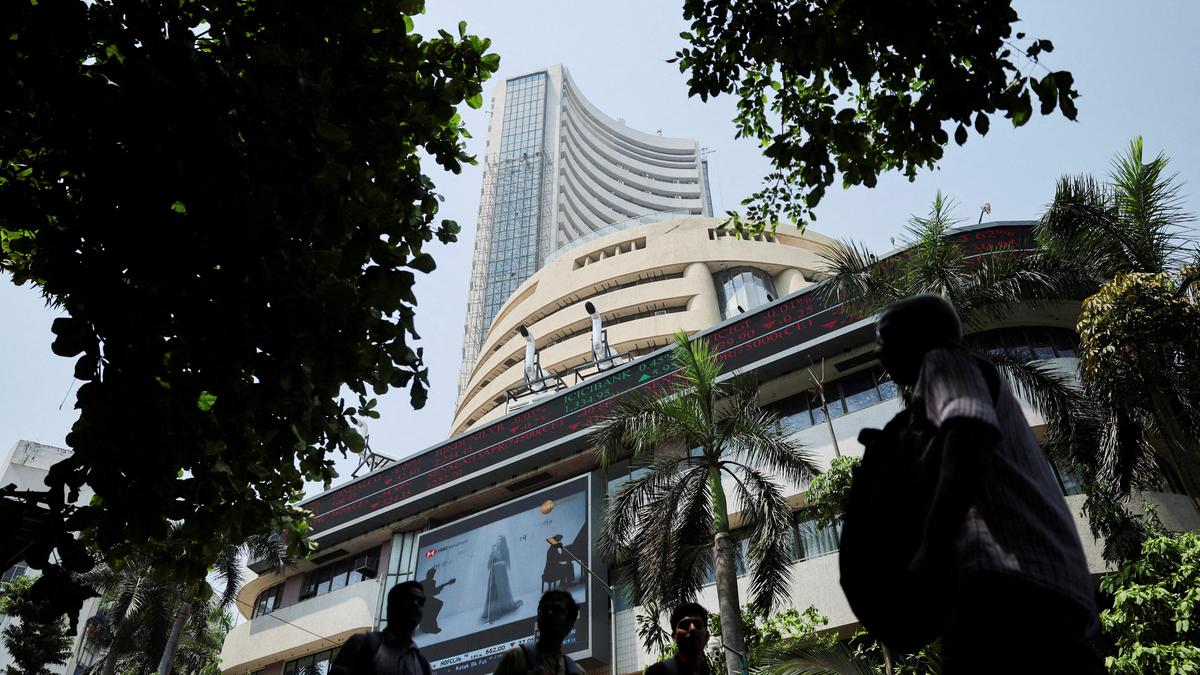
Top banks may witness re-rating, corporate loan growth likely to surprise: Gurmeet Chadha
The Economic Times· 2025-11-13 09:41
Core Insights - The reassessment of large banks in India indicates a positive outlook driven by macroeconomic tailwinds and improving financial metrics [1][7] - Analysts expect corporate loan book growth and retail loan expansion to significantly enhance the valuation outlook for top lenders [1][7] Banking Sector Performance - HDFC Bank's net interest margin (NIM) is believed to have bottomed out, with projections of a core pre-provision operating profit (PPOP) CAGR of approximately 19% from FY26 to FY28, compared to 9% for FY26 alone [4][8] - Morgan Stanley maintains an 'Overweight' rating on ICICI Bank with a target price of Rs 1,800, citing strong deposit growth and a 3% QoQ increase in loan growth, primarily from the retail segment [5][8] - Citi has re-initiated coverage on State Bank of India (SBI) with a 'Buy' rating and a target price of Rs 1,050, based on strong credit growth visibility and operational efficiencies [5][8] Loan Growth Projections - For FY26–FY27E, Citi projects SBI's loan growth to be between 13% and 14% annually, with NIMs expected to be in the range of 2.8% to 2.9% and credit costs at 40–45 basis points [6][8] - Analysts believe that the combination of favorable macroeconomic trends and improved earnings visibility will support a constructive stance on India's leading banks [7][8]
Goldman Sachs' Upgrade: A Signal to Invest in Indian ETFs?
ZACKS· 2025-11-12 13:15
Core Viewpoint - The Indian equity market has experienced significant underperformance in 2023, with the Nifty 50 index only increasing by approximately 5% year to date, contrasting sharply with a 22% gain in the previous year and lagging behind many Asian markets that have surged over 30% [1][2] Group 1: Causes of Underperformance - Disappointing corporate earnings growth, subdued domestic consumption, and adverse tariff disputes, including new U.S. tariffs, have negatively impacted export-sensitive sectors and contributed to rupee depreciation [4] - Domestic political uncertainty, a slowdown in capital expenditure (capex), and a shift of global capital to safer markets have pressured Indian equities, with foreign investors estimated to have sold over $30 billion in Indian equities over the past year [5] - The Indian equity market's valuation remains high, trading at approximately 22.3 times forward earnings, about 20% above its long-term norm, which has raised concerns [5][6] Group 2: Positive Outlook - Goldman Sachs has upgraded the Indian equity market to "overweight" after 13 months of a "neutral" rating, citing supportive policy changes such as anticipated RBI rate cuts, liquidity easing, and reductions in the Goods and Services Tax (GST) [7] - Record equity purchases by Domestic Institutional Investors (DIIs) and steady retail Systematic Investment Plan (SIP) inflows have stabilized the market amid foreign portfolio investor (FPI) selling [8] - The end of a year-long cycle of earnings downgrades suggests a clear earnings rebound is expected, contributing to a bullish outlook [9] Group 3: Investment Opportunities - Several Indian ETFs are highlighted as potential investment opportunities, including: - **iShares MSCI India ETF (INDA)**: Net assets of $9.57 billion, top holdings include HDFC Bank (8.12%), Reliance Industries (6.59%), and ICICI Bank (5.18%), with a year-to-date gain of 4% [11][12] - **WisdomTree India Earnings Fund (EPI)**: Total assets of $2.85 million, top holdings include Reliance Industries (7.49%), HDFC Bank (6.17%), and ICICI Bank (5.26%), with a year-to-date gain of 3.1% [13] - **iShares India 50 ETF (INDY)**: Total assets of $690.23 million, top holdings include HDFC Bank (12.73%), Reliance Industries (8.53%), and ICICI Bank (8.14%), with a year-to-date gain of 5.2% [14] - **Franklin FTSE India ETF (FLIN)**: Total assets of $2.59 billion, top holdings include HDFC Bank (7.13%), Reliance Industries (6.45%), and ICICI Bank (4.54%), with a year-to-date gain of 3.6% [15]