Databricks

Search documents
Smarter, Faster, Greener: The Technology Revolution in Automated Data Logging
Medium· 2025-11-10 05:26
Core Insights - The automated data logging market is projected to grow from $4.78 billion in 2024 to $11.99 billion by 2035, with a CAGR of 8.65% driven by global food demand, sustainability initiatives, and digital transformation [4]. Industry Transformation - Automated data logging has evolved into a critical component of industrial intelligence, utilizing AI, IoT, and edge computing to provide predictive insights and real-time decision-making [2][4]. - The integration of AI and machine learning in data logging systems allows for anomaly detection, forecasting, and preventive actions, enhancing operational efficiency [5][6]. - Edge computing has seen a 335% growth in AI/ML integration since 2023, enabling real-time data analysis at the source, which is crucial for mission-critical operations [7]. Technological Innovations - Cloud-based platforms offer scalability, security, and cost-efficiency, allowing for 24/7 access and real-time visualization while ensuring compliance through hybrid edge-cloud architectures [9]. - Multi-sensor fusion technologies are becoming standard in various sectors, providing more accurate insights and smarter control decisions [6]. Leading Companies - Databricks has emerged as a leader in data platforms, offering a unified ecosystem for AI, analytics, and data engineering, which is essential for compliance in regulated industries [10][11]. - Companies like John Deere and AGCO Corporation are at the forefront of precision agriculture, utilizing AI-driven systems for real-time monitoring of farming conditions [12][13]. Industry Applications - In agriculture, automated data logging enhances decision-making regarding irrigation and crop management, leading to increased yields and sustainable practices [16]. - The manufacturing sector benefits from predictive maintenance through continuous monitoring of machinery, optimizing production efficiency and reducing operational costs [17]. - Environmental monitoring is supported by automated data loggers that track air quality and water levels, aiding compliance with sustainability initiatives [18]. Future Trends - The rollout of 5G networks will facilitate high-speed data transmission, enhancing the capabilities of IoT-based loggers for real-time applications [19]. - Cybersecurity measures are becoming essential as connectivity increases, with a focus on hardware-based encryption and secure transmission protocols [20]. - Sustainability initiatives are driving the adoption of solar-powered and energy-efficient data loggers, supporting environmental and industrial goals [21]. Market Outlook - The future of automated data logging is characterized by the integration of AI, IoT, edge, and cloud technologies, leading to intelligent ecosystems capable of predictive and responsive actions [22]. - By 2035, the market's valuation will reflect a significant shift towards data-driven and sustainable operations across various industries [23].


私募晋升AI独角兽们最强“输血泵”! 美股IPO规模遭巨额私募融资碾压
Zhi Tong Cai Jing· 2025-11-07 07:53
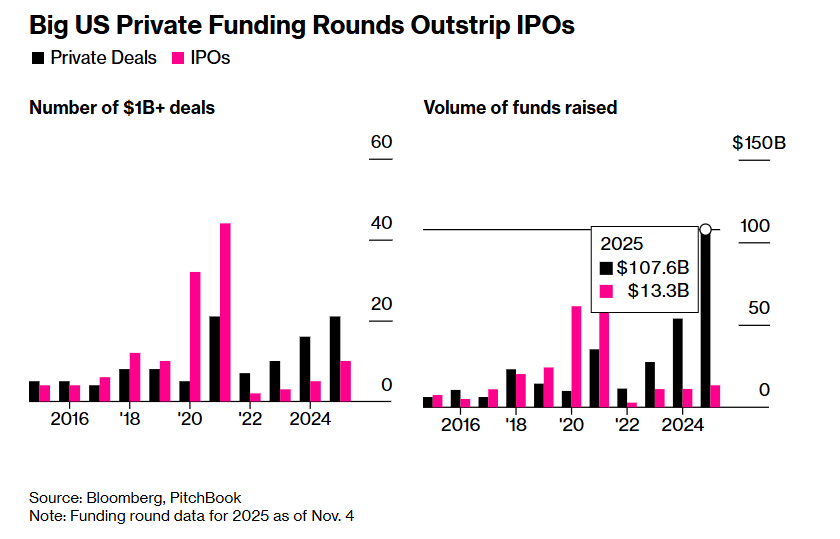
Core Insights - The article highlights the trend of private equity firms providing substantial funding to AI startups, which are raising billions in financing rounds, outpacing the IPO market for similar-sized companies [1][2][6] - Since the rise of ChatGPT, AI startups have increasingly opted to remain private, leveraging private funding to fuel growth without the pressures of public market scrutiny [1][7][9] Funding Landscape - In 2023, there have been 21 financing deals exceeding $1 billion led by U.S. private equity or venture capital firms, totaling an impressive $108 billion, compared to only 10 U.S. IPOs raising approximately $13.3 billion [2][6] - The share of venture capital funding directed towards AI startups reached a historic high, with approximately 62.7% in the U.S. and 53.2% globally, indicating a significant shift in investment focus [7] IPO Considerations - For major AI players like OpenAI, going public is not currently a priority, as they are still in a "burn rate" phase, making it less advantageous to pursue an IPO before achieving profitability [6][9] - The timing of an IPO for these companies is crucial, with many preferring to wait until they can maximize their valuation at the peak of their development [2][10] Market Dynamics - The private equity market is increasingly seen as a favorable environment for growth, allowing companies to focus on business expansion without the immediate pressures of public market performance [9][10] - The performance of recent IPOs has been mixed, with an average return of about 40%, but some stocks have significantly underperformed, highlighting the volatility and risks associated with public listings [9]
速递|斯坦福教授创业,Inception获5000万美元种子轮融资,用扩散模型解锁实时AI应用
Z Potentials· 2025-11-07 02:12
Core Insights - The article discusses the current surge of funding into AI startups, highlighting it as a golden period for AI researchers to validate their ideas [1] - Inception, a startup developing diffusion-based AI models, recently raised $50 million in seed funding, led by Menlo Ventures with participation from several notable investors [2] Company Overview - Inception is focused on developing diffusion models, which generate outputs through iterative optimization rather than sequential generation [3] - The project leader, Stefano Ermon, has been researching diffusion models prior to the recent AI boom and aims to apply these models to a broader range of tasks [3] Technology and Innovation - Inception has released a new version of its Mercury model, designed specifically for software development, which has been integrated into various development tools [3] - Ermon claims that diffusion-based models will significantly optimize two critical metrics: latency and computational cost, stating that these models are faster and more efficient than those built by other companies [3][5] - Diffusion models differ structurally from autoregressive models, which dominate text-based AI services, and are believed to perform better when handling large volumes of text or data limitations [5] Performance Metrics - The diffusion models exhibit greater flexibility in hardware utilization, which is increasingly important as AI's infrastructure demands grow [5] - Ermon's benchmarks indicate that the models can process over 1,000 tokens per second, surpassing the capabilities of existing autoregressive technologies due to their inherent support for parallel processing [5]

美国的“明星独角兽”:私募规模更大,为何还要IPO?
Hua Er Jie Jian Wen· 2025-11-06 23:57
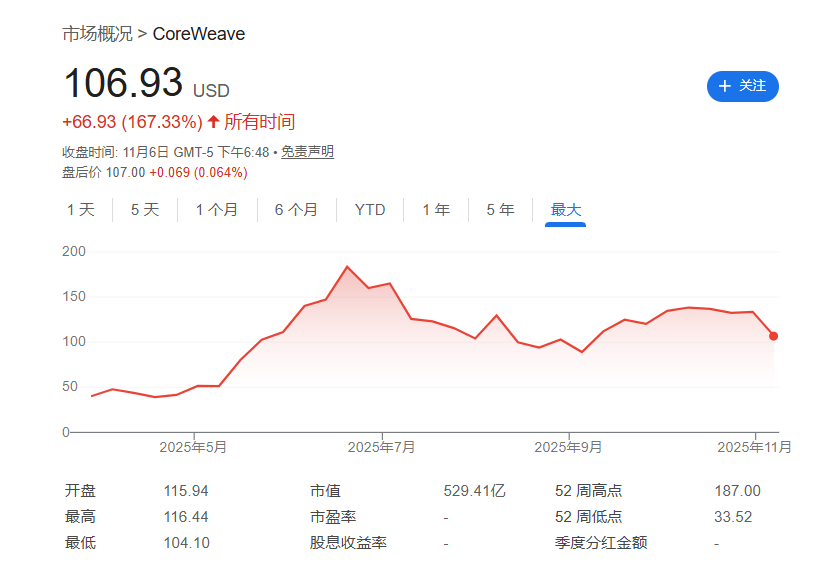
Group 1 - The core point of the articles highlights that private financing activities for large U.S. startups are significantly more active than IPOs this year, with 21 private financing deals exceeding $1 billion totaling $108 billion compared to only 10 IPOs raising $13.3 billion [1] - The trend is driven by the demand for growth funding in the private market, where investors are willing to finance companies before they become profitable, reducing the urgency for these companies to go public [2] - Despite the current preference for remaining private, it is widely believed that these high-valued private companies will eventually pursue IPOs to maximize their value at the peak of their development [2] Group 2 - The performance of large IPOs this year has been mixed, with an average return rate of 40%, outperforming the S&P 500 index, yet 4 out of 10 companies have seen their stock prices fall below the issue price [3] - The overall strong performance is primarily driven by a few companies, such as stablecoin issuer Circle and CoreWeave [3]
Genpact(G) - 2025 Q3 - Earnings Call Transcript
2025-11-06 23:00
Financial Data and Key Metrics Changes - Revenue for Q3 2025 increased by 7% year-over-year, reaching $1.291 billion, exceeding guidance by $21 million [4][16] - Gross margin improved to 36.4%, and adjusted operating income margin rose to 17.7%, reflecting healthy margin expansion [4][19] - Adjusted diluted EPS grew 14% year-over-year to $0.97, surpassing the high end of guidance by $0.07 [4][19] Business Line Data and Key Metrics Changes - Advanced technology solutions revenue surged 20% year-over-year to $311 million, now accounting for 24% of total revenue [17] - Core business services revenue grew 3% year-over-year to $980 million, driven by digital operations and technology services [17] - Data tech and AI revenue increased by 9.3% year-over-year to $622 million, while digital operations revenue rose by 4.3% to $669 million [17] Market Data and Key Metrics Changes - Revenue growth was strongest in high-tech and manufacturing at 14%, followed by financial services at 3%, and consumer and healthcare at 1% [18] - Non-FTE revenue accounted for 47% of total revenue, benefiting from advanced technology solutions [18] Company Strategy and Development Direction - The company is focused on establishing itself as a global leader in advanced technology solutions through its Genpact Next framework [5][24] - Investments in partnerships and AI talent are accelerating growth, with partner-related revenue increasing by 56% year-over-year [13] - The company aims to sharpen its go-to-market focus in decision support services to enhance execution and market share [9] Management's Comments on Operating Environment and Future Outlook - Management expressed confidence in the strong demand signals across various client segments and the overall environment [26][28] - The company raised its full-year revenue guidance to a range of 6.1%-6.4% and adjusted diluted EPS to between $3.60 and $3.61, reflecting double-digit growth [15][23] - Management highlighted the importance of building trust with clients as they transition to agentic operations, emphasizing the need for process intelligence alongside AI [40] Other Important Information - The company returned $119 million to shareholders through share repurchases and dividends, representing 59% of free cash flow year-to-date [20] - The company is committed to returning at least 50% of cash flow to investors while maintaining flexibility for strategic investments [23] Q&A Session Summary Question: Can you comment on the bookings performance in Q3? - Management noted strong demand signals across new and existing clients, with five large deals closed in the quarter [26][27] Question: What are the primary reasons clients are not ready to launch agentic operations? - Clients often face issues with data readiness and process standardization, which are critical for implementing advanced technology solutions [31][32] Question: How is the competitive landscape evolving? - The company differentiates itself through last-mile expertise and a strong culture of client centricity and innovation [34][35] Question: Why is a significant portion of agentic work coming from new clients? - New clients are increasingly adopting agentic solutions, while existing clients are also absorbing these solutions, indicating a growing total addressable market [36][37] Question: How are contracts structured for agentic AI solutions? - The company is shifting towards non-FTE models and subscription-based structures for its software solutions [41][42]

Stack Capital Group Inc. Reports Q3-2025 Financial Results
Globenewswire· 2025-11-05 12:45
Core Insights - Stack Capital Group Inc. reported its financial results for Q3 2025, highlighting a strong capital position and ongoing investments in high-growth technology companies [1][2]. Financial Summary - Book Value per Share ("BVpS") was $14.26 as of September 30, 2025, down from $14.34 at June 30, 2025 [4]. - Total Book Value reached $188.7 million [4]. - The company raised $35 million through a private placement during the quarter [4]. Portfolio Company Highlights - Stack Capital made significant investments in technology companies, including: - OpenAI: Invested US$8.0 million, focusing on generative AI and enterprise AI deployment [3]. - Databricks: Invested US$2.1 million in a unified cloud-based platform for data and AI workloads [9]. - PsiQuantum: Invested US$0.5 million in developing a silicon photonic quantum computer [9]. - Valuation of SpaceX increased from US$350 billion to US$400 billion during the quarter [4]. - Canva's valuation rose from US$32 billion to US$42 billion [4]. Management Commentary - The CEO of Stack Capital noted a robust IPO environment and strong momentum in private markets, particularly in AI, defense, and robotics, indicating attractive investment opportunities [5]. Breakdown of Book Value per Share - The detailed breakdown of Book Value per Share as of September 30, 2025, includes: - CoreWeave, Inc. (AI hyper-scaler): $2.37 - SpaceX: $2.28 - Canva, Inc.: $1.30 - Other notable investments include Locus Robotics, Omio, Hopper, and OpenAI, contributing to the overall Book Value per Share of $14.26 [5][6].

腾讯AI第一股来了!明略科技(2718.HK)登陆港交所开启新征程
Ge Long Hui· 2025-11-05 06:57
Core Insights - The emergence of ChatGPT has sparked a global AI boom, but the challenge of commercializing advanced technology remains a significant hurdle for the industry [1] - Minglue Technology has become the first "Agentic AI" stock to be listed on the Hong Kong Stock Exchange, providing a practical solution to the issue of "vertical scene adaptation" in AI [1] Group 1: Market Position and Competitive Advantage - Minglue Technology is the largest data intelligence application software provider in China, with a focus on "vertical" solutions, differentiating itself from general models that aim for broad coverage [2] - The company has developed a proprietary model product line, DeepMiner, which utilizes a multi-agent architecture to deliver intelligent solutions from data analysis to decision-making [2] - Minglue's unique competitive edge allows it to be compared with leading overseas companies like Palantir and Databricks, which have significant market valuations [3] Group 2: Financial Performance and Growth Potential - In the first half of 2025, Minglue reported total revenue of 644 million yuan, a year-on-year increase of 14%, with an adjusted operating profit of approximately 26.88 million yuan [5] - The company's gross margin improved to 55.9%, up 5.3 percentage points from the same period in 2024, indicating a successful AI-driven upgrade in its marketing and operational intelligence sectors [5] - Minglue has served 135 Fortune 500 companies, providing a natural advantage for its international business expansion [6] Group 3: Strategic Partnerships and Ecosystem - Minglue has signed a strategic agreement with Tencent Cloud to collaborate on cloud services, AI, and large models, enhancing its capabilities in the enterprise AI sector [4] - Tencent's long-term investment in Minglue since 2017 has not only validated the company's strategic direction but also provided essential resource synergies [3][4] Group 4: Future Outlook - The company aims to leverage its position in Hong Kong to accelerate global business expansion, helping Chinese enterprises establish international operations while attracting foreign companies [6] - Minglue's unique voting rights (WVR) structure for its IPO reflects its high growth potential and technological advantages, positioning it as a rare entity in the Hong Kong market [7] - With the ongoing expansion of China's data intelligence application software market, Minglue is expected to continue leading in the enterprise AI model sector, acting as a crucial link between Chinese companies and global AI opportunities [7]
SAP Empowers Developers to Drive the Business AI Revolution
Prnewswire· 2025-11-04 15:00
Core Insights - SAP is enhancing its development process by integrating AI capabilities into its SAP Build solution, aiming to empower developers to achieve faster and more impactful results [1][2] - The company has committed to equipping 12 million people globally with AI-ready skills by 2030, reflecting its focus on workforce development in the AI era [1][11] Developer Ecosystem - SAP Build now offers developers greater freedom to build, extend, and automate applications using familiar tools, enhancing the overall development experience [2] - New integrations with popular development solutions like Visual Studio Code and n8n will allow developers to utilize SAP Build capabilities seamlessly [3][6] Data Utilization - SAP Business Data Cloud is expanding its connectivity with various data and AI platforms, including a new partnership with Snowflake, which enhances data governance and interoperability [6] - Developers can now create data products from raw data, facilitating analytics and application development [7] - The SAP HANA Cloud knowledge graph engine can automatically generate knowledge graphs, providing insights into data relationships and business relevance [8] AI Advancements - SAP introduced its first enterprise relational foundation model, SAP-RPT-1, which predicts business outcomes, enhancing decision-making capabilities [9][10] - New AI assistants in Joule are designed to coordinate workflows across various departments, improving automation and operational efficiency [11]


Snowflake CEO Says He Isn’t Worried About Rising Data Intelligence Competition, Here’s Why
Forbes· 2025-11-04 14:39
Core Insights - Snowflake is positioning itself as a leader in the integration of agentic AI into enterprise operations, focusing on transforming data into actionable insights [4][6][7] - The company aims to empower all employees to interact with data using natural language, enhancing decision-making speed and effectiveness [5][6][8] - Snowflake's new platform, Snowflake Intelligence, is designed to provide verified and explainable answers to complex queries, moving beyond traditional analytics [7][8] Company Strategy - Snowflake's strategy emphasizes building governed data ecosystems that allow for reasoning over data while maintaining strict governance [4][12] - The company is integrating agentic AI gradually, ensuring that it aligns with customer outcomes and has clear application stories [10][12] - A prototype AI agent named "Raven" is being tested internally to demonstrate the capabilities of context-aware AI in supporting real-time decision-making [9] Market Position - Snowflake commands an estimated 18.33% market share in the data intelligence and cloud data warehousing sector, significantly ahead of competitors like Databricks [18] - The company reported total revenue of $942.1 million, reflecting a 28% year-over-year increase, with product revenue reaching $900.3 million, a 29% increase [18] - Industry experts suggest that Snowflake's strong network effects and existing infrastructure investments by enterprises provide a defensible competitive position [19][20] Industry Trends - The shift in the industry is moving from raw model performance to the integration of AI with enterprise data, emphasizing the importance of trust and governance [2][16] - Companies are increasingly focused on the ability of AI to explain its reasoning rather than just generating outputs, indicating a broader realignment in enterprise AI [20] - The future of enterprise AI is expected to be open, interoperable, and deeply data-driven, with a focus on trust and context as key differentiators [21]


Lumen(LUMN) - 2025 Q3 - Earnings Call Transcript
2025-10-30 22:00
Financial Data and Key Metrics Changes - The company reported total revenue of $3.087 billion, a decline of 4.2% year over year, while business segment revenue decreased by 3.2% to $2.456 billion [21] - Adjusted EBITDA was $787 million with a margin of 25.5%, down from approximately $900 million in the previous year [24] - Free cash flow for the quarter was over $1.7 billion, reflecting strong financial performance [24] Business Line Data and Key Metrics Changes - North America enterprise grow revenue increased by 10.5% year over year, now representing 50% of North America enterprise revenue, up from 35.5% three years ago [4][22] - Mass market segment revenue declined by 7.7% to $631 million, while fiber broadband revenue increased by 18.4% year over year [23] - The number of active customers in the Network-as-a-Service (NAS) grew by 32% since the last quarter, with services sold increasing by 36% [10] Market Data and Key Metrics Changes - The company signed over $1 billion in Private Connectivity Fabric (PCF) deals, bringing the total deal value to over $10 billion [4] - The company completed more than 3,200 miles of overpulls, achieving approximately 130% of its end-year 2025 target [9] - The company added approximately 122,000 fiber-enabled homes, bringing the total to approximately 4.5 million [23] Company Strategy and Development Direction - The company is focused on transforming its business model to support the AI economy, emphasizing the need for a fundamental reset in networking to support Cloud 2.0 [5][6] - The strategy includes building a connected ecosystem and enhancing digital capabilities, with expectations of generating $900 million to $1.1 billion in incremental revenue by 2028 [17][28] - The company is committed to a disciplined approach in signing deals that are value accretive to shareholders [8] Management's Comments on Operating Environment and Future Outlook - Management expressed confidence in achieving adjusted EBITDA stability over the next few quarters, with an inflection to growth expected in 2026 [26] - The company anticipates that the early 2026 closing of the AT&T transaction will significantly improve its debt profile and reduce annual interest expenses [20] - Management highlighted the urgency for structural change in network architecture due to the advent of AI, with expectations of data center footprints growing tenfold by 2030 [5][6] Other Important Information - The company is on track to achieve $350 million in run-rate cost takeout through its ERP system implementation [3] - The company has reduced annual interest expenses by approximately $235 million year to date through proactive balance sheet management [19] - The company expects free cash flow to be lumpy quarter to quarter as it moves through large PCF builds [24] Q&A Session Summary Question: Update on PCF deals and revenue growth - Management confirmed that the new $1 billion in PCF bookings has margins equivalent to previous deals and emphasized a disciplined approach to business [32] Question: Insights on grow revenue and sustainability - Management indicated that grow revenue is expected to continue growing, driven by dark fiber and IP, and is becoming a larger portion of the North America enterprise revenue base [32][36] Question: Revenue impact from recent announcements - Management stated that the recent announcements are part of the connected ecosystem strategy, which is expected to improve results over time [40][44] Question: Clarification on the digital revenue outlook - Management expressed confidence in achieving $500 million to $600 million in digital revenue by 2028, with multiple pathways to reach this goal [44][50] Question: Investments needed for digital platform growth - Management acknowledged significant investments are required for building the digital platform, which are already included in their plans [51] Question: Disconnects of legacy services - Management noted that disconnects have returned to normal levels and highlighted a one-time revenue item from the previous year as a significant factor [52]