Nvidia

Search documents
英伟达业绩超预期打破“AI泡沫”焦虑
Zheng Quan Ri Bao· 2026-02-26 16:14
日前,英伟达发布最新财报显示,截至2026年1月25日的2026财年第四季度,公司营收为681亿美元,较 上季度增长20%,较上财年同期增长73%,远超市场预期。其中,数据中心业务表现尤其亮眼。与此同 时,英伟达预计其2027财年第一季度营收为780亿美元,同样大幅超出市场预期。 笔者认为,在市场对"AI泡沫"的讨论逐渐升温之际,这份业绩无疑是对市场担忧的有力回应,为全球人 工智能产业注入新的动力。透过这份财报,我们可以看到,AI产业的底层需求仍在扩张,技术迭代与 应用落地仍在加速。 从结构上看,英伟达业绩高增的核心支撑来自数据中心业务。这一板块持续高增长,说明全球云计算厂 商、大型科技企业以及新兴AI企业仍在大规模采购算力基础设施。值得关注的是,春节前后国内外主 要AI模型纷纷完成重大升级,而算力租赁价格出现上调迹象,从侧面印证了算力供给的紧张格局。这 也意味着头部大模型企业有望推动算力硬件投资继续保持旺盛增长。 此前,市场上存在对"AI泡沫"的担忧,认为人工智能领域存在过度投资现象,下游企业尚未通过AI实现 大规模盈利,因而担心资本过度涌入后会迅速退潮。笔者认为,这种担忧并非毫无根据,但也容易忽略 技术周 ...


英伟达股价盘中一度跌超5%
Xin Lang Cai Jing· 2026-02-26 16:09
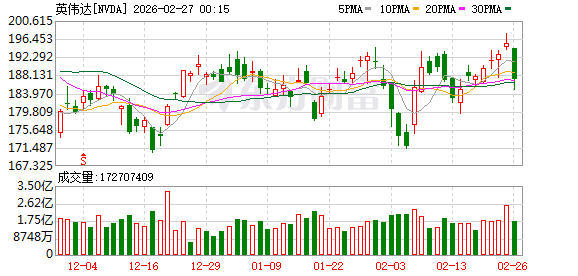
来源:第一财经 美股2月26日盘中,英伟达股价一度跌超5%,随后跌幅收窄至4.81%。此前一日,英伟达发布2026财年 第四季度财报,该季度营收681亿美元,同比增长73%,创历史新高,超分析师平均预测。但市场上关 于英伟达客户资本支出影响自身现金流、资本支出可能见顶仍有担忧情绪,而英伟达数据中心业务来自 超大规模云服务商的收入占比略超50%。英伟达CEO黄仁勋昨日回应称,对客户现金流增长有信心。 (第一财经记者 郑栩彤) ...
NVDA Plunges After Opening Bell, Software Shows Bullish Traction
Youtube· 2026-02-26 16:01
today. But let's get out to Kevin Green who joins me this morning. Hi to you KG.Obviously, we are watching uh the reaction to what we got from Nvidia. I mean, a blockbuster earnings. We've seen obviously the reaction out in Asia overnight with the Nvidia effect, particularly in some of those memory companies, but just talk us through the volatility you're seeing post Nvidia earnings.>> Yeah, we are seeing the shares kind of pull back here down about three and a half%. This is exactly what we've seen over th ...
美股跌幅加大 纳指跌幅扩大至2% 英伟达跌超5%
Xin Lang Cai Jing· 2026-02-26 15:49
来源:格隆汇APP 格隆汇2月26日|道琼斯指数跌0.42%,标普500指数跌1.24%,纳斯达克综合指数跌2.07%。科技股领 跌,英伟达股价下跌5.21%,报185.370美元/股,总市值报4.50万亿美元。博通股价下跌7.12%,报 308.660美元/股,总市值报1.46万亿美元。阿斯麦股价下跌5.67%,报1439.990美元/股,总市值报5550亿 美元。 ...
英伟达(NVDA.US)绩后遭投资者看空回应 早盘下跌超5%
Zhi Tong Cai Jing· 2026-02-26 15:47
周四,英伟达(NVDA.US)财报再超预期却遇冷淡回应,早盘股价下跌超5%,报186.54美元。英伟达最 新发布的销售额展望超预期,却引来投资者的看空反应,显示出市场对潜在泡沫的担忧,持续施压这家 人工智能芯片领域的绝对龙头企业。在此之前,这家芯片厂商给出的第一季度业绩展望轻松超出分析师 平均预期,且第四季度营收大幅增长73%。 哈格里夫斯兰斯当分析师在财报后报告中指出,股东仍有疑问:"当前这波AI投入浪潮,能否在未来数 年之外继续支撑增长;以及当AI从模型训练转向日常推理运行时,英伟达能否继续保持主导地位。" 尽管爆发式的销售增长已让总部位于加州圣克拉拉的英伟达成为全球市值最高公司——过去12个月股价 上涨约44%——但投资者仍在寻求更有力的保证,以确认这股狂热的支出势头能够持续。 ...
Nasdaq drops nearly 2% as the tech selloff deepens post Nvidia's earnings
Seeking Alpha· 2026-02-26 15:44
Wall Street retreated on Thursday as weakness in the technology sector weighed heavily on major averages, pushing the Nasdaq Composite (COMP:IND) down nearly 2%. The decline followed earnings from Nvidia (NVDA), with shares of the mega-cap chipmaker falling roughly ...

美股异动 | 英伟达(NVDA.US)绩后遭投资者看空回应 早盘下跌超5%
智通财经网· 2026-02-26 15:43
哈格里夫斯・兰斯当分析师在财报后报告中指出,股东仍有疑问:"当前这波 AI 投入浪潮,能否在未来 数年之外继续支撑增长;以及当 AI 从模型训练转向日常推理运行时,英伟达能否继续保持主导地位。" 尽管爆发式的销售增长已让总部位于加州圣克拉拉的英伟达成为全球市值最高公司—— 过去 12 个月股 价上涨约 44%—— 但投资者仍在寻求更有力的保证,以确认这股狂热的支出势头能够持续。 智通财经APP获悉,周四,英伟达(NVDA.US)财报再超预期却遇冷淡回应,早盘股价下跌超5%,报 186.54美元。英伟达最新发布的销售额展望超预期,却引来投资者的看空反应,显示出市场对潜在泡沫 的担忧,持续施压这家人工智能芯片领域的绝对龙头企业。在此之前,这家芯片厂商给出的第一季度业 绩展望轻松超出分析师平均预期,且第四季度营收大幅增长 73%。 ...
Why Nvidia's stock is falling despite a historic earnings beat
MarketWatch· 2026-02-26 15:36
Core Viewpoint - Nvidia's stock is experiencing a decline despite reporting record earnings, indicating market reactions may not align with financial performance expectations [1] Earnings Performance - Nvidia reported a fiscal fourth-quarter revenue of $43 billion, exceeding estimates by approximately $3 billion [1] - The company's guidance for future earnings was about $5 billion higher than analyst projections, showcasing strong growth potential [1] Market Reaction - Following the earnings report, Nvidia's stock fell over 4% after the market opened, suggesting investor sentiment may be influenced by factors beyond just earnings performance [1]
Compared to Estimates, Nvidia (NVDA) Q4 Earnings: A Look at Key Metrics
ZACKS· 2026-02-26 15:35
Core Insights - Nvidia reported a revenue of $68.13 billion for the quarter ended January 2026, marking a year-over-year increase of 73.2% and exceeding the Zacks Consensus Estimate by 4.14% [1] - The earnings per share (EPS) for the same period was $1.62, compared to $0.89 a year ago, representing a surprise of 6.71% over the consensus estimate of $1.52 [1] Revenue Performance by Segment - Data Center revenue reached $62.31 billion, surpassing the estimated $58.72 billion, with a year-over-year increase of 75.1% [4] - OEM and Other revenue was reported at $161 million, slightly below the estimated $174.4 million, but still showing a 27.8% increase year-over-year [4] - Automotive revenue was $604 million, compared to the average estimate of $662.65 million, reflecting a 6% year-over-year growth [4] - Professional Visualization revenue was $1.32 billion, significantly exceeding the estimated $757.59 million, with a remarkable year-over-year increase of 158.5% [4] - Gaming revenue was reported at $3.73 billion, below the estimated $4.26 billion, but still showing a 46.5% increase year-over-year [4] - Compute & Networking revenue reached $61.65 billion, surpassing the estimated $59.03 billion, with a year-over-year increase of 71.1% [4] - Data Center-Compute revenue was $51.33 billion, slightly above the estimated $51.06 billion, with a year-over-year growth of 57.7% [4] - Graphics revenue was reported at $6.48 billion, exceeding the estimated $6.27 billion, with a year-over-year increase of 96.5% [4] - Data Center-Networking revenue was $10.98 billion, significantly above the estimated $9 billion, reflecting a year-over-year increase of 263.1% [4] Stock Performance - Nvidia shares have returned +2.1% over the past month, outperforming the Zacks S&P 500 composite's +0.6% change, and currently hold a Zacks Rank 1 (Strong Buy) indicating potential for further outperformance in the near term [3]
Say Hello to the Growth Stock That's Winning the Streaming Wars
Yahoo Finance· 2026-02-26 15:35
When investors think about companies within the streaming market, the vast majority probably come up with Netflix first. However, there are other businesses in this evolving industry that also deserve some attention. For example, one streaming platform just reported revenue of $4.7 billion in 2025. That figure is 161% higher than in 2020, demonstrating robust adoption trends. Will AI create the world's first trillionaire? Our team just released a report on the one little-known company, called an "Indispen ...