
杭州银行

Search documents
财政金融促内需一揽子政策点评:财政金融六项政策落地,关注结构调优和息差改善
Yin He Zheng Quan· 2026-01-22 02:47
Investment Rating - The report maintains a "Recommended" rating for the banking industry [1] Core Insights - The implementation of six fiscal and financial policies aims to stimulate domestic demand, focusing on structural optimization and interest margin improvement [3] - The fiscal interest subsidies, typically between 1-1.5 percentage points, are designed to lower overall financing costs, boost investment and consumption demand, and guide financial resources towards key areas such as technology innovation and support for small and micro enterprises [3] - The report highlights that the fiscal policies will positively support banks in optimizing their structures and stabilizing interest margins, with expectations of a narrowing decline in interest margins due to the upcoming maturity of high-interest fixed deposits in 2026 [3] - The establishment of a 500 billion yuan special guarantee plan for private investment and the optimization of risk-sharing mechanisms for corporate bonds are expected to enhance banks' asset quality and increase their willingness to issue long-term loans [3] - The report suggests that the collaborative fiscal and financial policies will directly benefit credit growth, structural optimization, and risk expectation improvement, while the stable interest margin guidance remains unchanged [3] Summary by Sections Banking Industry - The report emphasizes the positive impact of fiscal policies on credit growth and structural optimization, with a focus on improving risk expectations and stabilizing interest margins [3] - Specific recommendations for individual banks include Industrial and Commercial Bank of China, Agricultural Bank of China, Postal Savings Bank of China, Jiangsu Bank, Hangzhou Bank, and China Merchants Bank [3]






1月20日贷款财政贴息四项政策点评:“一揽子”贷款财政贴息政策影响几何?
EBSCN· 2026-01-21 11:17
Investment Rating - The report maintains a "Buy" rating for the banking industry, indicating an expected investment return exceeding the market benchmark index by more than 15% over the next 6-12 months [29] Core Insights - The "package" loan interest subsidy policies aim to stimulate consumption and investment, focusing on enhancing effective domestic demand through financial and fiscal collaboration [2][7] - The new policies are expected to significantly increase the scale of interest subsidies compared to previous measures, with a projected subsidy scale of approximately 1000 to 2000 billion yuan for 2026 [17][19] Summary by Sections Loan Subsidy Policies - The policies include four main areas: subsidies for small and micro enterprises, equipment updates, service industry operators, and personal consumption loans, with a focus on key industries such as new energy vehicles and medical equipment [4][6] - The subsidy rate for small and micro enterprise loans is set at 1.5 percentage points, with a maximum loan amount of 50 million yuan per entity, potentially providing up to 150,000 yuan in subsidies [4][6] - The equipment update loan subsidy has been increased from 1% to 1.5%, expanding the scope to include technology innovation loans and related fields [4][6] - The personal consumption loan subsidy has removed previous restrictions, allowing for broader eligibility and a maintained subsidy rate of 1% [5][6] Economic Impact - The policies are designed to alleviate financial burdens on small and micro enterprises, encouraging investment and job stability, particularly in high-tech and essential service sectors [7][8] - The expected increase in loan demand from these sectors is anticipated to support the overall credit recovery in the economy, particularly for retail and service industries [7][8] Market Outlook - The report suggests that the coordinated fiscal and monetary policies will positively impact the banking sector's loan volume and pricing, particularly benefiting banks focused on small and micro enterprises and retail finance [23] - The banking sector has seen a decline in stock performance, and the new policies are expected to act as a catalyst for recovery, especially in the context of the "opening red" period for banks [23]
银行行业今日净流出资金4.47亿元,农业银行等5股净流出资金超5000万元
Zheng Quan Shi Bao Wang· 2026-01-21 09:21
Market Overview - The Shanghai Composite Index rose by 0.08% on January 21, with 18 out of the 28 sectors experiencing gains. The top-performing sectors were non-ferrous metals and electronics, with increases of 2.79% and 2.62% respectively [1] - The banking and coal sectors were the worst performers, declining by 1.58% and 1.57% respectively, with the banking sector leading the decline [1] Capital Flow - The net inflow of capital in the two markets was 11.983 billion yuan, with 14 sectors seeing net inflows. The electronics sector had the highest net inflow of 16.369 billion yuan, while the non-ferrous metals sector followed with a net inflow of 7.289 billion yuan [1] - Conversely, 17 sectors experienced net outflows, with the power equipment sector seeing the largest outflow of 6.688 billion yuan, followed by the defense and military industry with a net outflow of 2.906 billion yuan [1] Banking Sector Performance - The banking sector saw a decline of 1.58% with a net outflow of 447 million yuan. Out of 42 stocks in this sector, only one stock rose while 41 stocks fell [2] - Among the stocks with net inflows, Hangzhou Bank led with an inflow of 153 million yuan, followed by China Transportation Bank and Jiangsu Bank with inflows of 106 million yuan and 96.849 million yuan respectively [2] - The stocks with the highest net outflows included Agricultural Bank of China, Industrial and Commercial Bank of China, and Bank of China, with outflows of 555.7 million yuan, 227.4 million yuan, and 167.4 million yuan respectively [2] Detailed Banking Sector Data - A detailed table of banking stocks shows various performance metrics, including daily price changes and turnover rates. For instance, Agricultural Bank of China decreased by 2.93% with a turnover rate of 0.17% and a net outflow of 55.707 million yuan [3] - Other notable declines included Industrial and Commercial Bank of China at -2.52% and Bank of China at -2.02%, with respective net outflows of 22.740 million yuan and 16.737 million yuan [3]

强势股追踪 主力资金连续5日净流入101股
Zheng Quan Shi Bao Wang· 2026-01-21 09:20
证券时报·数据宝统计,截至1月21日收盘,深沪北共101只个股连续5日或5日以上主力资金净流入。杭 州银行等连续15日主力资金净流入,排名第一;云南白药连续13日主力资金净流入,位列第二。从主力 资金净流入总规模来看,德明利主力资金净流入金额最大,连续6天累计净流入15.50亿元,杭州银行紧 随其后,15天累计净流入14.39亿元。从主力资金净流入占成交额的比例来看,锋龙股份占比排名居 首,该股近15日上涨317.94%。(数据宝) 连续5日或以上主力资金净流入个股排名 | 证券代 | 证券简 | 主力资金净流入 | 主力资金净流入金额 | 主力资金净流入比例 | 累计涨跌幅 | | --- | --- | --- | --- | --- | --- | | 码 | 称 | 天数 | (亿元) | (%) | (%) | | 001309 | 德明利 | 6 | 15.50 | 6.77 | 22.39 | | 600926 | 杭州银 行 | 15 | 14.39 | 9.88 | -0.65 | | 000333 | 美的集 团 | 6 | 11.55 | 6.11 | 2.07 | | 000776 | ...



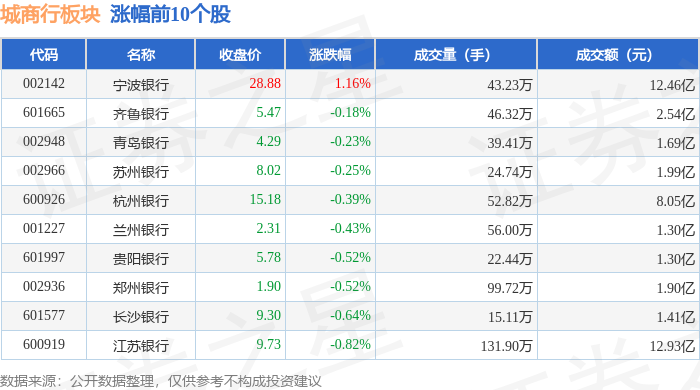
城商行板块1月21日跌0.55%,重庆银行领跌,主力资金净流入5.08亿元
Zheng Xing Xing Ye Ri Bao· 2026-01-21 08:54
Market Overview - The city commercial bank sector experienced a decline of 0.55% on January 21, with Chongqing Bank leading the drop [1] - The Shanghai Composite Index closed at 4116.94, up 0.08%, while the Shenzhen Component Index closed at 14255.12, up 0.7% [1] Individual Stock Performance - Ningbo Bank closed at 28.88, with an increase of 1.16% and a trading volume of 432,300 shares, amounting to a transaction value of 1.246 billion [1] - Chongqing Bank closed at 10.25, down 1.82%, with a trading volume of 106,800 shares and a transaction value of 110 million [2] - Other notable performers include Xiamen Bank, which closed at 7.13, down 1.66%, and Chengdu Bank, which closed at 15.72, down 1.38% [2] Capital Flow Analysis - The city commercial bank sector saw a net inflow of 508 million from institutional investors, while retail investors experienced a net outflow of 566 million [2] - The capital flow for individual stocks indicates that Hangzhou Bank had a net inflow of 158 million from institutional investors, while it faced a net outflow of 86.5 million from retail investors [3] - Shanghai Bank also saw a net inflow of 107 million from institutional investors, with a net outflow of 121 million from retail investors [3]


信贷开门红表现亮眼 杭州银行密集接待机构调研
Quan Jing Wang· 2026-01-21 07:17
Group 1 - The core viewpoint of the news is that Hangzhou Bank is demonstrating confidence in its operational stability and growth potential, as evidenced by recent institutional research and responses to key questions regarding credit lending and asset quality [1][2][3] - Hangzhou Bank has achieved steady growth in corporate credit lending at the beginning of 2026, with a notable increase in lending scale compared to the same period in previous years, ensuring stable profitability [1] - The bank's retail mortgage loan demand is expected to stabilize and recover in 2026, supported by ongoing policy efforts and a gradual market adjustment, with a focus on high-quality projects and differentiated strategies [2] Group 2 - For the first three quarters of 2025, Hangzhou Bank reported a steady performance with operating income of 28.88 billion yuan, a year-on-year increase of 1.35%, and a net profit attributable to shareholders of 15.88 billion yuan, a significant year-on-year growth of 14.53% [3] - The bank announced a mid-term dividend, distributing 3.80 yuan per 10 shares to ordinary shareholders, totaling approximately 2.76 billion yuan, which reflects its strong profitability and commitment to returning value to investors [3] - Hangzhou Bank has established a clear strategic plan for the next five years, aiming to become a "value-leading bank in China" and aligning with national and regional development strategies [3][4] Group 3 - The bank's strategic framework for 2026-2030 focuses on three core objectives: customer, scale, and efficiency, while emphasizing digitalization, internationalization, and enhancing key capabilities in talent, risk control, and technology [4] - The bank aims to concentrate its efforts on six core business segments, including corporate finance, small and micro finance, and retail finance, to drive high-quality growth [4]
一周银行速览(1.10—1.16)
Cai Jing Wang· 2026-01-21 06:05
财经网×企业预警通App ◆监管之声 2025年金融数据出炉:社融、M2高增长 直接融资占比显著上升 2025年全年金融数据出炉。中国人民银行1月15日发布的数据显示:据初步统计,截至2025年末,社会融资规模存量 为442.12万亿元,同比增长8.3%;人民币贷款余额271.91万亿元,同比增长6.4%;广义货币(M2)余额340.29万亿 元,同比增长8.5%。业内专家表示,2025年,我国货币信贷总量稳步增长,结构持续优化。直接融资在整个社融中的 占比提升,彰显金融供给侧结构性改革成效。同时,社会综合融资成本进一步下行,较好满足了企业和居民部门的资 金需求,为经济回升向好创造了适宜的货币金融环境。 中国人民银行推出八项举措 加大结构性货币政策工具支持力度 多家上市银行大股东或高管增持落地 开年以来,多家银行披露了获大股东、高管增持的相关消息。例如,渝农商行6位核心高管集体增持,齐鲁银行高管 超额兑现增持承诺,南京银行大股东持续加码增持。整体来看,银行主要股东及高管实施增持,展现了其对银行业发 展的信心。 ◆企业动态 中国人民银行副行长邹澜1月15日在国新办举行的新闻发布会上介绍,根据当前经济金融形势需要 ...
主力资金连续5日净流入71股
Xin Lang Cai Jing· 2026-01-20 14:53
据数据宝,截至1月20日收盘,深沪北共71只个股连续5日或5日以上主力资金净流入。杭州银行等连续 14日主力资金净流入,排名第一;晶品特装连续13日主力资金净流入,位列第二。从主力资金净流入总 规模来看,德明利主力资金净流入金额最大,连续5天累计净流入13.53亿元,杭州银行紧随其后,14天 累计净流入12.86亿元。从主力资金净流入占成交额的比例来看,锋龙股份占比排名居首,该股近14日 上涨279.93%。 ...

杭州银行:2026年开门红对公信贷投放情况整体良好
Zheng Quan Ri Bao Wang· 2026-01-20 13:42
证券日报网1月20日讯,杭州银行(600926)在接受调研者提问时表示,得益于近几年公司条线春耕行 动的积极开展,本行积累了对公资产开门红营销的丰富经验,同时形成了高效的营销组织模式。2026年 开门红对公信贷投放情况整体良好,较往年同期有所多增,资产投放收益率较上年四季度保持稳定。 2026年本行对公信贷将继续围绕具备良好发展动能和优秀产业基础的区域,聚焦主流市场、主流客户、 主流资产,做好浙江省内以及省外重点城市区域客户的服务。 ...
杭州银行:消费贷业务主要面向公务员、事业单位员工及上市公司等优质企业员工
Zheng Quan Ri Bao Wang· 2026-01-20 13:42
证券日报网1月20日讯,杭州银行(600926)在接受调研者提问时表示,公司消费贷业务主要面向公务 员、事业单位员工及上市公司等优质企业员工,该类客群工作、收入相对稳定,消费贷资产质量整体保 持稳健;按揭贷款业务受居民收入波动及房地产市场疲软等影响,2025年以来住房按揭贷款的不良率有 所上升,但目前仍保持在相对较低水平,抵押物平均抵押率处于相对安全区间,风险整体可控。 ...