SAP

Search documents
研判2025!中国关系型数据库行业市场规模、产品数量、竞争格局及未来趋势分析:仍占据市场主流地位,公有云关系型数据库发展迅速[图]
Chan Ye Xin Xi Wang· 2025-08-17 01:02
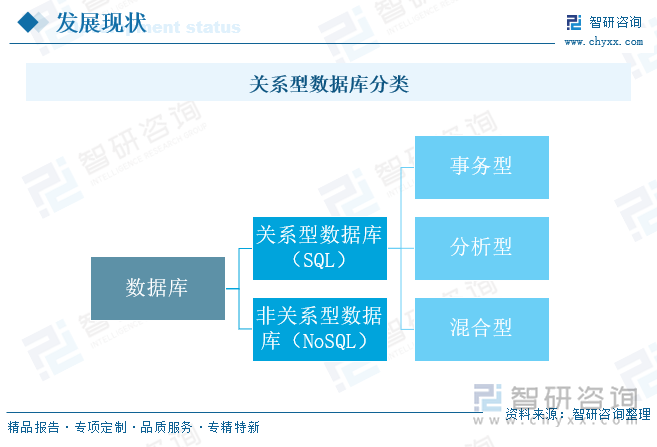
Core Insights - The relational database industry in China is experiencing rapid growth, driven by the "14th Five-Year Plan" which emphasizes digital development and the construction of a digital China [1][8] - The market size of China's relational database industry is projected to reach 29.98 billion yuan (approximately 4.21 billion USD) in 2024, with a year-on-year growth of 12.0% [8][10] - The public cloud has become the primary deployment method for relational databases, with the public cloud relational database market expected to reach 19.51 billion yuan in 2024, accounting for 65.1% of the market share [10][18] Market Overview - The overall database market in China is expected to reach 59.616 billion yuan in 2024, growing by 14% year-on-year [6][8] - The domestic relational database market is characterized by a diverse range of participants, including traditional vendors, startups, cloud providers, and cross-industry players, leading to intense competition [18][19] - The market concentration is increasing, with the top five players in the public cloud relational database market expected to hold nearly 85% of the market share by the second half of 2024 [18][19] Product Landscape - As of June 2025, there are 164 database products in China, with 96 being relational databases, representing 58.5% of the total [12][14] - The global database product landscape shows a predominance of non-relational and hybrid databases, while China maintains a focus on relational databases [12][14] Competitive Landscape - Major players in the public cloud relational database market include Alibaba Cloud and Tencent Cloud, which dominate the market [18][19] - In the on-premises relational database market, local companies like Huawei, Dameng, and Tencent compete with international firms such as Oracle, Microsoft, and SAP [18][19] Technological Trends - The relational database market in China is expected to exceed 75 billion yuan by 2029, driven by software localization, rapid AI application development, and the growth of the digital economy [21] - Key technological trends include the deepening of cloud-native databases and the integration of vector engines and multimodal data management [21]



大利空!欧洲软件巨头暴跌
Zhong Guo Ji Jin Bao· 2025-08-13 09:27
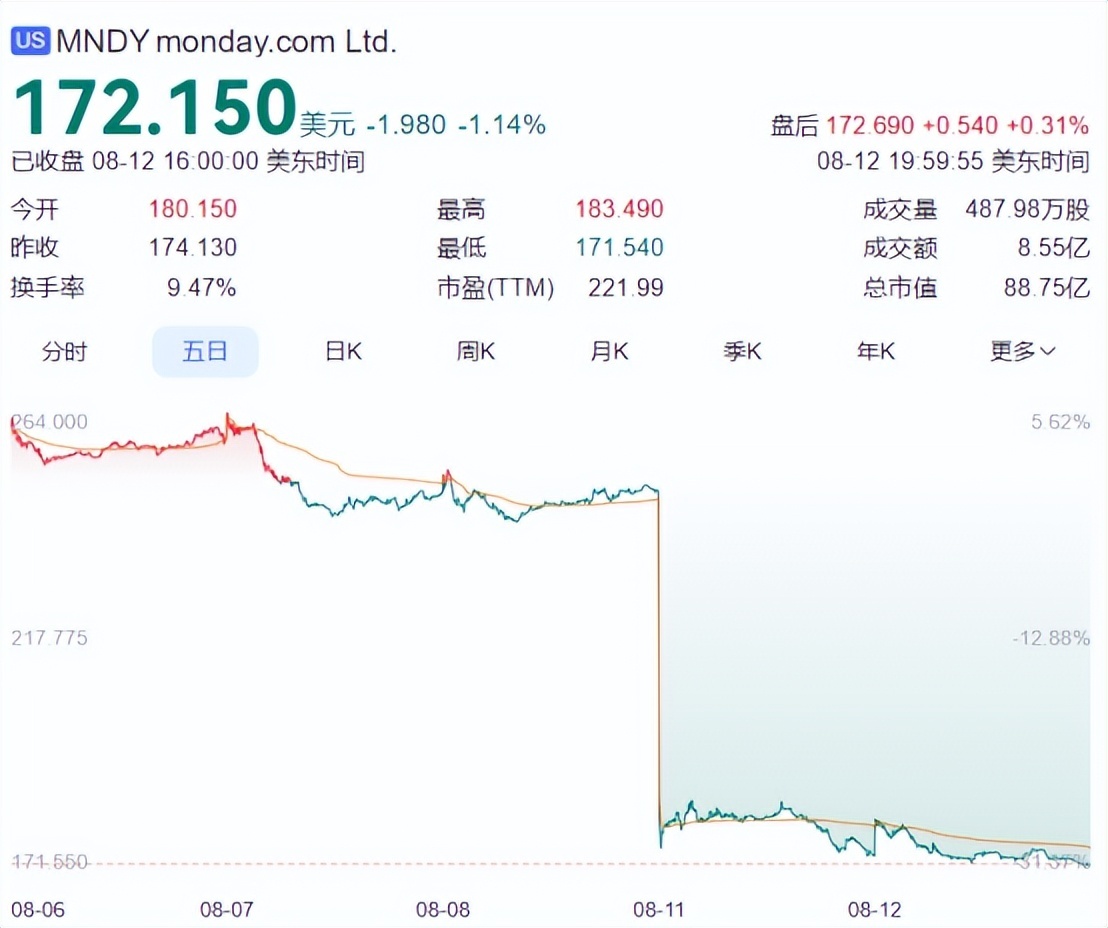
Group 1 - The core point of the article is that Monday.com experienced a significant stock price drop of 29.6%, resulting in a market value loss of over $2 billion, primarily due to disappointing Q3 revenue guidance and the disruptive impact of AI technology on the software industry [1][2][4]. Group 2 - Monday.com reported Q2 revenue of $299 million, a 27% year-over-year increase, and earnings per share of $1.09, surpassing analyst expectations [4]. - The company's Q3 revenue guidance median is projected to be between $306 million and $310 million, which is below the market expectation of $313 million, and the full-year operating margin forecast has been revised down from 15% to a range of 11% to 12% [4]. - The sudden slowdown in growth expectations for a company that previously maintained over 40% annual revenue growth has led to a reevaluation of its valuation model [4]. Group 3 - The underlying issue causing the industry-wide reaction is the disruption of traditional software logic by AI, with OpenAI's CEO stating that AI agents will transform SaaS into a fast-moving consumer good [5]. - Analysts indicate that the software industry is facing a crisis of functional replacement, as AI can now perform core functions like project management and requirement tracking through natural language commands, reducing users' willingness to pay for specialized software [5]. - Despite the challenges, some investment firms see opportunities, with Morgan Stanley upgrading its rating to "overweight" and TD Cowen maintaining a "buy" rating with a target price of $290 per share, highlighting the revenue potential of Monday Magic, an AI product [5].

大利空!欧洲软件巨头暴跌
中国基金报· 2025-08-13 09:21
Core Viewpoint - The significant drop in Monday.com's stock price, nearly 30%, is attributed to disappointing Q3 revenue guidance, highlighting deeper issues related to the disruption of the software industry by AI technology [2][4][6]. Group 1: Stock Performance - Monday.com experienced a stock price decline of 29.8%, marking its largest drop since going public, resulting in a market capitalization loss of over $2 billion [4][6]. - The decline in Monday.com's stock triggered a ripple effect in the SaaS sector, with other companies like SAP also experiencing declines, losing nearly 7% of their market value [4]. Group 2: Financial Performance - In Q2, Monday.com reported revenue of $299 million, a 27% year-over-year increase, and earnings per share of $1.09, surpassing analyst expectations [6]. - The company's Q3 revenue guidance is projected to be between $306 million and $310 million, falling short of market expectations of $313 million, with a downward revision of the full-year operating margin from 15% to a range of 11% to 12% [6]. Group 3: Industry Disruption - The underlying issue causing the stock drop is the disruption of traditional software business models by AI, as noted by industry experts [8]. - AI technology is enabling functionalities that were traditionally provided by specialized software, leading to a decrease in user willingness to pay for dedicated software solutions [8]. - The development costs are rising as software companies increase R&D investments to adapt to the changing landscape, resulting in expanded GAAP operating losses [8]. Group 4: Market Outlook - Despite the challenges, some investment firms see opportunities; Morgan Stanley upgraded its rating to "overweight," suggesting that the current stock price reflects excessive risk [8]. - TD Cowen maintained a "buy" rating with a target price of $290 per share, indicating that the market may be overlooking the revenue potential of Monday Magic, an AI product from Monday.com [8].

欧美软件股遭抛售 AI冲击引发行业估值压力
Huan Qiu Wang· 2025-08-13 05:04
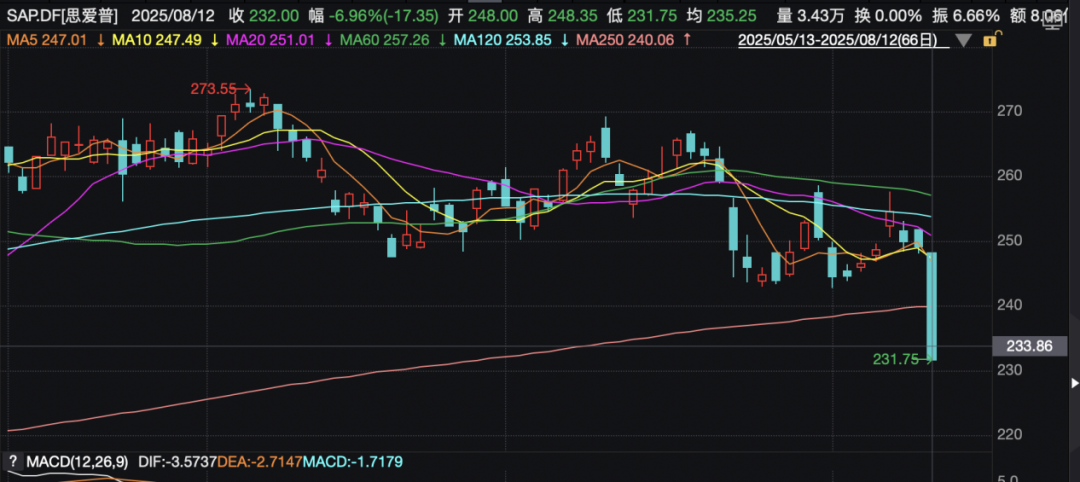
Group 1 - The stock price of Monday.com Ltd. plummeted by 30% after its earnings report, leading to a collective decline in European software stocks as investors sold off related shares [1] - SAP, one of Germany's "Big Seven" and the highest market capitalization company in Europe, saw its stock drop by 6.76%, resulting in a market value loss of nearly €19.5 billion (approximately ¥163.6 billion) [3] - Concerns over competition from AI technologies are driving this downturn, with analysts noting that existing software companies face increasing competitive risks as AI tools develop and become more cost-effective [3] Group 2 - The software sector in the U.S. is experiencing significant challenges, with the Dow component Salesforce down 30% year-to-date and Adobe, labeled as an "AI victim," down 25%, having lost half its value compared to two years ago [3] - Analyst opinions on the software sector's outlook are divided; Morgan Stanley upgraded Monday.com Ltd. to "overweight," suggesting that the stock's decline has largely reflected AI disruption risks [4] - Jefferies analysts indicated that investors are likely to avoid the software sector due to uncertainties surrounding AI's impact, expressing concerns that AI could undermine the software industry and lead to a collapse in price-to-earnings ratios [4]
“欧洲股王”市值蒸发千亿
财联社· 2025-08-13 01:08
就在财联社周一刚警告"某些股票会被AI啃得只剩骨头"后没过两天,预言中的景象就在欧美各地上演。 当地时间周二,受到知名SaaS概念股Monday.com Ltd.发布财报后股价暴跌30%冲击,欧洲投资者纷纷开始抛售当地软件公司股票。 欧洲市值最高上市公司、德国"七巨头"之一的SAP跳水6.76%,市值蒸发近195亿欧元(约合人民币1636亿元)。 英国软件公司 Sage Group也下跌近5%,法国达索系统公司也跌1.62%。 (SAP德股日线图,来源:TradingView) 背后的原因不难理解:随着 AI工具得以更快、更低成本地开发应用 ,现有软件厂商可能会面临剧烈增加的竞争风险。 就在上周,OpenAI首席执行官山姆·奥尔特曼还特意表示, SaaS行业很快将进入快消品时代 。 (来源:X) 他指出:"投资者担心人工智能会吞噬软件行业,市盈率将土崩瓦解。我认为这种恐惧被夸大了,但无论如何, 我们确实正处于一个时期, 投资者对这个板块根本不感兴趣 。" 下载财联社APP获取更多资讯 准确 快速 权威 专业 7x24h电报 头条新闻 VIP资讯 实时盯盘 RBC资本市场的Matthew Hedberg团队在周 ...

美股再创历史新高
财联社· 2025-08-12 23:35
Core Viewpoint - The recent CPI data has positively influenced the US stock market, leading to significant gains in major indices, with the S&P 500 and Nasdaq reaching all-time highs [1]. Market Performance - The S&P 500 index rose by 1.13% to 6445.76 points, the Nasdaq composite increased by 1.39% to 21681.9 points, and the Dow Jones Industrial Average climbed by 1.1% to 44458.61 points [1]. - The Russell 2000 index, which is seen as a beneficiary of interest rate cuts, surged nearly 3% [3]. Sector Highlights - Technology stocks rebounded, with notable performances from major companies: Apple up 1.09%, Microsoft up 1.43%, Amazon up 0.08%, Nvidia up 0.6%, Google-A up 1.16%, Tesla up 0.53%, and Meta up 3.15% [7]. - Intel experienced a significant increase of 5.62%, with a two-day gain of 11% following a shift in Trump's stance [8]. - Other companies such as Electronic Arts, BlackRock, Goldman Sachs, and Morgan Stanley also reached historical highs [9]. International Market - The Nasdaq Golden Dragon China Index rose by 1.49%, with Alibaba up 3.19%, JD.com up 3.01%, Baidu up 2.14%, and Pinduoduo up 3% [10]. - However, some Chinese companies faced declines, such as NIO down 8.96% and XPeng down 6.08% [10].





Saputo Announces Election of Directors
Globenewswire· 2025-08-08 19:28
Group 1 - Saputo Inc. announced the election of its board of directors at the annual meeting of shareholders held on August 8, 2025 [1] - The nominees received significant support, with voting results showing high percentages of approval, such as Victor L. Crawford receiving 99.94% of votes in favor [2] - The company is recognized as one of the top ten dairy processors globally, producing a wide range of dairy products including cheese, fluid milk, and dairy alternatives [3] Group 2 - Saputo is a leading cheese manufacturer in Canada and ranks among the top three cheese producers in the USA [3] - The company operates in multiple countries, including Australia, Argentina, and the United Kingdom, where it holds leading positions in dairy processing [3] - Saputo's products are marketed under both market-leading brands and private label brands, indicating a strong presence in the dairy market [3]


招商证券:中美AI应用商业化路径差异显著 本土场景孕育长期潜力
Zhi Tong Cai Jing· 2025-08-08 01:25
Group 1: Core Insights - The potential for AI applications in China is immense, with significant growth opportunities driven by a mature mobile internet ecosystem and diverse user scenarios [1][2] - The emergence of generative AI, exemplified by ChatGPT, marks a critical period for global technological competition and industry evolution [1] - Chinese enterprises are expected to leverage local scenarios and resources to develop AI products with practical value and commercial potential across various sectors such as education, healthcare, and industry [1] Group 2: Differences in AI Application between China and the US - In the education sector, China focuses on exam-oriented approaches, while the US emphasizes personalized learning [2] - The advertising sector in China operates within a closed-loop system prioritizing commercial monetization, contrasting with the US focus on user experience and brand value [2] - Video generation in China is efficiency-driven, while the US prioritizes creative expression and content ecosystem development [2][3] Group 3: Commercialization Opportunities in AI Products - Companies like SAP and Salesforce are integrating generative AI into enterprise processes to enhance automation and efficiency [4] - Palantir and Fourth Paradigm are developing AI-driven solutions for data governance and decision-making across various industries [4] - AppLovin and its Chinese counterparts are enhancing advertising precision and efficiency through AI technologies [4] - Figma and its Chinese equivalents are advancing UI/UX design processes through AI-driven collaboration and innovation [5] - Netflix and its Chinese counterpart, Kuaishou, are utilizing generative AI to improve content monetization and user experience [5] - Shopify and its Chinese counterpart, ZhiDeMai, are employing AI tools to streamline content creation and operational efficiency [5] - Spotify is enhancing user engagement and commercial conversion through AI-driven personalization [5] - Duolingo and its Chinese counterpart, DouShen Education, are innovating language learning experiences through AI technologies [6]

SAP is acquiring SmartRecruiters
TechCrunch· 2025-08-03 17:12
Group 1 - SAP has reached an agreement to acquire SmartRecruiters, a recruiting software company, enhancing its HR tools with SmartRecruiters' user-friendly interfaces and seamless workflows [1] - The acquisition will allow customers to manage the entire candidate lifecycle in a single system, improving the experience for recruiters, hiring managers, and candidates [2] - SmartRecruiters was valued at $1.5 billion during its last funding round, which raised $110 million in 2021 [3] Group 2 - The terms of the acquisition have not been disclosed, and the deal is expected to close in the fourth quarter of this year [2]

Amazon Stock Falls Despite Q2 Earnings & Revenues Beat Estimates
ZACKS· 2025-08-01 17:36
Core Insights - Amazon.com (AMZN) reported second-quarter 2025 earnings of $1.68 per share, a 36.6% increase year-over-year, surpassing the Zacks Consensus Estimate by 26.32% [1] - Net income rose 34.8% year-over-year to $18.2 billion, with net sales reaching $167.7 billion, a 13% increase, exceeding management's guidance and the Zacks Consensus Estimate [1][2] Financial Performance - Excluding a $1.5 billion negative impact from foreign exchange, net sales increased 12% year-over-year [2] - Product sales accounted for 40.7% of total sales, increasing 10.8% to $68.2 billion, while service sales, making up 59.3%, jumped 15.1% to $99.4 billion [4] - North America revenues rose 11.1% to $100 billion, and international revenues increased 16.1% to $36.7 billion, both exceeding consensus estimates [4] - AWS revenues grew 17.5% to $30.8 billion, also beating consensus estimates [5] Segment Performance - Third-party seller services generated $40.3 billion in sales, an 11% year-over-year increase, surpassing the Zacks Consensus Estimate [5] - Advertising services saw a 23% year-over-year growth to $15.6 billion, exceeding consensus expectations [6] - Prime services revenues reached $12.2 billion, a 12% increase year-over-year, indicating strong subscription growth [7] Strategic Developments - Amazon's AI initiatives are gaining traction, with significant investments planned for AI infrastructure, expected to reach over $100 billion [8][14] - AWS secured new partnerships with major enterprises, enhancing its position as a preferred infrastructure provider [13] Operating Metrics - Operating expenses increased 11.4% year-over-year to $148.5 billion, while operating income rose 30.7% to $19.1 billion [15][16] - North America segment operating income increased 48.4% to $7.51 billion, while international segment operating income rose significantly from $273 million to $1.49 billion [16][17] Balance Sheet and Cash Flow - Cash and cash equivalents decreased to $57.7 billion, while marketable securities increased to $35.4 billion [18] - Operating cash flow increased 12% to $121.1 billion, but free cash flow decreased to $18.2 billion [19] Guidance - Amazon projected weaker-than-expected operating income for Q3 2025, leading to a stock dip of over 7% [20] - Expected net sales for Q3 2025 are between $174 billion and $179.5 billion, reflecting a growth rate of 10-13% year-over-year [21]