
TikTok

Search documents
Web3 是什么以及它想解决什么问题?
3 6 Ke· 2025-12-17 23:11
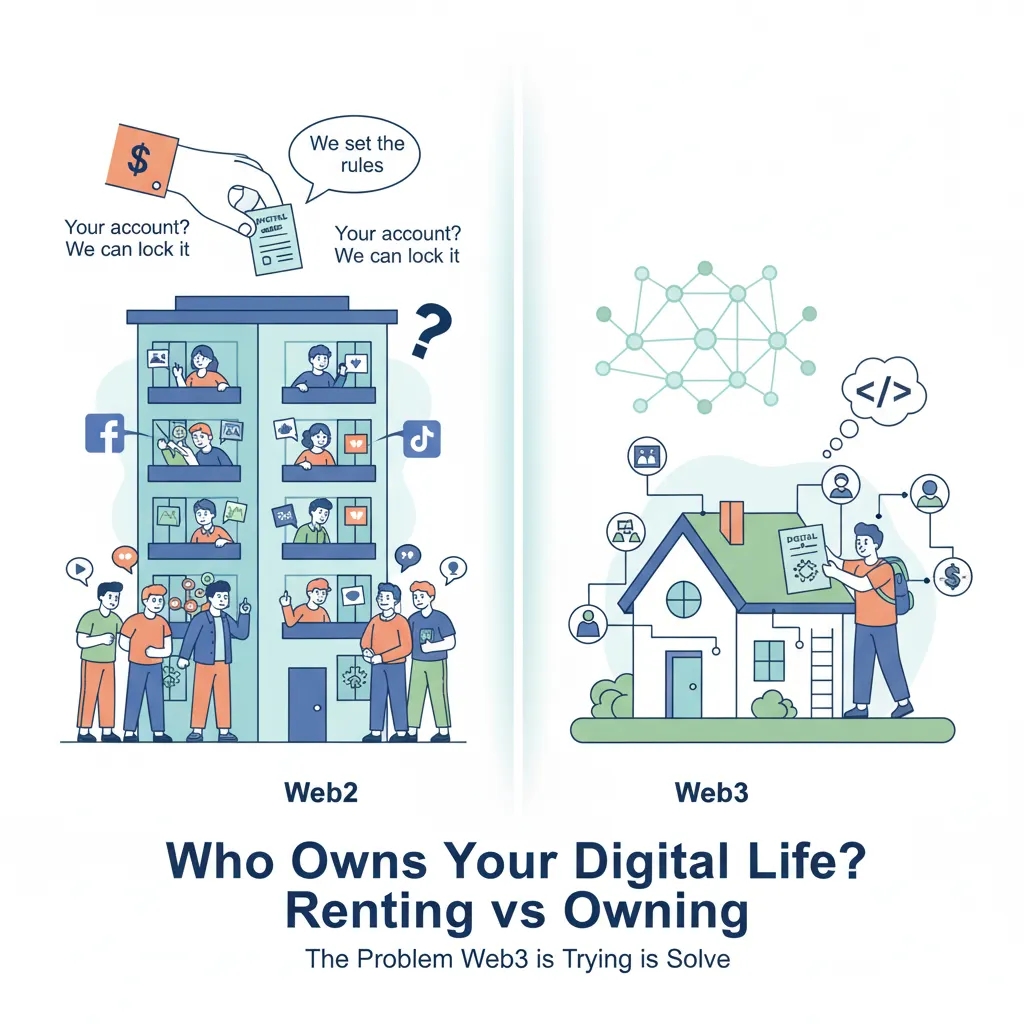
Core Concept - Web3 represents a shift from being passive "platform tenants" to owning "digital property," emphasizing digital ownership and governance as fundamental issues in the digital landscape [1][3]. Group 1: Understanding Web3 - Web3 is not merely about cryptocurrencies or avatars; it fundamentally questions who owns and controls digital identities and assets [3][4]. - The current internet (Web2) is dominated by large tech companies that control user data and interactions, making users mere tenants rather than owners [4][6]. - The core idea of Web3 is to allow users to own their "digital land," where data, identity, and content are tied to individuals and stored in personal "wallets" [4][5]. Group 2: Blockchain and Ownership - Blockchain technology underpins the concept of digital ownership by providing a decentralized and transparent method of recording transactions, ensuring that ownership cannot be easily revoked by any single entity [5][7]. - The analogy of a neighborhood group chat illustrates how blockchain records transactions collectively, making it difficult for any individual to alter the truth [5]. Group 3: Issues Addressed by Web3 - Web3 aims to resolve structural issues in Web2, such as the lack of true ownership of digital assets, where users' followers and content are owned by platforms [7]. - It seeks to decentralize content moderation, allowing community governance rather than centralized control by a few companies [7]. - Web3 proposes a more inclusive financial system that eliminates barriers to entry, enabling anyone with internet access to participate in financial activities [7]. Group 4: Challenges Facing Web3 - Many Web3 applications currently have user-unfriendly experiences, with high barriers to entry and complex processes that can lead to asset loss [8]. - Some decentralized applications still rely on centralized infrastructure, which can recreate the power structures that Web3 aims to dismantle [8]. - The Web3 ecosystem is often marred by speculative activities, leading to scams and significant losses for inexperienced users, alongside environmental concerns related to energy consumption [8]. Group 5: Evaluating Web3's Value - The discussion around Web3 is crucial as it challenges the existing internet structure and explores potential alternatives [9]. - Web3 is still in its early stages, characterized by numerous failures and unresolved issues, but it raises important questions about digital ownership and governance [9]. - The future of the internet remains open for transformation, with Web3 serving as a catalyst for rethinking the current surveillance-based structures of large tech companies [9].

Fospha:2025年销售高峰期品牌营销策略指南报告(英文版)
Sou Hu Cai Jing· 2025-12-17 10:36
今天分享的是:Fospha:2025年销售高峰期品牌营销策略指南报告(英文版) 2025年销售高峰期品牌营销策略指南核心总结 《2025年销售高峰期品牌营销策略指南》基于2023-2025年跨四大洲、三大行业的8.3万场营销活动数据,为零售品牌提供了高峰期营销的核心策略。报告指 出,高峰期(如黑色星期五、网络星期一)是品牌实现年度营收目标的关键节点,单纯依赖最后一刻的转化推动已不足以应对市场变化,提前规划、全渠道 测量与灵活适配才是成功关键。 报告核心发现显示,全漏斗投资是提升绩效的关键。将至少5%预算投入认知与考虑阶段的品牌,综合营销效率(MER)最高可提升218%,其中大型品牌 (月支出60万美元以上)受益更显著,投入超10%预算时ROAS可提高110%。传统的最后点击归因模式会遗漏90%以上的营销影响,而贝叶斯媒体混合模型 (MMM)等全漏斗测量工具,能精准呈现各渠道的真实价值。 报告共计:63页 2025年高峰期将面临宏观环境挑战,商品价格高企、消费者储蓄不足且对价格更敏感,购买窗口期缩短,竞争加剧。对此,报告强调三大核心策略:一是提 前布局认知与考虑阶段,在CPM较低、竞争较小时积累高意向受众;二是 ...

TikTok monitored Grindr activity through third-party tracker, privacy group alleges
Reuters· 2025-12-17 06:02
Core Point - A privacy advocacy group, noyb, has filed complaints against TikTok, Grindr, and AppsFlyer for allegedly breaching regional privacy laws, which could lead to the exposure of sensitive data [1] Group 1 - The complaints were submitted to Austria's data protection authority [1] - The allegations suggest that the companies risk exposing sensitive user data [1]


TikTok's Live Shopping Experience Catches on in US
Bloomberg Technology· 2025-12-16 19:26
So any big surprises here. No, not exactly. A little faster, honestly, than I thought.If you remember when we chatted with Adam Mosseri in October, he kind of hinted that this was something they were looking toward. Here we are just two months later. They do have this app that they're debuting.The one thing I'll point out is that this is just for the Amazon fire TV right now. I imagine that they want to create this app for all those different smart TV platforms. So, you know, sort of limited in scope at the ...

AI时代,我们需要“锐感力” | 林 宋琪 | TEDxNanjing
TEDx Talks· 2025-12-16 17:57
作为一个从小就非常敏感,容易大喜大悲的人,林宋琪在成长中逐渐意识到这种对情绪的敏感其实是一种可以称之为“锐感力”的宝贵天赋,在AI时代反而拥有特别的意义。 林宋琪是⼀位连续创业者、AI创业先锋,Tanka AI CEO,曾任TikTok全球商业化战略总监和Facebook集团战略经理。她北京⼤学+⾹港⼤学⾦融经济学本科毕业,却裸辞摩根⼤通,选择了互联⽹和科技领域,在Facebook从销售做到集团战略经理,后加⼊字节任战略总监,之后开始AI领域创业。4年AI圈创业经验 + 8年互联⽹经验,⾹港/⼤陆/新加坡/硅⾕多地⼯作经历,喜欢不停挑战,不停蜕变。凭借对AGI浪潮的敏锐直觉和丰富的跨国实战经验,她持续探索着在⼈⼯智能时代,技术创新与⼈类价值的全新结合点。 This talk was given at a TEDx event using the TED conference format but independently organized by a local community. Learn more at https://www.ted.com/tedx ...

福建福州冲出一家IPO,做跨境电商服务,依赖Google、TikTok等供应商
格隆汇APP· 2025-12-15 12:34
Core Viewpoint - The article discusses a new IPO from Fuzhou, Fujian, focusing on a company that provides cross-border e-commerce services, heavily relying on suppliers like Google and TikTok [1] Group 1: Company Overview - The company is positioned in the cross-border e-commerce sector, indicating a growing trend in online international trade [1] - It leverages major platforms such as Google and TikTok for its operations, highlighting the importance of digital marketing and social media in its business model [1] Group 2: Market Context - The IPO reflects the increasing interest and investment in the cross-border e-commerce industry, which has seen significant growth in recent years [1] - The reliance on established tech giants suggests a strategic approach to enhance visibility and reach in a competitive market [1]

品牌出海手册2.0:2026关键趋势+全链路策略
Sou Hu Cai Jing· 2025-12-15 05:40
Core Insights - The globalization process of Chinese brands is accelerating, with the "AI Empowering Brand Going Overseas" theme providing comprehensive guidance for enterprises [1] - The past year has seen trade frictions and regulatory changes increase costs and entry barriers for companies, but also create structural opportunities in emerging markets [1] - Key trends for 2025-2026 include a shift from "product going overseas" to "brand going overseas," AI-driven marketing intelligence, and a focus on market diversification and localization [1] Group 1: Impact of Trade and Regulations - Trade wars and new compliance regulations have significantly impacted cross-border e-commerce, with reliance on the US market declining by 10-15% [5] - Increased tariffs have raised costs by 15-20% for companies in sectors like medical devices and electronics, affecting profit margins and operational stability [7] - Compliance challenges have become critical, with many small sellers facing difficulties in meeting stringent regulations, leading to a significant portion of inquiries related to compliance issues [7] Group 2: Opportunities Arising from Challenges - The challenges have prompted companies to explore new markets, with rapid growth in regions like Southeast Asia, the Middle East, and Latin America [6] - The Belt and Road Initiative has shifted focus towards favorable policies in emerging markets, providing new opportunities for brand expansion [6] - AI tools are being utilized to enhance compliance capabilities, reducing the time needed for certification processes and enabling companies to gain market access more efficiently [7] Group 3: AI's Role in Brand Globalization - AI is becoming central to brand globalization, aiding in market insights, cultural adaptation, strategy optimization, and content generation [1][39] - Companies are encouraged to establish a "human + AI" collaborative decision-making mechanism to enhance market scanning, consumer understanding, and compliance management [1] - The integration of AI into marketing strategies is seen as essential for overcoming traditional barriers to international expansion [39] Group 4: Key Trends for Future Brand Expansion - The transition from "selling products" to "building brands" is crucial, as global consumers increasingly value brand culture and values [19] - AI-driven marketing intelligence and content production are reshaping the advertising industry, enhancing efficiency and effectiveness [20] - Companies should focus on market diversification and localization, particularly in emerging markets, to build resilience and adaptability [21] Group 5: Strategic Recommendations - Companies should embrace AI as a core tool for enhancing operational efficiency and market responsiveness [24][25] - Compliance with data security and environmental standards is becoming a competitive necessity, with proactive measures being essential for brand trust [26] - Building a localized brand presence through deep cultural understanding and tailored marketing strategies is vital for long-term success in international markets [23]

From TikTok to Labubu: How Chinese Brands Are Going Global
Bloomberg Originals· 2025-12-12 09:00
Market Trends & Soft Power - Chinese soft power is emerging globally as China moves up the value chain [1][2] - Chinese companies are investing in overseas markets, similar to post-war American companies [3] - Chinese brands are winning over global consumers and changing perceptions [4] Company Performance & Expansion - Pop Mart's annual revenue has more than tripled since 2024, with overall sales growing as much as 250% [6] - Luckin became China's biggest coffee brand in 2023, surpassing Starbucks in sales revenue and store numbers, with three times as many stores in China as Starbucks as of October 2024 [9][10] - Meituan plans to invest $1 billion over the next five years to launch in Brazil [13] Challenges & Opportunities - Chinese companies face geopolitical uncertainties, including tariffs and data privacy scrutiny [15] - Factory deflation and intense competition in China are pushing companies to seek higher profit margins overseas [14][15] - Retention is a big issue for Shein and Temu, with Temu having a user retention rate in the 60% range compared to Amazon's 93% in the US [18][19] Consumer Behavior & Technology - TikTok has over 1 billion users worldwide, including over 170 million per month in the US alone, introducing a generation of young Americans to Chinese brands [7] - Approximately 40% of all retail payments in China are made using phones, indicating a mobile-first e-commerce environment [9]
