Dollar General

Search documents
Best Stock to Buy Right Now: Realty Income vs. Vici Properties
Yahoo Finance· 2025-09-13 16:15
Core Viewpoint - Many investors are attracted to dividend-paying stocks, particularly real estate investment trusts (REITs), due to their requirement to distribute at least 90% of taxable income as dividends [1] Group 1: Realty Income - Realty Income has been operating for over 50 years and owns more than 15,600 properties, primarily generating rental income from retailers, which account for about 80% of its annual rent [4] - The company maintains a high occupancy rate of 98.6% and has achieved a 3.4% increase in rental renewal rates during the second quarter [5] - Realty Income has a history of consistently increasing dividends, having raised payouts annually for approximately 30 years, with a current annualized dividend rate of $3.23 [6][7] - The stock offers a dividend yield of 5.4%, compared to the FTSE Nareit All Equity REITs Index yield of 4% as of the end of July [9] Group 2: Vici Properties - Vici Properties, established in 2017, focuses on leasing properties to gaming and entertainment companies, which are subject to economic cycle fluctuations [10]


Kohl's Crushed Earnings Expectations, but Should You Buy the Stock Now?
The Motley Fool· 2025-08-31 13:30
Core Insights - Kohl's reported second-quarter earnings that exceeded analyst expectations, with adjusted earnings per share of $0.56 compared to the projected $0.29, and revenue of $3.35 billion versus an expectation of $3.32 billion, leading to a 24% increase in stock price [1][2] Financial Performance - The company achieved an adjusted earnings per share of $0.56, nearly double the expected $0.29 [2] - Revenue totaled $3.35 billion, slightly above the expected $3.32 billion, but down 5.1% compared to the same quarter in 2024 [2][8] - Same-store sales fell by 4.2%, indicating a decline in customer engagement [8] Management and Strategic Direction - The board of directors has not yet appointed a permanent CEO after parting ways with the previous one, creating uncertainty regarding the company's future direction [4][7] - The lack of a permanent CEO raises concerns about the sustainability of the recent positive performance [7][12] Competitive Landscape - Compared to competitors like Dollar General, which saw a 5.1% increase in sales and a 2.8% rise in same-store sales, Kohl's is struggling to resonate with customers [9] - The turnaround efforts at Kohl's appear less robust than those at Dollar General, suggesting a challenging path ahead for Kohl's [9] Operational Efficiency - Kohl's improved its gross margin and managed to cut costs, but the overall performance indicates that it is merely doing less poorly rather than showing significant improvement [10] - Until customer traffic increases, the retailer may continue to face challenges in regaining its footing [10]



X @Bloomberg
Bloomberg· 2025-08-28 11:29
Dollar General reported stronger-than-expected sales and raised its forecast, adding to signals that US shoppers are still willing to spend on items they see as good value https://t.co/tKgeM0sw9w ...
The Smartest Dividend Stock to Buy With $100 Right Now
The Motley Fool· 2025-08-22 09:10
Core Viewpoint - Realty Income is highlighted as a reliable dividend stock with a yield of 5.5%, which is one percentage point higher than the average for real estate stocks, and it has a consistent history of dividend payments [11]. Company Overview - Realty Income operates a vast portfolio, leasing over 15,600 properties across the U.S., U.K., and Europe to more than 1,600 clients, ensuring a diversified and stable income stream [6]. - The company boasts an occupancy rate of over 98%, with tenants spanning more than 90 industries, which mitigates risks associated with industry-specific downturns [6]. Sector Breakdown - The company's annualized contractual rent is distributed across various sectors, including: - Grocery stores: 10.7% - Convenience stores: 9.8% - Home improvement: 6.4% - Dollar stores: 6.2% - Fast-food restaurants: 4.9% - Drug stores: 4.6% - Automotive service: 4.3% [7]. Investment Characteristics - Realty Income is classified as a Real Estate Investment Trust (REIT), which allows it to avoid federal corporate income tax by distributing at least 90% of its profits to shareholders, resulting in above-average dividends [10]. - The company has issued its 662nd consecutive monthly dividend and has increased its dividend every quarter for over 27 years, showcasing its commitment to consistent returns [11]. Financial Performance - In the second quarter, Realty Income reported revenue of $1.41 billion, an increase from $1.34 billion year-over-year, although net income decreased to $196.9 million from $256.6 million [12]. - The stock has appreciated by 10% year-to-date, outperforming the S&P 500's return of 9%, and is projected to provide a total return of 12.5% in 2025 [12].

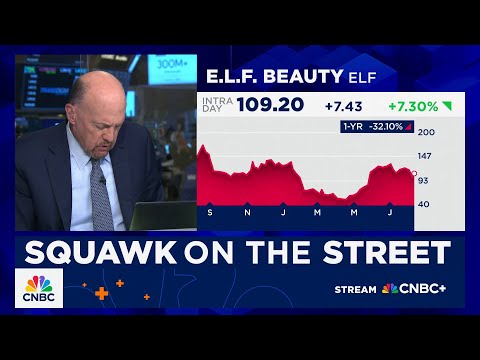
Cramer's Stop Trading: e.l.f. Beauty
CNBC Television· 2025-08-11 14:26
Company Focus - The company is a cosmetics company with rights to the "road" cosmetic line from Hailey Bieber [1] - The "road" cosmetic line will be available in Sephora next month [1] - The company is heavily shorted, but Morgan Stanley recommends a "buy" [1] Market & Distribution - Anticipation for the "road" launch at Sephora is high, potentially leading to long lines [2] - Ulta may not significantly benefit from the Sephora launch [2] - Elf products are now available in Dollar General stores, expanding rural distribution [3]

Mad Money 8/07/25 | Audio Only
CNBC Television· 2025-08-07 23:50
Hey, I'm Kramer. Welcome to Mad Money. Welcome to Crane America. Other people do my make friends. Hey, I'm just trying to make you a little money. My job is not just to teach you, but to educate, entertain, too. So, call me at 1800743 CBC. Tweet me at Jim Kramer. In any given market, you need to understand the themes, what's really going on, not in the averages, but underneath. So, on a day where the Dow lost 224 points, as we shed 008%, but the NASDAQ, where the hottest stocks are, gain 35%. Let's take a m ...



2 High-Yield Dividend Stocks to Buy in August and Hold for a Decade or Longer
The Motley Fool· 2025-08-04 07:37
Core Viewpoint - The article highlights Realty Income and W.P. Carey as attractive real estate investment trusts (REITs) for generating passive income, especially in the context of current market conditions influenced by tariffs and interest rates. Realty Income - Realty Income is a REIT that avoids income taxes by distributing nearly all profits as dividends, and it has a strong history of increasing its payouts, having raised dividends 131 times since 1994 [4] - The stock is currently down about 29% from its all-time high in early 2020, primarily due to rising interest rates [5] - Realty Income offers a yield of 5.7%, significantly higher than the average 1.2% yield from S&P 500 dividend-paying stocks [6] - Management expects adjusted funds from operations (FFO) to be between $4.22 and $4.28 per share in 2025, well above the current annualized dividend commitment of $3.228 per share [7] - The company has a diversified portfolio of 15,627 commercial properties, with major tenants including 7-Eleven, Dollar General, and Walgreens, which collectively account for only 10% of annualized rent [8][9] - Realty Income recently issued €1.3 billion in unsecured notes at an average yield of 3.7%, allowing it to maintain strong profits and competitive lease terms [9] W.P. Carey - W.P. Carey is another net lease REIT with a diverse tenant base, but it has a less consistent dividend-raising history, having lowered its dividend by 19.6% in 2023 due to a spinoff of underperforming assets [10] - The stock currently offers a yield of 5.5%, with potential for future increases as the company has raised its dividend six times since the spinoff [11] - W.P. Carey has a property portfolio of 178 million square feet, which is about half the size of Realty Income's, but it is growing rapidly, having invested $1.1 billion in new properties since early 2025 [12] - Management expects adjusted FFO to rise 4.5% this year to $4.91 per share, exceeding the current annualized dividend commitment of $3.60 per share [13] - The company maintains a high occupancy rate of 98.2%, which has not fallen below 98% since 2011, indicating a well-managed and diversified portfolio [14]


X @Arthur Hayes
Arthur Hayes· 2025-07-20 16:01
Dollar General is about to be stocking $ENA https://t.co/3Ep1lBAZkn ...
Dollar Tree Stock Sell-Off: Should You Buy the Dip?
The Motley Fool· 2025-06-27 07:23
Core Viewpoint - Dollar Tree is facing significant challenges due to trade relations with China, supply chain issues, and rising inflation, leading to a stock decline of over 40% since its 2022 high. However, the company is now focusing on its core business after spinning off Family Dollar, which may present new investment opportunities [1][11]. Company Overview - Dollar Tree operates as an ultra-discounter, offering a variety of products primarily at a $1.25 price point, with new price tiers introduced up to $7 due to inflationary pressures [4]. - The company is in the process of selling Family Dollar to two private equity firms for approximately $1 billion, having previously acquired it for over $9 billion in 2015 [5][6]. Financial Performance - In Q1 2025, Dollar Tree reported net sales of $4.6 billion, an 11% increase year-over-year, with same-store sales up 5.4% and net income rising 14% to $343 million [9]. - For the full year 2025, management projects net sales between $18.5 billion and $19.1 billion, indicating a 7% increase at the midpoint [9]. Market Position and Valuation - Despite recent losses, Dollar Tree's stock has increased by nearly 35% since the beginning of the year, although it remains down about 40% from its all-time high [10][11]. - The forward price-to-earnings (P/E) ratio is 19, suggesting that the stock may be attractive for new investors as the company refocuses on its core operations [10]. Future Outlook - The divestiture of Family Dollar is expected to allow Dollar Tree to concentrate on its primary business, potentially leading to market-beating returns and the possibility of surpassing its previous stock highs in the coming years [12].

Is Dollar Tree a Buy, Sell, or Hold in 2025?
The Motley Fool· 2025-06-20 00:05
Core Viewpoint - Dollar Tree is emerging as a compelling comeback story following a disappointing period in 2023 and 2024, driven by steady demand and operational efficiency, resulting in a 30% stock price increase year to date [1]. Company Overview - Dollar Tree operates a value-driven business model, offering a wide range of products priced at $1.25, which has attracted a loyal customer base with over 9,000 stores in the U.S. and Canada [4]. - The company has faced challenges with its Family Dollar brand, which struggled with a broader merchandising approach, leading to declining sales and profitability [5]. Strategic Moves - Dollar Tree announced the sale of its Family Dollar chain for $1 billion to a private equity group, expected to close soon, providing a significant cash infusion and streamlining operations [5][6]. - The sale comes amid uncertainties from proposed U.S. trade policy changes, with Dollar Tree estimating an additional $20 million in monthly costs due to tariffs on imported goods [6]. Financial Performance - In Q1, Dollar Tree reported an 11.6% year-over-year increase in net revenue, driven by a 5.4% rise in comparable sales and the opening of 148 new stores [7]. - The company achieved adjusted earnings per share (EPS) of $1.26, up 2.4% from the previous year, supported by strong performance in discretionary merchandise categories [8]. Future Outlook - Dollar Tree expects comparable sales growth of 3% to 5% for the full year, with an EPS target of $5.15 to $5.65, slightly below the previous year's $5.51 due to tariff costs and Family Dollar sale expenses [9]. - The stock is trading at a forward price-to-earnings (P/E) ratio of 18, which is below the average of around 25 from 2020 to 2023, suggesting potential undervaluation [10]. Competitive Landscape - Dollar Tree faces intense competition from larger rivals like Dollar General and Walmart, which could impact its market share and sales growth [12]. - The lack of a major digital strategy may hinder Dollar Tree's ability to compete effectively in the increasingly important e-commerce segment [12]. Economic Considerations - Economic uncertainties, such as a potential trade war escalation or rising unemployment, could pose significant challenges to Dollar Tree's sales estimates [13].