
浙商银行

Search documents
近30家银行,一夜消失
商业洞察· 2026-02-20 09:29
Core Viewpoint - The rapid dissolution of village banks in China, with nearly 30 banks disappearing in the first two months of 2026, indicates an accelerating trend in the consolidation and exit of these financial institutions, which have largely completed their historical mission [2][4][7]. Group 1: Current Status of Village Banks - As of early 2026, 30 village banks have been deregistered, surpassing the 231 banks that exited in the entirety of 2025, suggesting a faster pace of consolidation [2]. - Major commercial banks, particularly the 12 large joint-stock banks, are leading the integration efforts, with some banks like Everbright Bank completely exiting the village banking sector [4][6]. - The majority of village banks are now under the control of larger banks, with significant reductions in their numbers, such as Shanghai Pudong Development Bank reducing its village banks from 28 to 13 [6][7]. Group 2: Reasons for Consolidation - The consolidation is driven by the completion of the village banks' original roles, as modern banking systems like postal savings and rural credit cooperatives have taken over their functions [7]. - A significant factor in the accelerated exit of village banks is the 400 billion yuan crisis involving five village banks in Henan five years ago, which severely impacted public trust and highlighted the risks associated with these institutions [8][10]. - The operational failures of village banks, where they became akin to "personal ATMs" for their owners, have led to a loss of confidence among depositors, prompting a need for swift action from regulators [10][11]. Group 3: Overall Reform Landscape - Currently, there are approximately 1,624 village banks in China, with 1,173 (72.2%) still operational, while 451 (27.8%) have exited the market [14]. - The provinces with the highest rates of bank exits include Jilin (80.6%), Inner Mongolia (79.5%), and Hunan (62.2%), indicating regional disparities in the reform process [14]. - The ongoing reforms suggest that over half of the remaining village banks may not survive the next two years, reflecting a critical phase in the banking sector's evolution [14].


年内近30家村镇银行注销解散
21世纪经济报道· 2026-02-18 07:53
Core Viewpoint - The article highlights the accelerated pace of integration and exit of village banks by joint-stock banks, marking a shift from rapid expansion to a focus on high-quality development in the industry [1][6]. Group 1: Recent Developments in Village Bank Exits - As of the end of January 2026, Everbright Bank has completed the exit of its three village banks, achieving a total "zero" status for its village banking operations [1][3]. - Shanghai Pudong Development Bank (SPDB) is also actively pursuing the "village to branch" model, with two of its village banks exiting in early February 2026, making it one of the most active banks in this regard [1][5]. - Nearly 30 village banks have been deregistered since the beginning of 2026, significantly higher than the same period last year [1][6]. Group 2: Integration and Exit Strategies - The exit actions by Everbright Bank are characterized as a "proactive application + compliance approval" model, with the bank inheriting all rights and obligations of the exited banks [3][4]. - The trend indicates a shift towards a more specialized and high-quality development phase for village banks, as the government emphasizes risk management and transformation of local financial institutions [6][10]. - The restructuring of over 230 village banks in 2025 through mergers, acquisitions, and exits reflects a deep reshaping of the industry, driven by both state-owned and joint-stock banks [6][9]. Group 3: Differentiated Approaches Among Joint-Stock Banks - SPDB has notably accelerated its exit process, reducing its village banks from 28 to approximately 13, with significant exits occurring between July 2025 and February 2026 [8][9]. - In contrast, Minsheng Bank has retained a broader network of village banks, exiting only two out of 28, indicating a different strategic focus [9]. - Other banks like Huaxia Bank and several others have completed their exits, while some banks have not engaged in village banking at all, highlighting varied strategies across the sector [7][9]. Group 4: Implications for Industry Personnel - The integration and exit of village banks signal a transition for employees, potentially moving from subsidiary roles to formal positions within parent banks, which may offer better resources and processes [9][10]. - However, this transformation also poses challenges, including changes in job roles and assessment systems, as well as potential impacts on existing business structures and client relationships [9][10].



系统重要性银行名单更新,浙商银行首次入选
Hua Xia Shi Bao· 2026-02-15 11:57
Core Viewpoint - The People's Bank of China and the National Financial Regulatory Administration have published the list of systemically important banks for 2025, with notable changes including the inclusion of Zheshang Bank as the 10th national joint-stock bank and adjustments in rankings for several other banks [2][3][4]. Group 1: Systemically Important Banks - A total of 21 banks have been recognized as systemically important, categorized into five groups based on their importance scores [3][4]. - The first group includes 11 banks such as China Minsheng Bank and Zheshang Bank, while the second group includes 4 banks including Industrial Bank and China Postal Savings Bank [3][4]. - The list comprises 6 state-owned commercial banks, 10 joint-stock commercial banks, and 5 city commercial banks, with Zheshang Bank marking the first time the number of joint-stock banks has reached 10 [3][4]. Group 2: Regulatory Implications - Being classified as a systemically important bank enhances a bank's credibility and brand image but also necessitates greater resource allocation for internal control and risk management to meet stricter regulatory standards [2][4]. - The additional capital requirements for these banks vary by group, with the first group requiring an additional 0.25% capital and the fifth group requiring 1.5% [5][6]. Group 3: Specific Bank Analysis - Zheshang Bank, which officially opened in August 2004, reported a revenue of 33.248 billion yuan and a net profit of 7.667 billion yuan for the first half of 2025, with total assets of 3.35 trillion yuan and a non-performing loan ratio of 1.36% [6]. - The inclusion of Zheshang Bank in the systemically important list is expected to enhance its market reputation and brand influence, while also imposing stricter requirements on its capital adequacy and governance [6][7]. - For Industrial Bank, moving from the third to the second group may alleviate some capital pressure and reduce compliance costs, reflecting a relative improvement rather than a decline in operational performance [7].



银行业周报:央行关注存款搬家,2025Q4银行业净利增速回正
Zhong Guo Yin He Zheng Quan· 2026-02-15 06:24
Investment Rating - The report maintains a "Recommended" rating for the banking sector, highlighting the continued attractiveness of high dividend yields and low valuations for long-term investors [5]. Core Insights - The banking sector is expected to benefit from a stable growth in scale and a recovery in net profit growth, with a year-on-year increase of 2.33% in net profit for 2025 [9][11]. - The central bank's monetary policy will continue to be moderately accommodative, focusing on structural optimization and financial support for key areas such as domestic demand and small and medium enterprises [7][8]. - The phenomenon of "deposit migration" is impacting the liability structure of banks, but overall liquidity remains stable [8][9]. Summary by Sections Latest Research Insights - The central bank's 2025Q4 monetary policy report emphasizes maintaining ample liquidity and optimizing financial resource allocation through fiscal and monetary policy coordination [7]. - The report indicates that the average weighted interest rate for new loans in 2025 was 3.15%, a decrease of 9 basis points compared to the previous year [7]. Weekly Market Performance - The banking sector underperformed the market, with a decline of 1.31% compared to a 0.36% increase in the CSI 300 index [5]. - The current price-to-book ratio for the banking sector is 0.64, with a dividend yield of 4.64% [5]. Regulatory and Policy Updates - The banking sector's key regulatory indicators for 2025Q4 show a net profit growth recovery, with total assets increasing by 9% year-on-year [9][10]. - The non-performing loan ratio decreased to 1.5%, indicating an improvement in asset quality across various types of banks [10][11]. Investment Recommendations - The report suggests focusing on banks with low valuations and high dividend yields, recommending specific banks such as ICBC, Agricultural Bank of China, and Postal Savings Bank [5][39]. - The anticipated continuation of accommodative monetary policy and structural financial support is expected to enhance the effectiveness of policies aimed at boosting domestic demand [5][7].






最新21家系统重要性银行名单出炉 浙商银行首次上榜
Di Yi Cai Jing· 2026-02-15 00:07
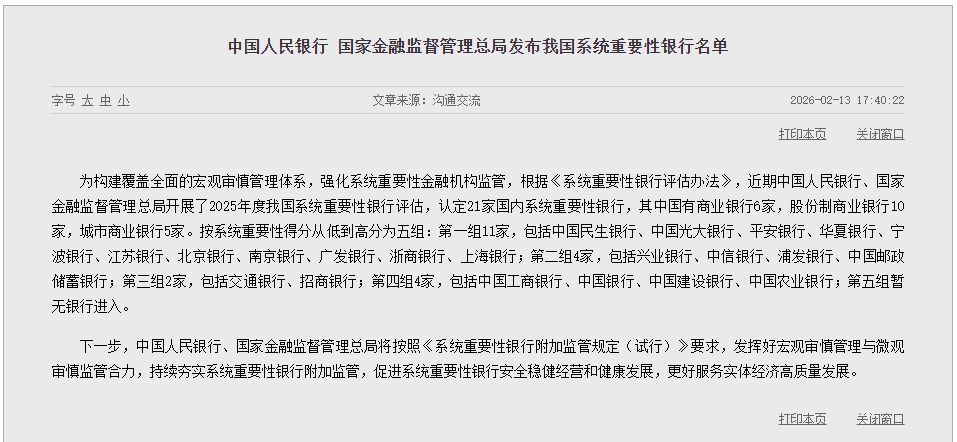
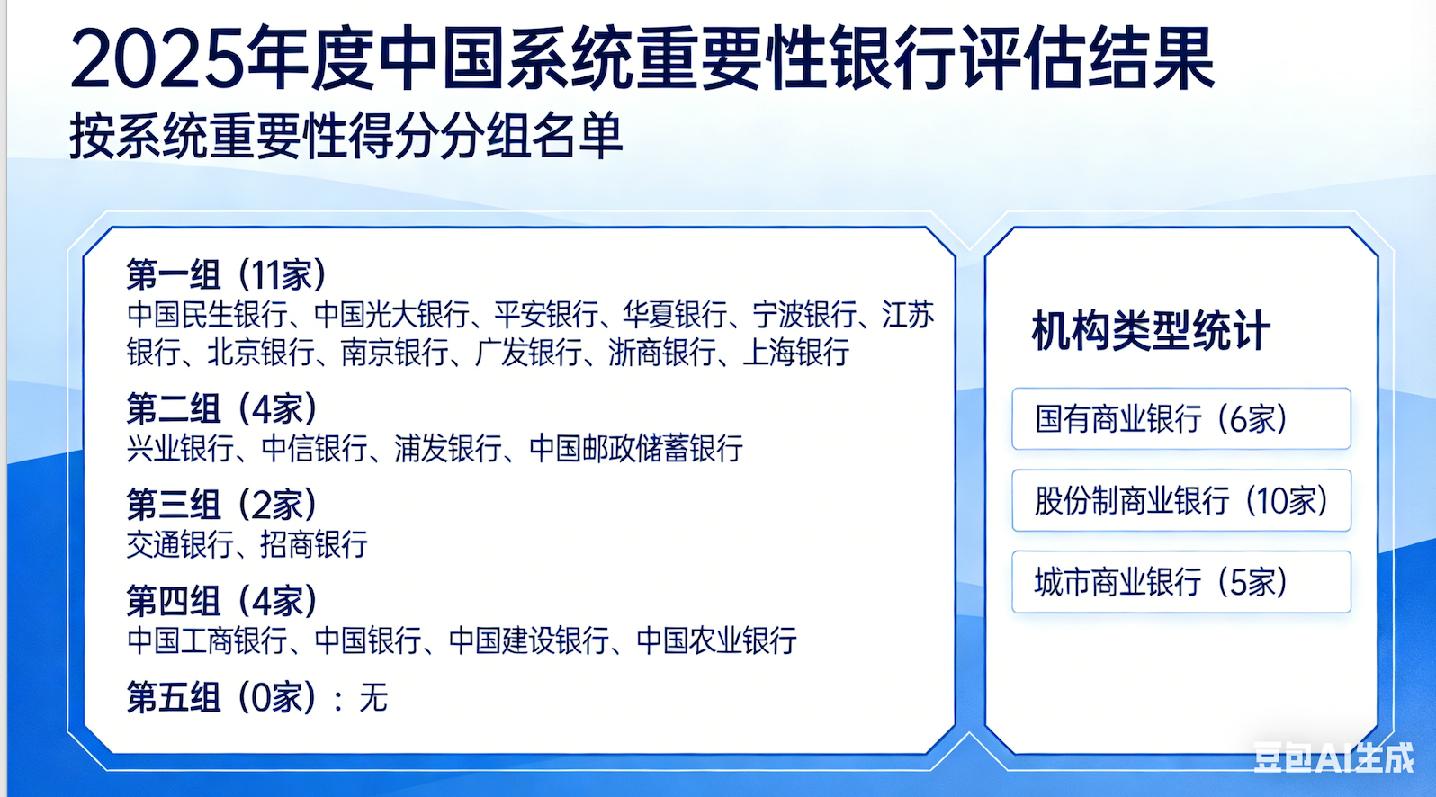
我国系统重要性银行新增一家。 系统重要性银行是指银行中规模较大、地位重要的少数银行。因为其结构和业务复杂、与其他金融 机构关联性强,在金融体系中具有举足轻重的地位,往往对其采取更严格的监管措施,以保障其更加稳 健持续发展,解决"大而不能倒"问题,防范化解金融风险,确保金融稳定和金融安全。 下一步,中国人民银行、国家金融监督管理总局将按照《系统重要性银行附加监管规定(试行)》 要求,发挥好宏观审慎管理与微观审慎监管合力,持续夯实系统重要性银行附加监管,促进系统重要性 银行安全稳健经营和健康发展,更好服务实体经济高质量发展。 (责任编辑:张厚为) 2月13日,2025年我国系统重要性银行名单公布。中国人民银行、国家金融监督管理总局开展了 2025年度我国系统重要性银行评估,认定21家国内系统重要性银行,其中国有商业银行6家、股份制商 业银行10家、城市商业银行5家。 第一财经记者注意到,与此前的名单相比,浙商银行新入选系统重要性银行,表明其系统重要性程 度有所上升。 在此次公布的名单中,按系统重要性得分从低到高分为五组:第一组11家,包括中国民生银行、中 国光大银行、平安银行、华夏银行、宁波银行、江苏银行、北京银 ...
21家银行被认定为国内系统重要性银行,资本和杠杆率要求更高
Mei Ri Jing Ji Xin Wen· 2026-02-14 23:43
Core Insights - The list of systemically important banks in China has been expanded for the first time in over two years, now including a total of 21 institutions [1][3] - The new list features two significant changes: Zhejiang Commercial Bank has been newly included, while Industrial Bank has been reclassified from the third group to the second group [3][4] Group Summary - The 21 systemically important banks are categorized into five groups based on their importance scores, with the first group containing 11 banks, including Zhejiang Commercial Bank, and the second group containing 4 banks, including Industrial Bank [4][5] - Zhejiang Commercial Bank's inclusion signals its significant scale and importance, enhancing its reputation among clients and investors, and it will now face stricter capital and leverage requirements [5][6] - Industrial Bank's reclassification to the second group indicates a relative decline in its assessment based on size, interconnectedness, substitutability, and complexity, although this does not necessarily reflect a deterioration in its operations [6][7] Regulatory Framework - Systemically important banks are subject to higher capital and leverage requirements due to their size and complexity, which are crucial for maintaining financial stability [8][9] - The assessment framework for these banks was established in December 2020, focusing on four dimensions: scale, interconnectedness, substitutability, and complexity [9] - The additional capital requirements for these banks vary by group, with the first group requiring an additional 0.25% and the second group requiring 0.5% [10][11]
浙商银行:董事长陈海强任职资格获核准
Cai Jing Wang· 2026-02-14 10:28
陈海强,1974年10月出生,浙商银行党委书记、董事长。硕士学位、正高级经济师。陈海强曾任国家开发银行杭州分 行副主任科员,招商银行宁波北仑支行行长、宁波分行党委委员、行长助理、副行长,浙商银行宁波分行党委书记、 行长,杭州分行党委书记、行长,浙商银行行长助理,浙商银行党委委员、副行长、首席风险官,浙商银行党委副书 记、行长。现兼任浙江省国际商会常务副会长。 (浙商银行) 陈海强简历 2月13日,浙商银行发布公告称,2026年2月13日,该行收到《国家金融监督管理总局关于陈海强浙商银行董事长任职 资格的批复》(金复〔2026〕93号)。根据有关规定,国家金融监督管理总局已核准陈海强的董事长任职资格。 ...
我国系统重要性银行名单发布,共计21家
Xin Lang Cai Jing· 2026-02-14 07:12
第五组,暂无银行进入。 记者2月13日从中国人民银行了解到,近期中国人民银行、国家金融监督管理总局开展了2025年度我国 系统重要性银行评估,认定21家国内系统重要性银行,其中国有商业银行6家、股份制商业银行10家、 城市商业银行5家。 中国人民银行表示,下一步将持续夯实系统重要性银行附加监管,促进系统重要性银行安全稳健经营和 健康发展,更好服务实体经济高质量发展。 按系统重要性得分从低到高分为五组: 第三组2家,包括:交通银行、招商银行; 第四组4家,包括:中国工商银行、中国银行、中国建设银行、中国农业银行; 第一组11家,包括:中国民生银行、中国光大银行、平安银行、华夏银行、宁波银行、江苏银行、北京 银行、南京银行、广发银行、浙商银行、上海银行; 第二组4家,包括:兴业银行、中信银行、浦发银行、中国邮政储蓄银行; 来源:央视新闻 ...
系统重要性银行分层洗牌:谁在晋级,谁在降组?
Jing Ji Guan Cha Wang· 2026-02-14 06:32
Core Insights - The People's Bank of China and the National Financial Regulatory Administration released the list of systemically important banks (D-SIBs) for 2025, expanding the number of institutions from 20 to 21, with Zheshang Bank being the new addition [1][3] - The list reflects a significant internal reshuffling, with Industrial Bank being downgraded from the third group to the second group, indicating a re-evaluation of systemic risk profiles by regulators [3][8] Group Summaries - **First Group (10 Banks)**: Includes China Everbright Bank, China Minsheng Bank, Ping An Bank, Huaxia Bank, Ningbo Bank, Jiangsu Bank, Guangfa Bank, Shanghai Bank, Nanjing Bank, and Beijing Bank [5] - **Second Group (4 Banks)**: Comprises CITIC Bank, Shanghai Pudong Development Bank, China Postal Savings Bank, and now includes Industrial Bank [5][8] - **Third Group (3 Banks)**: Contains Bank of Communications, China Merchants Bank, and Industrial Bank [5][6] - **Fourth Group (4 Banks)**: Dominated by the four major state-owned banks: Industrial and Commercial Bank of China, Bank of China, China Construction Bank, and Agricultural Bank of China [5][6] - **Fifth Group (0 Banks)**: No banks are currently classified in this group, which has the highest additional capital requirements [10] Zheshang Bank's Inclusion - Zheshang Bank's inclusion in the first group is attributed to its performance across four dimensions: scale, interconnectedness, substitutability, and complexity, achieving a weighted score that meets the threshold [6][11] - As of Q3 2025, Zheshang Bank's asset size reached 3.39 trillion yuan, with a core Tier 1 capital adequacy ratio rising by 0.02 percentage points to 8.40% [6][11] Industrial Bank's Downgrade - Industrial Bank's downgrade to the second group signifies a reduction in regulatory costs, as the additional capital requirement drops from 0.75% to 0.5%, potentially freeing up hundreds of billions in capital [8][10] - The downgrade reflects a shift in the competitive landscape, where Industrial Bank's relative advantages in market operations may have diminished due to the performance of peer banks [8][11] Regulatory Dynamics - The release of the new list comes after a gap of nearly 18 months, indicating a shift in regulatory oversight and a more cautious approach to data evaluation by the authorities [9][10] - The regulatory framework emphasizes both macro-prudential and micro-prudential management, requiring banks to meet various additional capital and leverage ratio requirements based on their group classification [10][11]
系统重要性银行扩围至21家:浙商银行突围,兴业银行跌落第三组
Jing Ji Guan Cha Wang· 2026-02-14 06:32
Core Viewpoint - The People's Bank of China and the National Financial Regulatory Administration have updated the list of Domestic Systemically Important Banks (D-SIBs), increasing the total from 20 to 21, with Zhejiang Commercial Bank being newly included [2][3]. Group Summaries Group 1 - The first group now includes 10 banks, such as China Everbright Bank, Minsheng Bank, and Ping An Bank, reflecting a strong position in the financial system [6]. - Zhejiang Commercial Bank's inclusion in this group indicates its significant role and improved risk profile within the banking sector [4][8]. Group 2 - The second group consists of four banks, including Citic Bank, Shanghai Pudong Development Bank, and Postal Savings Bank, with the addition of Industrial Bank [3][6]. - The adjustment of Industrial Bank to this group signifies a shift in its risk assessment and regulatory requirements [4]. Group 3 - The third group includes three banks: Bank of Communications, China Merchants Bank, and Industrial Bank, which maintain advantages in cross-regional operations and market coverage [3][6]. - The downgrade of Industrial Bank from the third to the second group reflects a relative loss of competitive edge in the financial market [6]. Group 4 - The fourth group remains unchanged with the four major state-owned banks: ICBC, ABC, BOC, and CCB, which continue to be the backbone of the national financial system [3][6]. - These banks are subject to the highest regulatory scrutiny due to their systemic importance [3]. Regulatory Insights - The update of the D-SIB list demonstrates a dynamic adjustment in the assessment of systemic risk, emphasizing the importance of both macro and micro-prudential regulations [3][7]. - The additional capital requirements for each group range from 0.25% to 1.5%, with the first group facing the lowest and the fifth group (currently empty) facing the highest [7][8]. - The regulatory framework aims to ensure that banks not only meet micro-level indicators but also adhere to macro-level capital and leverage requirements [7].