
Samsung SDI

Search documents
Samsung SDI says discussing supplying Tesla with ESS batteries, nothing decided
Reuters· 2025-11-03 23:21
Core Viewpoint - Samsung SDI is in discussions to supply Energy Storage System (ESS) batteries to Tesla, with the potential order valued at approximately 3 trillion won ($2.11 billion) or more [1] Group 1: Company Developments - Samsung SDI is exploring a significant supply agreement with Tesla for ESS batteries [1] - The reported value of the potential order is around 3 trillion won, equivalent to $2.11 billion [1] Group 2: Industry Implications - The collaboration between Samsung SDI and Tesla highlights the growing demand for energy storage solutions in the electric vehicle and renewable energy sectors [1]



Elon Musk-Led Tesla Pens $2 Billion Energy Storage Deal With Samsung After 44% Growth In Q3: Report - NVIDIA (NASDAQ:NVDA), Tesla (NASDAQ:TSLA)
Benzinga· 2025-11-03 11:51
Group 1 - Tesla Inc. has agreed to a $2 billion deal with Samsung SDI to supply energy storage system batteries over the next three years [2][3] - Tesla's Energy Storage business has experienced a 44% growth, generating $3.4 billion in revenue, which accounts for 12% of the company's total revenue [3] - Tesla previously signed a $4.3 billion deal with LG Energy Storage Solutions for LFP batteries for its energy storage systems [4] Group 2 - Redwood Materials, a battery recycling and energy storage startup founded by Tesla co-founder JB Straubel, secured over $350 million in Series E funding, with backing from Nvidia's NVentures [5] - Tesla scores well on Momentum and Quality metrics, with satisfactory Growth but poor Value, and has a favorable price trend in the short, medium, and long term [6]
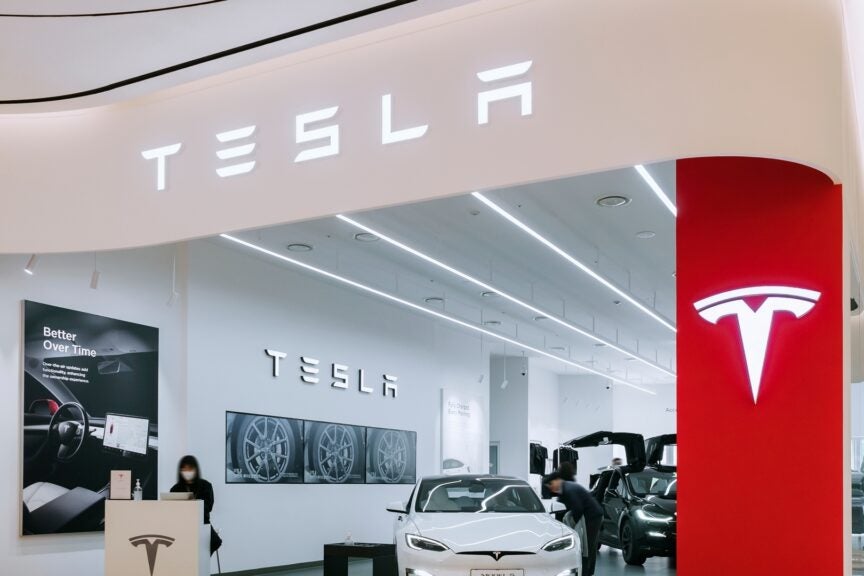
Tesla to buy $2 bln of ESS batteries from Samsung SDI over 3 years, newspaper says
Reuters· 2025-11-03 08:45
Core Insights - Samsung SDI has signed an agreement with Tesla to supply over 3 trillion won ($2.11 billion) worth of Energy Storage System (ESS) batteries over a three-year period [1] Company Summary - The agreement signifies a strategic partnership between Samsung SDI and Tesla, enhancing Tesla's battery supply chain for energy storage solutions [1] - The deal reflects Samsung SDI's commitment to expanding its presence in the energy storage market, which is expected to grow significantly in the coming years [1] Industry Summary - The energy storage market is becoming increasingly important as demand for renewable energy solutions rises, and companies like Samsung SDI are positioning themselves to capitalize on this trend [1] - This agreement may indicate a broader trend of collaboration between battery manufacturers and electric vehicle producers, as both sectors seek to innovate and meet growing energy demands [1]
Best ETF For The Critical Minerals Boom? Here Are Rare Earth Winners
Benzinga· 2025-10-31 17:22
Core Insights - A significant demand for critical minerals is emerging, essential for electric vehicles, batteries, and clean energy systems, with two U.S.-listed ETFs, VanEck Rare Earth And Strategic Metals ETF (REMX) and Amplify Lithium & Battery Technology ETF (BATT), positioned at the forefront of this trend [1][2] ETF Overview - REMX focuses on rare earth and strategic metal miners, tracking the MVIS Global Rare Earth/Strategic Metals Index, and includes companies like MP Materials Corp, Lynas Rare Earths, and Pilbara Minerals, which are crucial in the U.S.-China supply chain dynamics [3] - BATT tracks the EQM Lithium & Battery Technology Index, combining miners such as Albemarle Corp and Glencore with downstream manufacturers like Panasonic and Samsung SDI, thus capturing both extraction and downstream demand from the EV and energy storage sectors [4] Performance Metrics - Both ETFs have expense ratios between 0.58% and 0.59%, with REMX managing approximately $1.3 billion in assets and BATT around $91 million; REMX has shown a 79% year-to-date return, while BATT has returned 55% year-to-date, reflecting differing investor interests and market conditions [5] - REMX's performance is heavily influenced by Chinese policy risks, while BATT's broader focus ties its performance to EV adoption and battery margins [6] Investment Implications - For investors interested in mining geopolitics, REMX offers a concentrated investment in supply scarcity, while BATT may appeal to those seeking a more diversified exposure to the clean energy sector [7]

X @Bloomberg
Bloomberg· 2025-10-28 05:54
South Korean battery maker Samsung SDI is in talks with multirole humanoid robot makers to supply batteries as it seeks to diversify revenue sources https://t.co/pCNSdEx4IP ...
电池周刊 10 月 20 日-Battery Weekly 20 October
2025-10-23 13:28
Summary of Key Points from the Conference Call Industry Overview - **Industry**: Global Energy Storage and Electric Vehicles (EVs) - **Key Focus**: Developments in battery technology, EV sales, and market dynamics Key Insights 1. **Record NEV Sales in China**: In September, China recorded 1.6 million new energy vehicles (NEVs), marking a 24.6% increase year-over-year and a 15.0% increase from August. Battery electric vehicles (BEVs) surpassed one million units for the first time, with exports doubling compared to September 2024, although they stagnated at around 222,000 units, representing 13.8% of total NEV sales in China [1][1][1] 2. **POSCO Future M's Supply Deal**: POSCO Future M signed a $470 million contract to supply natural graphite anode materials to a global automaker, highlighting its growing role in the battery materials supply chain. The deal could expand to a total value of 1.7 trillion won if extended to ten years [1][1][1] 3. **BYD's Vehicle Recall**: BYD, the largest EV manufacturer, is recalling over 115,000 vehicles due to technical defects, raising concerns about quality control. The recalls involve both hybrid and pure-electric models, with issues related to component design and battery waterproofing [1][1][1] 4. **Air China Flight Incident**: A fire caused by a lithium battery in a passenger's luggage forced an Air China flight to divert. This incident has led to increased scrutiny and regulations regarding the transport of lithium batteries on flights [1][1][1] 5. **China's EV Charging Capacity Plan**: The National Energy Administration of China aims to double the service capacity of EV charging facilities to over 300 GW by 2027, expanding the national charging network to around 28 million facilities [2][2][2] 6. **SK On's New Battery Prototype**: SK On is manufacturing prototypes of its new 46-series cylindrical batteries in China, with a production capacity of 300,000 units per year. This positions SK On to compete in the growing battery market [2][2][2] 7. **Fluence's Market Outlook**: Fluence Energy anticipates that the US will account for half of its demand in 2026, driven by increased power demand from electrification and data center growth. The company is working to meet eligibility requirements for federal incentives [5][5][5] 8. **US EV Market Dynamics**: In Q3, US electric vehicle sales reached 438,500 units, representing 11% of all new car sales, driven by consumers rushing to take advantage of federal incentives before they expired [5][5][5] 9. **GM and Posco's Plant Expansion Halt**: GM and Posco have paused the expansion of their joint cathode material plant in Canada due to changing market dynamics, although the initial phase of the project remains on track [5][5][5] 10. **Synthetic Graphite Production in Europe**: Imerys and Shanshan are partnering to produce synthetic graphite in Europe, aimed at supplying high-performance materials for lithium-ion battery anodes [5][5][5] 11. **Norway's EV VAT Changes**: Norway plans to phase out the VAT exemption for electric vehicles by 2027, reducing the threshold from NOK 500,000 to NOK 300,000, which has drawn criticism from the Electric Vehicle Association [6][6][6] Additional Insights - **Cobalt Price Dynamics**: Rising cobalt prices due to export limits in the Democratic Republic of Congo may push battery makers to seek alternatives, as prices have more than doubled recently [10][10][10] - **BYD's Flash Charging Stations**: BYD plans to introduce 'flash charging' stations in South Africa, allowing vehicles to recharge significantly in a short time, which could enhance the EV infrastructure in the region [10][10][10] - **Battery Material Prices**: Recent data indicates fluctuations in battery material prices, with cobalt prices rising significantly while lithium prices show signs of stabilization [8][8][8] This summary encapsulates the critical developments and insights from the conference call, providing a comprehensive overview of the current state of the global energy storage and electric vehicle industries.

投资者简报-存储器、特种工程塑料、中国数据中心与光模块-Investor Presentation Asia Pacific-Tuesday TMT Webcast Memory, SPE, China IDC vs. Transceiver
2025-09-17 01:51
Summary of Key Points from the Conference Call Industry Overview - **Industry Focus**: The conference call primarily discusses the semiconductor industry, particularly in the context of memory technology and production equipment in Asia Pacific, with a specific emphasis on NAND technology and its evolution due to AI advancements [1][4][21][23]. Core Insights and Arguments - **NAND Technology and AI**: The integration of AI is expected to significantly impact NAND technology, enhancing its capabilities and applications [21][26]. - **Investment Themes**: Various investment themes are highlighted, including advanced packaging, high bandwidth memory (HBM), and flash memory, which are crucial for edge AI applications [9][11]. - **Equipment Impact**: The call outlines how different types of semiconductor production equipment are affected by industry drivers, including steppers, coater/developers, and memory testers, indicating a diverse range of equipment that will see varying levels of demand [9][11]. Equipment and Performance Metrics - **Performance Metrics**: The call provides specific metrics on equipment performance, such as throughput rates for fan-out packaging, indicating a significant increase in efficiency with new technologies [11]. - **Adoption of FOPLP**: The advantages of adopting Fan-Out Panel Level Packaging (FOPLP) are discussed, showcasing improvements in carrier size, usable area, and throughput compared to traditional methods [11]. Analyst Ratings and Coverage - **Analyst Ratings**: The document includes a list of companies within the South Korean technology sector, detailing their stock ratings and recent price points, indicating a mix of overweight, equal-weight, and underweight ratings across various firms [77][79]. - **Market Positioning**: Companies like Samsung Electronics and SK hynix are highlighted as key players in the semiconductor market, with ongoing investment banking relationships noted for several firms [36][38]. Additional Important Information - **Research Disclosures**: The call emphasizes the importance of understanding potential conflicts of interest in research, as Morgan Stanley may have business relationships with the companies discussed [2][31][35]. - **Global Market Context**: The performance of the semiconductor industry is expected to be in line with broader market benchmarks, suggesting a stable outlook for investors [4][50]. This summary encapsulates the critical insights and data points from the conference call, providing a comprehensive overview of the semiconductor industry's current landscape and future prospects.
中国电池行业_季节性供需紧张推升电池涨价预期;我们保持谨慎-China Battery Sector_ Seasonal S_D tightness leading to battery price hike expectations; we stay cautious
2025-09-12 07:28
Summary of the China Battery Sector Conference Call Industry Overview - The conference call focused on the **China Battery Sector**, highlighting recent trends and expectations regarding battery prices and market dynamics [1][2]. Key Points Price Trends and Market Dynamics - The **Wind China lithium battery index** has increased by approximately **40%** over the past **60 trading days**, outperforming the **CSI300** index, which gained **18%** [1]. - Major players like **CATL** have seen their A/H shares rise by **33%/40%**, while tier 2 manufacturers such as **EVE Energy**, **Gotion High-tech**, and **CALB** have experienced share price increases of **50-80%** [1]. - Despite the current tightness in the battery market, there is caution regarding the sustainability of price hikes due to expected seasonal weaknesses in **Q1 2026** and a balanced supply-demand dynamic [2][10]. Earnings Sensitivity and Valuation - A sensitivity analysis indicates that a **10%** increase in battery prices could lead to a **30%-60%** upside in earnings for **2026E** [2][10]. - The recent rally in share prices has already priced in **2%-5%** battery average selling price (ASP) hikes for **2026E** [3][15]. - Current trading P/E ratios for CATL-A, Gotion, EVE Energy, and CALB are **17x, 21x, 18x, and 21x** respectively, compared to target P/Es of **20x, 24x, 16x, and 18x** [3]. Company Preferences and Target Prices - **CATL** and **Gotion** are preferred within the coverage due to their potential benefits from a cyclical recovery and attractive valuations [4][27]. - Target prices have been raised as the market begins to price in a cyclical recovery for **2026E** [27]. Capacity Utilization and Capital Expenditure - Industry utilization is expected to recover to **72%/74%** in **2025E/26E** from **63%** in **2024** [10]. - Tier 1 and 2 capacity utilization is projected to remain above **90%** for the remainder of the year, with a **50%** recovery in capital expenditure likely to cap battery price increases [10][25]. Investment Theses for Key Companies - **CATL**: Expected to deliver a **24% EPS CAGR** from **2024-2030E**, driven by volume growth and improving product mix [32]. - **Gotion**: Positioned well for overseas expansion, particularly with partnerships like Volkswagen, and rated as a **Buy** [34]. - **EVE Energy**: Transitioning to EV/ESS battery supply with a focus on diversified demand, but rated **Neutral** due to potential profit caps [35]. - **CALB**: Gaining market share through competitive pricing, but profitability may be impacted; rated **Neutral** [37]. - **Farasis**: Facing challenges with high costs and increasing domestic market exposure, leading to a **Sell** rating [38]. Additional Insights - The market is currently navigating through a period of **seasonal supply tightness**, which is expected to last longer than previous instances [10]. - The potential for battery price hikes remains uncertain, influenced by market share dynamics and demand volatility into **2026E** [10]. - The report emphasizes the importance of monitoring quarterly earnings and market conditions as catalysts for share price movements [33]. This summary encapsulates the key insights and projections discussed during the conference call regarding the China Battery Sector, focusing on price trends, company performance, and market dynamics.



电池周报_8 月 18 日-Battery Weekly 18 August
2025-08-22 01:00
Summary of Key Points from the Conference Call Industry Overview - **Industry**: Global Energy Storage and Electric Vehicle (EV) Battery Market - **Key Players**: LG Energy Solution (LGES), Samsung SDI, SK On, Posco Future M, Ganfeng Lithium, CATL, Ford Motor Co. Core Insights 1. **Declining Plant Utilization Rates**: Major battery manufacturers are experiencing a steady decline in factory utilization rates due to a slump in the EV market. LGES reported a utilization rate of 51.3% in the first half of the year, down from 73.6% in 2022 and 57.8% last year [1][1][1] 2. **China's NEV Sales Trends**: In July, China's new energy vehicle (NEV) sales reached 1,262,000 units, a 27% year-on-year increase, but a slight decrease from June. Battery-electric vehicles (BEVs) saw a 47.1% increase year-on-year, while plug-in hybrids (PHEVs) experienced a decline in demand [1][1][1] 3. **Strategic Partnerships**: Posco Future M signed an MOU with CNGR Advanced Material to expand its battery materials business, focusing on cathode materials for various battery types [1][1][1] 4. **Ganfeng Lithium's Restructuring**: Ganfeng Lithium is consolidating its lithium assets in Argentina and providing a USD130 million loan to its partner, Lithium Argentina, to support the development of a lithium salt separation production line [1][1][1] Market Dynamics 5. **U.S. EV Battery Imports**: U.S. imports of lithium-ion batteries from Korea surged by 1,320% to $234.5 million in the first half of the year, while imports from China fell by 58% to $683 million. Korea's market share in U.S. EV battery imports increased from 0.73% to 13.1% [5][5][5] 6. **Ford's EV Strategy**: Ford announced a $5 billion investment to develop a new line of budget electric vehicles, aiming to compete with Chinese EV manufacturers. The first model is expected to be a mid-sized pickup truck priced at $30,000 [5][5][5] 7. **Korean Battery Material Recovery**: Korean battery material manufacturers anticipate a recovery in the latter half of the year, driven by U.S. policy changes and growth in the energy storage system market [5][5][5] Regional Insights 8. **Scandinavian EV Sales Growth**: Electric vehicle registrations in Norway exceeded 95% of new registrations in July, with other Scandinavian countries also showing significant growth in EV sales [5][5][5] 9. **UK Electric Van Market**: Battery-electric van registrations in the UK rose by 72.6% year-on-year in July, indicating strong growth in the zero-emission light commercial vehicle market [5][5][5] Financial Performance 10. **Battery Material Prices**: Lithium carbonate (LiCO) spot prices are at $11,691 per tonne, with a 1-year price increase of 13%. Lithium hydroxide (LiOH) spot prices are at $10,786 per tonne, with a 1-year increase of 7% [7][7][7] 11. **Company Valuations**: LGES has a market cap of $49.5 billion with a P/E ratio of 344.8x, while Samsung SDI has a market cap of $10 billion with a P/E ratio of 48.3x. CATL has a market cap of $160.6 billion with a P/E ratio of 17.2x [8][8][8] Additional Insights 12. **Li-Cycle Acquisition**: Glencore has finalized the acquisition of Li-Cycle, enhancing its battery recycling capabilities with one of the largest battery recycling plants in Europe [6][6][6] 13. **CATL's Expansion**: CATL has opened flagship stores for its service brand Ning in Shanghai and Bangkok, expanding its service network to 75 countries [2][2][2] This summary encapsulates the key points from the conference call, highlighting the current state and future outlook of the global energy storage and EV battery market.
电力 -是否有足够电力满足人工智能增长需求-Bernstein Energy & Power_ Is there enough power to meet AI growth_
2025-08-18 02:52
Summary of Key Points from the Conference Call Industry Overview - The focus of the conference call is on the energy sector, specifically the implications of increasing power demand driven by AI growth and other factors [2][18]. Core Insights and Arguments 1. **Electricity as a Limiting Factor for AI Growth**: The availability of electricity is identified as a critical constraint for the growth of AI technologies, as highlighted by tech leaders [2][18]. 2. **Projected Power Demand Growth**: Global power demand is currently at 30,000 TWh, with the IEA forecasting it to reach 60,000 TWh by 2050. Bernstein estimates this could be as high as 70,000 TWh, representing a 3% CAGR [3][21]. 3. **Historical Power Demand Trends**: Power demand grew by 4.3% last year, one of the largest increases in 30 years, with a power multiplier of 1.31, indicating increasing power intensity in the global economy [6][7]. 4. **Demographic Impact on Power Demand**: Future power demand growth may slow due to demographic changes, with global population growth expected to decrease to 0.8% CAGR by 2050 [9][13]. 5. **Drivers of Increased Power Demand**: Four main drivers are identified: AI, electrification of transport, cooling needs due to global warming, and the transition to net-zero energy sources [18][24]. Additional Important Insights 1. **AI's Role in Power Demand**: AI is projected to be a significant driver of incremental power demand, with estimates suggesting that by 2050, AI could account for nearly 15,000 TWh, or 25% of global electricity demand [20][21]. 2. **Cooling Demand**: The demand for air conditioning is expected to triple, potentially increasing power consumption to 6,300 TWh by 2050 due to rising global temperatures [23][24]. 3. **Electrification of Transport**: Electric vehicles (EVs) are projected to account for 8% of total electricity demand by 2050, with potential additional demand from heavy electric trucks and other electric transport modes [24][25]. 4. **Transition from Fossil Fuels**: The gradual replacement of fossil fuels with electricity in various sectors is anticipated to significantly increase power demand, with heat pumps and electric furnaces contributing to this shift [25][26]. 5. **Renewable Energy Supply Challenges**: To meet the projected demand of 70,000 TWh, a substantial increase in renewable energy sources, particularly solar and wind, is necessary. Current projections suggest that solar and wind could account for 60% of the power mix by 2050 [28][42]. Investment Implications 1. **Investment Opportunities**: The report suggests that investments in solar, wind, and energy storage technologies will be crucial to meet future energy needs. Companies involved in these sectors may benefit from the anticipated growth in power demand [39][42]. 2. **Risks of Dependency on Supply Chains**: The reliance on China for solar and wind supply chains poses risks for Western countries, particularly the US, in achieving energy independence and meeting renewable energy targets [32][42]. 3. **Nuclear Power Limitations**: While nuclear power will play a role, its scalability is limited compared to solar and wind, making it less viable as a primary solution for meeting future energy demands [35][42]. This summary encapsulates the key points discussed in the conference call, highlighting the critical relationship between AI growth and electricity demand, the projected trends in power consumption, and the implications for investment in the energy sector.