iShares

Search documents
海外创新产品周报20251110:商品多空策略产品发行-20251110
Shenwan Hongyuan Securities· 2025-11-10 11:57
Group 1: Report Summary - The report focuses on the latest developments in US ETFs and public mutual funds, including new product launches, capital flows, and performance [2] Group 2: New US ETF Products - Last week, 19 new products were launched in the US, with more than half being single - stock products. These included 2x leveraged products, leveraged + option strategy products, and other types [5] - Stoneport Advisors issued a commodity long - short strategy product, which uses a quantitative method to construct a long - short strategy for US - listed commodity futures [6] - First Trust launched a "critical metals" ETF, investing in 50 stocks related to new - energy and technology metals [6] - iShares issued a large - cap core index enhancement product and a European corporate bond product [7] - KraneShares launched an options strategy product using a Delta - neutral spread strategy [7] Group 3: US ETF Dynamics 3.1 US ETF Capital Flows - In the past week, US ETF inflows exceeded $30 billion, with significant inflows into stock products and outflows from Bitcoin ETFs [8] - BlackRock's S&P 500 ETF ranked first in inflows, short - term bond ETFs had obvious inflows, while technology - related products and Bitcoin ETFs had outflows [11] 3.2 US ETF Performance - Korean - related products led the gains among US - listed stock ETFs this year. Two passive products had gains of over 80%, and a 3x leveraged product had a gain of over 300%. However, except for the largest product with a scale close to $7 billion, the other products had small scales [14] Group 4: Recent Capital Flows of US Public Mutual Funds - In September 2025, the total amount of non - money public mutual funds in the US was $23.47 trillion, an increase of $0.49 trillion from August 2025. The S&P 500 rose 3.53% in September, and the scale of US domestic equity products increased by 2.13%, but the redemption pressure increased [15] - Last week, the outflows of US domestic equity funds expanded to $37 billion, and bond products also had small outflows [16]
海外创新产品周报:商品多空策略产品发行-20251110
Shenwan Hongyuan Securities· 2025-11-10 10:17
Report Summary 1. Report Industry Investment Rating No industry investment rating is provided in the report. 2. Core Viewpoints - The US ETF market has new developments, with the issuance of a commodity long - short strategy product and continuous inflow of funds into stock products. Meanwhile, the performance of Korean - related ETF products is outstanding. The US non - money public funds have experienced changes in scale and redemption pressure, and recently, domestic stock funds have seen an expanded outflow [2]. 3. Summary by Relevant Catalogs 3.1 US ETF Innovation Products: Commodity Long - Short Strategy Product Issuance - Last week, 19 new products were issued in the US, more than half of which were single - stock products. These single - stock products involve 2x leveraged products and products combining options and leverage, targeting various companies such as those in the cryptocurrency, sports, health, and AI sectors [7]. - Stoneport Advisors issued a commodity long - short strategy product, which tracks an index using a quantitative method to construct a long - short strategy for US - listed commodity futures. The index determines the investable pool annually based on the S&P GSCI and Dow Jones Commodity Index, currently including 23 commodities from sectors like agriculture, precious metals, industrial metals, and energy. It decides long - short weights monthly according to the yield trend algorithm [8]. - First Trust issued a "critical metals" ETF, investing in companies mainly earning income from North America and involved in the mining of new - energy - related metals, new - energy vehicle metals, and other technology metals, ultimately selecting 50 stocks [8]. - iShares issued a large - cap core index enhancement product aiming for low tracking error against the Russell 1000 index and excess returns, managed by a quantitative team, and a European corporate bond product using euro - dollar foreign exchange hedging to reduce exchange - rate impact [10]. - KraneShares issued an options strategy product, using a Delta - neutral spread strategy by buying put options and selling call options while selecting stocks to obtain option premium differences [10]. 3.2 US ETF Dynamics 3.2.1 US ETF Funds: Stock Products Continuously Inflow - In the past week, the inflow of US ETFs exceeded $30 billion, with significant inflow into stock products and outflow from Bitcoin ETFs. BlackRock's S&P 500 ETF ranked first in inflow, short - term bond ETFs had obvious inflows, while technology - related products and Bitcoin ETFs had outflows [2][11][14]. - Gold ETFs had relatively stable fund flows last week, and among broad - based ETFs, the S&P 500 had higher inflows than the Nasdaq 100 in the past two weeks [16]. 3.2.2 US ETF Performance: Korean - Related Products Lead in Gains - US - listed stock ETFs have performed excellently this year. Two passive products have gains of over 80%, and 3x leveraged products have gains of over 300%. However, except for the largest product with a scale close to $7 billion, other products have relatively small scales [17]. 3.3 Recent US Ordinary Public Fund Fund Flows - In September 2025, the total amount of US non - money public funds was $23.47 trillion, an increase of $0.49 trillion compared to August 2025. In September, the S&P 500 rose 3.53%, the scale of US domestic equity products increased by 2.13%, and the redemption pressure increased [2][18]. - Last week, the outflow of US domestic equity funds expanded to $37 billion, and bond products also had a slight outflow [2][19].
The iShares Bitcoin Trust ETF Grows to $88 Billion Handily Beating the VanEck Bitcoin ETF
The Motley Fool· 2025-11-09 18:17
Core Insights - The VanEck Bitcoin ETF (HODL) and iShares Bitcoin Trust ETF (IBIT) are designed to closely track Bitcoin's price, providing investors with direct exposure to the cryptocurrency's performance [1] Cost & Size - HODL has an expense ratio of 0.20%, making it slightly more affordable than IBIT's 0.25% [2] - As of November 3, 2025, HODL has $2.0 billion in assets under management (AUM), while IBIT has significantly larger AUM of $88.0 billion [2] Holdings - IBIT primarily holds Bitcoin with small cash amounts, aiming to match Bitcoin's price performance; it is relatively new at 1.8 years old [3] - HODL also holds 100% Bitcoin, tracking its price passively without any added complexity [4] Performance - Over the 12 months ending November 4, 2025, IBIT rose by 45.16%, while HODL delivered a slightly better return of 45.47% [7] Fee Structure - HODL is waiving all sponsor fees for the first $2.5 billion of its assets until January 10, 2026, allowing investors to buy shares without fees [5][6] - After January 10, 2026, HODL will charge a 0.20% fee [6]
LQD Offers Broader Bond Exposure Than VCLT, But With Higher Fees and Lower Yield
The Motley Fool· 2025-11-09 17:37
Core Insights - The Vanguard Long-Term Corporate Bond ETF (VCLT) and the iShares iBoxx Investment Grade Corporate Bond ETF (LQD) focus on investment-grade U.S. corporate bonds but differ in maturity range, diversification, and cost structure, making them suitable for different types of fixed-income investors [1] Cost & Size Comparison - VCLT has a lower expense ratio of 0.03% compared to LQD's 0.14%, providing a cost advantage [2][3] - As of November 6, 2025, VCLT has a 1-year return of -1.21%, while LQD has a return of 1.34% [2] - VCLT offers a higher dividend yield of 5.37% compared to LQD's 4.35% [2][3] - VCLT has assets under management (AUM) of $8.53 billion, while LQD has AUM of $31.79 billion [2] Performance & Risk Analysis - Over the past five years, VCLT experienced a maximum drawdown of 34.31%, while LQD had a drawdown of 24.96% [4] - The growth of $1,000 invested over five years would result in $704 for VCLT and $811 for LQD [4] Portfolio Composition - VCLT holds 1,797 bonds with maturities ranging from 10 to 25 years, primarily from the industrials sector (68%), followed by finance (17%) and utilities (14%) [5] - LQD has a broader exposure with 2,998 holdings, heavily weighted in banking (23%), consumer non-cyclical (18%), and technology (12%) [6] Investment Strategy - VCLT's concentrated approach may lead to higher returns but also increased volatility, as indicated by its higher beta of 2.06 and lower one-year total returns [8] - LQD offers more stability through greater diversification and lower price volatility, but has a higher expense ratio and lower dividend yield compared to VCLT [9]
Silver ETFs: SLV Is a Bigger Fund But SIVR Is More Affordable
The Motley Fool· 2025-11-09 15:27
Core Insights - The abrdn Physical Silver Shares ETF (SIVR) and iShares Silver Trust (SLV) are two of the largest physical silver ETFs, with SIVR being cheaper in terms of expense ratio, which could impact long-term returns [1][2][10] Cost and Size Comparison - SIVR has an expense ratio of 0.30%, while SLV has a higher expense ratio of 0.50% [3][4] - As of October 28, 2025, SIVR has a one-year return of 39.4% compared to SLV's 39.0% [3] - SIVR has assets under management (AUM) of $3 billion, significantly lower than SLV's AUM of $22.7 billion [3][6] Performance and Risk Metrics - The maximum drawdown over five years for SIVR is -38.61%, while SLV's is slightly worse at -38.79% [5] - An investment of $1,000 in SIVR would grow to $1,988 over five years, compared to $1,967 for SLV [5] Investment Characteristics - Both ETFs are designed to track silver prices and do not pay dividends [7] - SIVR offers a straightforward approach to physical silver exposure, similar to SLV, but with lower costs [7][10] Market Context - Silver is used extensively in industrial applications, with nearly 60% of global demand coming from sectors like electronics and electricals [8] - Investing in silver can be achieved through various methods, but ETFs like SIVR and SLV provide direct exposure to silver prices [9]


SPLB Offers Higher Yield and Lower Fees, While LQD May Help Limit Risk
The Motley Fool· 2025-11-08 16:51
Core Insights - The iShares iBoxx Investment Grade Corporate Bond ETF (LQD) and State Street SPDR Portfolio Long Term Corporate Bond ETF (SPLB) are both focused on U.S. investment-grade corporate bonds but differ in fees, yield, and risk profile [1] Cost & Size Comparison - LQD has an expense ratio of 0.14%, while SPLB has a lower expense ratio of 0.04% [2] - As of November 6, 2025, LQD has a 1-year return of 1.34%, whereas SPLB has a negative return of -1.04% [2] - SPLB offers a higher dividend yield of 5.13% compared to LQD's 4.35% [2] - LQD has assets under management (AUM) of $31.79 billion, significantly larger than SPLB's AUM of $908.06 million [2] Performance & Risk Comparison - Over the past five years, LQD experienced a maximum drawdown of 24.96%, while SPLB had a higher maximum drawdown of 34.47% [3] - An investment of $1,000 in LQD would have grown to $810.94, compared to $705.61 for SPLB over the same period [3] Portfolio Composition - SPLB focuses on long-term investment-grade U.S. corporate bonds with maturities of 10 years or more, holding 2,960 securities [4] - LQD provides exposure to a broader range of investment-grade corporate bonds across different maturities, with a slightly larger portfolio of 2,998 holdings [4] - Both funds offer significant diversification without notable sector tilts [4] Investment Considerations - SPLB has advantages in fees and dividend yield, making it appealing for income-focused investors [7] - LQD is positioned as a lower-risk option with a smaller maximum drawdown and lower beta, which may attract more risk-averse investors [8]
Better U.S. Treasury Bond ETF: Vanguard Long-Term Treasury Fund vs. iShares 20+ Year Treasury Bond ETF
The Motley Fool· 2025-11-08 15:00
Core Insights - The Vanguard Long-Term Treasury ETF (VGLT) and the iShares 20+ Year Treasury Bond ETF (TLT) provide exposure to long-term U.S. Treasury bonds, with distinct differences in cost, performance, and structure [1] Cost & Size - TLT has an expense ratio of 0.15% while VGLT has a lower expense ratio of 0.03% [2] - As of October 31, 2025, TLT's one-year return is 1.84% compared to VGLT's 2.73% [2] - TLT offers a dividend yield of 4.3%, slightly lower than VGLT's yield of 4.4% [2] - TLT has assets under management (AUM) of $49.7 billion, significantly higher than VGLT's AUM of $14.3 billion [2][8] Performance & Risk Comparison - Over the past five years, TLT experienced a maximum drawdown of -47.75%, while VGLT had a drawdown of -45.47% [4] - The growth of a $1,000 investment over five years would result in $576 for TLT and $552 for VGLT [4] Portfolio Composition - VGLT tracks U.S. Treasury bonds with maturities between 10 to 25 years, holding 96 securities and incorporating an ESG screen [5] - TLT focuses exclusively on Treasury bonds with maturities greater than 20 years, consisting of 46 holdings and does not apply ESG screens [6] Investment Considerations - VGLT is more suitable for cost-conscious investors seeking lower fees and a broader range of bonds [7][9] - TLT is better for investors who prioritize high liquidity and frequently trade bonds due to its larger AUM [8][9]
Better Artificial Intelligence ETF: iShares Semiconductor vs. the Fidelity MSCI Information Technology Index
The Motley Fool· 2025-11-08 14:30
Core Viewpoint - The Fidelity MSCI Information Technology Index ETF (FTEC) and the iShares Semiconductor ETF (SOXX) offer different investment strategies within the technology sector, with FTEC providing broader diversification and lower costs compared to the more concentrated SOXX [1][10]. Cost & Size Comparison - SOXX has an expense ratio of 0.34%, while FTEC has a lower expense ratio of 0.08% [2] - As of October 31, 2025, SOXX has a 1-year return of 28.64% compared to FTEC's 26.99% [2] - SOXX has a dividend yield of 0.5%, slightly higher than FTEC's 0.4% [2] - Assets Under Management (AUM) for SOXX is $16.8 billion, while FTEC has $17.5 billion [2] Performance & Risk Comparison - The maximum drawdown over five years for SOXX is (45.75%), significantly higher than FTEC's (34.95%) [4] - An investment of $1,000 would grow to $2,842 in SOXX over five years, compared to $2,568 in FTEC [4] Portfolio Composition - FTEC holds 288 stocks, providing nearly complete coverage of the U.S. tech sector, with 98% in technology and 1% in communication services [5] - Top holdings in FTEC include Nvidia, Microsoft, and Apple [5] - SOXX is concentrated with only 35 stocks, all in technology, featuring top positions in Advanced Micro Devices (AMD), Broadcom, and Nvidia [6] Sector Exposure - Both ETFs provide exposure to the artificial intelligence sector, with SOXX focusing on semiconductor stocks essential for AI systems [7] - FTEC includes semiconductor stocks like Nvidia and AMD, but also encompasses non-semiconductor companies that have experienced significant gains, such as Palantir, which saw a 200% increase in shares over the past year [8] Market Outlook - SOXX is positioned to benefit from the anticipated growth in semiconductor stocks as governments and businesses upgrade to specialized AI chips [9] - FTEC offers exposure to both semiconductor and major tech players like Microsoft, which are also expected to grow due to AI advancements, providing a more diversified investment opportunity [10]




2 ETFs to Watch for Outsized Volume on Emerging Market Stocks
ZACKS· 2025-11-07 14:46
Market Performance - Wall Street experienced poor performance in the last trading session, with SPY slipping 0.9%, DIA tumbling 0.7%, and QQQ moving 1.7% lower [1] ETF Trading Volumes - Two specialized ETFs showed significantly higher trading volumes, exceeding normal levels, with both experiencing volume levels more than double their average for the most recent trading session [1] EEMA ETF Details - The iShares MSCI Emerging Markets Asia ETF (EEMA) had a trading volume of approximately 210,379 shares, which is 2.72 times its average volume of about 77,361 shares, while EEMA lost about 0.6% in the last trading session and gained 0.4% over the past month [2] EDZ ETF Details - The Direxion Daily MSCI Emerging Markets Bear 3x Shares (EDZ) ETF saw around 223,668 shares traded, which is 4.24 times its average of 53,610 shares per day, with EDZ gaining 1.3% in the last session but losing 2.8% over the past month [3]

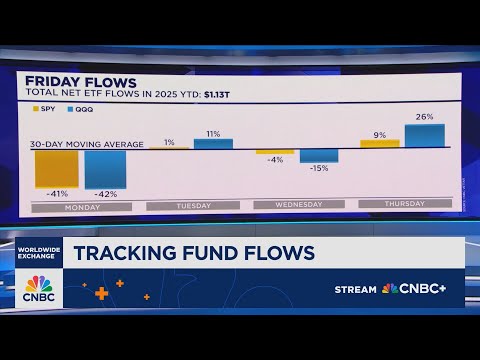
ETF inflows surge as health care names lead gains amid easing headwinds
CNBC Television· 2025-11-07 12:28
Turning to the ETF market right now. We're tracking ETF net inflows that are now over$1.13% trillion dollars year to date. Almost at last year's record.We're also tracking the moves above and below the 30-day moving averages for the popular index funds, the spy and the triple Q's. Top inflows this week, they went to the IWMSares Russell 2000 ETF. That's a small cap ETF. Of course, that was followed by the LQD, the iShares uh investment grade bond ETF, and the JR, the EyesShares Core S&P Small Cap ETF.a lot ...