Circle

Search documents
Stablecoin Transactions Soared 72% in 2025, Hit $33T With USDC in Lead
Yahoo Finance· 2026-01-09 05:49
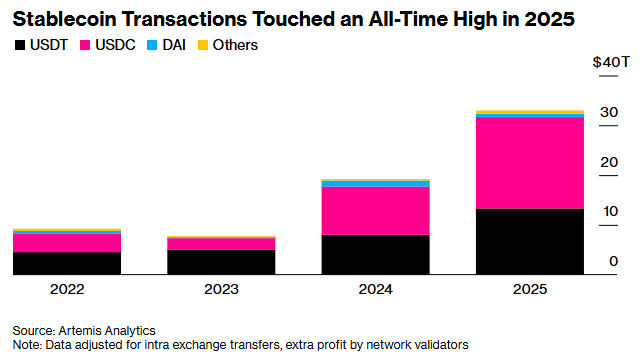
Core Insights - The total transaction value of global stablecoins reached $33 trillion in 2025, marking a 72% increase from the previous year, with USDC leading the market [1] - The passing of the GENIUS Act in July 2025 established a comprehensive regulatory framework for payment stablecoins in the U.S., contributing to the surge in stablecoin transactions [1][2] Transaction Insights - USDC processed $18.3 trillion in transactions, becoming the most-used stablecoin by transaction flow, while Tether's USDT recorded $13.3 trillion [1] - In Q4 2025, stablecoin transaction volumes hit $11 trillion, up from $8.8 trillion in Q3 [5] Market Predictions - Bloomberg Intelligence forecasts that stablecoin payment flows could reach $56 trillion by 2030, despite warnings from regulators about potential disruptions to traditional finance [5] User Preferences - DeFi traders prefer USDC for its utility in moving in and out of positions, while users in inflation-affected countries favor USD-pegged stablecoins for ease of access [3] - Tether is more commonly used for everyday payments and business transactions, with users typically holding its value rather than actively trading it [4] Regulatory Impact - The GENIUS Act has facilitated broader adoption of digital assets among major financial and tech institutions, with companies like Standard Chartered and Amazon exploring their own stablecoin offerings [6]
特朗普政策点燃数字美元狂热!2025年稳定币交易量暴增72%创新高
智通财经网· 2026-01-09 00:48
Group 1 - The core viewpoint of the articles highlights the significant growth of stablecoin trading volumes, driven by favorable policies under the Trump administration, with a projected total trading volume of $33 trillion by 2025, marking a 72% year-on-year increase [1][6] - Circle Internet Group's USDC leads the trading volume with $18.3 trillion, while Tether's USDT follows with $13.3 trillion [1] - The introduction of the "Genius Act" has established clear legal standards for stablecoins, contributing to their wider adoption among major institutions like Standard Chartered, Walmart, and Amazon [5] Group 2 - Despite the overall increase in funds, the trading volume on decentralized platforms has decreased, indicating a shift towards mainstream usage of stablecoins [2] - USDC is favored on decentralized finance (DeFi) platforms due to its frequent use in trading activities, while USDT is more commonly used for everyday payments and value storage [5] - The growth of stablecoins is expected to accelerate, with a record trading volume of $11 trillion in Q4 2025, up from $8.8 trillion in Q3 2025, and projections suggest that stablecoin payments could exceed $56 trillion by 2030 [6][9]


Why the Latest Wave of Crypto Firms Seeking US Bank Charters Raises Red Flags
Yahoo Finance· 2026-01-08 21:14
Core Viewpoint - World Liberty Financial (WLFI) has applied for a national trust bank charter, aiming to expand its stablecoin services, amidst concerns from established banks regarding regulatory compliance and systemic risk [1][2][5]. Group 1: Company Developments - WLFI's affiliate, WLTC Holdings LLC, submitted a de novo application to the Office of the Comptroller of the Currency (OCC) to establish the World Liberty Trust Company, National Association (WLTC) [2]. - The planned institution will focus on stablecoin-related activities and will operate under a single federal framework, eliminating the need for individual state licenses [3]. - WLFI anticipates that WLTC will comply with the GENIUS Act, implementing strict anti-money laundering (AML), sanctions screening, and cybersecurity standards [4]. Group 2: Industry Reactions - Banking industry groups have expressed concerns that the issuance of trust charters to crypto firms could increase systemic risk and undermine the integrity of the charter framework [5][6]. - There are warnings about regulatory and supervisory gaps, as crypto firms may not be subject to the same comprehensive regulations that traditional banks face, including capital, liquidity, and risk-management standards [6]. - Rebeca Romero Rainey, president and CEO of the Independent Community Bankers of America, criticized the conditional approvals of national trust bank charters, stating it stretches the charter's purpose and endangers consumers [7].
Trump’s World Liberty Financial Applies for National Banking Charter in Push for USD1 Stablecoin
Yahoo Finance· 2026-01-08 07:51
Core Viewpoint - World Liberty Financial, a crypto firm linked to Donald Trump, has applied for a national banking charter to establish the World Liberty Trust Company, aiming to issue the USD1 stablecoin and provide custody and conversion services [1][2]. Group 1: National Banking Charter Application - The application for the national charter has been submitted to the US Office of the Comptroller (OCC) [1]. - If approved, the Trust company will issue the USD1 stablecoin, which is pegged to the US dollar [2]. - The firm plans to offer custody solutions and stablecoin conversion services, facilitating easy transitions for other stablecoin holders to USD1 [2]. Group 2: Institutional Adoption and Market Growth - The market cap of the USD1 stablecoin has increased significantly from $128 million to $3.37 billion over the past 6-8 months [4]. - Institutional adoption of USD1 is rising, with its use in cross-border payments, settlement, and treasury operations [4]. - The trust company aims to provide a full-stack offering under a highly regulated entity, enhancing anti-money laundering controls and sanctions screening [4]. Group 3: Expansion Plans - In addition to the national bank charter, World Liberty Financial is looking to expand its offerings with more financial products, including RWA products, entering the tokenization industry [6]. - The filing aligns World Liberty Financial with other crypto firms seeking federal trust bank charters, following recent conditional approvals granted by the OCC to companies like Circle and Ripple [5].
World Liberty Financial Applies for OCC Trust Bank Charter
Yahoo Finance· 2026-01-08 02:14
Core Viewpoint - World Liberty Financial has applied to form a national trust bank to place its USD1 stablecoin under federal supervision, joining other crypto-linked firms in a newly recognized regulatory category [1][4]. Group 1: Company Overview - The proposed entity, World Liberty Trust Company, aims to manage the issuance and redemption of USD1, provide conversion services from other stablecoins, offer custody services, and manage reserves for USD1 [2]. - The filing targets a trust charter that allows custody and settlement functions without engaging in lending or accepting insured deposits [5]. Group 2: Industry Context - Stablecoins are designed to maintain a stable value, typically pegged to the U.S. dollar, facilitating price-stable digital payments and settlements [3]. - Recent approvals for federal charters have been granted to several firms, including Circle's First National Digital Currency Bank and Ripple National Trust Bank, indicating a growing acceptance of crypto banks [4]. - The structural upgrade represented by World Liberty's charter application is seen as a shift from using the stablecoin as a trading instrument to a settlement instrument, enhancing its utility in digital transactions [6]. - The need for a federally regulated structure for settling transactions in digital currencies is emphasized as more institutions adopt these currencies [7].
Trump-linked World Liberty Financial-connected firm applies for federal bank charter
Yahoo Finance· 2026-01-07 23:16
Core Viewpoint - World Liberty Financial is seeking to establish a national charter for its proposed entity, World Liberty Trust Company, which aims to issue a stablecoin pegged to the U.S. dollar and provide related services [1][2][4]. Group 1: Company Overview - World Liberty Trust Company has applied for a national charter with the U.S. Office of the Comptroller of the Currency (OCC) to launch its operations [1][2]. - The proposed trust firm plans to issue the USD1 stablecoin, which is directly linked to the U.S. dollar, and will offer custody and conversion services for other stablecoins [2][3]. - The company is closely associated with former President Donald Trump, listing him as "co-founder emeritus," and includes his sons as co-founders [3]. Group 2: Regulatory Context - The OCC has previously granted charters to several crypto firms, allowing them to operate trust banks, including notable names like Circle and Ripple [4]. - Under the Trump administration, the OCC has shown a more favorable stance towards crypto-related services compared to the previous administration [5]. Group 3: Future Plans and Market Position - If approved, Zach Witkoff, co-founder of World Liberty, would assume the role of president and chairman of the trust company [6]. - The company claims that USD1 has experienced unprecedented growth in its first year, being utilized by institutions for various financial operations [7].
Tokenization 'supercycle' set to drive crypto’s next leg higher in 2026: Bernstein
Yahoo Finance· 2026-01-07 16:12
Wall Street broker Bernstein said 2026 is likely to mark the start of a tokenization “supercycle,” with digital assets having probably bottomed after a weak end to 2025, making market dips an opportunity to add exposure to crypto-linked stocks. The broker says sentiment weakened late last year but underlying fundamentals remain intact, analysts led by Gautam Chhugani wrote in a Tuesday report. Bernstein maintained its bitcoin (BTC) forecast of $150,000 in 2026, with a $200,000 target for the peak of the ...
Bunq re-applies for OCC license
Yahoo Finance· 2026-01-07 14:49
Core Viewpoint - Bunq has re-applied for a de novo banking license in the U.S. after previously withdrawing its application due to regulatory differences between the U.S. and the Netherlands [1][2]. Group 1: Company Developments - Bunq aims to launch its services in U.S. metropolitan areas with large expatriate communities if its application is approved [2]. - The platform will enable users to quickly build credit scores using European financial records and maintain both U.S. and European checking accounts if eligible [2]. - CEO Ali Niknam emphasized the need for a safe and user-friendly banking solution for users living across borders [3]. Group 2: Regulatory Context - Several fintech companies have recently applied for banking licenses with the Office of the Comptroller of the Currency (OCC), reflecting a trend of relaxed financial regulations [4]. - The OCC has conditionally approved applications for several digital asset firms and a de novo bank charter for Erebor Bank [4]. - Bunq's CEO indicated a preference for a thorough evaluation process rather than rushing the application [5].
2025年全球支付的十条明线与暗线
Sou Hu Cai Jing· 2026-01-07 13:52
Key Insights - The global payment industry underwent significant changes in 2025, with stablecoins emerging as a key infrastructure for payments, gaining widespread recognition and acceptance [3] - The development of Central Bank Digital Currencies (CBDCs) has been hesitant, with various countries taking different stances on their implementation [4] - The rise of AI applications in payments, particularly through AI Agents, has transformed transaction processes and user experiences [5] - The integration of Web2 and Web3 has become a hot topic, as traditional payment giants adapt to the growing influence of stablecoins [6] - The acceleration of e-wallet adoption is reshaping the global payment landscape, challenging traditional card networks [7] - A surge in mergers and acquisitions within the payment sector indicates a shift towards more specialized services and localized operations [8] - Strengthened anti-money laundering regulations are creating new challenges and changes in the payment industry [9] - A trend towards reducing payment fees is emerging, driven by competition and regulatory pressures [10][11] - The global payment infrastructure is undergoing reconstruction, with initiatives like SWIFT's ISO 20022 migration enhancing efficiency and transparency [12] - Emerging markets are gaining attention from payment companies, with significant investments and expansions occurring in regions like Africa and South America [13]

2026 年加密货币展望:代币化超级周期开启 ——2026 年可逢低买入相关股票-2026 Crypto Outlook Tokenization supercycle begins - start 2026 by buying stocks on the dip
2026-01-07 03:05
Summary of Key Points from the Conference Call Industry Overview - The conference call focuses on the **Crypto Industry** and its outlook for **2026**, highlighting a **tokenization supercycle** that includes the tokenization of stablecoins, capital markets, and prediction markets [1][2][3]. Core Insights and Arguments 1. **2025 Performance**: Despite a weak Q4 in 2025, Bitcoin ended the year down 6%, while crypto equities had an average return of approximately **59%** [1]. 2. **Bitcoin Price Forecast**: The forecast for Bitcoin in 2026 is set at **$150K**, with a peak target of **$200K** in 2027, indicating a belief that the market has bottomed [1][8]. 3. **Stablecoin Growth**: Total stablecoin supply is expected to grow by **56% YoY** to **$420 billion** by 2026, driven by various factors including cross-border payments and fintech integration [2][47]. 4. **Tokenization of Real-World Assets**: The market for tokenized real-world assets is projected to increase from approximately **$37 billion** in 2025 to **$80 billion** in 2026, with equity tokenization expected to rise from **2%** to **16%** of total assets [3][47]. 5. **Prediction Markets**: The total volume for prediction markets is anticipated to double in 2026, reaching around **$70 billion**, with a significant portion of revenue expected from sports and political markets [4]. Company-Specific Insights Robinhood (HOOD) - **Management Strength**: HOOD is recognized for its effective management across equity, crypto, banking, and wealth management, with a strong distribution network of **14 million active traders** [12]. - **Prediction Markets Revenue**: Expected to contribute **9%** of total trading revenue by 2026, with HOOD building its own prediction markets exchange [15][77]. - **Tokenization Platform**: Plans to launch a full-scale equity tokenization platform, potentially impacting revenues significantly [15]. Coinbase (COIN) - **Business Transition**: COIN is transitioning to an 'everything exchange' model, expanding into tokenized stocks, prediction markets, and derivatives [16]. - **New Product Revenue**: New products are expected to drive **17%** of total trading revenues in 2026 [85]. - **Strategic Partnerships**: Partnerships with Circle are aimed at increasing USDC demand across various trading and payment platforms [16]. Circle (CRCL) - **Market Position**: Circle remains the largest regulated stablecoin provider in the U.S., with USDC growing by **73%** in 2025 to **$76 billion** [19][89]. - **Revenue Growth**: Despite concerns over interest rates, Circle's revenue and EBITDA have shown strong growth, maintaining pace with market demands [19]. Figure (FIGR) - **Loan Origination**: FIGR is expected to capture **5%** of U.S. HELOC origination by 2026, with strong momentum in tokenized consumer credit [26]. - **EBITDA Margin Expansion**: Projected EBITDA margins are expected to increase from **47%** in 2025 to **52%** in 2026 [26]. MicroStrategy (MSTR) - **Bitcoin Holdings**: MSTR holds approximately **674K BTC**, valued at around **$63 billion**, with a strong cash position to cover dividends [30]. - **Market Recovery**: MSTR is expected to benefit significantly from Bitcoin price appreciation, with a forecasted price of **$150K** in 2026 [31]. IREN - **AI Pivot**: IREN is focusing on building a vertically integrated AI business, with plans to set up **100K GPUs** over **350MW** of power [34]. - **Revenue Potential**: Expected to generate approximately **$2.5 billion** in annual recurring revenue by 2027 [39]. Important but Overlooked Content - **Regulatory Catalysts**: Key regulatory changes, such as the SEC crypto innovation exemption and the CLARITY Act, are expected to provide legitimacy to crypto trading platforms and could significantly impact market dynamics [10][11]. - **Market Risks**: The potential launch of crypto trading by legacy brokers and the competitive landscape with new entrants like Binance.US could pose risks to existing players [15][19]. This summary encapsulates the critical insights and projections from the conference call, providing a comprehensive overview of the current state and future outlook of the crypto industry and key companies within it.