Chime

Search documents
X @Forbes
Forbes· 2025-08-08 17:31
During San Francisco digital bank Chime’s inaugural call Thursday night, it announced revenue and profit that exceeded Wall Street analysts’ predictions. But this morning, the stock fell by 13% in early trading—why? (Photo: Bloomberg)https://t.co/E9KuVvxAYg https://t.co/y6GAGIOWuk ...
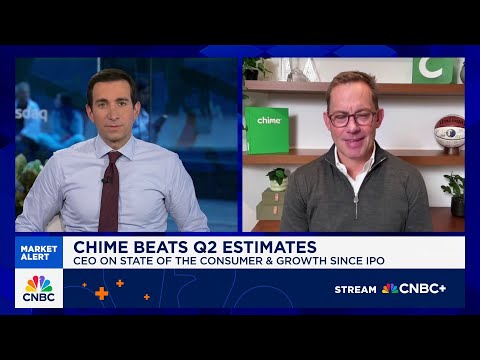
Chime CEO Chris Britt: We're a technology company focused on the needs of everyday consumers
CNBC Television· 2025-08-08 13:49
Financial Performance - Chime's topline grew 37% in Q1 [1] - Chime's active member base grew by 23% year-over-year [2] - Chime demonstrated adjusted EBITDA of 3% [2] Business Model & Strategy - Chime operates as a technology company partnering with banks to hold deposits, ensuring money is FDIC insured [4][6] - Chime focuses on serving the needs of everyday consumers, particularly the two-thirds of Americans living paycheck to paycheck [4] - Chime differentiates itself by focusing on short-term liquidity, avoiding fees, building credit, and promoting saving habits for everyday consumers [5][9] - Chime's low-cost structure allows it to develop profitable relationships with everyday consumers without relying on billions of dollars of fees [9] Market Perspective - Traditional banks primarily focus on high net worth clients and services like rewards cards with high costs, neglecting the everyday consumer [8][9] - Chime does not view cryptocurrency as a currency for everyday consumer transactions in America in the near future [12]

Tastytrade's Tom Sosnoff on IPO market: Years of pent-up demand and 'crazy asymmetric speculation'
CNBC Television· 2025-08-08 11:05
IPO Market Dynamics - Investor appetite for IPOs is picking up, with companies like Figma, Circle, Chime, and Firefly Aerospace experiencing significant gains on their first trading days [1] - The IPO market is experiencing pent-up demand and asymmetric speculation, with abundant capital seeking high-return, low-risk opportunities [2] - Speculative excess is evident in the market, potentially indicating a frothy environment with red flags [3][4] - Post-IPO volatility can reach 100% to 250%, attracting traders seeking to double their investment [5] IPO Pricing and Insider Advantage - Most individuals cannot participate in IPOs directly, focusing on post-IPO trading, particularly in options markets [6] - Underwriters may intentionally underprice IPOs, benefiting investment banks and insiders who hold restricted stock with a typical 6-month lockup period [8] - Underpricing IPOs creates positive PR and allows insiders to benefit from an initial price surge [9] - A small percentage of outstanding shares traded at a high price can significantly inflate the company's market capitalization [10] Retail Investor Access to Private Markets - There's a push to allow retail investors access to private equity, venture capital, and private credit through 401(k)s, traditionally limited to accredited investors [12] - Advocates argue for self-directed investment choices in 401(k)s, allowing individuals to invest in a wider range of assets [13][14] - Opening private markets to retail investors democratizes the process but also introduces new levels of risk due to less stringent disclosure rules compared to public companies [15] - Opening up private markets is expected to increase market efficiency and foster industry growth, despite potential risks [16][17] Private Equity Investment - The argument that private equity outperforms public markets long-term is primarily due to the lack of day-to-day liquidity, rather than inherent differences in the underlying business [19] - The extended duration of private equity funds (e.g., 7 years) reduces the observed volatility in their P&L, potentially masking the true risk [21]

Chime Leans on Cost Edge to Win ‘Unhappily Banked'
PYMNTS.com· 2025-08-08 02:16
Core Insights - Chime aims to become the largest provider of primary account relationships in the U.S. as stated by CEO Chris Britt during the company's first earnings call [1] - Analysts are focusing on Chime's user base expansion, member spending durability, and the impact of proposed bank data fees on its business model [2] Business Strategy - Chime is enhancing user experience by allowing newcomers to try services without immediate commitment, broadening access to features like Apple Pay and mobile check deposits [3] - The company is targeting improved activation and funding rates by offering introductory access to value propositions previously behind a direct deposit requirement [3] Financial Performance - Revenue increased by 37% year-over-year to $528 million for the quarter ending June 30, with payments revenue growing 19% to $366 million and platform-related revenue (including MyPay) climbing 113% to $162 million [8] - Active members rose by 23% to 8.7 million, and average revenue per active member (ARPAM) increased by 12% [8] Product Development - Chime's earned-wage access feature, MyPay, has reached a revenue run rate of approximately $300 million, with improved loss rates and tripled transaction margins quarter-over-quarter [5] - The company is also scaling Instant Loans and introducing "Chime Plus," a free tier offering higher savings rates and cash-back offers [8] Market Position - Chime claims to serve customers at about one-third the cost of large banks and one-fifth the cost of regional banks, leveraging its proprietary ledger and processing system to enhance unit costs [8] - The company maintains a strong brand presence with unaided brand awareness at 40%, comparable to major U.S. banks, and over half of new members are acquired through organic and referral channels [8] Future Outlook - Guidance for Q3 revenue is set between $525 million and $535 million, with full-year revenue projected at $2.135 billion to $2.155 billion, and an adjusted EBITDA margin of about 4% for 2025 [9]


X @Bloomberg
Bloomberg· 2025-08-07 21:00
Chime reported earnings that topped Wall Street analyst estimates in the fintech company’s first quarterly results as a public company https://t.co/UL8u71Fy18 ...
TriplePoint Venture Growth(TPVG) - 2025 Q2 - Earnings Call Transcript
2025-08-06 22:00
Financial Data and Key Metrics Changes - The debt investment portfolio grew to $663 million at cost, marking the highest level of funding activity in the last ten quarters [6][21] - Total investment income for Q2 was $23.3 million with a portfolio yield of 14.5%, down from $27.1 million and 15.8% in the prior year [24] - Net investment income for Q2 was $11.3 million or $0.28 per share, compared to $12.6 million or $0.33 per share for the previous year [25] - The company's net increase in net assets resulting from operations was $13.2 million or $0.33 per share, compared to $8.6 million or $0.22 per share for the prior year [26] Business Line Data and Key Metrics Changes - In Q2, the company funded $79 million in debt investments, up from $28 million in the prior quarter [21][15] - The weighted average annualized portfolio yield for funded investments was 12.3%, down from 13.3% in Q1 [16] - Loan prepayments totaled $44 million during the quarter, impacting overall portfolio yield [16] Market Data and Key Metrics Changes - Venture growth stage investments reached $84 billion across approximately 499 deals in 2025, with a notable increase in M&A and IPO activity [7] - The company held warrants in 106 companies and equity investments in 52 companies, with a total fair value of $127 million, primarily due to a markup in holdings in Revolut [17] Company Strategy and Development Direction - The company aims to increase scale, durability, and income-generating assets while focusing on sectors like AI, verticalized software, FinTech, and health tech [5][9] - A discretionary share program was announced to acquire up to $14 million of the company's outstanding shares, enhancing alignment with shareholders [11] - The regular quarterly distribution was reduced to $0.23 per share to better align with funding levels and prepayment activity [12] Management's Comments on Operating Environment and Future Outlook - Management noted that while uncertainties remain in the venture capital market, investment activity continued to surge, particularly in the AI space [7] - The expectation is that portfolio growth will take longer due to prepayment activity and the rate of utilization of underfunded commitments [11] - Future refinancing plans are being considered to optimize the capital structure in light of upcoming debt maturities [28] Other Important Information - The company ended the quarter with total liquidity of $313 million, consisting of cash and available capacity under its revolving credit facility [21] - The leverage ratio stood at 1.22x, with net leverage at 1.04x after accounting for cash [23] Q&A Session Summary Question: Outlook for fundings and expectations for Q3 and Q4 - Management indicated that lower utilization of historical unfunded commitments and seasonality are factors affecting funding expectations, with Q4 expected to be busier [30][31] Question: Stock buybacks and capital allocation - The company is considering capital allocation strategies, including potential stock buybacks, while prioritizing financial flexibility [32] Question: Elevated repayment activity and future expectations - Elevated repayment activity is attributed to robust equity funding from portfolio companies, with expectations for a slowdown in prepayment activity in 2026 [36][38]

250%!Figma上市首日股价暴涨
Di Yi Cai Jing Zi Xun· 2025-08-01 02:53
Core Insights - The U.S. IPO market is experiencing a significant resurgence, highlighted by Figma's successful debut on the New York Stock Exchange, where its opening price was $83, more than double its issuance price of $33, and it closed at $115.5, marking a 250% increase on its first day [2][3][4] Company Overview - Figma is a design software company that provides collaborative design tools for websites, applications, and digital products, with notable clients including Netflix, Airbnb, and Duolingo [3] - The company raised $1.2 billion by selling 36.9 million shares during its IPO, with early investors including prominent venture capital firms like Sequoia Capital and Kleiner Perkins [3][4] Market Context - Figma's IPO is seen as a symbol of the recovery of the tech IPO market, as it coincides with a strong rebound in the U.S. stock market, driven by robust earnings reports from major tech companies like Microsoft and Meta, and a growing interest in generative AI [3][4] - The overall IPO market in the U.S. is showing signs of recovery, with 59 IPOs completed in Q2 2025, raising a total of $15.02 billion, surpassing the previous quarter's figures [4][5] AI Integration - Figma is accelerating its AI capabilities to maintain its competitive edge in the design software industry, having launched several AI features aimed at enhancing design efficiency and lowering barriers to use [6][7] - The competitive landscape is intensifying, with other design platforms like Canva and Adobe rapidly integrating AI functionalities to capture market share [6][7] Valuation and Growth Potential - Figma's improved capabilities in AI are seen as a key factor in its valuation reassessment, especially after a failed acquisition attempt by Adobe at a $20 billion valuation [7]