
平安银行

Search documents
平安银行(000001) - 平安银行股份有限公司关于拟赎回优先股的公告
2025-11-21 10:46
在本行董事会于 2025 年 8 月 22 日审议并通过上述议案时,赎回本次优先股 事项尚需取得有关监管机构批准或认可,赎回事项存在不确定性,根据《上市公 司信息披露暂缓与豁免管理规定》和《深圳证券交易所上市公司自律监管指引第 5 号——信息披露事务管理》等相关规定,本行经审慎判断,决定暂缓披露,并 按相关规定办理了暂缓披露的内部审批和登记程序。 近日,本行收到国家金融监督管理总局答复,对赎回本次优先股无异议。本 行拟于本次优先股下一派息日,即 2026 年 3 月 9 日,赎回本次优先股。 本行将依照有关法律法规及本次优先股发行文件的规定,向相关监管机构办 理其他申请手续,并及时履行信息披露义务。 特此公告。 证券代码:000001 证券简称:平安银行 公告编号:2025-057 优先股代码:140002 优先股简称:平银优01 平安银行股份有限公司关于拟赎回优先股的公告 本公司及董事会全体成员保证信息披露的内容真实、准确、完整,没有虚假记载、误导 性陈述或重大遗漏。 平安银行股份有限公司(以下简称本行)于 2016 年 3 月按票面金额发行 2 亿股境内优先股(以下简称本次优先股)补充其他一级资本,发行规 ...

苏州银行发布诉讼事项进展:一审驳回内蒙古农商行鄂尔多斯东胜区支行起诉
Bei Jing Shang Bao· 2025-11-21 10:40
Core Viewpoint - Suzhou Bank announced the latest development in a financial loan contract dispute, where the court ruled to dismiss the lawsuit in the first instance [1][2] Summary by Sections Case Details - The lawsuit involved a total amount of 981 million yuan (approximately 9.81 billion yuan) as of June 12, 2024, along with all litigation costs [1] - The original plaintiff, Ordos Rural Commercial Bank, filed a lawsuit against multiple defendants, including Hangzhou Hankan Trading Co., Ltd., and several banks [2] Court Ruling - On November 20, 2025, the court allowed Ordos Rural Commercial Bank to withdraw from the lawsuit, permitting the Ordos Dongsheng District Branch of Inner Mongolia Rural Commercial Bank to replace it as the plaintiff [2] - The court ultimately dismissed the lawsuit filed by the Ordos Dongsheng District Branch [2] Impact on Suzhou Bank - Suzhou Bank indicated that the dismissal of the lawsuit has uncertain implications for its current and future profits [2] - The bank will continue to monitor the situation and take necessary actions to protect its legal rights while adhering to information disclosure requirements [2]

因贷款业务管理不审慎等,平安银行成都分行被罚240万元
Bei Jing Shang Bao· 2025-11-21 10:20
Group 1 - The core point of the article is that Ping An Bank's Chengdu branch has been fined for improper management of loans and bank acceptance bills, amounting to 2.4 million yuan [1] - The penalties also extend to four responsible individuals who received warnings and fines totaling 260,000 yuan [1]
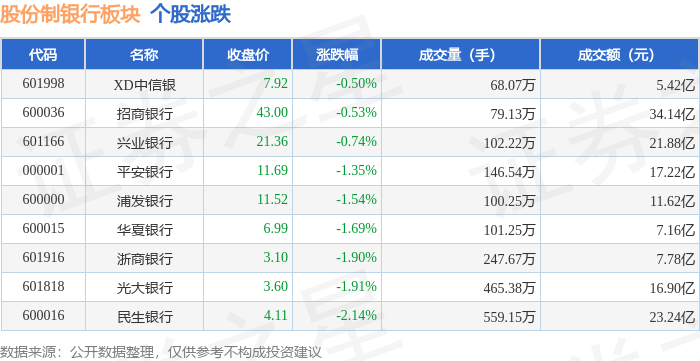
股份制银行板块11月21日跌1.29%,民生银行领跌,主力资金净流出5.23亿元
Zheng Xing Xing Ye Ri Bao· 2025-11-21 09:33
Core Points - The banking sector experienced a decline of 1.29% on November 21, with Minsheng Bank leading the drop [1] - The Shanghai Composite Index closed at 3834.89, down 2.45%, while the Shenzhen Component Index closed at 12538.07, down 3.41% [1] Banking Sector Performance - CITIC Bank (601998) closed at 7.92, down 0.50% with a trading volume of 680,700 shares and a transaction value of 542 million yuan [1] - China Merchants Bank (600036) closed at 43.00, down 0.53% with a trading volume of 791,300 shares and a transaction value of 3.414 billion yuan [1] - Industrial Bank (601166) closed at 21.36, down 0.74% with a trading volume of 1,022,200 shares and a transaction value of 2.188 billion yuan [1] - Ping An Bank (000001) closed at 11.69, down 1.35% with a trading volume of 1,465,400 shares and a transaction value of 1.722 billion yuan [1] - Shanghai Pudong Development Bank (600000) closed at 11.52, down 1.54% with a trading volume of 1,002,500 shares and a transaction value of 1.162 billion yuan [1] - Huaxia Bank (600015) closed at 6.99, down 1.69% with a trading volume of 1,012,500 shares and a transaction value of 716 million yuan [1] - Zhejiang Commercial Bank (601916) closed at 3.10, down 1.90% with a trading volume of 2,476,700 shares and a transaction value of 778 million yuan [1] - China Everbright Bank (601818) closed at 3.60, down 1.91% with a trading volume of 4,653,800 shares and a transaction value of 1.690 billion yuan [1] - Minsheng Bank (600016) closed at 4.11, down 2.14% with a trading volume of 5,591,500 shares and a transaction value of 2.324 billion yuan [1] Capital Flow Analysis - The banking sector saw a net outflow of 523 million yuan from main funds, while speculative funds had a net inflow of 224 million yuan and retail investors had a net inflow of 299 million yuan [1]





不良贷款 加速“促销”转让!
Zheng Quan Shi Bao· 2025-11-21 08:53
Core Viewpoint - The recent data from the National Financial Regulatory Administration indicates a slight increase in both the non-performing loan (NPL) balance and the NPL ratio of commercial banks, while the market for transferring non-performing loans has seen significant growth this year [1] Group 1: Non-Performing Loan Market Trends - The scale of non-performing loan transfers has surged, with over 26 billion yuan in asset packages listed since November, and the total for the first half of 2025 expected to exceed 167 billion yuan, doubling from the same period in 2024 [1][2] - The issuance of asset-backed securities (ABS) for non-performing loans has surpassed 67.857 billion yuan this year, reflecting an increase of over 80% compared to the previous year [1] Group 2: Retail Loan Risks - There is a consensus in the industry that retail loan risks are becoming more apparent, with no signs of reaching a peak yet [1][6] - Major banks are increasingly transferring personal non-performing loans to improve asset quality and release capital [1][3] Group 3: Asset Transfer Dynamics - Banks are actively listing large amounts of non-performing assets, particularly in personal loans and credit card overdrafts, with significant amounts being transferred [2] - The trend of "discount promotions" for non-performing assets is growing, with some assets being sold for as little as 10% of their original value [4] Group 4: Retail Loan Quality Indicators - The non-performing loan ratio for retail loans is on the rise, with specific banks reporting increases in their personal loan NPL ratios [6][7] - The characteristics of retail loan risks include a higher default rate in consumer loans and credit card loans, while mortgage loans remain the most stable [6][7]

不良贷款,加速“促销”转让!
证券时报· 2025-11-21 08:48
Core Viewpoint - The article highlights a significant increase in non-performing loans (NPLs) and the market for transferring these loans, indicating rising risks in retail lending and the banking sector's response to manage asset quality [1][2][6]. Group 1: Non-Performing Loans Data - Recent data from the National Financial Regulatory Administration shows a slight increase in both the balance and rate of non-performing loans in commercial banks [1]. - The market for transferring non-performing loans has surged, with over 26 billion yuan in asset packages listed since November, and a projected 167 billion yuan in transfers for the first half of 2025, doubling from the same period in 2024 [1][2]. - The issuance of asset-backed securities (ABS) related to non-performing loans has exceeded 67.857 billion yuan this year, representing an over 80% increase compared to the previous year [1]. Group 2: Retail Loan Risks - There is a consensus in the industry that retail loan risks are increasing, with no signs of reaching a peak yet [1][6][7]. - Major banks are experiencing rising non-performing loan rates in their retail segments, with specific examples showing increases in personal loan delinquency rates [6][7]. - The characteristics of retail loan risks include higher delinquency rates in consumer loans and credit cards, while mortgage loans remain the most stable [6][7]. Group 3: Asset Transfer Strategies - Banks are increasingly using loan transfers as a strategy to manage non-performing assets, which is seen as advantageous for resolving retail asset risks [3]. - The transfer of non-performing loans allows for better debt restructuring and risk mitigation, helping to prevent large-scale defaults [3]. Group 4: Discounted Asset Sales - Financial institutions are resorting to significant discounts to expedite the sale of non-performing loans, with some assets being sold for as little as 10% of their original value [4]. - Examples include credit card loans sold at steep discounts, indicating a challenging recovery environment for these assets [4]. Group 5: Market Trends - A report from Dongfang Asset indicates a downward trend in the acquisition prices of non-performing asset packages, particularly in regions with mature markets [5]. - The overall activity in the primary market for non-performing assets has increased, with a notable rise in transaction volumes compared to previous years [5].

不良贷款,加速“促销”转让!
券商中国· 2025-11-21 04:02
Core Viewpoint - The article highlights a significant increase in non-performing loans (NPLs) and the market for transferring these loans, indicating rising risks in retail loans despite overall asset quality remaining stable among listed banks [1][6]. Group 1: Non-Performing Loans Data - The balance of non-performing loans and the non-performing loan ratio for commercial banks have both slightly increased [1]. - The market for transferring non-performing loans has seen a surge, with over 26 billion yuan in asset packages listed since November, and the total for the first half of 2025 exceeding 167 billion yuan, doubling from the same period in 2024 [1][2]. - The issuance of asset-backed securities (ABS) for non-performing loans has surpassed 67.857 billion yuan this year, reflecting an over 80% increase compared to the previous year [1]. Group 2: Retail Loan Risks - There is a consensus in the industry that retail loan risks are becoming more apparent, with no signs of reaching a peak yet [1][7]. - Major banks are increasingly transferring personal non-performing loans to improve asset quality and release capital [1][3]. - The rise in retail loan risks is characterized by a significant increase in non-performing rates for personal loans, credit card overdrafts, and personal business loans [6][7]. Group 3: Transfer Market Dynamics - The demand for transferring non-performing loans has intensified as banks approach year-end, with many institutions listing large asset packages, particularly in retail loans [2]. - The average discount rates for transferring personal loans are influenced by asset type and overdue duration, with some transactions seeing recovery prices as low as 10% of the original amount [4][5]. - The trend of "discount promotions" for non-performing assets is becoming more common as financial institutions seek to expedite transactions [4][5]. Group 4: Specific Bank Data - As of September, the non-performing loan ratio for China’s major banks has shown an upward trend, with specific figures indicating increases for banks like China Communications Bank and China Merchants Bank [6][7]. - For instance, China Communications Bank's personal loan non-performing ratio rose from 1.08% at the end of last year to 1.42% by September [6].

平安银行支付清算系统将在11月23日凌晨进行系统维护
Jin Tou Wang· 2025-11-21 03:32
2025年11月21日,平安银行(000001)发布公告称,支付清算系统将于2025年11月23日凌晨0:00-6:00进 行系统维护。在此期间,平安银行个人网银、手机银行、企业网银、银企直联等渠道将暂停受理通过网 上支付跨行清算系统、小额支付系统发起的跨行汇款业务,由此给您带来的不便,敬请谅解!如有疑 问,请垂询平安银行客服电话。 ...
海南控股与平安银行总行、招商银行总行签署战略合作协议
Hai Nan Ri Bao· 2025-11-21 01:08
Core Points - Hainan Development Holding Co., Ltd. has signed strategic cooperation agreements with Ping An Bank and China Merchants Bank, marking a new phase in collaboration aimed at boosting Hainan's free trade port development [1] - Hainan Development Holding is now the first strategic partner of Ping An Bank in Hainan, focusing on integrating quality resources across various fields including comprehensive credit, transaction settlement, retail and technology finance, and industrial collaboration [1] - The partnership with China Merchants Bank aims to deepen innovative business cooperation, sharing new opportunities for development in the free trade port, and achieving mutual benefits [1] Financial Implications - The agreements will enhance Hainan Development Holding's funding assurance capabilities, increase credit scale and flexibility, optimize capital allocation, reduce financing costs, and improve financing efficiency [1] - Financial support will be directed towards key business areas including airport construction and operation, urban comprehensive operation, commercial services, investment and capital operations, clean energy, and new productivity sectors such as low-altitude economy and new energy [1] - The collaboration will leverage the banks' cross-border business advantages to expand the group's domestic and international industrial chains, thereby enhancing market competitiveness [1]
最低0息起 银行密集推购车金融方案
Bei Jing Shang Bao· 2025-11-20 23:40
Core Viewpoint - The automotive consumer finance business of banks is entering a "sprint period" as the year-end car purchasing season approaches, with various banks launching attractive loan schemes to stimulate demand and enhance customer experience [1][2]. Group 1: Marketing Strategies - Multiple banks, including Postal Savings Bank and Ping An Bank, are intensifying marketing efforts for auto loans, offering incentives such as 0% interest rates and financial subsidies [2][3]. - Postal Savings Bank has introduced a special offer for the newly launched BJ40 model, providing up to 4,500 yuan in financial subsidies, with annual interest rates ranging from 0% to 6% [2]. - Ping An Bank's auto loan program features a minimum interest rate of 0% and allows loans from 10,000 yuan up to 1 million yuan, with personalized service for loan approval [2]. Group 2: Market Trends - The automotive consumer finance sector is becoming a focal point for banks amid slowing retail credit growth and increasing scarcity of quality assets [3]. - As of September, Ping An Bank's auto consumer finance loan balance reached 300.3 billion yuan, a 2.2% increase from the previous year, with new energy vehicle loans growing by 23.1% [3]. - Shanghai Bank reported an auto consumer loan balance of 50.33 billion yuan, up 16.95% year-on-year, with new energy vehicle loans increasing by 63.08% [3]. Group 3: Policy Adjustments - Some banks, like Guangfa Bank, are relaxing early repayment rules for auto loans to enhance customer experience and service levels [4][5]. - Guangfa Bank has removed the previous restriction that prevented borrowers from applying for early repayment before the sixth payment, allowing applications from the first payment onward [5]. - The adjustment aims to balance risk and customer satisfaction, with expectations for further relaxation of early repayment rules in the future [5]. Group 4: Regulatory Environment - The automotive finance sector is transitioning from a "high interest, high return" model to a focus on service excellence due to regulatory pressures [6][7]. - Regulatory bodies have mandated the cessation of high-interest, high-return practices, promoting a healthier automotive finance market [6]. - Banks are encouraged to innovate and provide personalized services while ensuring consumer rights are protected [7][8].