
Gazprom Neft

Search documents
Serbia's NIS seeks new sanctions waiver to allow crude oil imports
Reuters· 2026-02-13 10:36
Core Viewpoint - Serbia's NIS is seeking a new sanctions waiver from the U.S. to facilitate crude oil imports while awaiting the completion of a sale to Hungary's MOL [1] Group 1: Company Operations - NIS operates Serbia's only oil refinery located in Pancevo and supplies 80% of the fuel needs in Serbia [1] - The company has filed a motion to the U.S. Office of Foreign Assets Control on February 12 for the waiver, which is crucial for its operations [1] Group 2: Sanctions and Waivers - The U.S. imposed sanctions on NIS in October as part of measures against Russia's energy sector due to the war in Ukraine [1] - A previous waiver allowing NIS to operate is set to expire on February 20, and the company emphasizes the importance of its operations for the Serbian economy [1] Group 3: Stakeholder Information - Gazprom Neft holds a 44.9% stake in NIS, while Gazprom holds 11.3%, and the Serbian government has a 29.9% stake [1] - Hungary's MOL signed a binding agreement to acquire the stakes held by Russian companies in NIS on January 19 [1]

Global Geopolitical Shifts and Regional Challenges Dominate Friday’s Headlines
Stock Market News· 2026-01-24 12:08
Defense Strategy - The Pentagon's 2026 National Defense Strategy emphasizes a primary focus on defending the U.S. homeland and deterring China in the Indo-Pacific region, indicating a more limited support role for allies in Europe and other regions [2][7] - The strategy characterizes Russia as a "persistent but manageable threat" and suggests that South Korea should take primary responsibility for deterring North Korea, with critical but limited U.S. assistance [2][7] Arms Embargo - Belgium has imposed a ban on the export and transit of military equipment to Israel, initiated by Foreign Minister Maxime Prevot, to prevent worsening humanitarian conditions in the West Bank and Gaza [3][7] - A Brussels Court has reinforced this ban by ordering the Flemish government to block military equipment containers and imposing a €50,000 fine for each violation, citing failures to uphold legal obligations under the Genocide Convention [3][7] Energy Sector - Hungary's MOL Group has reached an agreement to acquire a 56.15% stake in Serbian oil refiner NIS from Gazprom Neft, pending U.S. approval due to prior sanctions on NIS [4][7] - Serbia has increased its own stake in NIS by five percentage points, and discussions are ongoing with the Abu Dhabi National Oil Company (ADNOC) to join the deal as a minority shareholder [4][7] E-commerce Data Leak - U.S. Vice President JD Vance and South Korea's Prime Minister Kim Min-seok discussed the resolution of issues related to a mass data leak affecting over 33 million customers of U.S.-listed e-commerce company Coupang (CPNG) [6][7] - The report on the data leak was delayed for over 15 months, with assertions from Prime Minister Kim that there is no discriminatory treatment of U.S. corporations [6][7]


X @Bloomberg
Bloomberg· 2026-01-24 11:34
Hungary's Mol said Gazprom Neft has accepted its bid for a stake in Serbian oil refiner NIS. https://t.co/qYgD9bP61g ...
MOL to acquire Gazprom Neft’s stake in Serbian refiner NIS
Yahoo Finance· 2026-01-20 14:55
Core Viewpoint - MOL Group has signed a heads of agreement with Gazprom Neft to acquire a 56.15% stake in Naftna Industrija Srbije, enhancing its control over Serbia's only oil refinery and expanding its operations in the central and south-eastern European energy market [1][2]. Group 1: Acquisition Details - The acquisition will ensure sustained operations at the Pancevo refinery, providing a consistent energy supply to the region [2]. - The deal's completion is contingent upon fulfilling conditions outlined in the HoA, including necessary regulatory approvals from the US and Serbian governments, with a target deadline of March 31, 2026, for finalizing the sales and purchase agreement [5]. Group 2: Strategic Implications - MOL Group aims to strengthen energy security in Serbia and the region through collaboration with local refineries and strong partners [3]. - The Pancevo refinery, operational since 1968, has a refining capacity of approximately 4.8 million tonnes per year and produces petroleum products that meet EU standards [4]. Group 3: Future Collaborations - MOL Group is in discussions with ADNOC from the UAE regarding a potential minority stake in NIS, while maintaining majority ownership [4].
回望2025:原油最值得关注的4个时刻
Xin Lang Cai Jing· 2026-01-02 05:42
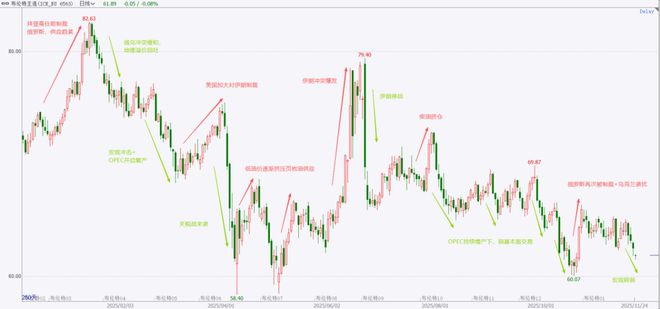
热点栏目 自选股 数据中心 行情中心 资金流向 模拟交易 客户端 来源:紫金天风期货研究所 【20251231】回望2025:原油最值得关注的4个时刻 时刻1:特朗普归来 年初(1月20日)特朗普宣誓就职,其施政纲领之一即打压通胀,其中油价作为关键的一环。为掣 肘新政府的施政进展,拜登政府公布了对俄罗斯两大能源公司Gazprom Neft和Surgutneftegas和180 多艘船只进行制裁,制裁自2月27日生效。根据统计,两家公司原油出口约占全俄原油出口的 30%,拥有炼能占全俄的20%左右。受此消息影响,盘面大幅拉升。 事后复盘也可以看出,此次制裁的实际影响影响较为明显,为规避制裁而成立的新出口公司占比 有较明显的提升,其中对影子油轮的制裁在年初对部分物流也形成一定的冲击。 时刻2:关税战时刻和OPEC增产 北京时间4月3日,,特朗普于美国白宫宣布"对等关税"计划,主要内容为双重关税机制,即自4月 5日起对所有国家进口商品统一加征10%的"基准关税",4月9日起对与美国存在显著贸易逆差的60 个经济体加征差异化关税,其中对中国本年内加征关税已经高达54%(20%+34%)。中国方面随 后出台了相关的反制 ...

石油市场周报:壁垒后的原油 -委内瑞拉与俄罗斯-Oil Markets Weekly_ Barrels behind barriers—Venezuela and Russia
2025-12-22 14:29
Summary of Key Points from the Conference Call Industry Overview - The conference call primarily discusses the oil markets, focusing on Venezuela and Russia, and the implications of U.S. sanctions on their oil exports [1][2][3]. Core Insights and Arguments - **Sanctions on Venezuela**: The recent drop in WTI oil prices to $55/bbl has prompted the Trump administration to consider enforcing sanctions on Venezuelan oil exports. The administration may monitor Venezuelan tankers or implement stricter sanctions, but the extent of enforcement remains uncertain [1][2][4]. - **Quantitative Impact of Sanctions**: The term "sanctioned" in Trump's statement limits the blockade's impact to approximately 0.4 million barrels per day (mbd) of Venezuela's heavy crude exports and 0.1 mbd of product exports, primarily fuel oil [1][5]. - **U.S. Military Presence**: An increased U.S. military presence in the Caribbean is noted, which may influence oil futures and suggests a potential political transition in Venezuela [1][7]. - **Russian Oil Exports**: Despite sanctions, Russian crude exports are estimated at around 3.5 mbd in December, only slightly below previous highs. Product exports have also recovered to approximately 2.1 mbd, supported by refinery throughput of 5.3–5.4 mbd [1][21]. - **Sanctions' Effect on Trading Structures**: Sanctions have altered trading structures rather than significantly reducing export volumes. Exports are being rerouted through new intermediaries, which increases transaction costs and clearance times [1][22][28]. - **Economic Pressure on Russia**: Russia's upstream sector is experiencing declining gross profits, dropping from about $57/bbl at the start of 2025 to below $30/bbl now. This trend may have more significant long-term implications than the sanctions themselves [1][34]. Additional Important Insights - **Potential for Venezuelan Production Recovery**: In a post-Maduro scenario, production could initially drop by up to 50% due to operational disruptions but may rebound to around 1.2 mbd within months if political stability is restored [1][11][16]. - **Investment Opportunities**: The return of former partners, including Chinese companies, could lead to increased production levels in Venezuela, contingent on political changes and new investments [1][15]. - **Long-term Outlook**: The oil supply and demand balance for 2025 and beyond indicates a potential increase in global oil supply, with Venezuela representing a significant upside risk if political conditions improve [1][37][38]. This summary encapsulates the critical points discussed in the conference call, highlighting the current state of the oil markets concerning Venezuela and Russia, the implications of U.S. sanctions, and potential future developments in the industry.

原油市场周报:两周已过 -评估俄罗斯制裁的早期影响-Oil Markets Weekly_ Two weeks in—assessing the early impact of Russia sanctions
2025-12-08 00:41
Summary of Key Points from the Conference Call Industry Overview - The conference call focuses on the oil market, particularly the impact of sanctions on Russian crude oil exports and the dynamics of global oil supply and demand. Core Insights and Arguments - **Resilience of Russian Crude Flows**: Despite the expansion of sanctions and the transition deadline on November 21, Russian crude oil exports to Asia, especially from Rosneft, have remained resilient. China and India continue to import significant volumes, offsetting declines from Lukoil [2][3][5]. - **Infrastructure and Logistics**: Rosneft has established a robust infrastructure, including a wide network of intermediaries and shipping capabilities, which has allowed it to maintain crude flows despite regulatory challenges. This contrasts with Lukoil, which has seen a sharp decline in exports [2][15]. - **Market Reactions**: Turkey is the only major market adhering strictly to new sanctions, while Asian refiners are focusing on pricing and logistics rather than the seller's identity [2][3]. - **Caspian Pipeline Consortium (CPC) Disruption**: A late-November outage at the CPC reduced throughput from 1.7 million barrels per day (mbd) to 0.9 mbd, jeopardizing December Kazakh crude exports, which typically average 1.5 mbd. Kazakhstan can redirect some volumes, but not enough to fully compensate for CPC constraints [2][57][59]. - **Price Differentials**: Following the sanctions, price differentials for major Russian crude grades have widened significantly, with Urals DAP India and ESPO CFR China trading at steep discounts [4][5]. Additional Important Insights - **Buyer Differentiation**: India and Turkey have largely stopped purchasing Lukoil barrels, while Rosneft continues to see strong demand. This is attributed to deeper discounts and logistical flexibility from Rosneft [15][19]. - **Stable Imports Post-Sanctions**: Combined imports of Russian crude into China, India, and Turkey have remained stable, with a slight increase of approximately 50,000 barrels per day (kbd) post-November 21 [14][23]. - **Refined Product Exports**: Russian refined product exports remain subdued, averaging around 1.9 mbd, significantly below the summer average of 2.4 mbd. This decline is attributed to both sanctions and domestic logistical issues [38][39]. - **Future Outlook**: The report suggests that as temporary constraints ease, refined product exports could stabilize in January, supported by the expiration of the diesel ban for non-producers and a normalized domestic fuel market [42]. Conclusion - The oil market is currently navigating complex dynamics due to sanctions on Russian oil, with varying impacts on different companies and countries. Rosneft's ability to adapt and maintain exports contrasts sharply with Lukoil's struggles, highlighting the importance of infrastructure and market strategies in the current environment.
【原油年报】静待花开
Xin Lang Cai Jing· 2025-12-01 12:17
来源:市场资讯 (来源:油市小蓝莓) 市场回顾 行情回顾 库存:平衡表的弱平衡Q4才体现到显性库存 弱平衡对库存的传导逐渐兑现,除了旺季以外,整体显性库存的大规模累积于9月后才更为明显。 拆分当下的水上原油库存,9月初至今累库2亿桶,水上库存累库月1.7亿桶。其中浮仓累库5千万 桶(伊朗3千万桶、俄罗斯1千万桶),在途库存累库1.2亿桶(OPEC大概1亿桶)。 数据来源:紫金天风期货研究所 供应:如期增产的OPEC 自上半年以来OPEC开启增产进程,根据IEA统计,和1月相比,9月全球原油产量增长约700万桶 日,拆分来看,其中OPEC+ 9月产量相较于1月产量增长约400万桶日,Americas Quintet国家增长 约200万桶日,Biofuel增长约100万桶日。 我们去年年报给出了230万桶日的年度增量(包含美国制裁伊朗的100万桶日),就兑现结果来看 供应端整体评估较为合理,平均下来年度增长量级约为250-300万桶日左右。 数据来源:紫金天风期货研究所 回顾2025年的原油市场,波动区间80-55(以Brent为例),价格重心整体继续下移,两次主要的 冲高分别位于年初(美国制裁俄罗斯)和年中(伊 ...
X @Bloomberg
Bloomberg· 2025-11-15 13:56
The steadfast US stance on sanctions against Serbia’s sole refiner has left Belgrade facing a stark choice: seize the company from Russia, or risk running out of crude, its energy minister said https://t.co/Hzg0Lyj9DC ...
China’s Sanctioned Yulong Thrives on Russian Oil
Yahoo Finance· 2025-10-28 23:00
Core Insights - The article discusses the significant shift in Shandong Yulong Petrochemical's crude sourcing, primarily moving to Russian oil due to Western sanctions impacting access to other suppliers [4][3][2] Group 1: Supply Chain Changes - Shandong Yulong has transitioned from a diverse supply portfolio to relying almost entirely on Russian crude, securing approximately 350,000 b/d for November delivery compared to only 100,000 b/d earlier in the year [2][4] - The refinery's operational capacity is currently at about 90% of its 400,000 b/d design, with Russian crude now providing nearly all its feedstock [2][5] Group 2: Impact of Sanctions - Western sanctions have inadvertently created a new trade dynamic, linking Russian producers with sanctioned Chinese refiners like Yulong, which now operates almost exclusively on discounted Russian oil [4][3][9] - The sanctions imposed by the UK and EU have restricted Yulong's access to Western supplies, forcing it to adapt its sourcing strategy [4][3] Group 3: Operational Efficiency - Yulong's operational efficiency has improved due to the lower costs associated with sourcing Russian crude, which has offset the deflation in product prices and maintained profitability despite an oversupplied market [6][5] - The refinery has achieved record-high throughput in September and October, running at approximately 90% capacity [5] Group 4: Future Supply Considerations - Analysts express concerns about Yulong's ability to secure the heavy crude necessary for consistent product output, although some suggest that Russia's Urals blend could serve as a suitable substitute [8][7] - Gazprom Neft may redirect its Arctic ARCO crude to Yulong, potentially supplying the heavy feedstock needed for efficient operations [9]