Imax

Search documents
AMC Entertainment Hits 83% Odds to Beat Earnings -- Is the Meme Stock Era Finally Giving Way to Real Returns?
Yahoo Finance· 2026-02-23 17:24
Like sitting through 25 minutes of ads and movie trailers before getting to the featured attraction, investors had to wait to see if AMC Entertainment (NYSE: AMC) could earn rave reviews this earnings season. The country's leading multiplex operator kicked off this week by announcing its fourth-quarter results. As the owner of one of the ugliest stock charts in recent years, you might think the expectations would be low. Shares of AMC have declined sharply for four consecutive years, tumbling 85%, 85%, 3 ...

X @Bloomberg
Bloomberg· 2025-10-16 01:54
Imax’s Chief Financial Officer Natasha Fernandes sees an opportunity to buy back shares at an attractive price in the event of a broader selloff in the entertainment industry https://t.co/k0snadTdwr ...
Trump’s Market Mayhem: Where the Tweets Meet the Tickers
Stock Market News· 2025-10-05 18:00
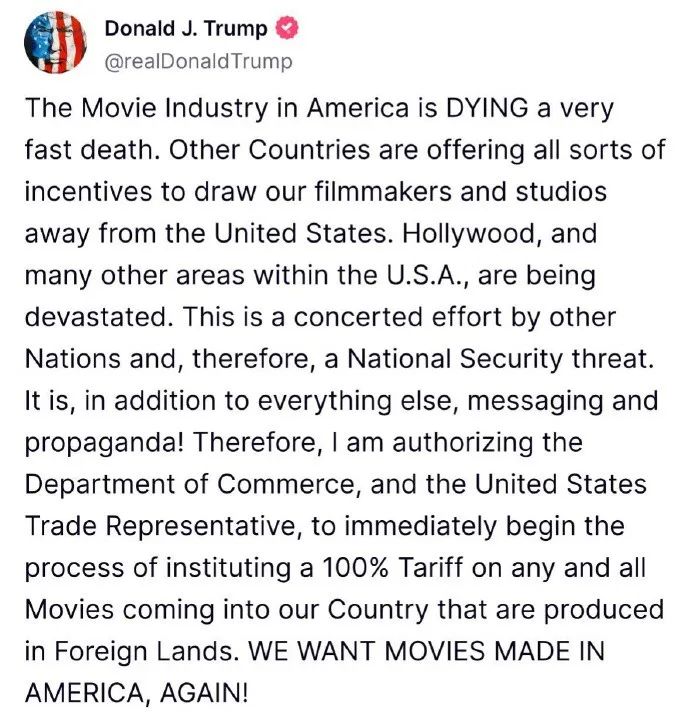
Group 1: Tariffs and Market Reactions - Trump announced a 100% tariff on foreign films and new duties on lumber and furniture, aiming to protect domestic industries, which led to negative market reactions from major streaming and production companies [2][3] - Shares of Netflix and Amazon fell by 1.5%, while Warner Bros Discovery and Paramount dropped by 1.1% and 1% respectively, indicating immediate market concerns over the enforceability of these tariffs [3] - The furniture and lumber industries are facing significant tariffs, with 10% on imported timber and 25% on kitchen cabinets and upholstered furniture, set to increase by 2026, causing stock declines for companies reliant on imports like Wayfair and Restoration Hardware [4][5] Group 2: Domestic Manufacturing Gains - Domestic manufacturers such as La-Z-Boy and Ethan Allen saw stock gains, with Ethan Allen up 5% year-to-date, benefiting from the tariffs imposed on foreign competitors [5] - The U.S. Lumber Coalition supported the new tariffs, while Canadian lumber producers face high total tariff rates of 45%, leading to reduced shipment targets and weaker earnings [5] Group 3: Government Shutdown and Market Indices - The U.S. government experienced a partial shutdown, yet major market indices like the Dow Jones and S&P 500 rose, indicating resilience in the face of political turmoil [9][10] - Historically, markets have shown the ability to weather government shutdowns, often viewing them as minor disruptions rather than significant economic threats [10] Group 4: Agricultural Aid and Market Impact - Trump announced a substantial aid package for U.S. soybean farmers, estimated between $10 billion and $14 billion, which positively affected soybean futures [11] - The aid is seen as a response to the trade tensions with China, where soybean purchases have been halted, highlighting a circular economic model where tariff revenue is used to mitigate damage from tariffs [11] Group 5: Geopolitical Factors and Market Behavior - Trump's foreign policy announcements, including a "zero-enrichment policy" for Iran and a ceasefire agreement in Gaza, have historically led to predictable market reactions, such as falling stocks and rising oil prices [7][8] - Despite initial market jitters, these geopolitical events often result in short-lived impacts, with markets quickly recovering as investors compartmentalize global crises [8]



特朗普加征“100%电影关税”:“大刀”重创好莱坞?
3 6 Ke· 2025-05-07 00:16
Core Viewpoint - The announcement of a 100% tariff on foreign-made films by the U.S. government is seen as a misguided attempt to protect the American film industry, which is already facing significant challenges and may lead to adverse effects on Hollywood and the broader entertainment sector [2][3][5]. Group 1: Impact on the Film Industry - The U.S. film industry is experiencing a rapid decline, with foreign countries offering incentives to attract American filmmakers, leading to a significant loss of talent and production [2][3]. - Major media stocks fell sharply following the announcement, with Netflix down 4.55%, Lions Gate Entertainment down 8.5%, and Warner Bros. Discovery down 2.6% [2]. - The proposed tariffs could substantially increase production costs for Hollywood studios and trigger a global upheaval in the entertainment industry [2][3]. Group 2: Economic and Legal Concerns - Industry associations have urged Congress to carefully evaluate the economic and legal implications of the tariff policy, arguing that it will not revive Hollywood but rather have the opposite effect [2][3]. - The U.S. film industry had a trade surplus of $15.3 billion in 2023, with exports amounting to $22.6 billion, indicating that the film sector is not in the same position as the manufacturing sector that faces trade deficits [3]. Group 3: Structural Challenges - Hollywood is facing a structural crisis exacerbated by the pandemic, strikes, and now tariffs, with predictions of further declines in production and revenue [9][12]. - The film industry is experiencing a shift towards shorter content formats, with streaming becoming the primary viewing channel for 73% of American adults, indicating a decline in traditional cinema attendance [13]. - The overall production budget for U.S. film and television projects is projected to decrease by 26% compared to 2022, highlighting a trend of reduced investment in the industry [12]. Group 4: Potential Consequences - The tariff could lead to increased production costs, reduced output, and a decline in profitability, further diminishing audience interest in cinema [6]. - There is a risk of international retaliation, which could severely impact the revenue generated from overseas markets, where U.S. films typically earn about 70% of their total box office [6][9]. - The film industry's reliance on international markets makes it vulnerable to policy changes, with potential job losses and a decrease in cultural influence as a result of the tariff [6][9].


Donald Trump's “Strong Stand” With Tariffs Draws Praise From Charter CEO Chris Winfrey: “Trade Imbalances Are By Definition Unfair”
Deadline· 2025-04-25 14:41
Core Viewpoint - Charter Communications' CEO Chris Winfrey presents a positive perspective on tariffs, contrasting with other CEOs who express concerns about their impact on business forecasts and consumer behavior [1][3]. Company Overview - Charter Communications serves over 57 million U.S. families and businesses, with a 100% U.S.-based workforce, emphasizing a preference for American-made products when competitively priced [2]. Financial Outlook - CFO Jessica Fischer states that tariffs are not expected to significantly impact Charter's capital expenditures, maintaining a guidance of $12 billion in spending despite anticipated tariff effects [3]. - Charter reported total revenue of $13.74 billion, exceeding expectations, although earnings per share were $8.42, below the consensus estimate of $8.69 [5][6]. Customer Trends - The company lost 60,000 internet customers and 181,000 video customers in the first quarter, an improvement from a loss of 405,000 video customers in the same quarter the previous year [5]. - The integration of streaming services like Max, Disney+, and Peacock into Spectrum plans is seen as beneficial, with a net value to customers estimated at over $80 per month [5]. Industry Context - Other media companies, including Comcast and Netflix, report minimal concerns regarding tariffs, indicating resilience in their business operations [3][7]. - The upcoming earnings reports from tech companies, particularly Apple, are highly anticipated as they may provide further insights into the impact of trade tensions with China [7].