
Pony.ai

Search documents
“AI 2028危机”,究竟有多少已然发生
Xi Niu Cai Jing· 2026-02-26 06:57
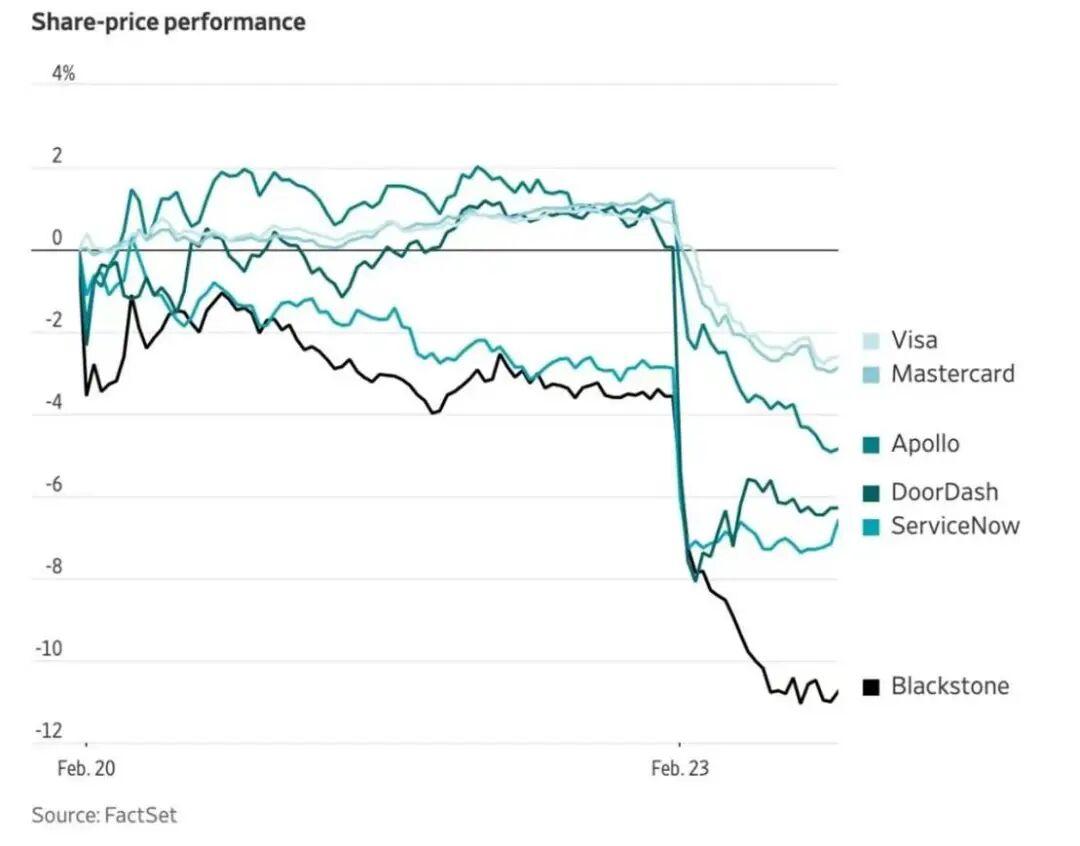
来源:未尽研究 作者:未尽研究 这些危机叙事显得逼真,是因为它们并非从未来倒推,而是从当下延伸。现实已经出现了若干可被拼接的信号。 "软件只是开场"正在变成一种共识。近期,Anthropic突破白领工业革命的积极尝试,让市场相信,那些支撑美国经济的高价值知识工作,不再被视为自动 化的例外,正在接近系统性替代的拐点。 进入2026年,进入马年,市场正弥漫着一种诡异的、前所未有的气氛。 资本市场正在提前交易一场尚未真正到来的结构变化。从"一件大事正在发生",到"2028年全球AI危机",美国股市越来越容易被这些宏大叙事所牵引。华尔 街怀疑,AI能力的自我递归提升,会先于制度与市场的调节能力,同时制造一次宏观经济的自我递归式的恶化。 昨晚,独立研究机构Citrini用一篇假设写于2028年6月的备忘录,讲述了这样相互嵌套的递归链条。当晚,美国再次崩盘,道指下跌800点,不仅包括前阵子 就深跌的SaaS股与网络安全股,这次还包括黑石(Blackstone)、万事达(Mastercard)这样的金融大蓝筹。 Citrini并带来没有太多新鲜的观点,很多都是ChatGPT刚出现时,经济学家就已经提出的担忧,以及一些AI大 ...

Uber's new autonomous vehicle division is about survival and opportunity
TechCrunch· 2026-02-23 19:54
Core Insights - Uber has launched a new division called Uber Autonomous Solutions to manage all aspects of operating autonomous vehicles, including software and support services [1] - The company has formed partnerships with nearly two dozen autonomous vehicle technology firms, covering various applications from robotaxis to delivery robots [2] - Uber aims to make itself indispensable to these partners by providing operational support, allowing them to focus on software development [3] Partnerships and Investments - Uber has invested in companies like Lucid, Nuro, Waabi, and WeRide, and has allocated $100 million for building fast-charging stations for autonomous vehicles [2] - The company has established a shared robotaxi service with Waymo in Atlanta and Austin, and has partnerships with Chinese firms such as Baidu and Pony.ai [9] Operational Goals - The initiative aims to reduce costs per mile for partners and accelerate the deployment of robotaxis to over 15 cities by the end of the year [4] - Uber plans to handle infrastructure needs such as training data, mapping, fleet financing, and regulatory services [7] User Experience and Fleet Management - The new division will also focus on enhancing user experience, including customer support and fleet management, which involves remote assistance and insurance [8] - Uber's approach to fleet management is particularly relevant given recent scrutiny over labor practices in the autonomous vehicle sector [8] Strategic Context - The launch of this division follows Uber's sale of its in-house AV development unit, Uber ATG, in 2020, which was a response to internal challenges and external pressures [9] - The new division is seen as a way for Uber to protect its business model against potential revenue loss from the rise of autonomous vehicles [10]


Pony.ai Expands Robotaxi Commercialization With ATBB, Advancing Asset-Light Scaling Across Urban and Airport Mobility
Prnewswire· 2026-01-28 02:00
Core Insights - Pony.ai has announced a strategic partnership with Beijing ATBB Travel & Express Service Co., Ltd. to enhance the commercialization of Robotaxi services in China [1][2] Partnership Details - The collaboration will focus on deploying and operating Robotaxi services in tier-1 cities in China, with an emphasis on airport and business travel applications [2][5] - The partnership aims to leverage ATBB's mobility expertise and resources to improve capital efficiency and support the asset-light strategy of Pony.ai [2][3] Fleet and Technology - A new Robotaxi fleet will be established using Pony.ai's seventh-generation vehicles, operating in major cities and connecting airports and high-speed rail stations [3][4] - The initial fleet will be integrated into Pony.ai's ride-hailing platform and ATBB's Xinghui Mobility platform, allowing for shared access to demand and fleet resources [4] Market Positioning - The partnership aims to cater to premium and business-class travelers by offering customizable in-vehicle experiences and on-time performance, positioning Robotaxis as a differentiated mobility option [5] Progress and Milestones - Pony.ai has made significant progress in scaling its commercial Robotaxi operations, achieving a citywide permit for fully driverless operations in Shenzhen and expanding services in Beijing, Guangzhou, and Shanghai [6][7] - The total Robotaxi fleet has surpassed 1,159 vehicles, with plans to expand to over 3,000 by the end of 2026 [7] - The Gen-7 Robotaxi operations have reached breakeven in city-wide unit economics in Guangzhou, indicating the commercial viability of the model [8]

Pony.ai and BAIC BJEV Deepen Strategic Partnership to Accelerate Robotaxi Development and Commercialization
Prnewswire· 2026-01-10 05:46
Core Insights - Pony.ai and BAIC BJEV have announced a comprehensive upgrade to their strategic partnership to enhance the mass production and commercialization of autonomous driving solutions [1][5] - The partnership aims to address challenges in scaling Level 4 (L4) autonomous driving from pilot programs to sustainable commercial operations [2] Partnership Details - The new agreement focuses on the design and development of purpose-built Robotaxi models, optimizing vehicle architectures and in-cabin systems for better autonomous operations and passenger experience [3] - Collaboration will extend to user acquisition, fleet operations, and vehicle maintenance, leveraging BAIC BJEV's strengths in manufacturing and supply chain to reduce the bill of materials (BOM) and operating costs [4] Strategic Goals - The partnership reflects a commitment to transition autonomous driving from technical readiness to large-scale commercial reality, combining Pony.ai's technology with BAIC BJEV's manufacturing expertise [5] - The aim is to build a more efficient and sustainable intelligent mobility ecosystem with global competitiveness [5] Previous Collaborations - Since their collaboration began in 2024, the companies have developed the Arcfox Alpha T5 Robotaxi, with over 600 units produced and currently in operation in Beijing and Shenzhen [5][6] - The Arcfox Alpha T5 features upgrades in pick-up convenience and ride comfort, enhancing public acceptance of fully autonomous mobility services [6] Global Expansion Plans - Pony.ai operates in eight countries and plans to introduce the Arcfox Alpha T5 Robotaxi to strategic global markets, including Europe and the Middle East [7] - The partnership has seen nearly RMB 1 billion invested in autonomous driving research and development, with further capital investment expected to support joint priorities [8]

Former DJI self-driving unit seeks an edge in adapting drone tech to lorries, logistics
Yahoo Finance· 2025-12-31 09:30
Core Viewpoint - The former autonomous driving unit of DJI, now known as ZYT, is set to enter the heavy vehicle industry by 2026, marking a significant shift in focus from passenger cars to heavy-duty lorries and unmanned logistics vehicles as the commercialization of autonomous driving technology intensifies in China [1][5]. Company Developments - ZYT plans to introduce its navigate-on-autopilot feature for lorries on highways, with mass production expected in the first half of 2026, according to CEO Shen Shaojie [2]. - The company has established partnerships with major trucking firms, including Xuzhou Construction Machinery Group, Shaanxi Automobile Group, and China National Heavy Duty Truck Group, to facilitate its entry into the heavy vehicle market [3]. - A new partnership with a leading Chinese commercial vehicle manufacturer will be launched in January to design unmanned logistics vehicles utilizing ZYT's autonomous driving technology [4]. Industry Context - ZYT is entering a competitive landscape for autonomous driving in China, facing established players like Horizon Robotics and Shenzhen Yinwang Intelligent Technology, which is a spin-off from Huawei Technologies [5]. - The company aims to tap into the lucrative logistics market, positioning itself against rivals such as Pony.ai, which has also announced plans for mass production and deployment of autonomous trucks in 2026 [5]. - Originally established in 2016 as DJI's automotive division, ZYT was spun off in 2023 due to its divergence from DJI's core drone business and the impact of geopolitical tensions between China and the US [6].
robotaxi
小熊跑的快· 2025-12-04 12:38
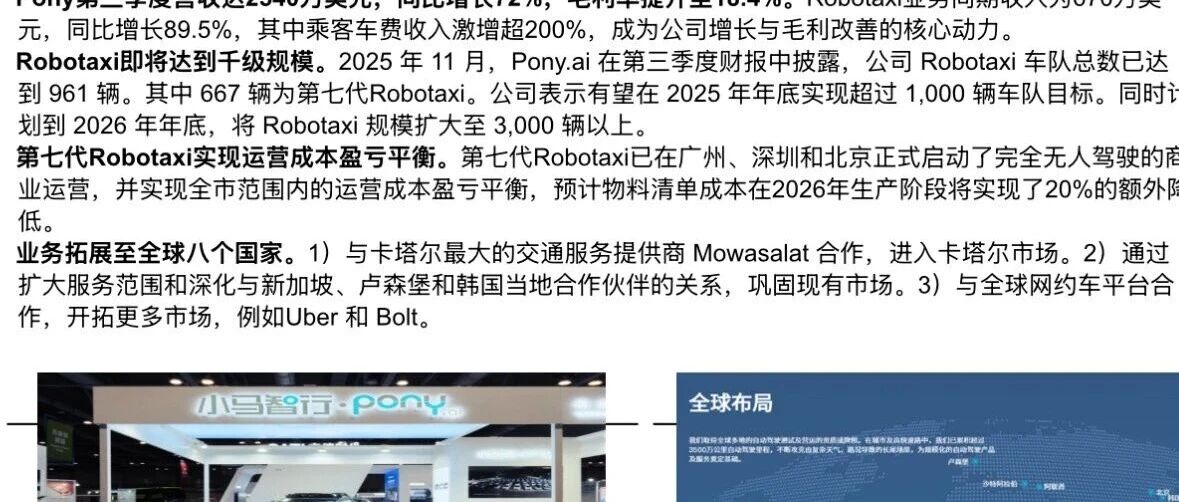
Core Viewpoint - The article discusses the advancements and financial performance of Pony.ai's Robotaxi business, highlighting its transition to profitability and expansion plans in various global markets. Financial Performance - Pony.ai reported a third-quarter revenue of $25.4 million, a 72% year-over-year increase, with a gross margin improvement to 18.4% [3] - The Robotaxi segment generated $6.7 million in revenue during the same period, marking an 89.5% year-over-year growth, with passenger fare revenue increasing over 200% [3] Operational Milestones - The seventh-generation Robotaxi has achieved operational cost breakeven across major cities including Guangzhou, Shenzhen, and Beijing, with a fleet size of 961 vehicles as of November 2025 [3] - The company aims to exceed 1,000 vehicles by the end of 2025 and expand the fleet to over 3,000 by the end of 2026 [3] Global Expansion - Pony.ai has expanded its operations to eight countries, including a partnership with Qatar's largest transportation provider, Mowasalat, and collaborations with local partners in Singapore, Luxembourg, and South Korea [4] Future Projections - Projections indicate that with a fleet of over 3,000 vehicles, the Robotaxi business will start to become profitable [6][7] - The average annual revenue per vehicle is expected to increase from 152,880 yuan in 2026 to 196,560 yuan by 2029, while operational costs are projected to decrease over time [6]
China’s Pony AI plans to triple global robotaxi fleet by the end of 2026
Yahoo Finance· 2025-11-25 16:54
Core Insights - Pony.ai plans to triple its robotaxi fleet by the end of next year, aiming for over 3,000 vehicles by the end of 2026, with a target of 1,000 vehicles by the end of this year [1][3] Fleet Expansion - The current fleet consists of approximately 961 robotaxis, with plans to significantly increase this number [1] - The company is expanding its commercial robotaxi services in major Chinese cities such as Beijing, Shanghai, Guangzhou, and Shenzhen [2] International Growth - Pony.ai is looking to expand its operations internationally, targeting eight countries including Qatar and Singapore through partnerships with local firms and ride-hailing companies like Bolt and Uber [3] Financial Performance - In the third quarter, Pony.ai reported revenue of $25.4 million, a 72% increase from $14.8 million in the same period last year [3][4] - Revenue sources include $6.7 million from robotaxi services, $10.2 million from self-driving trucks (robotrucks), and $8.6 million from licensing and application fees [4] Cost and Losses - Despite revenue growth, expenses are outpacing revenue, leading to a net loss of $61.6 million in the third quarter, a 46% increase from the same period in 2024 [5] - As of September 30, the company had $587.7 million in cash and cash equivalents, down from $747.7 million in the previous quarter, with part of the decrease attributed to investments in a joint venture with Toyota [6]
China's Pony.ai plans to triple global robotaxi fleet by the end of 2026
TechCrunch· 2025-11-25 16:54
Core Insights - Pony.ai plans to triple its robotaxi fleet by the end of next year, aiming for over 3,000 vehicles by the end of 2026, with a target of 1,000 vehicles by the end of this year [1][3] Company Operations - Pony.ai currently operates approximately 961 robotaxis and has expanded its commercial operations to major cities in China, including Beijing, Shanghai, Guangzhou, and Shenzhen [2][3] - The company is also looking to expand internationally into eight countries, including Qatar and Singapore, through partnerships with local firms and ride-hailing companies like Bolt and Uber [3] Financial Performance - In the third quarter, Pony.ai reported revenue of $25.4 million, a 72% increase from $14.8 million in the same period last year, driven by robotaxi services and technology licensing [3][4] - Revenue breakdown includes $6.7 million from robotaxi services, $10.2 million from self-driving trucks (robotrucks), and $8.6 million from licensing and application fees [4] - Despite revenue growth, the company reported a net loss of $61.6 million in the third quarter, a 46% increase compared to the same period in 2024 [5] Cash Position - As of September 30, Pony.ai had $587.7 million in cash and cash equivalents, down from $747.7 million in the previous quarter, with half of the decrease attributed to a one-off cash outflow related to its joint venture with Toyota [6]

Bolt partners with Pony.ai for driverless cars in Europe
Yahoo Finance· 2025-11-25 00:06
Core Insights - Estonian ride-hailing company Bolt has partnered with Chinese autonomous driving firm Pony.ai to introduce driverless cars to its taxi services in Europe [1][2] - Bolt aims to be among the first platforms to offer fully driverless autonomous vehicles in the EU, with plans for initial deployments by 2026 [2] - Chinese self-driving technology firms, including Pony.ai, are expanding into Europe due to restrictions in the U.S. market, raising competition concerns among local rivals [3] Company Developments - Bolt is focused on testing and validating the safety of fully autonomous vehicles before deploying them across various European countries [1] - CEO Markus Villig emphasized the urgency for Europe to avoid regulatory mistakes that could hinder the development of autonomous vehicles [4] Industry Context - The autonomous driving sector is currently dominated by U.S. companies like Waymo and Tesla, as well as Chinese firms such as Baidu and Pony.ai [2] - Many European countries have not issued new operating licenses for professional drivers in decades, limiting the growth of ride-hailing services and creating a demand for innovation in autonomous vehicle deployment [4]
‘Robotaxi has reached a tipping point': Baidu, Nvidia leaders see momentum as competition rises
CNBC· 2025-11-20 07:14
Core Insights - Baidu has announced the capability to sell robotaxi rides without human staff, indicating a significant advancement in autonomous driving technology [1] - Chinese robotaxi companies are expanding internationally at a faster pace than U.S. competitors, with industry leaders suggesting that autonomous driving is nearing a critical turning point [2] - Positive public feedback and increased exposure to driverless rides are expected to accelerate regulatory approvals for robotaxi services [3] Industry Growth Potential - The global robotaxi market is projected to exceed $25 billion by 2030, highlighting significant growth opportunities [4] - Chinese companies are aggressively pursuing international expansion, aiming to establish robotaxis as a viable business model rather than merely focusing on market share [6] Profitability and Operational Efficiency - Baidu's Apollo Go unit has achieved per-vehicle profitability in Wuhan, operating over 1,000 vehicles, which demonstrates the potential for profitability in other cities [8] - The cost of rides in Wuhan is approximately 30% lower than in major cities like Beijing and Shanghai, making it competitive against U.S. and European prices [9] - Partnerships with ride-hailing services like Uber are deemed critical for operational efficiency and quicker profitability [7] Fleet Size and Competitive Landscape - Companies like Baidu, Pony.ai, and WeRide are leading in fleet size, which is becoming a key competitive factor in the race for profitability [13] - Pony.ai plans to deploy 1,000 robotaxis in the Middle East by 2028, while WeRide aims for a similar fleet size by the end of next year [14] Safety and Regulatory Environment - No fatalities or major injuries have been reported by any of the six robotaxi operators, which is crucial for gaining regulatory approval [16] - The Chinese government is expected to increase support for robotaxi operations, which could further enhance market conditions [16][17]

