
Samsung Foundry

Search documents
Arteris(AIP) - 2025 Q4 - Earnings Call Transcript
2026-02-12 22:32
Financial Data and Key Metrics Changes - Total revenue for Q4 2025 was $20.1 million, up 16% sequentially and 30% year-over-year, exceeding guidance [20] - Full year 2025 total revenue reached $70.6 million, a 22% increase year-over-year [20] - Annual contract value plus royalties was $83.6 million, a 28% year-over-year increase, marking a new record [21] - Remaining performance obligations (RPO) totaled $117 million, representing a 32% year-over-year increase, another record high [21] - Non-GAAP gross profit for Q4 was $18.5 million, with a gross margin of 92% [22] - GAAP operating loss for Q4 was $8.5 million, compared to a loss of $7.1 million in the prior year [25] Business Line Data and Key Metrics Changes - Variable royalties increased by 50% year-over-year, with Q4 setting a new record [20] - FlexGen, an AI-driven smart NoC IP product, saw strong customer adoption, licensed for over 30 production device deployments [11] - Ncore, a cache coherent interconnect IP product, also experienced strength in licensing across various edge and server applications [12] Market Data and Key Metrics Changes - The largest impacts on revenue were seen in enterprise computing, automotive, and consumer electronics markets [7] - The number of large royalty reporters tripled in the last two years, indicating a diversified customer base [20] Company Strategy and Development Direction - The acquisition of Cycuity enhances Arteris' product portfolio, focusing on semiconductor cybersecurity assurance [8] - The company aims to address the growing need for cybersecurity in semiconductor designs, which is becoming a major issue [10] - Arteris is positioned to support semiconductor applications in the AI era across various sectors, including automotive and aerospace [17] Management's Comments on Operating Environment and Future Outlook - Management expressed confidence in the growth trajectory, expecting to report a non-GAAP operating profit as early as Q4 2026 [28] - The company anticipates continued strong demand for its products driven by the proliferation of AI-driven semiconductor designs [7] Other Important Information - Free cash flow was positive $3 million for Q4 and positive $5.3 million for the full year [26] - The company ended the year with $59.5 million in cash and no financial debt [26] Q&A Session Summary Question: Cross-sell opportunities and customer segments - Management highlighted that hardware security assurance is a major issue, opening significant cross-sell opportunities across the semiconductor industry [30][31] Question: NXP's increased use of Arteris solutions - Management confirmed that deploying multiple solutions increases average selling prices significantly, especially with the addition of Cycuity [35][36] Question: Strength in royalties and market segments - Management noted that the growth in royalties was due to both customer diversification and strength in various market segments, particularly automotive [37][38] Question: Impact of security acquisition on P&L - Management indicated that approximately $7 million of the projected revenue for 2026 would come from Cycuity, with expectations of breakeven by Q4 2026 [45][46]

Arteris(AIP) - 2025 Q4 - Earnings Call Transcript
2026-02-12 22:30
Financial Data and Key Metrics Changes - In Q4 2025, total revenue reached $20.1 million, a 30% year-over-year increase and 16% sequential growth, exceeding guidance [20] - For the full year 2025, total revenue was $70.6 million, representing a 22% increase year-over-year [20] - Annual contract value plus royalties hit a record $83.6 million, up 28% year-over-year [21] - Remaining performance obligations (RPO) totaled $117 million, a 32% year-over-year increase, with approximately half expected to be recognized as revenue in 2026 [21] - Non-GAAP gross profit for Q4 was $18.5 million, with a gross margin of 92% [22] - Non-GAAP operating loss for Q4 was $2.2 million, while the full year loss was $12.5 million, an improvement over the previous year [25] Business Line Data and Key Metrics Changes - The company reported a significant increase in variable royalties, which were 50% higher year-over-year, with Q4 setting a new record [20] - The number of large royalty reporters tripled over the last two years, contributing to a balanced mix of customers across vertical markets [20] - FlexGen, an AI-driven smart NoC IP product, saw strong adoption with over 30 production device deployments [11] - Ncore, a cache coherent interconnect IP product, also experienced strength in licensing across various applications [12] Market Data and Key Metrics Changes - The company noted expanding demand for AI-driven semiconductor designs across various markets, including enterprise computing, automotive, and consumer electronics [6] - The number of chiplet projects incorporating Arteris technology has more than tripled over the past two years, indicating strong market growth [15] - The automotive segment remains the largest vertical market, with emerging strength in consumer and aerospace sectors [39] Company Strategy and Development Direction - The acquisition of Cycuity enhances the company's product portfolio by adding cybersecurity assurance products, addressing market concerns about increasing cyberattacks [8][9] - The company aims to leverage its technology to improve hardware security and vulnerability testing across all SoCs, expanding its customer base [10] - Arteris is focusing on supporting semiconductor applications in the AI era, with a strong position in various sectors including autonomous vehicles and industrial automation [17] Management's Comments on Operating Environment and Future Outlook - Management expressed confidence in the company's growth trajectory, expecting to report a non-GAAP operating profit as early as Q4 2026 [28] - The company anticipates continued strong demand for its products driven by the rise of AI and the need for efficient data movement in semiconductors [6] - Management highlighted the importance of addressing cybersecurity in semiconductor designs, which is becoming a critical issue in the industry [30] Other Important Information - The company ended the year with $59.5 million in cash and no financial debt, with positive free cash flow of $3 million for Q4 [26] - The guidance for Q1 2026 includes expected ACV plus royalties of $85 million-$89 million and revenue of $20.5 million-$21.5 million [27] Q&A Session Summary Question: Cross-sell opportunities and customer segments - Management indicated that hardware security assurance is a growing issue, and the acquisition opens significant opportunities to enhance system IP value across various semiconductor companies [30][31] Question: NXP announcement and customer interest - Management confirmed that NXP is now using four solutions, indicating increased interest in deploying a full suite of solutions, which could drive average selling prices above $1 million [36] Question: Strength in royalties and market segments - Management noted that the growth in royalties is attributed to both customer diversification and an increase in large royalty reporters across various segments, including automotive and consumer markets [38][39] Question: Impact of security on P&L - Management clarified that approximately $7 million of the projected revenue for 2026 is expected from the Cycuity acquisition, with a slight contribution to operating loss anticipated [47] Question: Equity raising efforts post-acquisition - Management stated that they are in the process of activating an ATM for equity raising, with expectations for small amounts to be raised in the first quarter [49]
Arteris(AIP) - 2025 Q4 - Earnings Call Presentation
2026-02-12 21:30
Arteris 4Q 2025 Earnings Presentation Charlie Janac CEO Nick Hawkins CFO February 12, 2026 1 © 2026 Arteris, Inc. Disclaimer This presentation and the accompanying oral presentation have been prepared by Arteris, Inc. ("Arteris" or "the "Company") for informational purposes only and not for any other purpose. Nothing contained in this presentation is, or should be construed as, a recommendation, promise or representation by the presenter or Arteris or any officer, director, employee, agent or advisor of Art ...
Arteris (NasdaqGM:AIP) Earnings Call Presentation
2026-02-12 12:00
Accelerating The Creation Of Semiconductors Corporate Overview Charlie Janac CEO Nick Hawkins CFO February 2026 1 © 2026 Arteris, Inc. Disclaimer This presentation and the accompanying oral presentation have been prepared by Arteris, Inc. ("Arteris" or "the "Company") for informational purposes only and not for any other purpose. Nothing contained in this presentation is, or should be construed as, a recommendation, promise or representation by the presenter or Arteris or any officer, director, employee, ag ...
晶圆厂规划更新-台积电 2027 年资本支出;中介层外包给 Vanguard-The Foundry Floorplan Update on TSMC's 2027 capex; interposer outsourcing to Vanguard
2026-01-14 05:05
Summary of TSMC's 2027 Capex Update and Foundry Dynamics Company and Industry Overview - **Company**: Taiwan Semiconductor Manufacturing Company (TSMC) - **Industry**: Semiconductor Foundry - **Date of Report**: January 13, 2026 Key Points and Arguments TSMC's Capital Expenditure (Capex) - TSMC's estimated capex for 2027 has been raised to **US$54 billion**, up from **US$49 billion** in 2026, driven by strong demand for **2nm and AI semiconductors** [1][8][19] - The company is expected to see **EUV (Extreme Ultraviolet) orders increase by approximately 40-50%** from 2026 levels [1][8] Capacity and Production Plans - TSMC plans to convert part of its **Fab 12 and Fab 14** capacity for **interposer production** and may outsource **CoWoS (Chip on Wafer on Substrate) interposer production** to **Vanguard** in 2027 [1][8][9] - The company added **~20kwpm** of its **55nm/65nm capacity** for interposer production in 2025, indicating strong demand for AI semiconductors [9] Market Dynamics and Competitors - **Data center-related PMIC (Power Management Integrated Circuit)** faces shortages, with **SMIC and Vanguard** expected to benefit and potentially increase their **8-inch wafer prices** [1][8] - **Samsung Foundry** is gradually reducing its **8-inch engineering resources** to support leading-edge demand, which may lead to a shift of some display driver IC orders to **UMC** in the second half of 2027 [1][8] Financial Projections and Stock Ratings - TSMC's revenue growth is projected at **30% year-over-year in 2026**, exceeding the Street consensus of **24%** [1][23] - Price targets for TSMC have been raised to **NT$1,988** from **NT$1,888** [1][48] - **UMC** has been downgraded to **Underweight** due to potential investor disappointment regarding wafer price hikes and interposer production [1][8] Foundry 2.0 Concept - TSMC introduced the **Foundry 2.0** concept, expanding its business definition to include both front-end and back-end operations, with advanced packaging revenue approaching **10% of total revenue by 2025** [32][33] Long-term Outlook - TSMC is expected to outgrow the foundry industry due to its leadership position and heavy capex investments compared to peers [1][24] - The company aims to expand its **2nm capacity to 140kwpm by 2027**, with further growth anticipated beyond that [1][24] Additional Important Insights - TSMC's **EUV layer count** for future nodes is not significantly increasing, but the installed base of EUV scanners is expected to accelerate, particularly in 2027 [11] - The report highlights the importance of TSMC's capacity expansion as a key driver for the entire foundry industry's growth and revenue trajectory [19][23] This summary encapsulates the critical insights from the conference call regarding TSMC's strategic direction, financial outlook, and the broader semiconductor foundry landscape.
ANAFLASH Advances Embedded FLASH Memory for Next-Generation Smart Edge Devices with Samsung Foundry
Businesswire· 2025-11-03 18:00
Core Insights - ANAFLASH has developed an AI MCU utilizing proprietary standard logic compatible embedded flash technology, leveraging Samsung Foundry's 28 nm process [1] - The new AI MCU features zero-standby-power weight memory based on ANAFLASH's Logic-EFLASH technology, which uses only standard logic devices [1] - This innovation aims to provide a cost-effective and energy-efficient solution for battery-powered smart edge devices [1]


DEEPX and Baidu Form AI Ecosystem Partnership to Accelerate Global On-Device AI Projects in Drones, Robotics, and OCR
GlobeNewswire News Room· 2025-08-08 07:00
Core Insights - DEEPX has signed a partnership agreement with Baidu to enhance AI solutions in global industrial applications [1][12] - The collaboration will leverage Baidu's PaddlePaddle framework for various AI projects, including OCR, drones, and robotics [3][7] Company Overview - DEEPX specializes in low-power AI semiconductors and has a significant patent portfolio with over 350 patents pending [13][14] - The company is focused on developing high-performance AI chips that improve energy efficiency and enable advanced AI functionalities [14] Partnership Details - As an official ecosystem partner, DEEPX will co-develop products and participate in global customer promotion activities [3][12] - The partnership aims to enhance the practical applicability of PaddlePaddle-based AI models across various industries [11][12] Technology and Product Development - DEEPX's DX-M1 chip has demonstrated high performance in real-time applications, particularly in edge environments [6] - The company is also developing the V-NPU, a dedicated NPU card for vision AI, with mass production expected to begin in September [9] Future Initiatives - DEEPX and Baidu plan to showcase their collaboration at the 2025 Shenzhen Artificial General Intelligence Conference [10] - The partnership is expected to facilitate the adoption and scaling of AI products powered by DEEPX's NPUs among global partners [8]


CDNS Unveils LPDDR6/5X Memory IP System for Next-Gen AI & HPC Workload
ZACKS· 2025-07-14 15:11
Core Insights - Cadence Design Systems (CDNS) has launched the first LPDDR6/5X memory IP system solution, achieving speeds of 14.4Gbps, which is a 50% increase compared to previous LPDDR generations [1][9] - The new memory IP system is designed for AI infrastructure, high-performance computing (HPC), data centers, and mobile applications, facilitating faster data movement and lower latency [1][4] Product Features - The LPDDR6/5X memory IP features a sophisticated PHY architecture and a high-performance controller, optimized for power, performance, and area (PPA) efficiency, supporting both LPDDR6 and LPDDR5X DRAM protocols [2][3] - This solution integrates seamlessly into both conventional monolithic SoCs and advanced multi-die systems, leveraging Cadence's chiplet framework [2][3] - The integrated PHY and controller architecture is scalable and adaptable, building on existing product lines such as DDR5, LPDDR5X, and GDDR7 [3] Market Applications - The LPDDR6/5X memory IP solution targets diverse markets, including AI, mobile, consumer electronics, enterprise HPC, and cloud data centers, providing flexibility to meet varying performance, capacity, and cost requirements [4][8] - The solution is designed to support extended product lifecycles and can be tailored to different package and system configurations [4] Competitive Landscape - Cadence is experiencing growth due to strong demand driven by trends such as 5G expansion, hyperscale computing, and advancements in autonomous driving [8] - The company has entered a multi-year IP agreement with Samsung Foundry to enhance its memory and interface IP solutions, focusing on advanced process technologies [9][10] - However, Cadence faces competition from other EDA firms, which may impact pricing and margins, prompting increased R&D investments [11] Financial Performance - Cadence's stock has seen a 21.3% increase over the past three months, although this is below the Zacks Computer-Software industry's growth of 29.8% during the same period [12]


2024 年 Q4 全球晶圆代工行业收入同比增长 26%
Counterpoint Research· 2025-03-18 09:14
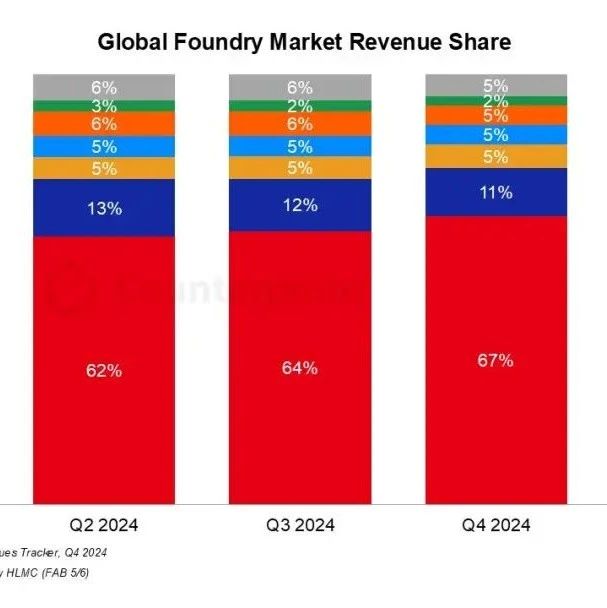
Core Viewpoint - The global wafer foundry industry is expected to see a 26% year-on-year revenue growth and a 9% quarter-on-quarter growth in Q4 2024, driven primarily by strong AI demand and the ongoing recovery of the Chinese market [1][3]. Summary by Sections Industry Performance - The advanced process capacity utilization remains high, driven by AI and flagship smartphone demand, particularly for TSMC's N3 and N5 processes [1][3]. - The overall utilization rate for global (excluding China) mature process foundries hovers between 65%-70%, with 12-inch processes recovering faster than 8-inch processes due to weaker demand in automotive and industrial sectors [1][3]. Demand Recovery - Non-AI demand is gradually recovering, particularly in consumer electronics and PC semiconductor sectors, supported by pre-production demand related to U.S. tariffs and demand driven by Chinese subsidies [1][3]. - Advanced packaging demand remains strong and stable, with TSMC actively expanding its CoWoS-L and CoWoS-R capacities, alleviating previous market concerns regarding capacity and order adjustments [1][3]. Company-Specific Insights - TSMC's revenue share reached a record 67% in Q4 2024, up from 64% in the previous quarter, primarily due to high capacity utilization in advanced processes [4]. - Samsung Foundry experienced a slight quarter-on-quarter revenue decline in Q4 2024, attributed to lower-than-expected demand for Android smartphones, leading to a decrease in its market share from 12% to 11% [5]. - SMIC's performance in Q4 2024 met expectations, with revenue growth driven by the recovery in consumer electronics and domestic localization efforts, although overall capacity utilization decreased from 90.4% to 85.5% [6]. - UMC's performance in Q4 2024 was stable, supported by occasional urgent orders in consumer electronics, but faced pricing pressure and a negative impact from a January earthquake [7]. - GlobalFoundries reported stable performance in Q4 2024, with strong wafer shipments offsetting seasonal weakness in the smartphone sector, driven by automotive demand and growth in communication infrastructure [8]. Analyst Commentary - The strong performance of the wafer foundry industry in Q4 2024 is largely attributed to the surge in AI and flagship smartphone demand, maintaining high capacity utilization in advanced processes [9].

2024 年 Q4 全球晶圆代工行业收入同比增长 26%
Counterpoint Research· 2025-03-18 09:14
根据 Counterpoint Research 的 《晶圆代工季度追踪报告》 数据,全球晶圆代工行业在 2024 年 Q4 收 入同比增长 26% ,环比增长 9% ,主要受强劲的 AI 需求以及中国市场持续复苏的推动。先进制程 的产能利用率依然维持在高位,主要受 AI 及旗舰智能手机需求驱动,尤其是TSMC的 N3 和 N5 制 程。与此同时,全球(不含中国)的成熟制程晶圆代工厂仍面临较低的产能利用率困境,本季度整 体利用率徘徊在 65%-70% 之间。其中,12 英寸制程的复苏势头强于 8 英寸制程,后者受汽车和工 业领域需求低迷的影响更大。不过,非 AI 需求正逐步回暖,尤其是在消费电子和 PC 半导体领域, 这得益于与美国关税相关的预先生产需求以及中国补贴驱动的需求,这为更广泛的市场稳定带来了 一些乐观因素。 随着 AI 和高性能计算(HPC)持续推动先进制程需求增长,先进封装在支撑行业增长方面发挥了关 键作用。TSMC 积极扩展 CoWoS-L 和 CoWoS-R 产能,进一步强化这一趋势,并缓解了市场此前对 产能及订单调整的担忧。 数据来源:《2024 年 Q4 全球晶圆代工行业收入追踪报告》, ...