
N3

Search documents
三大晶圆厂,巅峰之战
半导体行业观察· 2026-02-15 01:37
Core Viewpoint - The global semiconductor industry is crucial for modern technology, with TSMC, Samsung Foundry, and Intel Foundry as the three major players driving innovation and competition in advanced chip manufacturing [2][4][6]. Group 1: Company Profiles - TSMC is the absolute leader in pure foundry services, focusing solely on wafer manufacturing and avoiding competition in chip design, which has fostered strong relationships with companies like NVIDIA, AMD, Apple, and Qualcomm [2]. - Samsung Foundry represents a vertically integrated alternative, producing both chips and consumer electronics, and is investing heavily in advanced process nodes like 2nm GAA technology [3]. - Intel Foundry is a strategic newcomer, transitioning from a vertically integrated model to opening its fabs to external customers, with a roadmap that includes advanced nodes like Intel 18A [3]. Group 2: Competitive Dynamics - Competition among these companies drives technological advancement, as the need for innovation in transistor architecture and manufacturing processes is fueled by competitive pressure [5]. - The presence of multiple strong competitors enhances supply chain resilience, reducing risks associated with geopolitical tensions and natural disasters [5]. - Customers benefit from increased choice and bargaining power, allowing for better pricing and capacity allocation, which encourages foundries to respond actively to customer needs [5]. Group 3: Industry Implications - The competition among TSMC, Samsung, and Intel is not merely a commercial issue but has structural significance for the semiconductor ecosystem, ensuring innovation, resilience, and sustainable growth [4][6]. - The semiconductor industry is recognized as one of the most strategically important sectors globally, underscoring the necessity of these three companies for its success [6].


台积电:2030 年营收有望达 3000 亿美元
2026-01-13 11:56
TSMC (2330.TW) Earnings Call Summary Company Overview - **Company**: TSMC (Taiwan Semiconductor Manufacturing Company) - **Market Cap**: NT$43,566,640 million (approximately US$1,380,482 million) [6][8] Key Industry Insights - **Revenue Growth**: TSMC is expected to achieve revenue growth of 20-25% in 2026, driven by strong demand from AI datacenters and edge AI applications [1][2] - **Long-term Revenue Target**: TSMC's revenue is projected to reach US$300 billion by 2030, aligning with a long-term CAGR of 20% [1][4] - **AI Revenue Growth**: TSMC anticipates a mid-40s% CAGR in AI revenue by 2029, with potential for upward revision during the upcoming earnings call [9][32] Financial Performance - **Recent Sales**: TSMC reported 4Q25 revenue of NT$1,046 billion, a 6% QoQ increase, surpassing guidance of a 1% decline [4] - **Earnings Projections**: - 2023A: Net Profit NT$838,498 million, EPS NT$32.33 - 2024A: Net Profit NT$1,173,268 million, EPS NT$45.24 - 2025E: Net Profit NT$1,670,190 million, EPS NT$64.40 - 2026E: Net Profit NT$2,200,192 million, EPS NT$84.84 - 2027E: Net Profit NT$2,805,252 million, EPS NT$108.17 [5][8] Capital Expenditure (Capex) - **Capex Guidance**: TSMC's capex for 2026 is expected to be around US$50 billion, with a focus on advanced nodes (N3/N2) and advanced packaging [3][11] - **Capacity Expansion**: TSMC plans to increase N3 capacity by 30% by early 2027 and aims for CoWoS capacity of 1.2-1.3 million wafers in 2026 and 1.8-2 million wafers in 2027 [3][11] Market Position and Competitive Landscape - **Customer Demand**: TSMC is expected to see strong demand from major customers like Nvidia and Google, particularly for AI chips and advanced packaging solutions [11][25] - **Pricing Strategy**: Anticipated price hikes of 5-10% due to technology mix and demand dynamics are expected to positively impact TSMC's gross margins [25][26] Valuation and Investment Outlook - **Target Price**: The target price for TSMC has been raised to NT$2,450 from NT$1,800, reflecting a 45.8% expected return [6][4] - **Investment Recommendation**: The recommendation remains a "Buy" based on strong growth prospects and favorable market conditions [1][4] Additional Insights - **Gross Margin Stability**: Despite potential impacts from foreign exchange and advanced node dilution, TSMC is expected to maintain a gross margin of around 60% throughout 2026 [4] - **Analyst Expectations**: Analysts expect TSMC to provide a positive outlook during the upcoming earnings call, with strong demand for its leading process nodes and advanced packaging business [32] This summary encapsulates the key points from TSMC's earnings call and provides a comprehensive overview of the company's financial health, market position, and future outlook.
TSMC-Another 30% growth year in 2026E driven by AI; raise PT to NT$2,100
2026-01-07 03:05
Summary of TSMC Conference Call Company Overview - **Company**: TSMC (Taiwan Semiconductor Manufacturing Company) - **Industry**: Semiconductor Manufacturing Key Points and Arguments Revenue Growth Projections - TSMC is expected to achieve **30% USD revenue growth in 2026**, driven by increased demand for N3 technology, a stronger ramp of N2, and growth in advanced packaging [1][11] - Revenue growth is projected to continue at **20+% in 2027**, supported by tight capacity in leading-edge nodes and ongoing investments in AI [1][11] Gross Margins and Financial Performance - Gross Margins (GMs) are anticipated to remain around **60% through 2026**, aided by a favorable product mix and higher yields from N3 technology [1][11][36] - GMs are expected to be elevated in **1H26** due to high demand for expedited wafer orders, which carry a significant price premium [1][36] Capacity Expansion and Capital Expenditure - TSMC is entering a **capex upcycle**, with expected capital expenditures of **$48 billion in 2026** and **$55 billion in 2027**, focusing on N2, N3, and US fab expansions [1][51] - N3 capacity is projected to reach **147k wafers per month by the end of 2026**, with significant contributions from capacity conversions and new builds [1][19][57] Datacenter AI Revenue Growth - Datacenter AI revenue is forecasted to grow at a **57% CAGR from 2024 to 2029**, driven by strong demand for GPUs and ASICs, larger die sizes, and higher wafer ASPs [1][29] - By 2029, Datacenter AI could represent over **40% of TSMC's total revenues**, up from mid-teens in 2024 [1][31] Market Position and Competitive Landscape - TSMC is expected to maintain a **95% market share in AI accelerators** during the N2 era, despite competition from Intel and Samsung [1][49] - The company is not experiencing any significant share loss in leading-edge technology, with strong momentum in N2 tapeouts [1][42][49] Risks and Challenges - Key upside risks include stronger-than-expected gross margins and continued demand for N2 and N3 technologies [1] - Downside risks involve potential weakness in AI capital expenditures and increasing competition from Intel [1][11] Upcoming Guidance and Expectations - For **1Q26**, TSMC is expected to guide for flattish revenues quarter-over-quarter, with GMs projected to remain in the **61-63% range** [1][70] - The company will announce its **4Q25 results** on January 15, with expectations for revenues to exceed guidance [1][69] Additional Important Insights - Non-wafer revenues are expected to grow by **44% and 29% in 2026 and 2027**, respectively, driven by CoWoS expansion and increased adoption of advanced packaging technologies [1][21] - TSMC's aggressive capacity expansion plans are in response to strong demand from major clients like NVDA and Apple, indicating robust future growth potential [1][51][68]
台积电_受云人工智能大趋势推动,上调资本支出与增长预期
2025-11-25 01:19
Summary of TSMC Conference Call Company Overview - **Company**: Taiwan Semiconductor Manufacturing Company (TSMC) - **Industry**: Semiconductors Key Points Capital Expenditure and Growth Estimates - TSMC raised its capital expenditure (capex) estimates for 2026 and 2027 to **US$50 billion** and **US$52 billion**, respectively, from **US$46 billion** and **US$50 billion** previously [2][5] - The increase is driven by the demand for cloud AI and the need for capacity expansion to support this demand [2][3] - TSMC plans to expand its N3 capacity to **170kwpm** by the end of 2026, up from **120kwpm** at the end of 2025 [2] Sales Growth Projections - TSMC's sales growth for 2026 is projected to increase from **22%** to **25%**, with an expected growth of **28%** in 2027 driven by cloud AI [3] - Factors contributing to this growth include: - Migration of cloud AI to N3 with higher wafer prices - Strong ramp-up of new AI product generations from companies like Nvidia, Google, and Amazon [3] Geopolitical Expansion - TSMC is accelerating its expansion in Arizona to align with U.S. government priorities for reshoring, particularly for cloud AI production [4] - The company may upgrade part of its first phase capacity from N4 to N3 in 2026 to support local production [4] Financial Performance and Valuation - TSMC's EPS estimates for 2026 and 2027 have been raised by **4%** and **7%**, respectively [5] - The price target has been increased from **NT$1,700** to **NT$1,800**, maintaining a Buy rating [5][7] - Revenue projections for 2026 and 2027 are **NT$4,658 billion** and **NT$5,961 billion**, respectively, reflecting a year-over-year growth of **23%** and **28%** [18] Operating Metrics - TSMC's revenue for 2025 is estimated at **NT$3,781 billion**, with a gross margin of **59.4%** and an operating margin of **49.9%** [20] - The company is expected to maintain a strong profitability profile with a net profit margin of **44.1%** in 2025 [18] Client Demand and Capacity Analysis - TSMC's N3 capacity is expected to meet increasing demand from cloud AI, with significant contributions from major clients like Nvidia and Google [11][12] - The demand for N3 capacity from cloud AI is projected to grow significantly, indicating a robust market for TSMC's advanced technology [11] Market Position - TSMC holds a significant market cap of **NT$36,178 billion** (approximately **US$1,160 billion**) and has a free float of **87%** [7] - The company is positioned as a major foundry provider for U.S. production, leveraging its scale and technology [4] Additional Insights - TSMC's utilization rate is projected to improve, with a target of **89%** by 2027 [10] - The company is expected to maintain a strong return on invested capital (ROIC) of **62.2%** in 2027 [6] This summary encapsulates the critical insights from TSMC's conference call, highlighting the company's strategic direction, financial outlook, and market positioning in the semiconductor industry.
台积电分享在封装的创新
半导体行业观察· 2025-09-26 01:11
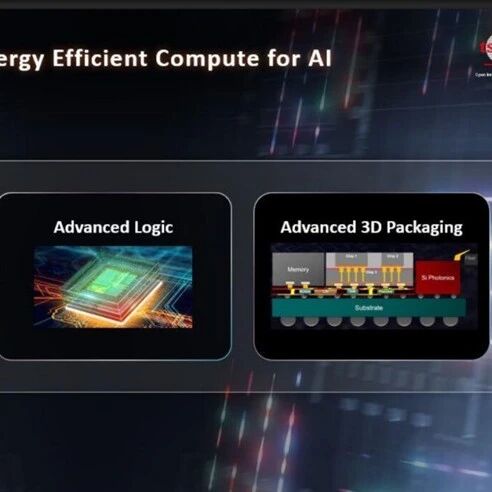
Core Insights - The proliferation of artificial intelligence (AI) is driving exponential growth in power demand across various sectors, from large-scale data centers to edge devices, injecting new vitality into everyday applications [2] - Energy efficiency is crucial for the sustainable growth of AI, as the power consumption of AI accelerators has tripled in five years, and deployment scale has increased eightfold in three years [4] Group 1: TSMC's Strategic Focus - TSMC is prioritizing advanced logic and 3D packaging innovations to address the challenges posed by increasing power demands [6] - The roadmap for TSMC's logic scaling is robust, with N2 expected to enter mass production in the second half of 2025, and N2P planned for next year [6] - Enhancements from N3 and N5 continue to increase value, with speed improvements of 1.8 times and power efficiency improvements of 4.2 times from N7 to A14, while power consumption decreases by approximately 30% per node [6] Group 2: Technological Innovations - N2 Nanoflex DTCO has optimized high-speed, low-power dual-unit designs, achieving a 15% speed increase or a 25-30% reduction in power consumption [8] - Dual-rail SRAM combined with Turbo/Nomin mode has improved efficiency by 10%, while memory computing (CIM) technology offers 4.5 times TOPS/W and 7.8 times TOPS/mm² performance compared to traditional 4nm DLA [9] - AI-driven design tools, such as Synopsys' DSO.AI, enhance power efficiency by 7% in the APR process and 20% in analog design integration with TSMC's API [9] Group 3: Packaging and Integration Advances - TSMC's 3D Fabric technology has shifted towards 3D packaging, including SoIC for die stacking and InFO for mobile/HPC chipsets [9] - The efficiency of 2.5D CoWoS has improved by 1.6 times with a reduction in micro-bump pitch from 45µm to 25µm, while 3D SoIC shows a 6.7 times efficiency improvement [10] - HBM integration technology has advanced, with TSMC's N12 logic substrate providing 1.5 times the bandwidth and efficiency of HBM3e DRAM substrates [12] Group 4: Overall Efficiency Gains - The effectiveness of Moore's Law remains evident, with logic scaling from N7 to A14 achieving a 4.2 times efficiency increase, and CIM technology improving by 4.5 times [17] - Packaging efficiency has improved by 6.7 times from 2.5D to 3D, while photonic technology has enhanced efficiency by 5-10 times [17] - AI has significantly boosted production efficiency, with improvements ranging from 10 to 100 times in various processes [17]
台积电_Communacopia + 2025 年科技大会- 关键要点
2025-09-12 07:28
TSMC (2330.TW) Conference Call Summary Company Overview - **Company**: Taiwan Semiconductor Manufacturing Company (TSMC) - **Ticker**: 2330.TW - **Event**: Goldman Sachs Communacopia + Technology Conference 2025 - **Date**: September 8-11, 2025 - **Presenters**: Wendell Huang (CFO), Jeff Su (Head of Investor Relations) Key Industry Insights 1. **Advanced Node Capacity**: - TSMC's advanced node peak capacity is expected to be higher than previous nodes due to increased demand from smartphone and high-performance computing (HPC) sectors [2][3] - N2 technology is projected to contribute 11.5% of wafer revenue in 2026, significantly higher than N3's 5.1% in its first year [3] 2. **N3/N5 Capacity Growth**: - TSMC maintains over 90% tool commonality between adjacent advanced nodes, allowing for flexible capacity adjustments to meet AI demand [2][7] - The company plans to convert capacity from N7 to N5 and N5 to N3 to support strong AI demand, leading to tight capacity in advanced nodes [7] 3. **Advanced Packaging Expansion**: - TSMC is allocating 10-20% of capital expenditures to advanced packaging, which is expected to grow faster than the corporate average [2][8] - Advanced packaging is projected to account for over 10% of revenue in 2025, up from 8% in 2024, with increasing adoption in non-AI applications [8] 4. **Long-term Gross Margin (GM) Target**: - Despite overseas expansion plans, TSMC's long-term GM target of 53%+ remains achievable [2][9][11] - The company plans to mitigate GM pressure through geographical diversification, cost efficiency, and leveraging government support [11] 5. **Revenue Growth Forecast**: - TSMC reaffirms a close to 20% compound annual growth rate (CAGR) for the 2024-2029 period, with potential upside driven by strong N2 demand and tightness in N3 and N5 nodes [12] Financial Metrics - **Market Capitalization**: NT$32.2 trillion / $1.1 trillion - **Revenue Projections**: - 2024: NT$2,894.3 billion - 2025E: NT$3,667.9 billion - 2026E: NT$4,211.2 billion - 2027E: NT$4,873.4 billion - **EPS Projections**: - 2024: NT$45.25 - 2025E: NT$60.36 - 2026E: NT$68.49 - 2027E: NT$77.56 - **Price Target**: NT$1,370.00 (upside of 10.5%) [18] Investment Thesis - TSMC is positioned as a leading global foundry with over 60% market share, benefiting from its technology leadership in AI, 5G, HPC, and EV sectors [13][15] - The stock is rated as a "Buy" due to its attractive valuation and long-term growth prospects [14][15] Key Risks 1. Deterioration in end-demand recovery affecting capacity utilization [16] 2. Slower customer node migrations impacting revenue [16] 3. Delays in 5G penetration affecting semiconductor growth [16] 4. Poor yields or execution leading to profitability issues [16] 5. Increased competition affecting pricing and margins [16] 6. Unfavorable foreign exchange trends or cost increases impacting margins [16] Conclusion TSMC's strong positioning in advanced technology nodes and packaging, along with a robust growth forecast, supports a positive investment outlook despite potential risks associated with market dynamics and competition.
台积电营收,三分之一来自于AI
半导体行业观察· 2025-07-20 04:06
Core Insights - TSMC is expected to dominate the high-end chip manufacturing market in the U.S., posing challenges for Intel and SMIC [2][3] - TSMC's expansion plans include significant investments in the U.S. and Taiwan, with a focus on advanced manufacturing processes [4][9] Global Capacity Layout - TSMC's wafer fabrication capacity will remain primarily in Taiwan, but additional capacity in the U.S. and Europe will provide a buffer against disruptions in Taiwan [3] - TSMC plans to build 11 new fabs and 4 packaging plants in Taiwan, potentially requiring more investment than the $165 billion planned for U.S. facilities [9] U.S. Expansion Plans - TSMC has committed to investing $165 billion in six chip fabs, two advanced packaging plants, and a research center in Phoenix, Arizona [4] - The first Arizona fab is already operational, while the second fab focusing on 3nm technology is completed and expected to ramp up production [6] Advanced Process Developments - TSMC anticipates that 2nm technology will see higher initial tape-out numbers compared to 3nm and 5nm, driven by demand from smartphones and high-performance computing (HPC) applications [11] - The A16 process is set to begin mass production in the second half of 2026, offering significant improvements in transistor density and energy efficiency [11] Financial Performance - TSMC reported record revenue of $30.07 billion for Q2, a 44.4% year-over-year increase, with net profit reaching $12.8 billion [14] - The company has a substantial cash reserve of $90.36 billion, supporting its ambitious capital expenditure plans in the U.S. and Taiwan [14] AI Chip Revenue Contribution - TSMC's HPC devices generated approximately $18 billion in sales, a 66.6% increase year-over-year, indicating a shift in revenue drivers from smartphones to AI-related products [16][19] - AI chip manufacturing and packaging contributed $8.78 billion in revenue, suggesting that AI could soon account for half of TSMC's total sales [19]
台积电_ 业绩回顾_ 2025 年二季度强劲超预期;先进制程节点需求无放缓迹象;目标价上调至新台币 1,370 元,重申买入评级-TSMC_ Earnings review_ 2Q25 strong beat; Advanced node demand shows no signs of slowdown; TP up to NT$1,370, reiterate Buy (on CL)
2025-07-19 14:57
TSMC (2330.TW) Earnings Call Summary Company Overview - **Company**: Taiwan Semiconductor Manufacturing Company (TSMC) - **Ticker**: 2330.TW - **Market Cap**: NT$29.3 trillion / $997.4 billion - **Enterprise Value**: NT$27.4 trillion / $932.3 billion - **12-Month Price Target**: NT$1,370.00 - **Current Price**: NT$1,130.00 - **Upside Potential**: 21.2% Key Industry Insights - **Advanced Node Demand**: TSMC's outlook on advanced node demand is increasingly positive, particularly driven by AI customers showing no signs of demand slowdown [2][20] - **Revenue Contribution**: Expected revenue contribution from N2 is anticipated to be significantly higher than N3 during the initial ramp-up stage, especially in the first two years, driven by both smartphone and HPC applications [2][21] - **Capacity Management**: TSMC plans to improve productivity through node conversions (e.g., N7 to N5, N5 to N3) to meet the strong demand for N5/N3 nodes [3][20] Financial Performance Highlights - **2Q25 Results**: - Revenue: NT$933.8 billion, up 11.3% QoQ and 38.6% YoY [18][39] - Gross Profit: NT$547.4 billion, with a gross margin of 58.6% [18][39] - Net Income: NT$398.3 billion, EPS of NT$15.36, up 10.1% QoQ and 60.6% YoY [18][39] - **2025 Revenue Guidance**: Raised to 30% YoY growth from mid-20% previously, supported by strong demand from AI and HPC applications [19][40] Pricing and Profitability - **Pricing Strategy**: TSMC is negotiating pricing for 2026, with expectations of a higher magnitude of price hikes due to strong demand for advanced nodes [4][23] - **Gross Margin Target**: Management maintains a long-term gross margin target of 53% and higher, with expectations for gross margin to reach 57.9% by 2026 [4][17][23] Future Projections - **Revenue Forecasts**: - 2025 Revenue: NT$3,667.9 billion (up from NT$3,581.1 billion) [6][42] - 2026 Revenue: NT$4,211.2 billion (up from NT$4,073.7 billion) [6][42] - **EPS Growth**: EPS estimates for 2025 have been raised to NT$60.36 from NT$56.38, reflecting a 7.1% increase [40][42] Capacity and Demand Dynamics - **CoWoS Demand**: Continued strong demand for CoWoS (chip on wafer on substrate) amid AI growth, with management focused on narrowing the supply-demand gap [24] - **Tight Capacity Outlook**: Anticipated tightness in N5 and N3 capacity over the next several years, with ongoing conversions from N7 to N5 and N5 to N3 to alleviate this [20][24] Conclusion - TSMC's strong performance in 2Q25 and positive outlook for advanced nodes, particularly driven by AI demand, positions the company favorably for future growth. The raised revenue guidance and pricing strategies indicate robust demand and operational efficiency, reinforcing the investment thesis for TSMC.
台积电(TSM):毛利率因汇率承压,全年收入指引上修
SINOLINK SECURITIES· 2025-07-17 15:09
Investment Rating - The report maintains a "Buy" rating for the company, indicating a strong expectation for future growth [4]. Core Insights - The company reported Q2 2025 revenue of $30.07 billion, a year-on-year increase of 44.4% and a quarter-on-quarter increase of 17.8%. The gross margin was 58.6%, up 5.4 percentage points year-on-year but down 0.2 percentage points quarter-on-quarter. Net profit reached $12.8 billion, reflecting a year-on-year increase of 60.7% and a quarter-on-quarter increase of 10.2% [2]. - The company has raised its full-year revenue growth guidance to approximately 30%, driven primarily by demand for advanced processes. In Q2 2025, revenue from N3, N5, and N7 processes accounted for 24%, 36%, and 14% of total wafer revenue, respectively, totaling 74% [3]. - The company is expected to benefit significantly from the growing demand for AI chips, with projections for net profits of $49.686 billion, $60.379 billion, and $66.768 billion for the years 2025 to 2027, respectively [4]. Summary by Sections Performance Review - In Q2 2025, the company achieved revenue of $30.07 billion, with a gross margin of 58.6% and net profit of $12.8 billion [2]. Operational Analysis - The decline in gross margin is attributed to the appreciation of the New Taiwan Dollar (TWD), which impacts revenue when converted from USD. A 1% appreciation in TWD results in a 1% revenue loss and a 40 basis points loss in gross margin. In Q2 2025, TWD appreciated by 4.4%, leading to a 180 basis points decline in gross margin, with further expected appreciation causing an additional 260 basis points loss [3]. - The company anticipates the first-generation N2 process to enter mass production in H2 2025, with subsequent processes expected in 2026 and 2028 [3]. Profit Forecast, Valuation, and Rating - The company is positioned as a leader in the wafer foundry industry, with a competitive edge in advanced processes, expected to benefit from the rise in AI chip demand. The projected net profits for 2025, 2026, and 2027 are $49.686 billion, $60.379 billion, and $66.768 billion, respectively [4].
台积电(TSM.US)2025Q2电话会:N3、N5产能很紧张 未来需求很高
Zhi Tong Cai Jing· 2025-07-17 08:28
Group 1: Company Insights - TSMC's N3 capacity is very tight and will remain so for the next few years, with N5 also experiencing tight capacity. High demand is noted as many AI applications are still using N4 and will transition to N3 in the next two years [1][9][10] - The company has a competitive advantage with its giga fab clusters, where 85-90% of the equipment is similar across different processes, facilitating capacity switching [1][10] - The semiconductor opportunity in humanoid robots is still in early stages, with significant potential expected in the medical sector. It is suggested that the opportunity in robotics could be ten times that of electric vehicles (EVs) [1][19] Group 2: Demand and Supply Dynamics - AI demand is increasingly strong, with CSP CEOs acknowledging this trend. The company is working to narrow the supply-demand gap rather than achieving a balance [2][15] - The growth in edge AI is expected to take one to two years for customers to complete new designs and products, with a moderate increase in shipment volumes but a 5-10% increase in die size anticipated [3] - The company is seeing strong demand for N3, N5, and future N2 processes, with many AI data centers being announced recently [12] Group 3: Financial Guidance and Margins - The company is adopting a conservative approach to its financial guidance due to potential tariff impacts and other uncertainties, despite aiming for higher revenue targets [4] - The company expects to maintain a gross margin of 53% or higher, with various factors influencing this margin, including exchange rates [5][11] - Capital expenditure (CAPEX) guidance remains unchanged, reflecting a cautious stance due to macroeconomic uncertainties, but the company is open to increasing investment if opportunities arise [14][21] Group 4: Future Technologies and Innovations - The company is focused on advanced packaging technologies and will expand production based on customer demand. Various technologies are being developed to support customer needs [16][17] - The return on investment (ROI) for N2 is expected to be higher than for N3, with production ramp-up anticipated in the second half of this year and revenue expected to begin in the first half of next year [13] - The company is not overly concerned about potential overcapacity in mature processes, as it is developing specialized processes based on customer demand [18]