Sublime Systems

Search documents
邱慈观专栏 | 颠覆性碳中和技术创新:利用公共资本撬动市场化资本
Xin Lang Cai Jing· 2025-12-29 05:26
Core Viewpoint - The article emphasizes the necessity of developing disruptive carbon-neutral technologies to achieve significant reductions in carbon emissions in high-carbon industries such as electricity, steel, cement, and aluminum smelting, which currently rely on traditional processes that do not meet carbon neutrality standards [1][2]. Group 1: Disruptive Carbon-Neutral Technologies - Approximately half of carbon-neutral technologies have not yet reached commercial scale, particularly in "hard tech" and "deep tech," which are crucial for significant carbon emission reductions [2]. - Disruptive technologies related to "hard tech" include efficient photovoltaic cells, green hydrogen, and new energy storage systems, while "deep tech" encompasses electrochemical ironmaking, silicon-magnesium cement, and inert anode aluminum smelting [2]. - These technologies face market investment challenges due to high capital intensity and long investment cycles, often requiring decades to scale from prototypes to commercial viability [2][3]. Group 2: Public Capital to Leverage Market Capital - Public capital is essential for supporting the development of disruptive carbon-neutral technologies, as it can alleviate some financial constraints, but its scale is limited [4]. - The main challenge for market capital is obtaining risk-adjusted returns, which can be addressed by using public capital to reduce field risks and attract diverse investors [4]. - Public capital can catalyze market capital by improving the risk-return profile through donations, guarantees, and other financial structures, thereby accelerating the development of tech startups [5][4]. Group 3: Case Studies of Public Capital Leveraging Market Capital - Boston Metal and Sublime Systems are examples where public capital provided grants for prototype validation and technology scaling, successfully attracting market investments for further development [8][11]. - Elysis and Zhongchu Guoneng are cases where public capital was used to co-invest with market capital during the demonstration and early commercialization stages, effectively filling funding gaps [11][12]. - The article outlines various international and domestic cases where public capital has successfully attracted market capital, demonstrating effective mechanisms for leveraging investments in disruptive carbon-neutral technologies [10][12]. Group 4: Future Outlook - To further promote the innovation and development of disruptive carbon-neutral technologies, public capital should focus on supporting tech startups, establishing clear financing policies, and exploring financing mechanisms suitable for carbon-neutral tech [13][14]. - The transition from merely providing funds to achieving tangible outcomes for enterprises is crucial for unlocking economic potential and achieving climate goals [14].

颠覆性碳中和技术创新:利用公共资本撬动市场化资本
Jin Rong Shi Bao· 2025-12-15 05:17
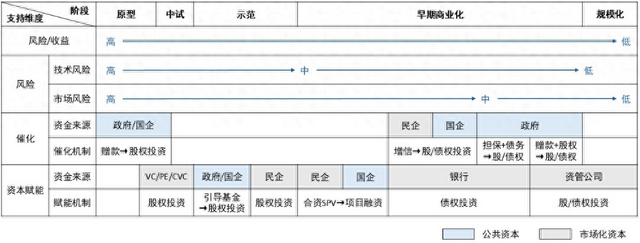
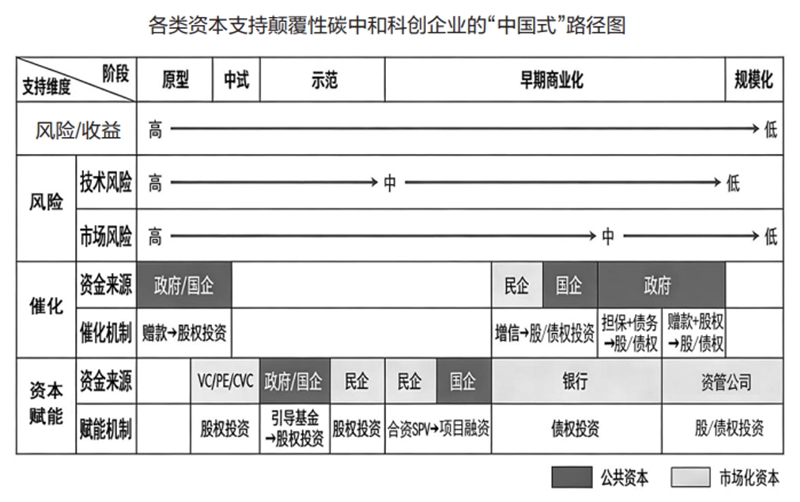
Core Viewpoint - The necessity of developing disruptive carbon-neutral technologies is emphasized as high-carbon industries in China, such as electricity, steel, cement, and aluminum smelting, have not yet achieved carbon neutrality through traditional methods, highlighting the need for significant investment and innovative approaches to reduce carbon emissions to near-zero levels [1][2]. Summary by Sections Disruptive Carbon Neutral Technology Investment - Approximately half of carbon-neutral technologies have not reached commercial scale, particularly in "hard tech" and "deep tech," which rely heavily on foundational scientific research [2]. - High-carbon industries face significant market investment challenges due to the high capital intensity and long investment cycles required for scaling up carbon-neutral technologies [2][3]. Public Capital to Leverage Market Capital - Public capital is essential for supporting the development of disruptive carbon-neutral technologies due to their dual positive externalities of technological spillover and carbon reduction [4]. - The key to attracting market capital lies in reducing perceived risks through public funding, which can help address both technological and market risks faced by investors [4][5]. Catalytic Mechanisms - Public capital can intervene in the early stages of technology development by providing catalytic funding to improve the risk-reward profile for investors, thus attracting more market capital [5]. - In early commercialization, public capital can enhance the investment appeal by offering guarantees and hybrid funding structures to mitigate the low returns associated with carbon-neutral technologies [5][6]. Capital Empowerment - Public capital can collaborate with market capital in the demonstration and early commercialization phases to fill funding gaps and empower the scaling of innovative technologies [6]. - Establishing venture capital funds focused on carbon-neutral technologies can signal to the market and attract additional investments [6]. Case Studies - Several international and domestic cases illustrate how public capital has successfully attracted market capital in the field of disruptive carbon-neutral technologies, with specific mechanisms and support structures detailed [7][9]. - Examples include Boston Metal and Sublime Systems, which received public grants to validate and scale their technologies, leading to successful market capital participation [10]. - Elysis and Zhongchu Guoneng are highlighted as cases where public capital effectively partnered with market capital to accelerate technology development [11]. Future Outlook - To further promote the innovation of disruptive carbon-neutral technologies, public capital should focus on incubating tech companies, establishing supportive financing policies, and exploring financing mechanisms that align with China's unique context [13][14][15].
Trump’s DOE proposes cutting billions in grants for GM, Ford, and lots of startups
Yahoo Finance· 2025-10-07 21:11
Core Points - The Department of Energy is proposing significant cuts to federal funding, which could impact various startups and major automakers like Ford, General Motors, and Stellantis [1][2] - The proposed cuts include the cancellation of over $500 million in contracts awarded to more than a dozen startups, in addition to previous cuts of more than $7.5 billion announced by the Trump administration [2][3] Impact on Startups - Startups are expected to face substantial losses, with some awards being critical to their operations. The proposed cuts include new awards that have not been publicly announced yet [5] - Notable startups affected include Brimstone, which was granted $189 million to build a plant for low-carbon materials, and Anovion, which aimed to produce synthetic graphite for lithium-ion batteries [6] Impact on Automakers - General Motors stands to lose at least $500 million from a federal grant intended for retooling its Lansing Grand River Assembly Plant for electrified vehicle production [4] - Other automakers, including Daimler Trucks North America, Harley-Davidson, and Volvo Technology of America, are also slated to lose grants worth hundreds of millions [3] Specific Grants Affected - Li Industries received $55.2 million for recycling LFP batteries, while Sublime Systems was awarded $86.9 million for an ultra-low-carbon cement plant. Both are at risk of losing their funding [7]


Trump's DOE proposes cutting billions in grants for GM, Ford, and lots of startups
TechCrunch· 2025-10-07 21:11
Core Points - The Department of Energy is proposing significant cuts to federal funding, which could impact various startups and major automakers like Ford, General Motors, and Stellantis [1][2] - The proposed cuts include the cancellation of over $500 million in contracts awarded to more than a dozen startups, in addition to previous cuts of more than $7.5 billion announced by the Trump administration [2][3] Impact on Startups - Startups are expected to face substantial losses, with some awards being critical for their operations. The proposed cuts include new awards that have not been publicly announced yet [5] - Notable startups affected include Brimstone, which was set to receive $189 million for a plant to produce low-carbon materials, and Anovion, which aimed to build a factory for synthetic graphite [6] Impact on Automakers - General Motors could lose at least $500 million in grant money intended for retooling its Lansing Grand River Assembly Plant for electrified vehicle production [4] - Other automakers like Ford, Daimler Trucks North America, and Stellantis are also at risk of losing hundreds of millions in grants [3] Specific Grant Losses - Several building materials companies are on the list for proposed cuts, including CleanFiber and Hempitecture, which could lose $10 million and $8.4 million respectively [11] - TS Conductor, which produces advanced conductors for electric lines, is at risk of losing $28.2 million, which contradicts the administration's goals for energy dominance [12]

行业报告解析:脱碳混凝土市场规模约1525百万美元
Sou Hu Cai Jing· 2025-08-21 04:36
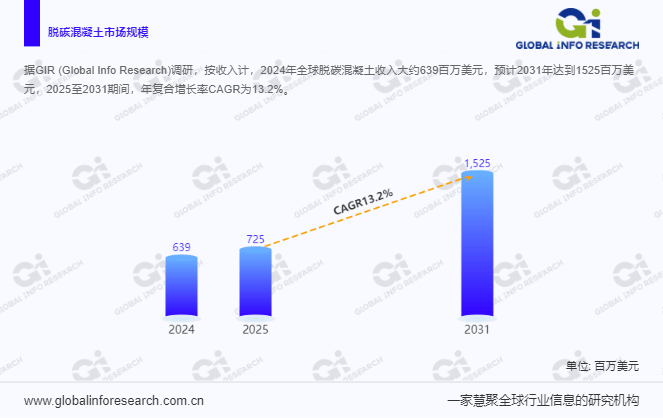
Group 1: Market Overview - The global decarbonized concrete market is projected to generate approximately $639 million in revenue in 2024, with expectations to grow to $1.525 billion by 2031, reflecting a compound annual growth rate (CAGR) of 13.2% from 2025 to 2031, indicating strong growth potential [1] - In terms of production, the global output of decarbonized concrete is expected to reach approximately 26.5 million tons in 2024, with an average selling price of $234.33 per ton [3] Group 2: Product Characteristics and Technology - Decarbonized concrete is defined as an innovative building material aimed at reducing CO₂ emissions during traditional concrete production by utilizing low-carbon raw materials, optimizing production processes, and integrating carbon capture technologies [3] - Key technological approaches include CO₂ mineralization, alternative clinker materials, and the development of completely cement-free geopolymers or biological methods, which not only reduce environmental impact but also enhance structural strength and durability [3] Group 3: Competitive Landscape - Major companies in the global decarbonized concrete market include CarbonCure Technologies, CarbiCrete, Brimstone, Sublime Systems, Hoffmann Green, C-Crete, Solidia Technologies, CarbonBuilt, Oxara, Blue Planet Systems, LafargeHolcim, Buzzi Unicem, Geopolymer Solutions, Heidelberg, and Cemex [4] - The market can be segmented into carbon-negative cement and cement-free concrete, with core applications in infrastructure, residential and commercial buildings, marine engineering, and other related fields [4] Group 4: Historical and Forecast Data - Historical data from 2020 to 2024 includes industry status, competitive landscape, production expansion, mergers and acquisitions, and market data segmented by product type, application field, and region [4] - Forecast data from 2025 to 2031 will cover industry status predictions, market size, product pricing, market share, growth rates, and competitive trends [5]