Yield Curve

Search documents
June CPI rises 2.7% annually
CNBC Television· 2025-07-15 12:56
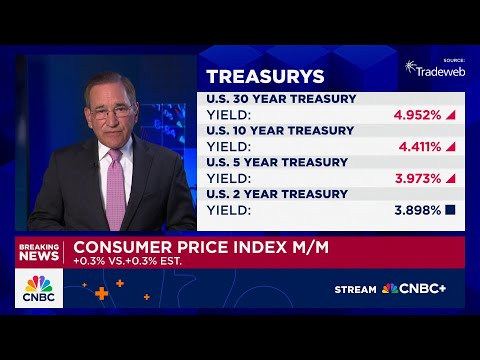
We do have that breaking news right now. Let's get straight to Rick Santelli for more on that. Rick, take it away.Yes, this is our June read on CPI, the consumer price uh inflationary guide, and it is a little warmer than expected on year-over-year, but headline looks good. Up 3/10 as expected. That does follow up one10enth.Up 3/10 will be the second warmest of the year. January was the warmest at up half 1%. This is as expected but two ten hotter than the rearview mirror.If we strip out food and energy com ...

Fed is split almost 50/50 on rate cuts, says Ariel Investments' Charlie Bobrinskoy
CNBC Television· 2025-07-11 20:59
Tariffs and Market Risk - The market is largely discounting the risk of higher tariffs, viewing President's threats as saber rattling [2][3] - There is a risk that tariffs, with an effective rate of 13-14%, will start to impact second quarter earnings, as they began to kick in during May [4] - Mega cap tech companies are relatively invulnerable to tariffs [12] Interest Rates and Fed Policy - The Fed is split on interest rate policy, with approximately 50% favoring rate cuts due to concerns about unemployment and 50% worried about the inflationary effects of tariffs [6] - Chicago Fed chairman Goulsby is considered dovish and signals potential rate cuts [5] Yield Curve and Banking Sector - A steepening yield curve is generally considered positive for the overall economy and is beneficial for banks, as they borrow short and lend long [8] - The banking sector is fundamentally benefiting from the current yield curve [9] - Mega cap banks like JP Morgan are trading at high valuations (250% of book value), but regional banks may still offer attractive opportunities [10] Tech Sector - Tech names are showing strong positive indications pre-earnings, with approximately 60% of positive pre-announcements coming from the tech sector, compared to about 14% for industrials [13] - Mega cap tech companies still have room to grow, driven by long-term growth pathways, despite recent pullbacks for profit taking [12]

高盛:全球利率-上涨空间有限
Goldman Sachs· 2025-07-04 03:04
Investment Rating - The report indicates a modestly richer range for US yields, with expectations for 2-year and 10-year yields to finish the year at 3.45% and 4.20% respectively, down from previous forecasts of 3.85% and 4.50% [2][5]. Core Views - The revised Fed baseline suggests earlier cuts and a lower terminal rate, leading to a lower range for US yields across the curve. The expectation for 10-year US yields is now 4.20% at the end of 2025, compared to 4.50% previously [1][2]. - The report anticipates that the improved macro outlook will compress risk premia throughout the Gilt curve, with a forecast of 10-year Gilts at 4.25% by year-end [19]. - European duration is expected to trade weaker over time, with a 10-year Bund yield forecast of 2.8% for end-2025, driven by fiscal support from Germany [19][11]. Summary by Sections US and Canada - The firmer than expected June jobs report has led to a modestly richer range for US yields, with the revised forecasts reflecting a dovish stance compared to market pricing [2][5]. - The risks associated with diminished central bank independence and fiscal pressures are limiting factors for long-end richening [2]. Europe - The report maintains Bund yield forecasts at 2.8% for end-2025, with expectations that fiscal support will push yields higher as growth expectations improve [11][19]. - The ECB's strategy assessment indicates a need for forceful policy action to address inflation volatility, with limited guidance on near-term policy [11]. UK - The report notes ongoing fiscal fragilities in the UK, but front-end longs are expected to remain relatively well protected despite recent volatility in the Gilt market [16][19]. - The expectation is for 10-year Gilts to rally towards 4.25% by year-end, supported by bullish spillovers from the US [19]. Japan - The report suggests that the BOJ normalization cycle will be prolonged, with a medium-term neutral rate of 1.25-1.5%, impacting yields across the curve [19]. General Market Dynamics - The report highlights that a benign path to lower short-term rates can improve the economic appeal of US Treasuries, despite downward revisions to US yields [1][4]. - The potential for deeper cuts to support lower yields is acknowledged, with a steeper curve expected in spot terms [4][7].
Rieder Favors Equities Over Long Duration Bonds
Bloomberg Television· 2025-06-30 17:20
Market Trends & Investment Strategies - The discussion revolves around investment strategies concerning treasuries, particularly the 20-year Bond ETF (TLT), and European bonds [1] - The firm expresses reservations about the back end of the yield curve, considering alternatives like ECB rate cuts or seeking opportunities at the long end [2] - Tactical buying of the long end of the yield curve is considered around quarter-end [2] - Long-duration assets can be helpful if geopolitical risks resurface or inflation declines [5] - Currently, equities, especially growth equities with a 19% ROE, are favored over long-duration bonds due to inflation concerns and tariff issues [5][6] Duration & Hedging - Duration is viewed as no longer a reliable hedge [4] - TLT is considered an efficient vehicle for gaining duration when needed, although not currently favored [3] Economic Factors - Inflation expectations and potential tariff problems are key themes influencing market movements [5]
September Is Live Meeting for Fed, Says Guggenheim's Brown
Bloomberg Television· 2025-06-20 19:27
They've been signaling basically to ignore the inflation data for now because it's either a lagging indicator or has the potential to change. The one thing that could make the Fed move quicker would be a weakening of the labor market. But as Ed said, the important thing to note as as bond investors and credit investors is the next move is still going to be lower rates.I am curious, Steve, when we talk about this idea of the next move and if it is lower and you have a market that at least right now seems to ...
Should the Federal Reserve Cut Interest Rates?
Principles by Ray Dalio· 2025-06-20 15:35
Interest Rate Policy & Economic Outlook - Market anticipates approximately two rate cuts by year-end, while some Fed officials suggest potentially only one [1] - There's significant uncertainty and deteriorating sentiment in the economy, making it difficult for the Fed to balance monetary policy [2] - Political factors, including a new Fed chair, may lead to increased pressure for rate cuts due to the impact of interest rates on large debts [3] Impact of Rate Cuts - Lowering rates could reduce returns on assets, requiring interventions that devalue money [4] - Aggressive rate cuts could negatively impact the bond market [5] - Monitoring the yield curve, dollar movement, and gold prices can reflect shifts away from bonds due to concerns about the value of money [6] Monetary Policy & Elections - Midterm elections and potential changes in monetary policy create a period of concern for the markets [5]
Long end of the curve more important than Fed rate decision: Fidelity Investments’ Jurrien Timmer
CNBC Television· 2025-06-17 15:13
Monetary Policy & Fed's Actions - The Fed's dual mandates of growth and inflation are now equally important, a shift from the past 15 years where growth shocks allowed for asymmetric easing [2] - The Fed funds rate, currently at 4 and 3/8%, has room for a couple of cuts to reach a neutral rate, estimated at inflation plus 100 basis points [2] - The market's reaction to the Fed's actions, particularly at the long end of the curve, is more critical than the Fed's direct control over short-term rates [3][4] - The Fed is likely monitoring fiscal policy to avoid repeating the 2021 scenario where it underestimated fiscal stimulus and delayed tightening [6] - The Fed primarily focuses on core inflation, currently around 25% to 26% based on core PCE, and may overlook temporary oil price spikes due to geopolitics [8][9] - The market and the Fed are currently in agreement regarding the future path of interest rates, as indicated by the alignment between the dots and the forward curve [14] Inflation & Economic Outlook - While inflation has decreased to 25%, it hasn't consistently fallen below 2%, which is necessary for the 5-year average to return to 2% [10] - Rising oil prices could impact the tips market and the intermediate part of the yield curve, but the Fed is likely to look beyond temporary spikes [9][10] - The level above 45% at the long end of the curve is not conducive to positive economic outcomes [4] Market Indicators & Fed's Communication - The "dots" are less relevant now that the Fed funds rate is at 4 and 3/8%, as they were initially designed for forward guidance at the zero lower bound [13] - The forward curve, specifically the SOFR curve, serves as a real-time indicator of market expectations, making the "dots" less impactful [14]
Why Have Markets Gone Cold on Long-Term Treasuries? | Presented by CME Group
Bloomberg Television· 2025-06-13 20:52
Market Trends - The yield curve exhibits unusual behavior with 30-year Treasury yields rising while shorter-term yields are falling, a pattern last seen in 2001 [1][2] - The Federal Reserve has cut short-term interest rates by 100 basis points since September 2024, contributing to lower short-end yields [2] - Further easing by the Federal Reserve is anticipated, potentially reaching 50 basis points in 2025 [2] Investment Risks and Opportunities - Longer-term yields have increased, with 30-year Treasuries exceeding 5%, a level unseen since 2007 [3] - Investors are demanding higher yields for longer-dated bonds due to concerns about US fiscal policy, growing federal debt, and potential future inflation [3] - Uncertainty surrounds the government's future debt issuance and market demand to absorb it without further yield increases [4] Economic Outlook - Falling short-term yields reflect expectations for additional Federal Reserve rate cuts [4] - Economic uncertainty is potentially linked to recent trade conflicts and tariff discussions [4]

Why Have Markets Gone Cold on Long-Term Treasuries? | Presented by CME Group
Bloomberg Television· 2025-06-13 20:49
Market Trends & Yield Curve - Different duration Treasury yields are moving in opposite directions, a rare occurrence with 30-year yields rising while shorter-term yields are falling [1] - This pattern was last observed in 2001 [2] Federal Reserve Policy - The Federal Reserve has cut short-term interest rates by 100 basis points (1%) since September 2024, lowering short-end yields [2] - Further easing by the Federal Reserve is anticipated, potentially as much as 50 basis points (0.5%) in 2025 [2] Long-Term Yields & Economic Concerns - Longer-term yields have increased, with 30-year Treasuries exceeding 5%, a level not seen since 2007 [3] - Investors are demanding higher yields for longer-dated bonds due to concerns about US fiscal policy, increasing federal debt, and potential future inflation [3] - Uncertainty exists regarding the amount of future government debt issuance and whether there will be sufficient demand to absorb it without further yield increases [4] Economic Uncertainty - Falling short-term yields reflect expectations for more Federal Reserve rate cuts, potentially linked to economic uncertainty from recent trade conflicts and tariff discussions [4]

Dollar Could Drop 10% in a Year, Says Tudor Jones
Bloomberg Television· 2025-06-11 20:30
But are you short the dollar. I mean, you mentioned you're into yields. I would say that the easiest long term trades are, you know, the yield curve is going to steep and probably the historic wise, you know, we're going to cut short term rates dramatically in the next year.And, you know, the dollar will probably be lower because of that. A lot lower because of that. How much lower off.10% from our high right now. Yes, I would say that that that's I think that's a year from today. That's probably a realisti ...