
险资入市

Search documents
35万亿险资重构底仓资产 权益配置盘浇灌“时间的玫瑰”
Zhong Guo Zheng Quan Bao· 2025-08-11 21:14
Core Insights - The insurance industry is experiencing a significant shift towards long-term equity investments, driven by low interest rates and the need for better asset-liability matching [1][5][6] - Insurance companies are increasingly focusing on high-dividend assets as a stable source of cash flow, with a notable rise in the number of equity investments and strategic shareholdings [2][3][5] - Regulatory reforms are facilitating the establishment of private equity funds by insurance firms, allowing them to invest more heavily in the stock market [2][8] Group 1: Investment Strategies - Insurance companies are restructuring their asset allocations to prioritize long-term equity investments, moving from trading-oriented assets to those that generate stable cash flows [1][3] - The trend of increasing shareholdings in listed companies is evident, with insurance firms triggering shareholding notifications through significant stock purchases [2][3] - High-dividend sectors such as banking, utilities, energy, and technology are particularly favored by insurance investors, reflecting a strategic shift towards stable income generation [2][5] Group 2: Regulatory Environment - The establishment of private equity funds is part of a broader regulatory initiative to encourage long-term investments by insurance companies, with over 220 billion yuan approved for various pilot projects [2][8] - New accounting standards are reshaping investment strategies, emphasizing the importance of stable dividend income and reducing reliance on capital gains [6][7] - There are ongoing challenges related to regulatory constraints, including solvency requirements and accounting measurement methods, which may hinder the full potential of insurance capital in equity markets [8][9][10] Group 3: Market Dynamics - The insurance sector is facing pressure from high liability costs and low bond yields, prompting a shift towards equities to enhance returns [5][6] - The demand for high-quality, stable cash flow assets is increasing, with insurance firms actively seeking opportunities in REITs and other equity instruments [3][6] - The industry's asset duration is currently shorter than its liability duration, necessitating a strategic focus on extending asset duration to mitigate risks associated with interest rate fluctuations [5][9]
天风证券:险资对银行股的增持空间还有多少?
智通财经网· 2025-08-11 13:28
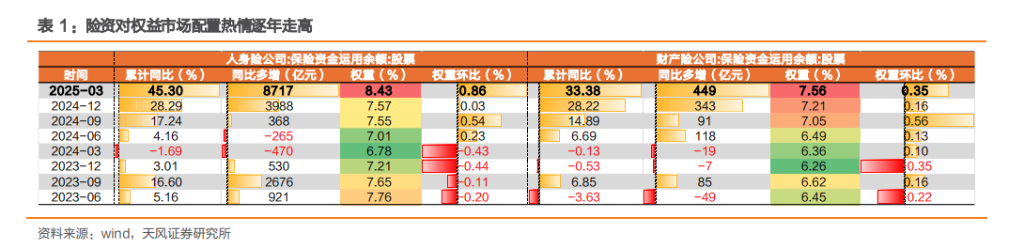
Core Viewpoint - The trend of insurance capital increasing equity allocation is evident, with banks and other high-dividend sectors likely to be the main beneficiaries. Group 1: Insurance Capital Allocation Trends - By the end of Q1 2025, life and property insurance companies had invested a total of 2.82 trillion yuan in the stock market, a year-on-year increase of 44.5%, and a 19.5 percentage point increase from the end of 2024 [1] - The stock investment of life and property insurance companies accounted for 8.4% and 7.6% of the total insurance fund utilization balance, respectively, both reaching their highest levels in nearly two years [1][2] - The stock investment of life insurance companies increased by 871.7 billion yuan year-on-year, while property insurance companies saw an increase of 44.9 billion yuan, marking the highest expansion levels in the past two years for both categories [1] Group 2: Investment Preferences - Insurance companies prefer high-dividend stocks, particularly in the banking sector, as evidenced by the significant increase in OCI account allocations, which accounted for 28.4% of stock investments by the end of 2024, up 7.6 percentage points from the end of 2023 [4] - By Q1 2025, the market value of insurance capital holdings in the banking sector reached 3.924 trillion yuan, representing a 30 billion yuan increase from the previous quarter, making it the highest among all Wind secondary industries [6][8] Group 3: Regulatory Environment and Future Outlook - Policies promoting long-term capital market investments have been introduced, including a requirement for large state-owned insurance companies to invest 30% of new premiums in A-shares starting in 2025 [12][20] - The banking sector is expected to remain a key focus for insurance capital due to its high dividend yields and low volatility, with banks being a primary target for recent capital increases [9][12] - The insurance sector's solvency ratios indicate that there is still significant room for increasing equity investments, with potential additional investments in bank stocks estimated at 2.432 trillion yuan [29][32]


A股三大指数集体高开,深成指涨0.27%
Feng Huang Wang Cai Jing· 2025-08-11 01:35
Group 1 - A-shares opened higher with the Shanghai Composite Index up 0.05%, Shenzhen Component Index up 0.27%, and ChiNext Index up 0.13% on August 11, 2023 [1] - Sectors such as lithium mining, Xinjiang, and rail transit equipment saw significant gains [1] Group 2 - Insurance capital is accelerating its market entry, with 22 instances of insurance capital increasing stakes this year, surpassing the total for 2024 [2] - Ping An Life has made 7 stake increases, and 35 companies have insurance capital among their top ten shareholders, holding a total of 889 million shares valued at 13.727 billion yuan [2] - Key sectors for insurance capital investments include telecommunications, non-ferrous metals, transportation, electronics, and machinery [2] Group 3 - Everbright Securities predicts that the market will enter a new phase of upward momentum in the second half of the year, potentially surpassing the peak levels of 2024 [3] - The market transition from policy-driven to fundamentals and liquidity-driven dynamics is noted, with expectations of continued improvement in fundamentals and sustained capital inflow [3] - Emerging industries are expected to present opportunities, contributing to the anticipated market rally [3] Group 4 - Huatai Securities highlights a rebound in A-shares driven by trading funds, with a focus on sectors showing improvement and potential for catch-up, including storage, software, general automation, certain chemicals, insurance, and coal [4] - Strategic allocations continue to favor large financials, pharmaceuticals, and military industries [4]



券商晨会精华 | 险资加快入市步伐
智通财经网· 2025-08-11 00:28
Market Overview - The market experienced slight declines last Friday, with the Shanghai Composite Index down 0.12%, the Shenzhen Component down 0.26%, and the ChiNext Index down 0.38% [1] - The total trading volume in the Shanghai and Shenzhen markets was 1.71 trillion yuan, a decrease of 115.3 billion yuan compared to the previous trading day [1] Institutional Insights - CITIC Securities noted that insurance capital is accelerating its market entry, with 22 instances of insurance capital increasing stakes this year, surpassing the total for 2024 [2] - The total number of shares held by insurance capital in the top ten shareholders of 35 listed companies amounts to 889 million shares, with a total market value of 13.727 billion yuan [2] Market Outlook - Everbright Securities predicts that the market will enter a new phase of upward momentum in the second half of the year, potentially surpassing the peak levels of 2024 [3] - The market's performance is expected to be driven by fundamental improvements, sustained capital inflows, and opportunities from emerging industries [3] Strategic Allocation - Huatai Securities continues to favor strategic allocations in large financials, pharmaceuticals, and military sectors, while also identifying tactical opportunities in sectors like storage, software, and certain chemicals [4] - The report highlights a return to a "barbell" investment style, focusing on dividend yield and small-cap stocks [4]
中信建投:险资加快入市步伐
Xin Lang Cai Jing· 2025-08-10 23:32
Core Insights - Insurance capital is accelerating its market entry, with 22 instances of capital injection this year, surpassing the total for the entire year of 2024 [1] - Ping An Life has made 7 of these capital injections, indicating a significant role in the market [1] - From the disclosed semi-annual reports of listed companies, 35 companies have insurance capital among their top ten circulating shareholders, holding a total of 889 million shares valued at 13.727 billion yuan [1] Industry Focus - The sectors where insurance capital is heavily invested include telecommunications, non-ferrous metals, transportation, electronics, and machinery [1] - The acceleration of insurance capital entering the market is driven by favorable policies and the need to enhance investment returns [1]
LP周报丨80亿,险资大佬又出手了
投中网· 2025-08-09 02:30
Core Viewpoint - The article highlights the increasing involvement of insurance capital in local economic development through the establishment of various funds, particularly emphasizing the collaboration between insurance companies and local governments to create investment opportunities and stimulate growth in specific industries [6][7]. Fund Establishment - Anhui Renbao Fund, with a total scale of 10 billion RMB, was established with significant contributions from China Insurance, which invested 8 billion RMB [6][13]. - The Zhejiang Zhanxing Industry Relay Fund, targeting a scale of 5 billion RMB, has successfully completed its first phase of fundraising [14]. - The Shaanxi Future Low-altitude Industry Investment Fund was established with a capital of 1.5 billion RMB, focusing on the low-altitude economy [15]. - The Hubei Xianning High-tech Industry Regional Mother Fund was launched with a total scale of 3 billion RMB, aimed at supporting local industrial development [19]. - The Nanning Qiang Chain No.1 Aluminum Industry Development Fund was established with a capital of 822 million RMB, focusing on the aluminum industry [20]. Fundraising Dynamics - Haichuan Capital completed the first closing of its main RMB fund, exceeding 300 million RMB, with a significant portion of LPs coming from industrial players [9]. - Xincheng Capital announced the successful fundraising of over 4.5 billion RMB for its new RMB merger fund, with over 70% of the LPs being insurance capital [11]. Investment Trends - Insurance capital is increasingly collaborating with local government funds, which is expected to become a trend in the primary market, providing essential liquidity [7]. - The establishment of S funds is gaining attention as a response to the challenges of exiting in the primary market, with various local governments actively promoting such initiatives [14]. GP Recruitment - Nanjing is seeking market-oriented fund management institutions for its 500 million RMB investment fund, focusing on sectors like aerospace, new energy materials, and digital economy [25]. - The Xiangxi Jin Furong Industry Development Guiding Mother Fund is also open for GP selection, targeting a total scale of 1 billion RMB for various emerging industries [26].


险资二季度买了啥?这些个股被重仓持有
Zhong Guo Zheng Quan Bao· 2025-08-08 09:04
炒股就看金麒麟分析师研报,权威,专业,及时,全面,助您挖掘潜力主题机会! 随着A股上市公司陆续披露2025年半年报,险资二季度的重仓股和调仓换股情况陆续出炉。 Wind数据显示,截至8月8日记者发稿时,共有150余家上市公司披露了2025年半年报,其中,31家公司 被险资重仓持有,包括北京文化、西部矿业、同洲电子等。 险资重仓持有31只个股 二季度,在已披露半年报的上市公司中,险资新进成为湘电股份、浙数文化(维权)、高能环境、凯尔 达、神通科技、回盛生物等个股的前十大流通股东。 在业绩方面,在险资重仓持有的上述股票中,26只个股上半年净利润实现同比增长。净利润增幅最高的 是容知日新,上半年实现归母净利润1423.55万元,同比增长2063.42%。同洲电子、回盛生物、华康洁 净、浙数文化等个股的净利润同比增幅也较为靠前。 Wind数据显示,截至8月8日记者发稿时,在已披露半年报的上市公司中,31家公司的前十大流通股东 名单中出现险资身影,合计持股数量为6.29亿股,合计持股市值为122.94亿元(以2025年6月30日收盘价 计算)。 从所属行业来看,在已披露半年报的上市公司中,险资重仓持有的个股分别属于机械 ...
财经深一度丨险资入市、利差损风险、人工智能——上市险企年报热点透视
Xin Hua She· 2025-08-08 07:26
"保险资金的投资时间跨度长,连续性、稳定性强,与长期资本、耐心资本天然匹配。"中国人寿副总裁 刘晖说,近年来中国人寿的权益配置规模一直在增长,同时配合长期投资特点,强化投研能力,建立长 周期考核机制,提升投资稳定性。 今年1月,《关于推动中长期资金入市工作的实施方案》发布,为中长期资金入市明确了诸多务实举 措。 新华保险副总裁秦泓波将保险资金入市的投资策略归纳为"做长、做宽、做深"三个要点——做长是要坚 定支持长期投资、价值投资的理念;做宽是进一步抓住市场新机会,投资品种丰富化、策略多元化,特 别要关注符合国家战略、具有新经济特征的投资项目,捕捉新质生产力带来的高质量投资机会;做深是 增强投研能力。 多家上市保险公司近日发布了2024年年报。在业绩发布会上,多家公司围绕保险资金入市策略、利差损 风险评估与应对、人工智能应用与展望等热点话题进行了回应与分析,进一步明晰了头部险企的发展路 径与方向。 险资入市:发挥耐心资本作用 年报数据显示,2024年,中国人保集团、中国人寿、中国平安、中国太保、新华保险五家A股上市险企 的归母净利润分别同比增长88.2%、108.9%、47.8%、64.9%、201.1%。利润 ...




中邮保险举牌东航物流 持股比例达到5%
Mei Ri Jing Ji Xin Wen· 2025-08-08 07:25
Core Viewpoint - China Post Life Insurance Co., Ltd. has acquired a 5% stake in Eastern Air Logistics Co., Ltd. through a share transfer agreement, marking a strategic investment aimed at supporting the development of Shanghai's logistics and transportation capabilities [1][2]. Company Summary - China Post Life Insurance has acquired 79.42 million shares of Eastern Air Logistics, representing 5% of the latter's total share capital, for a total price of 869 million yuan, which is 0.14% of China Post Life's total assets as of Q1 2025 [2][5]. - The funding for this acquisition comes from traditional insurance products managed by China Post Life's asset management subsidiary [2]. - Eastern Air Logistics, headquartered in Shanghai, is a modern comprehensive logistics service provider that went public on June 9, 2021, and reported Q1 2025 revenues of 5.486 billion yuan, a 5.02% increase year-on-year, but a net profit decline of 7.40% to 545 million yuan [3]. Industry Summary - The insurance sector is witnessing increased capital inflow into the stock market, with multiple insurance companies, including China Post Life, having made significant equity investments in 2025 [5][6]. - Regulatory changes are encouraging insurance companies to increase their investments in A-shares, with a target for large state-owned insurers to allocate 30% of new premiums to A-share investments starting in 2025 [6]. - It is projected that insurance funds will inject an additional 600 to 800 billion yuan into the market over the next three years, with a significant portion directed towards high-dividend assets [7].

新华保险拟出资不超过150亿元 认购私募证券基金
Zhong Guo Zheng Quan Bao· 2025-08-08 07:25
Core Viewpoint - The insurance giant Xinhua Insurance plans to invest up to 15 billion yuan in a private equity fund initiated by Guofeng Xinghua, responding to national policies promoting long-term capital market investments [1][2]. Group 1: Fund Details - The private equity fund, tentatively named Guofeng Xinghua Honghu Zhi Yuan Phase III, has a total size of 22.5 billion yuan, with Xinhua Insurance and China Life each committing 11.25 billion yuan [2]. - The fund's investment focus will be on large listed companies that are part of the CSI A500 index, specifically A+H shares that meet certain criteria [2][3]. - The fund aims to adopt a long-term investment strategy, emphasizing low-frequency trading and stable dividend income [2]. Group 2: Industry Trends - Multiple insurance companies are increasingly participating in long-term investment trials, with Xinhua Insurance and China Life being among the first institutions to engage in these initiatives [3]. - The total approved amount for the third batch of long-term investment trials is 40 billion yuan, with various insurance firms, including smaller ones, also participating [3]. - The acceleration of insurance capital entering the market is expected to enhance the supply structure of capital in the market, providing long-term incremental funds [4][5]. Group 3: Regulatory and Financial Implications - The trial funds primarily target the secondary stock market for long-term holding, which is beneficial for expanding "patient capital" in the capital market [4]. - The trial framework may help insurance companies mitigate the impact of equity market fluctuations on their profit statements and improve capital adequacy [5]. - The long-term stock investment trials are anticipated to increase the allocation of equity assets, addressing the mismatch between asset and liability durations for life insurance policies [5].