Economic Uncertainty

Search documents
Gold Is Pricier Than Ever. Here's Why Experts See It Rising Even Higher
Investopedia· 2025-09-22 21:20
Core Insights - Gold prices have reached an all-time high of approximately $3,780 per ounce, marking a significant rally that is expected to continue [2][6] - Deutsche Bank analysts predict gold prices could exceed $4,000 by the end of 2025, suggesting a potential full-year return of over 50% [3] - Central banks globally are increasing their gold reserves, with 95% of central bankers expecting an increase this year, driven by geopolitical tensions and economic uncertainty [7][8] Market Dynamics - The surge in gold prices is attributed to several factors, including geopolitical tensions, a weaker U.S. dollar, and the interest rate outlook [6][9] - The U.S. dollar index has declined over 10% this year, contributing to gold's attractiveness as it is priced in dollars [9][11] - The Federal Reserve's recent interest rate cuts are expected to further boost demand for gold, as lower Treasury yields make gold more appealing to investors [12] Investment Strategies - Experts recommend increasing exposure to gold as a hedge against inflation and economic uncertainty, with options including bullion and gold-related exchange-traded funds [4] - Veteran bond trader Jeffrey Gundlach suggests a 25% allocation to gold in investment portfolios, considering current market trends [6][11] - The World Gold Council's survey indicates a shift in central bank strategies, with a focus on diversifying reserves away from the U.S. dollar [8]


PFFA: A Solid And Stress-Tested Investment Option
Seeking Alpha· 2025-09-21 13:25
Economic Environment - The economic environment has become more perilous over the last several years due to inflation, slowing growth, and lower levels of consumer spending [1] - Investing and allocating capital have become more difficult in the current financial situation, which is characterized by increased uncertainty [1]

I'm cautiously optimistic about FedEx's future, says Jim Cramer
Youtube· 2025-09-20 00:10
Core Viewpoint - FedEx reported a significantly better-than-expected quarterly performance, leading to a stock price increase of over 2% despite previous struggles and negative market sentiment [1][2][4]. Financial Performance - The company experienced a nearly 20% decline in stock value for the year prior to the earnings report [2]. - FedEx's revenue beat expectations, driven by a 4% year-over-year increase in its core FedEx Express business, while earnings per share reached $3.83, surpassing Wall Street's expectation of $3.61, indicating a 6% growth [4][5]. - FedEx provided its first full-year forecast for the 2026 fiscal year, projecting 4% to 6% revenue growth, significantly higher than the analyst expectation of 1.1% [5]. Management Insights - Management expressed a more positive outlook on the operating environment, describing it as "dynamic," acknowledging challenges from a weak industrial economy and tariffs [6]. - The CEO highlighted the importance of customer service and the company's ability to adapt to changes in tariff regulations, particularly the removal of the dimminimous tariff exemption [8][9]. Market Position and Strategy - FedEx is gaining market share, particularly at the expense of UPS, by focusing on improved service rather than just price cuts [10][19]. - The company is implementing cost management initiatives, such as the "Network 2.0" project aimed at enhancing efficiency in its North American operations without compromising customer satisfaction [12][14]. - FedEx's "triolricolor strategy" focuses on increasing delivery speeds and profitability in its air freight business by optimizing capacity based on demand [16][17]. Future Outlook - The company is cautiously optimistic about its ability to navigate the current economic landscape while maintaining customer satisfaction and market share [19]. - FedEx's stock is considered undervalued, trading at less than 13 times the midpoint of its full-year earnings forecast, compared to the market average of 25 times earnings [20].

X @Bloomberg
Bloomberg· 2025-09-19 21:10
Europeans are booking fewer trips to the US this fall, with planned transatlantic travel down 11% according to a major data provider, as concerns linger over President Donald Trump’s tariffs and economic uncertainty https://t.co/2eh3imKcY3 ...
Gold’s breathless rally: How are jewellery buyers, central banks and investors responding?
BusinessLine· 2025-09-19 11:17
Group 1: Gold Price Dynamics - Gold prices have increased by 44% this year due to fears of higher global inflation, economic uncertainty from the US trade dispute, and geopolitical tensions [1] - Factors contributing to the rise in gold prices include increased trade barriers, concerns over US fiscal outlook, and hostilities between Israel and Iran [1] - JP Morgan predicts gold could reach $4,000 an ounce, up from the current price of $3,657, amid recession probabilities and ongoing trade risks [1] Group 2: Gold Investment Demand Outlook - The World Gold Council (WGC) indicates that falling interest rates and ongoing uncertainty will sustain investor demand for gold, particularly through gold ETFs and OTC transactions [2] - Central bank demand for gold is expected to remain strong in 2025, although it will moderate from previous records, staying above the pre-2022 average of 500-600 tonnes [2] - US investors are currently driving the surge in gold ETF purchases, but a cautious approach may emerge if geopolitical and economic concerns diminish [2] Group 3: Gold Consumption Demand - Jewellery demand for gold has decreased by 341 tonnes in Q2 2025, lower than the 395 tonnes in Q2 2024 and 383.4 tonnes in Q1 2025, primarily due to high gold prices [3] - Jewellers anticipate a return of consumer demand during the festival period, aided by savings from GST cuts on cars and FMCG products [3] - Consumers are exploring alternatives such as diamond-studded jewellery and lower-carat gold options, with some opting to exchange old jewellery for new [3] Group 4: Central Bank Gold Purchases - Central bank purchases of gold have slowed, with only 10 tonnes bought in July 2025 due to rising prices [4] - The National Bank of Poland is the largest net purchaser in 2025, acquiring 67 tonnes by July, despite stable gold reserves since May 2025 [4] - Global central banks added 166 tonnes of gold in Q2 2025, a 33% decline from Q1 2025, marking the lowest quarterly demand since Q2 2022, yet still 40% higher than the average quarterly purchases from 2010 to 2021 [4] Group 5: Silver Price Performance - Silver prices have risen over 43% this year, outperforming gold's 38% increase, driven by robust industrial demand and supply constraints [5] - The Silver Institute's World Silver Survey 2025 indicates that silver was expected to outperform gold due to supply shortages, but macro and geopolitical factors have favored gold [5] - Industrial demand from sectors like solar, electric vehicles, and electronics continues to support silver prices [5]

Cybersecurity, AI, and Economic Uncertainty: How Internal Audit Teams Are Managing 2025's Top Risks
Prnewswire· 2025-09-16 15:31
Core Insights - The 2025 Internal Audit Priorities Survey by Jefferson Wells highlights that cybersecurity remains the top emerging risk for the fifth consecutive year, emphasizing the need for strong cyber defenses in a vulnerable technology landscape [2][4] - Generative AI has emerged as the second most pressing concern, influencing audit strategies and the necessary skillsets to manage these risks [2][4] - Economic uncertainty has become a significant factor for audit leaders, with 26% of respondents citing it as a concern, a notable increase from nearly zero in the previous year [2] Group 1: Key Trends - Cybersecurity is identified as the foremost risk, indicating a critical focus for internal audit functions [2][3] - The rise of generative AI is reshaping audit strategies and toolsets, necessitating new skills for audit teams [2][4] - Economic uncertainty is now a prominent concern, reflecting changing market conditions and their impact on audit priorities [2] Group 2: Challenges Faced - Internal audit departments are facing skill shortages in key areas such as cybersecurity, AI, IT audit, and data analytics [3] - Over 85% of audit leaders are relying on external partners to fill critical skill gaps within their teams [3][4] - The need for internal audit functions to adapt to rapid advancements in technology and economic conditions is underscored [4]


How Job Hugging Could Affect Your Career Long Term
Forbes· 2025-09-16 11:07
Core Insights - The American workforce is experiencing a shift from job hopping to job hugging, driven by economic necessity and fear of unemployment rather than loyalty or satisfaction [1][2][3] Economic Context - Job hugging reflects broader economic realities, with job hunting becoming more challenging due to economic uncertainty, inflation, and fears of AI displacement [2][5][6] - Job optimism has reached its lowest level, with 800,000 job losses reported in 2025, the highest since the pandemic [5] Employee Behavior - Employees are increasingly reluctant to pursue new opportunities, with job-to-job pay raises dropping to around 7% in July, down more than three percentage points from 2019 levels [8] - The voluntary quit rate remains steady at around 2%, indicating a trend of employees staying in their current roles [4] Long-Term Implications - Job hugging may provide immediate security but carries long-term risks, including stagnant earnings and missed opportunities for career growth [11][12] - Workers who remain in their roles may stop pursuing additional responsibilities or learning new skills, impacting their marketability when the labor market improves [13] Organizational Impact - Excessive job hugging can hinder innovation and skill development within organizations, leading to potential stagnation [15] - The trend creates fewer opportunities for new market entrants, contributing to high unemployment rates among recent graduates [16][17] Strategic Career Management - Employees are advised to prepare for future job searches by assessing their current situation, building skills, and expanding networks [18][20][21] - Exploring internal opportunities and mapping out necessary skills for desired roles can help mitigate the risks associated with job hugging [22][23] Conclusion - While job hugging is a natural response to economic uncertainty, it should not become a permanent career strategy, as fear-driven decisions can have long-term consequences [26][27]


Why It’s Been Hard for Gen Z To Get Jobs in Tech, Finance & More
Yahoo Finance· 2025-09-08 18:12
Industry Concerns - The tech industry is experiencing significant anxiety among workers, particularly remote workers, with 47% expressing concerns about layoffs compared to 20% of in-office workers [1] - Layoffs are more prevalent in certain industries, prompting workers to reassess their skill sets and develop transferable skills to remain competitive [2] - The finance sector, especially investment banking and fintech, is undergoing transformations due to economic uncertainty, investment risks, and higher interest rates, leading to regular layoffs [7] - The healthcare industry, while historically stable, is facing challenges due to federal job cuts impacting the Health and Human Services Department, resulting in layoffs primarily affecting administrative roles [10][11] - The education sector is also grappling with layoffs, exacerbated by funding cuts from state and federal governments, leading to staff downsizing [12][13][14] Layoff Trends - Nearly one in three Americans would accept a 10% to 20% pay cut to avoid layoffs, highlighting the financial preparedness issues, with 13% having no savings [3] - Layoff concerns are driven by trends such as economic uncertainty, political volatility, AI and automation, shifting consumer behavior, and over-hiring during economic booms [3] - The outsourcing of talent due to funding issues is contributing to layoffs in the tech sector, as companies hire software developers in countries with lower wages [5][6] Future Outlook - Despite the volatility in the job market, the year is projected to be active in hiring, particularly in the finance sector, supported by a strong equities market and increased mergers and acquisitions activity [9] - The evolving nature of jobs means that while concerns about layoffs are valid, opportunities for growth and adaptation remain for younger generations entering the workforce [15][16]
X @Bloomberg
Bloomberg· 2025-09-04 09:06
Toronto home prices declined again in August as persistent economic uncertainty and a glut of inventory weighed on the market https://t.co/8lmQE3iKjq ...
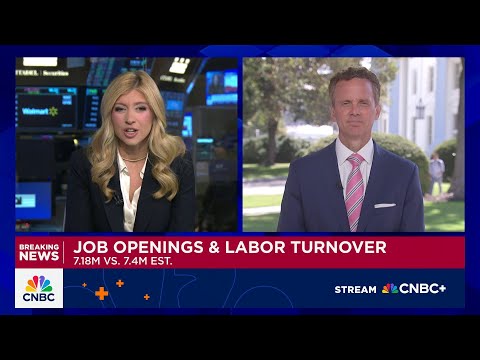
Treasury counselor Joseph Lavorgna: I don’t buy into this uncertainty argument
CNBC Television· 2025-09-03 15:57
Labor Market & Economic Growth - Jolt job openings came in below estimates at just below 72 million versus 74 million expected [1] - The current labor market rate is at the same level as the fourth quarter of 2019, when the Trump economy generated nearly 35% real GDP growth [2] - Capital spending grew over 15% in the first half of the year [3] - Atlanta Fed GDP is forecasting 35% GDP growth after a 3% plus gain in the last quarter [4] - When capital spending trends improve, hiring inevitably follows [6] Tariffs & Fiscal Policy - Tariff revenue could reach $300 billion this year, potentially adding 1% to GDP, leading to a possible 5% growth [9] - The revenues from tariffs are running above a $300 billion annualized rate, potentially hitting $500 billion [10] - The administration believes the courts will rule in favor of the president's ability and authority to implement tariffs [17] - Goods prices within the CPI are up 07% annualized since record tariff collection began in April [20][21] Monetary Policy & Federal Reserve - The economy needs interest rates in line with what are considered neutral, and even the highest dot on the Fed dot plot indicates rates are restrictive [8] - The central tendency of the FOMC's forecast is about 275% to 3%, maybe a shade higher, which is about 150 basis points higher than current rates [12] - There is a need for a wholesale re-evaluation of how the forecast process is done at the Fed, with more robust macroeconomic discussions and varied viewpoints [14][15]