
Embodied Intelligence

Search documents
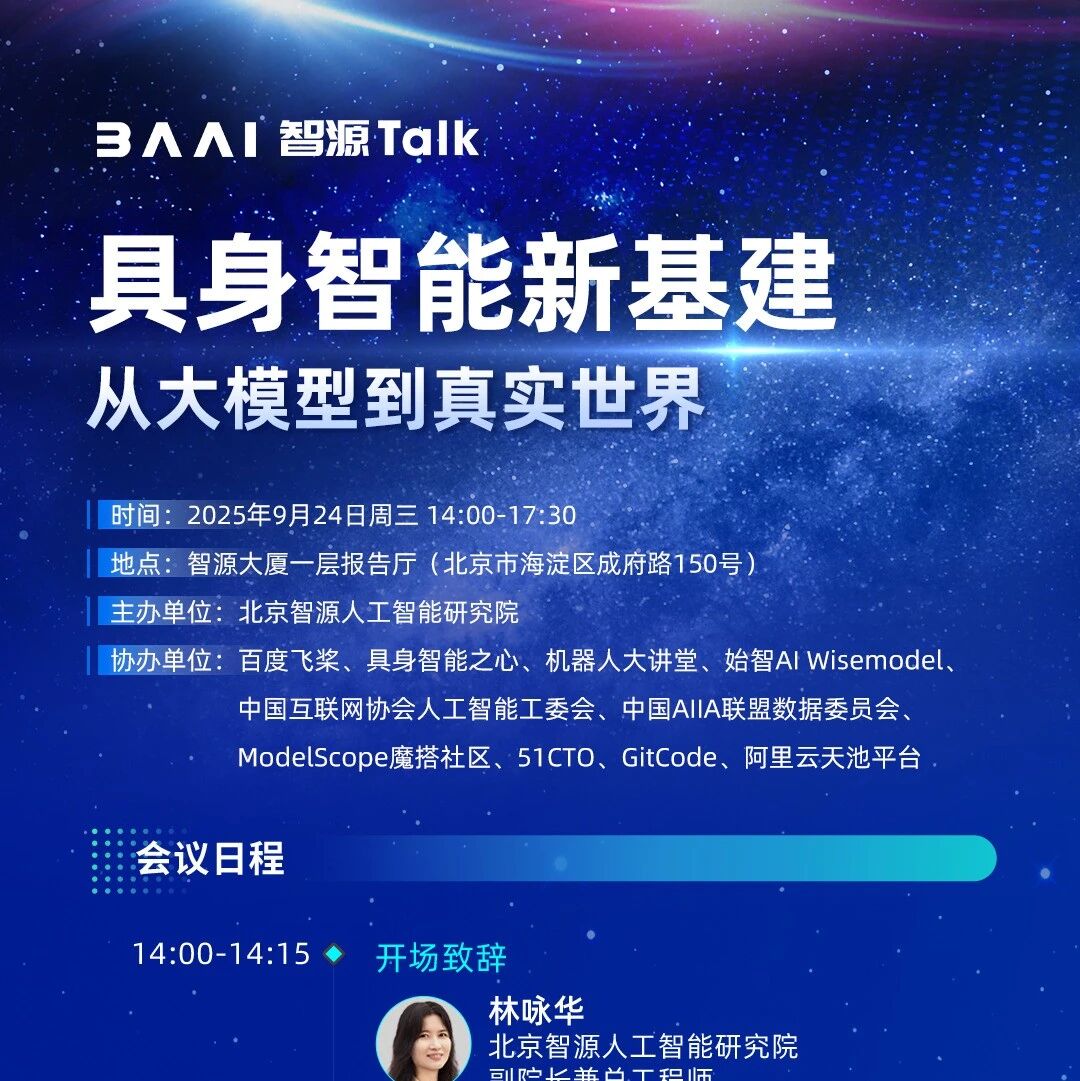
线下活动报名|智源“具身智能新基建”Workshop
机器人大讲堂· 2025-09-16 09:06
Core Viewpoint - The article promotes a workshop on embodied intelligence organized by the Beijing Zhiyuan Artificial Intelligence Research Institute, highlighting the latest advancements in the field and inviting participants to explore the future of embodied intelligence [1]. Event Details - Date and Time: September 24, 2025, from 14:00 to 17:30 [2] - Location: Zhiyuan Building, 1st Floor Auditorium, No. 150 Chengfu Road, Haidian District, Beijing [2]. Industry Participants - The article lists various companies involved in different sectors of robotics, including: - **Industrial Robotics Companies**: Estun Automation, Efort Intelligent Equipment, Feixi Technology, and others [7][8]. - **Service and Special Robotics Companies**: Yijiahe, Jingpin Special Equipment, Qiteng Robotics, and others [8]. - **Medical Robotics Companies**: Yuanhua Intelligent, Tianzhihang, Sizherui Intelligent Medical, and others [8]. - **Humanoid Robotics Companies**: UBTECH Robotics, Yushun, Yundong, and others [9]. - **Embodied Intelligence Companies**: Kuawei Intelligent, Galaxy General, Qianxun Intelligent, and others [10]. - **Core Component Companies**: Lide Harmonic, Yinshi Robotics, Kunwei Technology, and others [11]. - **Educational Robotics Companies**: Silicon Step Robotics, Shihe Educational Robotics, and others [11]. Community Engagement - The article encourages joining the "Robot Lecture Hall" reader discussion group to share insights and discuss topics related to robotics and technology advancements [12].

AI人才争夺战下的暗流:谁在为源头创新续费?
3 6 Ke· 2025-09-12 09:01
Core Insights - The article discusses the value of AI talent, particularly focusing on the choices faced by young researchers in China between academia and industry, highlighting the significant contributions of Chinese talent to global AI innovation [1][2][14]. Group 1: AI Talent Landscape - 61.1% of global AI patents originate from China, indicating a strong presence of Chinese researchers in the AI field [1]. - The competition for AI talent is intense, with tech giants offering high salaries and equity stakes to attract top talent [1]. - The InTech Award aims to support long-term foundational research in AI, reflecting a commitment to nurturing talent in the field [14][18]. Group 2: Key Research Areas - The four critical areas of focus for the InTech Award include General Artificial Intelligence (AGI), embodied intelligence, digital medicine, and data security, which are seen as essential for future technological advancements [2][6][14]. - AGI is characterized as a "red ocean" of competition, with a pressing need for foundational innovation rather than short-term engineering tasks [2][6]. - Embodied intelligence is anticipated to be the next breakthrough, requiring significant advancements in basic scientific challenges [5][6]. Group 3: Paths of Innovation - Researchers are navigating between the pull of industry, which offers resources and data, and academia, which allows for exploration of fundamental questions [7][8]. - Successful paths include deepening research in foundational science to address industry pain points, as demonstrated by Professor Zhang Fan's work in medical imaging technology [8][13]. - Another path involves returning to academia after industry experience to tackle deeper issues, as exemplified by Assistant Professor Li Meng's focus on privacy and deployment challenges in AI [9][13]. Group 4: Ant Group's Strategy - Ant Group's involvement in the InTech Award reflects its broader strategy to invest in foundational research and talent development in AI [14][18]. - The award not only provides financial support but also aims to create a collaborative ecosystem between academia and industry, fostering mutual growth [13][14]. - Ant Group's commitment to AI spans from foundational technology to application, aiming to create a comprehensive stack of capabilities in the AGI era [14][18].
X @Demis Hassabis
Demis Hassabis· 2025-08-24 02:15
AI Development & Innovation - AI can now be trained within another AI, indicating a significant advancement in AI training methodologies [1] - The world model, Genie 3, can imagine and generate new worlds dynamically, showcasing its advanced simulation capabilities [1] - An embodied agent, Sima, can autonomously navigate these AI-generated environments, demonstrating progress in embodied intelligence [1] - The entire environment-to-action loop is now generated by AI, highlighting the potential for fully AI-driven training simulations [1] - The industry anticipates the development of world simulators for training general embodied intelligence, suggesting future research directions [1]
免费报名!浙江人形机器人联盟大会【宁波9.5-9.6】
势银芯链· 2025-08-22 07:32
Group 1 - The article discusses the "Ten Chains, Hundred Events, Thousand Enterprises" series of matchmaking activities focused on humanoid robots in Zhejiang Province, highlighting the establishment of the Zhejiang Humanoid Robot Industry Technology Alliance [1] - The event is organized by the Zhejiang Provincial Department of Economy and Information Technology and the Ningbo Municipal People's Government, indicating strong governmental support for the humanoid robotics sector [1] - The event will take place on September 5-6, 2025, at the Pan Pacific Hotel in Ningbo, showcasing the region's commitment to advancing embodied intelligence technology [3]

舜宇光学科技(02382) - 2025 Q2 - 业绩电话会
2025-08-20 03:32
Financial Data and Key Metrics Changes - The profit attributable to the owners of the company reached JPY 1,650,000,000, reflecting a 52.6% increase [4] - Total operating expenses increased by 6.8%, while net cash from operating activities rose by 14% [4][5] - The gross profit margin for handset products is expected to fall between 20% to 30% for the whole year, with high-end products contributing significantly to this margin improvement [7][51] Business Line Data and Key Metrics Changes - Revenue from mobile handsets and modules grew significantly, with revenue from hybrid lenses increasing by over 100% year-on-year [6] - The automotive business saw an 18% revenue growth, with high demand for vehicle modules and lenses [58] - The XR business achieved JPY 1,200,000,000 in revenue, with a strong market share in smart goggles [18] Market Data and Key Metrics Changes - The global camera market size is expanding due to increased ADAS penetration, with leading car manufacturers accelerating LiDAR deployment [10][11] - The smart glass market is expected to exceed 10,000,000 units by 2025, driven by AI advancements [16] - The robotics sector is experiencing growth, particularly in intelligent lawn mowing and pool cleaning robots [28] Company Strategy and Development Direction - The company aims to integrate AI into manufacturing processes, emphasizing the importance of smart manufacturing for future competitiveness [30][36] - There is a focus on developing smart hardware based on optical perception technology, with plans to enhance capabilities in decision-making and control systems [32][34] - The company is adopting flexible overseas deployment strategies to respond to international market demands [46][47] Management's Comments on Operating Environment and Future Outlook - Management expressed confidence in the growth of the vehicle business, expecting a 20% revenue increase for the year [53] - The company is optimistic about the future of LiDAR technology, viewing it as a significant growth area [60][62] - Management highlighted the importance of maintaining high yield and efficiency in production to sustain market share [40] Other Important Information - The company has upgraded its ESG ranking from BB to A level, reflecting progress in climate-related disclosures [48] - Organizational optimization efforts are underway to consolidate resources for major projects in optical processing and technology development [42][43] Q&A Session Summary Question: What is the profitability contribution of the non-handset business? - The contribution from handset business is over 50%, with net profit growing by 52% year-on-year [50] Question: What is the guidance for the second half of the year? - The gross profit margin for handsets is expected to exceed 25%, with overall revenue growth projected at 5% to 10% [51][53] Question: Can you provide a breakdown of vehicle revenue growth? - The vehicle business is expected to grow by 20% for the year, with significant contributions from high-end products [54][58] Question: What is the outlook for the XR business? - The XR business is expected to grow moderately, despite a decrease in VR-related revenue [56] Question: When will explosive growth from overseas customers be expected? - The company anticipates a long-term trend of growth from overseas markets, particularly in Europe and Japan [77] Question: How will the gross profit margin be affected by AR and VR products? - The gross profit margin varies across different segments, with AR and VR products not expected to have high margins initially [80][82]

舜宇光学科技(02382) - 2025 Q2 - 业绩电话会
2025-08-20 03:30
Financial Data and Key Metrics Changes - The profit attributable to the owners of the company reached JPY 1,650,000,000, reflecting a growth of 52.6% year-on-year [5] - Total operating expenses increased by 6.8%, while net cash from operating activities rose by 14% [5] - Gross profit margin for handset products is expected to fall between 20% to 30% for the year, with high-end products improving margins significantly [8][9] Business Line Data and Key Metrics Changes - Revenue from handset lenses increased by over 9% year-on-year, while revenue from hybrid lenses grew by over 100% [7] - The automotive business saw an overall revenue growth of 8%, with expectations for a 20% growth for the year [54] - XR business achieved JPY 1,200,000,000 in revenue, with a 21% growth rate in the first half of the year [18][55] Market Data and Key Metrics Changes - The global camera market size is driven by the acceleration of ADAS penetration, with continuous improvement in camera specifications [11] - The smart glass market is expected to exceed 10,000,000 units by 2025, driven by AI empowerment [16] - The company is seeing increased orders from overseas markets, particularly in Europe and Japan, indicating a long-term growth trend [78] Company Strategy and Development Direction - The company aims to strengthen its advantage in optical perception technology while extending into decision-making and control domains [32] - There is a focus on developing technologies for autonomous driving and smart manufacturing, emphasizing the importance of AI integration [30][36] - The company plans to adopt flexible strategies for overseas deployment in response to customer demands and market developments [46] Management's Comments on Operating Environment and Future Outlook - Management expressed confidence in the growth of the vehicle business, expecting to surpass industry growth rates [79] - The company is optimistic about the future of the XR business, despite potential declines in VR-related revenue [56] - Management highlighted the importance of technological accumulation and innovation to maintain leadership in the industry [15] Other Important Information - The company has upgraded its ESG ranking from BB to A level, reflecting progress in addressing climate change risks [48] - Significant investments are being made in R&D for new technologies, particularly in the areas of LiDAR and smart glasses [90] Q&A Session Summary Question: What is the profitability contribution of the non-handset business? - The profitability from the handset business is over 50%, with rapid growth driven by gross profit margin improvements [50] Question: What is the guidance for the second half of the year? - The gross profit margin for handsets is expected to be between 25% to 30% for the year, with revenue growth anticipated [51][53] Question: Can you provide a breakdown of vehicle revenue growth? - The vehicle business is expected to see a revenue growth of 20% for the year, with significant contributions from high-end products [54] Question: What are the expectations for the LiDAR business? - The development of LiDAR is becoming clearer, and the company is focusing on technological capabilities and mass production [60][62] Question: How does the company plan to balance size, margin, and profitability? - Management emphasized the importance of technology-enabled products and maintaining high utilization rates in production [66][70] Question: What is the outlook for the gross profit margin in the vehicle module business? - The gross profit margin for vehicle modules is expected to be higher for premium cars, but competitive pressures exist in overseas markets [81]
Kandi(KNDI) - 2025 Q2 - Earnings Call Transcript
2025-08-19 13:00
Financial Data and Key Metrics Changes - Net revenues for Q2 2025 were $36.3 million, down 39.3% from $59.8 million in Q2 2024, primarily due to lower sales of auto vehicles and EV products [16] - Cost of goods sold decreased to $19.9 million, a 51.3% decline from $40.9 million in the same period of 2024, reflecting the decrease in sales [17] - Gross profit was $16.4 million, compared to $19 million in Q2 2024, with gross margin improving to 45.2%, up from 31.7% last year [17] - Total operating expenses were $18.3 million, down 21.4% from $23.3 million in Q2 2024 [17] - Net income was $1.7 million, compared to $2.4 million in Q2 2024, with basic and diluted net income per share at $0.02, down from $0.03 [20] Business Line Data and Key Metrics Changes - The focus on inventory management within retail channels led to a gross margin improvement to 45.2%, up 13.5 percentage points from 31.7% in the same period of 2024 [8] - The dealer to retail sales mix improved from 1:9 to 2:8 as of June 2025, indicating a more diversified channel structure [10] - Research and development expenses increased by 48.5% to $2.5 million, mainly due to a new battery product R&D project [18] Market Data and Key Metrics Changes - The company has reinforced partnerships with major retailers, including Lowe's, and expanded its dealer network to 50 retail outlets [9] - The company is exploring high-margin direct-to-consumer channels and e-commerce platforms to enhance market share and profitability [11] Company Strategy and Development Direction - The company is transitioning from a conventional manufacturing enterprise to a holding platform focused on intelligent equipment manufacturing [7] - Kandi Technologies is pursuing a dual engine strategy, balancing stable cash flow businesses with growth incubation businesses [14] - The company aims to maintain competitive edge and create long-term value for shareholders through disciplined execution and continuous innovation [14] Management's Comments on Operating Environment and Future Outlook - The global microeconomic landscape remains uncertain, presenting challenges for the business [6] - Despite short-term volatility, the company believes its focus on optimized operations and technological innovation positions it for long-term development [14] - The company is confident in its strategic growth initiatives and ongoing business expansions, supported by a strong balance sheet with $257 million in cash and equivalents [13] Other Important Information - The company has established itself as a pioneer in battery swapping technology and secured its first order to support CATL's rollout of 10,000 battery swapping stations [12] Q&A Session Summary - No specific questions or answers were recorded in the provided content, and the call concluded without further inquiries [22][23]

Kandi Technologies Reports First Half of 2025 Unaudited Financial Results
Globenewswire· 2025-08-19 11:00
Core Insights - Kandi Technologies Group, Inc. reported a significant improvement in gross margin to 45.2%, up from 31.7% in the prior-year period, despite a challenging global macroeconomic environment [1][3][6] - The company maintains a strong financial position with cash and cash equivalents totaling $256.7 million as of June 30, 2025, compared to $126.3 million at the end of 2024 [1][8][13] Financial Performance - Net revenues for the first half of 2025 were $36.3 million, a decrease of 39.3% from $59.8 million in the same period of 2024, primarily due to reduced sales of off-road vehicles and EV products [4][8] - Cost of goods sold decreased by 51.3% to $19.9 million from $40.9 million in the prior year, reflecting the decline in sales [5][8] - Gross profit was $16.4 million, down from $19.0 million in the same period of 2024, but gross margin improved significantly to 45.2% [6][8] - Operating expenses totaled $18.3 million, a decrease of 21.4% from $23.3 million in the same period of 2024 [9][10] - Net income was $1.7 million, a decrease of 28.7% from $2.4 million in the same period of 2024, with basic and diluted net income per share at $0.02 [12][8] Strategic Developments - The company is focusing on strengthening its core off-road vehicle business through improved inventory management, manufacturing efficiency, and sales network optimization [3] - Kandi is expanding into high-potential technology sectors, including embodied intelligence and battery swap infrastructure, establishing strategic partnerships to support sustainable growth [3][8] - The subsidiary, China Battery Exchange (Zhejiang) Technology Co., Ltd., has secured its first heavy-truck battery swap station equipment order under a major industry plan [8]
人形机器人-2025 年世界机器人大会收获:拥抱未来-Humanoids_ WRC 2025 Takeaways_ Embracing the Future
2025-08-14 02:44
Summary of the Conference Call on Humanoids Industry Industry Overview - The conference focused on the humanoid robotics industry, particularly highlighted at the World Robot Conference (WRC) 2025, showcasing rapid expansion and public interest in intelligent robots [1][4]. Key Insights - **Increased Public Engagement**: WRC 2025 saw significantly higher attendance compared to WRC 2024, with a notable presence of families, indicating a growing public interest in humanoid robots [4]. - **China's Leadership**: China's enthusiasm for humanoid robots is not limited to government officials but is widespread among the general public, which is crucial for the country's leadership in the humanoid ecosystem [4][9]. - **Market Sentiment**: The market sentiment for humanoid stocks is expected to remain strong, with potential increases of 2-5% by the end of WRC 2025, contingent on any major orders announced during the event [5]. Company Developments - **UBTECH**: Increased its 2025 delivery target to over 500 units from a previous range of 300-500 units, with a goal of 2,000-3,000 units in 2026 due to surging order volumes [10]. - **Galbot and Robotera**: Galbot targets 300-500 units, while Robotera aims for 100 robot units and 500-600 hands [10]. - **Linkerbot and OY Motion**: Linkerbot expects 5,000-10,000 shipments of dexterous hands this year, with a ten-fold increase projected for 2026; OY Motion anticipates 2,000-3,000 units in the second half of 2025 [10]. Technological Advancements - **Integration of Hardware and Software**: Companies are focusing on optimizing both hardware and software to enhance the intelligence level of humanoid robots, with full-stack players achieving better results through integrated systems [11]. - **Data Utilization**: The industry faces challenges in achieving generalization due to a lack of robot data, raising debates on the effectiveness of simulation versus real-world data [12][15]. - **Efficiency Improvements**: Observations at WRC indicated that humanoids still require significant time to perform tasks compared to humans, highlighting the need for efficiency enhancements [13]. Market Trends - **Adoption of Wheel-based Humanoids**: Wheel-based humanoids are expected to see earlier adoption in commercial services due to their simpler algorithms and better efficiency compared to bipedal robots [17]. - **Dexterous Hands**: The industry is shifting towards 5-finger dexterous hands, which are essential for humanoid capabilities, with expectations for increased adoption in the second half of 2025 [21][22]. - **Tactile Sensors**: Tactile sensors are becoming a standard feature in dexterous hands, accounting for 15-20% of their value, and are expected to see accelerated adoption [23]. Global Expansion - **Chinese Companies Going Global**: Several Chinese humanoid robot companies are strategically expanding into international markets, focusing on commercial services like retail, which offer easier scaling opportunities [26]. Conclusion - The humanoid robotics industry is experiencing significant growth, driven by public interest, technological advancements, and strategic company developments. China's position as a leader in this field is reinforced by widespread adoption and global expansion efforts by its companies.

科创50ETF(588000)开盘涨近1%,GPT-5发布有望带动AI应用发展
Mei Ri Jing Ji Xin Wen· 2025-08-11 06:14
Group 1 - The three major stock indices collectively rose on August 11, with the Science and Technology Innovation 50 ETF (588000) increasing by 0.82%. Notable performers included Hengxuan Technology and Baiwei Storage [1] - The 2025 World Robot Conference took place in Beijing from August 8 to August 12, highlighting significant growth in the robotics industry this year, driven by technological breakthroughs, policy support, capital influx, and increasing labor shortages. This growth is expected to create new opportunities for global economic development [1] - OpenAI's release of GPT-5 has attracted attention in the capital markets, with Citic Securities noting improvements in long text memory, reduced hallucination rates, and optimized reasoning efficiency, which provide a better foundation for the growth of AI applications [1] Group 2 - The Science and Technology Innovation 50 ETF (588000) tracks the Science and Technology Innovation 50 Index, with a deep coverage of core segments in the artificial intelligence industry. The index has a concentration of 63.74% in the electronics sector and 11.78% in the pharmaceutical and biotechnology sector, totaling 75.52% [2] - The index also encompasses various sub-sectors such as semiconductors, medical devices, software development, and photovoltaic equipment, indicating a high content of hard technology. The current position of the index is near its baseline, and future growth potential is promising based on historical trends of the ChiNext board [2] - Investors optimistic about the long-term development prospects of China's artificial intelligence and technology sectors are encouraged to maintain their focus on relevant investments [2]