Recession

Search documents
X @The Motley Fool
The Motley Fool· 2025-12-04 12:55
Since 1980, the U.S. has seen:– 6 recessions– 8 bear markets– Multiple wars & crisesS&P 500? +100x. ...
1% of Your Total Portfolio Should Be Allocated to Bitcoin, According to Billionaire Investor Ray Dalio
Yahoo Finance· 2025-12-03 10:15
Core Insights - Bitcoin is currently down 3% for the year, but billionaire investor Ray Dalio suggests an optimal allocation of 1% to Bitcoin in investment portfolios [1][6] Diversification Benefits - Bitcoin offers significant diversification benefits, remaining largely uncorrelated with major asset classes, which allows it to perform well even when other assets are declining [2][4] - Historical data shows that the correlation between Bitcoin and the S&P 500 has averaged between 0.2 and -0.1 over a 12-year period, indicating low correlation [4][5] Market Perception - Investors are increasingly viewing Bitcoin as a risky tech stock, leading to sell-offs in Bitcoin alongside tech and AI stocks, despite its long-term performance history [3][6] - Over the past decade, Bitcoin has been uncorrelated with major asset classes and has been the top-performing asset in 10 of the last 13 years [8] Economic Context - The recent federal government shutdown and uncertainty regarding tariffs are prompting investors to seek alternatives to dollar-denominated assets, which may enhance Bitcoin's appeal [9]
The Safest Dividend ETF for a Recession -- Based on 30 Years of Market Data
The Motley Fool· 2025-12-02 11:07
Core Insights - Exchange-traded funds (ETFs) provide a means for investors to diversify portfolios and manage risks during economic downturns [1][2] - Consumer staples are identified as a resilient sector during recessions, historically outperforming other sectors [4][5] Investment Strategy - Long-term investors should prepare for volatility and consider exposure to defensive sectors, which can provide reliable passive income during recessions [3] - Allocating a portion of capital to defensive ETFs like the Consumer Staples Select Sector SPDR Fund (XLP) is recommended, especially as investors approach retirement [10][11] Sector Performance - Consumer staples have shown strong performance historically, with an average return of 14% in the 12 months preceding recessions and 10% in the 12 months following [6][5] - The sector has consistently outperformed others during recession periods since 1990, including notable economic downturns [5] ETF Details - The Consumer Staples Select Sector SPDR Fund (XLP) has a yield of 2.71% and a diversified investment across various consumer staples categories [7][8] - Top holdings in the fund include Walmart (11.05%), Costco Wholesale (9.33%), Procter & Gamble (8.18%), Coca-Cola (6.62%), and Philip Morris International (5.77%) [12]


X @Michaël van de Poppe
Michaël van de Poppe· 2025-12-02 09:37
It's the first days of the month, which are usually bearish.Then, there's also the case that QT has been reduced.This takes time.Now, what's important in the coming week:- Unemployment dataThis is the primarily trigger for the FED to decide whether or not rate cuts are sufficient.Labor > Inflation.If the unemployment data rallies more than expected, the sounds of a recession will start to soar and that will mean that we're likely going to be getting QE.The past period has been volatile and markets have been ...
X @Wendy O
Wendy O· 2025-11-29 19:01
Black Friday sales at all time highAmerica is in a super recessionThe US economy is collapsingDebt is a powerful tool and being used to further destroy the economy to bring down the banks but in reality American tax payers will foot the bill.The Kobeissi Letter (@KobeissiLetter):BREAKING: American shoppers spent a RECORD $11.8 billion online on Black Friday, up +9.1% from last year.Adobe Analytics, which tracks over 1 trillion US retail site visits, expects shoppers to spend $5.5 billion on Saturday and $5. ...
X @Bloomberg
Bloomberg· 2025-11-28 12:10
On this episode of Everybody’s Business, the deputy editor of Wirecutter explains how tariffs and recession fears may have delayed consumer discounts https://t.co/OjG6PbbLbY ...
技术策略 2026 年展望:押注晴天,仍备雨伞-Technical Strategy_ 2026 Year-Ahead Outlook_ Betting on Sunshine, Still Packing an Umbrella. Thu Nov 20 2025
2025-11-27 05:43
Summary of J.P. Morgan's 2026 Year-Ahead Outlook Industry Overview - The report discusses the macroeconomic environment and market dynamics as they relate to various asset classes, particularly focusing on the U.S. Treasury yield curve, equities, and commodities [5][7][33]. Key Points and Arguments Market Dynamics - Markets are expected to face a multi-modal macro risk distribution, with a base-case scenario suggesting a shift from a central mode to a right-side distribution indicating improving growth expectations but with increased overheating risks [5][7]. - The left-side tail risk, representing recession, is acknowledged but considered less likely compared to the overheating scenario [5][7][26]. Treasury Yields - Front-end Treasury yields are anticipated to remain in a bullish range, while the belly and long end of the curve may face bearish pressure due to risk-on trends and widening inflation breakevens [5][33]. - The 2-year note is highlighted as a key indicator for market expectations, currently positioned near critical levels around 3.50% [8][12][35]. Equities - Large-cap U.S. stocks are expected to lead a bullish trend into the first half of 2026, with higher volatility and potential drawdowns anticipated [5][13]. - Chinese equity indexes, such as the CSI 300 and Hang Seng, are noted for their bullish patterns, suggesting potential for reaching 2021 cycle highs [15][17]. Commodities - Base metals are expected to catch up to the strong performance of precious metals, with a longer-term bullish trend anticipated [5][21]. - Crude oil prices are expected to remain range-bound, contrasting with the bullish outlook for base metals [5][21]. Currency Outlook - A stronger U.S. dollar is anticipated in early 2026, with the potential for simultaneous strength in the AUD/USD pair, which is historically an outlier [5][16]. Inflation and TIPS Breakevens - The report suggests that bullish trends in base metals could lead to upward pressure on 10-year TIPS breakevens, which are expected to widen towards the 240-250 basis points range [20][66]. - A gradual rally in front-end yields is expected, with TIPS breakevens potentially widening if inflation pressures increase [20][66]. Risk Scenarios - The report outlines a left-side tail risk scenario where recession could lead to predictable market trends, but this is viewed as a lower probability outcome [26][68]. - A more aggressive bullish scenario for the 2-year note could indicate a recession outcome, leading to a significant break in consumption and labor data [26][40]. Other Important Content - The report emphasizes the importance of monitoring key levels, trends, and patterns in various markets to react to potential regime changes [7][12]. - The technical setup for the 2-year note suggests a potential target near 1.75% if bearish scenarios materialize [40][46]. - The report also discusses the potential for a steepening of the yield curve, particularly in the 2s/5s and 2s/10s curves, as markets navigate through 2026 [54][60]. This comprehensive analysis provides insights into the expected market conditions and investment strategies for 2026, highlighting both opportunities and risks across various asset classes.
X @Nick Szabo
Nick Szabo· 2025-11-27 00:21
RT Nick Szabo (@NickSzabo4)In a deep or prolonged recession, attacks by technocratic authorities & political activists against digitally centralized assets will increase in volume & scope. Other forms of political or legal instability could also lower the safety of digitally centralized assets. ...
X @Bloomberg
Bloomberg· 2025-11-26 19:12
Mexico’s central bank cut its expectation for growth this year after the economy contracted in the third quarter, igniting recession fears for Latin America’s second-biggest economy https://t.co/Lr3D9Qdmwh ...
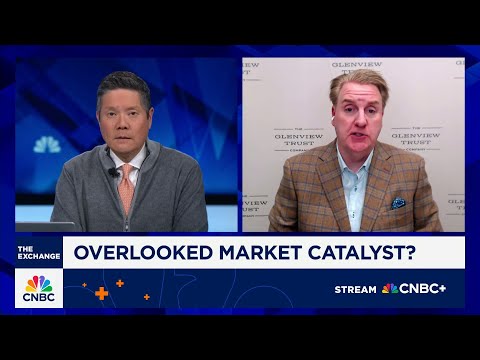
Expect significant stimulus from One Big Beautiful Bill in 2026, says Glenview Trust's Stone
CNBC Television· 2025-11-26 18:39
Market Catalysts & Economic Outlook - The market anticipates a potential rate cut next month, but tax and regulatory changes are another significant macro driver that should not be overlooked [1][2] - The economy appears to be in a soft patch, but upcoming tax cuts for both consumers and businesses are expected to provide stimulus [3] - The expectation is that the Fed will cut rates in December, further boosting the economy [3] - The primary concern is avoiding a recession, as current stock prices do not fully reflect the possibility of one [6][7] Consumer Spending & Market Impact - Tax cuts could lead to increased consumer spending, which is a major driver of the US economy [4] - Companies like Amazon may benefit from increased consumer spending, and the housing market could also see positive effects [5] Market Breadth & Growth - There is hope for a broader market rally, as the market had become narrowly focused on big tech names [8] - Small caps are starting to pick up, and a spreading out of earnings growth beyond tech names could revitalize them [8][9]