
GDP growth

Search documents
Fed Governor Waller sees more rate cuts but says central bank needs to be 'cautious about it'
CNBC Television· 2025-10-10 15:15
Monetary Policy Stance - The speaker believes that cutting rates is still necessary, but caution is warranted due to conflicting signals from the labor market and GDP growth [1] - The market has already priced in sequential rate cuts through the end of the year, which the speaker considers cautious enough if implemented in quarter-point increments [3] - A more aggressive rate cut, such as 75 basis points, carries a higher risk if the economic outlook is misjudged [4] - Gradual adjustments of 25 basis points allow for flexibility as new data becomes available [4] Economic Indicators - The labor market is weak, but GDP growth is strong, with forecasts near 4% [1] - Negative job growth is inconsistent with 4% GDP growth, suggesting an imbalance that needs to be resolved [1] - The labor market and GDP growth must align, either through a labor market rebound or a GDP growth slowdown [2] Policy Implications - If the labor market rebounds and growth remains strong, there is less need for rate cuts [2] - If GDP growth slows down, the labor market situation necessitates further rate cuts [2] - Policy decisions should be made cautiously to avoid significant errors in either direction [3]

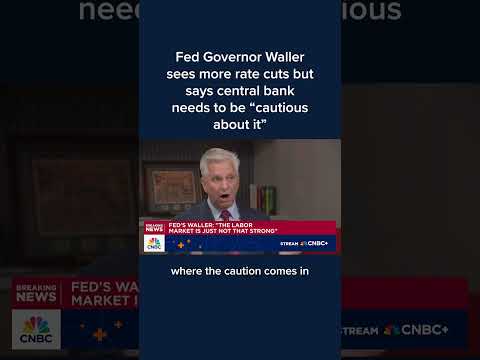
Fed Governor Chris Waller: Still believe we need to cut rates, but need to be 'cautious about it'
Youtube· 2025-10-10 12:18
Core Insights - Fed Governor Chris Waller discussed the challenges of making policy decisions without complete economic data, emphasizing the importance of private sector data to gauge the labor market's health [3][4][5][6][10] Economic Data and Labor Market - Waller noted that while government data is delayed, private sector indicators suggest a weak labor market, with job growth potentially negative in recent months [6][7][14] - Anecdotal evidence from businesses indicates a lack of hiring plans, with many companies not backfilling positions or making new hires [8][14] - The labor market's weakness is a primary concern for policy decisions, as it does not align with GDP growth forecasts, which are close to 4% [20][21] Inflation and Tariffs - Waller expressed that tariff effects are one-time price increases and do not lead to persistent inflation, aligning with historical central bank views [12][13] - He highlighted a two-tier effect in the market where higher-income consumers are more likely to absorb tariff costs, while lower-income consumers are more price-sensitive [18][19] Policy Direction - Waller advocates for cautious rate cuts, suggesting that the Fed should adjust its approach based on incoming data regarding the labor market and GDP growth [20][22] - The market anticipates sequential rate cuts, but Waller emphasizes a measured approach to avoid potential policy missteps [22][23] Private Credit Market - Waller addressed concerns about the private credit market, indicating that it is less risky due to the significant equity positions involved, which provide a buffer against defaults [24][25] - He noted that while losses may occur, it is part of the capitalist system, and it is not the Fed's role to protect individual wealth [26]

X @Cathie Wood
Cathie Wood· 2025-10-09 14:51
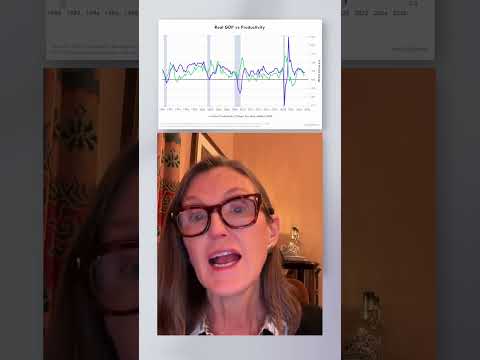
RT ARK Invest (@ARKInvest)Unlike past recoveries that lost momentum, @CathieDWood believes this one could mark a turning point where productivity drives GDP growth to the 5% range and sustains it. Hear more in the latest "In The Know." ...
Will This Recovery Last?
ARK Invest· 2025-10-09 13:40
If we're right, GDP growth could slow a bit more, but will turn around and we will enter into a a a real growth trajectory driven by productivity in the 5% range. And we believe that in that range, 5% plus or minus that unlike in past recoveries, it will be sustained. You can see in the past when productivity has recovered, usually after a recession, it settles back down.This time we don't think that's going to be the case. ...
China Stocks Rally Despite Soft Consumption Data and Rising Trade Tensions
FX Empire· 2025-10-09 03:43
Economic Outlook - The World Bank has raised its GDP growth projection for China to 4.8% for 2025, up from 4.0% in April, with a forecast of 4.2% growth in 2026 due to weaker external demand and fewer fiscal stimulus measures [1] - China is expected to set a GDP growth target of 4.5%-5.0% for the next five years, with a focus on boosting consumption and potentially increasing fiscal spending to enhance the social safety net [2] Trade Relations - US-China trade tensions have escalated ahead of the APEC Summit, with significant attention on trade developments as markets assess holiday spending and economic outlook [3] - US lawmakers are advocating for a broader ban on chip-making tool sales to China, which could hinder China's self-reliance in chip production and impact global chip prices [4] - Beijing has reportedly banned the export of technologies related to rare earth mining and semiconductor production, requiring foreign firms to obtain export licenses, which may be a focal point at the APEC Summit [5] Market Performance - Despite weak consumption data, mainland equity markets showed optimism with the CSI 300 rising 1.17% and the Shanghai Composite Index increasing by 0.75%, reaching new highs for 2025 [7] - Year-to-date, the CSI 300 and Shanghai Composite Index have gained 19.53% and 16.80%, respectively, while the Hang Seng Index has surged 33.65% in 2025 [8] Future Sentiment - The outcome of the APEC Summit could significantly influence market sentiment, particularly if the US decides to drop tariffs on Chinese goods [6] - Potential trade agreements and policy measures could lead to a bullish sentiment in the fourth quarter, while stalled talks and escalating tensions may dampen risk sentiment [9]
Carlyle’s Jason Thomas: There's 'so much enthusiasm' around AI right now
CNBC Television· 2025-10-07 12:32
Joining us now, Jason Thomas, head of global research and investment strategy at Carile. Jason, great to have you on to to kind of put a light on on this data. Um, so this is something just to uh kind of get the the the procedural stuff out there. This is uh these indicators are something that you have maintained for a while and you've tried to kind of knit them to the the publicly available data.>> Yeah, that's right. So the for the last 15 years we take portfolio company data as you mentioned 277 companie ...
Rockefeller's Ruchir Sharma: AI spending is driving U.S. markets and economy
CNBC Television· 2025-10-06 15:10
AI's Impact on US Economy - AI spending alone accounts for 40% of US GDP growth this year, with second and third-order effects further boosting the economy [1] - 80% of the gains in the US stock market this year are attributed to AI plays [2] - The US bond market implicitly bets on a significant productivity miracle driven by AI, justifying current debt and deficit levels [4] Consumer Spending & Wealth Distribution - The top 10% of US households own nearly 90% of US stocks and drive the majority of consumer spending [2] - The top 10% of consumers have an unprecedented share of overall consumer spending in the US this year [2] Capital Flows & Dollar Weakness - The American stock market attracted nearly $300 billion in flows even in a tough second quarter [7] - Dollar weakness is attributed to hedging by foreign investors bringing capital into America, correcting for an overvalued dollar at the beginning of the year [6][7] Productivity & Future Expectations - US market implicitly bets on a 05%-1% increase in productivity due to increased AI adoption [11][12] - Productivity growth began picking up after the pandemic, with increased focus on cost efficiencies [11] Global Market Performance - Outside of the top seven stocks, European stocks have outperformed American stocks this decade [8] - The bet on AI needs to pay off for America, as the rest of the world has been outperforming [9]
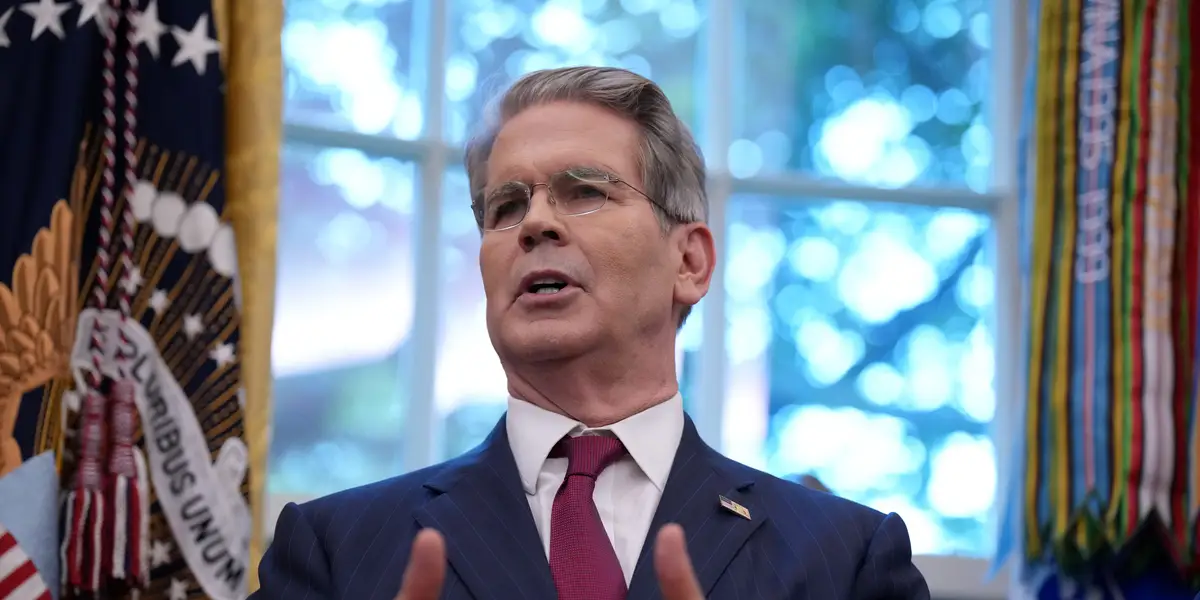
Treasury Secretary Scott Bessent warns government shutdown will hurt growth and be a 'hit to working America'
Business Insider· 2025-10-02 12:00
Core Viewpoint - The ongoing government shutdown could negatively impact the US economy, potentially leading to a decrease in GDP and growth, as well as affecting American workers [1][2]. Economic Impact - Past government shutdowns have had minimal economic impact, but this shutdown, which began recently, may be different due to its prolonged nature [2][4]. - Economists warn that a lengthy shutdown could result in billions being shaved off quarterly GDP and could disrupt the Federal Reserve's decision-making process [11]. Political Dynamics - Treasury Secretary Scott Bessent attributes the shutdown to Democratic leadership's failure to provide solutions, labeling them as weak and disorganized [3][4]. - Bessent dismissed President Trump's threats to fire federal workers as mere "talking points" [3]. Effects on Federal Employees - Federal employees are facing immediate consequences, including furloughs and job security concerns, particularly in agencies like the CDC and Social Security Administration [9]. - The shutdown is causing confusion and politically charged communications among federal workers [9]. Market Reactions - Financial markets are showing signs of nervousness, with stock prices dipping, bond yields decreasing, and gold prices rising as investors seek safe havens [10]. - Historical data suggests that while shutdowns typically have a short-lived impact on markets, the current situation is occurring at a sensitive time [10]. Data Release Delays - The Bureau of Labor Statistics has indicated that the September jobs report will not be released if the shutdown continues, with potential delays for mid-October inflation figures as well [10].
Inflation likely to be much lower than RBI projections in FY26 and FY27: SBI Report
BusinessLine· 2025-10-02 03:56
Inflation Projections - The Reserve Bank of India (RBI) has revised downwards its FY26 Consumer Price Index (CPI) inflation projection by 50 basis points to 2.6%, which is a significant 160 basis point cut from earlier projections made in April [2][3] - The report suggests that actual inflation for both FY26 and FY27 could be much lower than the RBI's revised estimates due to favorable domestic conditions [2][3] Economic Growth Estimates - The RBI has also increased its estimate for real GDP growth for FY26 to 6.8% [3] - For FY27, the inflation projection is set at 4.5% [3] Monetary Policy Insights - The Monetary Policy Committee (MPC) has decided to maintain the policy rate unchanged, which is seen as a logical move given the current global economic uncertainties [4] - The report emphasizes the importance of monetary policy communication in shaping expectations and maintaining clarity in forward guidance [4] Future Rate Cuts - The report indicates that the RBI may be open to future rate cuts due to low inflation forecasts and recent downward adjustments in growth estimates, although the timing of such cuts remains uncertain [5] Domestic Financial System - The MPC's decision reflects a dynamic approach that goes beyond traditional monetary policy, supported by comfortable liquidity conditions and a stable external sector despite trade uncertainties [6] - The domestic financial system is expected to benefit from forward-looking reforms aimed at enhancing India's global positioning and reinforcing its resilient economic ecosystem [6]

I'm not too worried about the impact of a shutdown, says Jim Cramer
Youtube· 2025-09-30 00:29
How worried should we be about a potential government shutdown once we blow through the deadline tomorrow at midnight. Democrats in the Senate, they're filibustering the Republican bud budget bill. They want to extend the health insurance subsidies and the Affordable Care Act, reverse some of the president's recent Medicaid cuts.So far, it sounds like that both sides are pretty intransigent. And if you look at the predictions market, they're currently assigning a roughly 75% odds of a shutdown by Wednesday. ...