
稳定币

Search documents
央行、国家发改委、工信部、公安部、市场监管总局、金融监管总局、证监会、外汇局:进一步防范和处置虚拟货币等相关风险
财联社· 2026-02-06 13:14
在境内开展现实世界资产代币化活动,以及提供有关中介、信息技术服务等,涉嫌非法发售代币票券、擅自公开发行证券、非法经营证券期货业 务、非法集资等非法金融活动,应予以禁止;经业务主管部门依法依规同意,依托特定金融基础设施开展的相关业务活动除外。境外单位和个人不 得以任何形式非法向境内主体提供现实世界资产代币化相关服务。 中国人民银行 国家发展改革委 工业和信息化部 公安部 市场监管总局 金融监管总局 中国证监会 国家外汇局关于进一步防范和处置虚拟货币等相关风 险的通知(银发〔2026〕42号) 各省、自治区、直辖市人民政府,新疆生产建设兵团: 近期,虚拟货币、现实世界资产(RWA)代币化相关投机炒作活动时有发生,扰乱经济金融秩序,危害人民群众财产安全。为进一步防范和处置虚 拟货币、现实世界资产代币化相关风险,切实维护国家安全和社会稳定,依据《中华人民共和国中国人民银行法》、《中华人民共和国商业银行 法》、《中华人民共和国证券法》、《中华人民共和国证券投资基金法》、《中华人民共和国期货和衍生品法》、《中华人民共和国网络安全 法》、《中华人民共和国人民币管理条例》、《防范和处置非法集资条例》、《中华人民共和国外汇管理 ...


重磅|央行八部门升级虚拟货币等监管框架,重申虚拟货币非法,境内RWA代币化遭禁!
Di Yi Cai Jing Zi Xun· 2026-02-06 13:09
虚拟货币领域监管高压态势升级。 2月6日,中国人民银行、证监会等8部门联合发布《关于进一步防范和处置虚拟货币等相关风险的通 知》(下称《通知》),再度明确虚拟货币相关业务活动属于非法金融活动,并强调在境内开展现实世 界资产(RWA)代币化活动以及提供有关中介、信息技术服务等,涉嫌非法发售代币票券、擅自公开 发行证券、非法经营证券期货业务、非法集资等非法金融活动,应予以禁止。 值得注意的是,《通知》首次明确提出,未经相关部门依法依规同意,境内主体及其控制的境外主体不 得在境外发行虚拟货币。未经相关部门依法依规同意,境内外任何单位和个人不得在境外发行挂钩人民 币的稳定币。 近一段时间,虚拟货币价格波动剧烈。2月6日,比特币暴跌至约6万美元附近,创下16个月以来的新 低。爆仓的人数更是触目惊心,据Coinglass数据,过去24小时内,全球有超40万人爆仓,各类代币的多 头头寸清算规模达17.03亿美元。 市场权威专家对记者表示,近期,受多种因素影响,虚拟货币、RWA代币化相关投机炒作活动时有发 生,风险防控面临新形势、新挑战,为进一步完善监管政策,防范和处置虚拟货币、RWA代币化业务 相关风险,央行、证监会等八部 ...
新华社权威快报|8部门联合发文进一步防范和处置虚拟货币等相关风险
Sou Hu Cai Jing· 2026-02-06 13:07
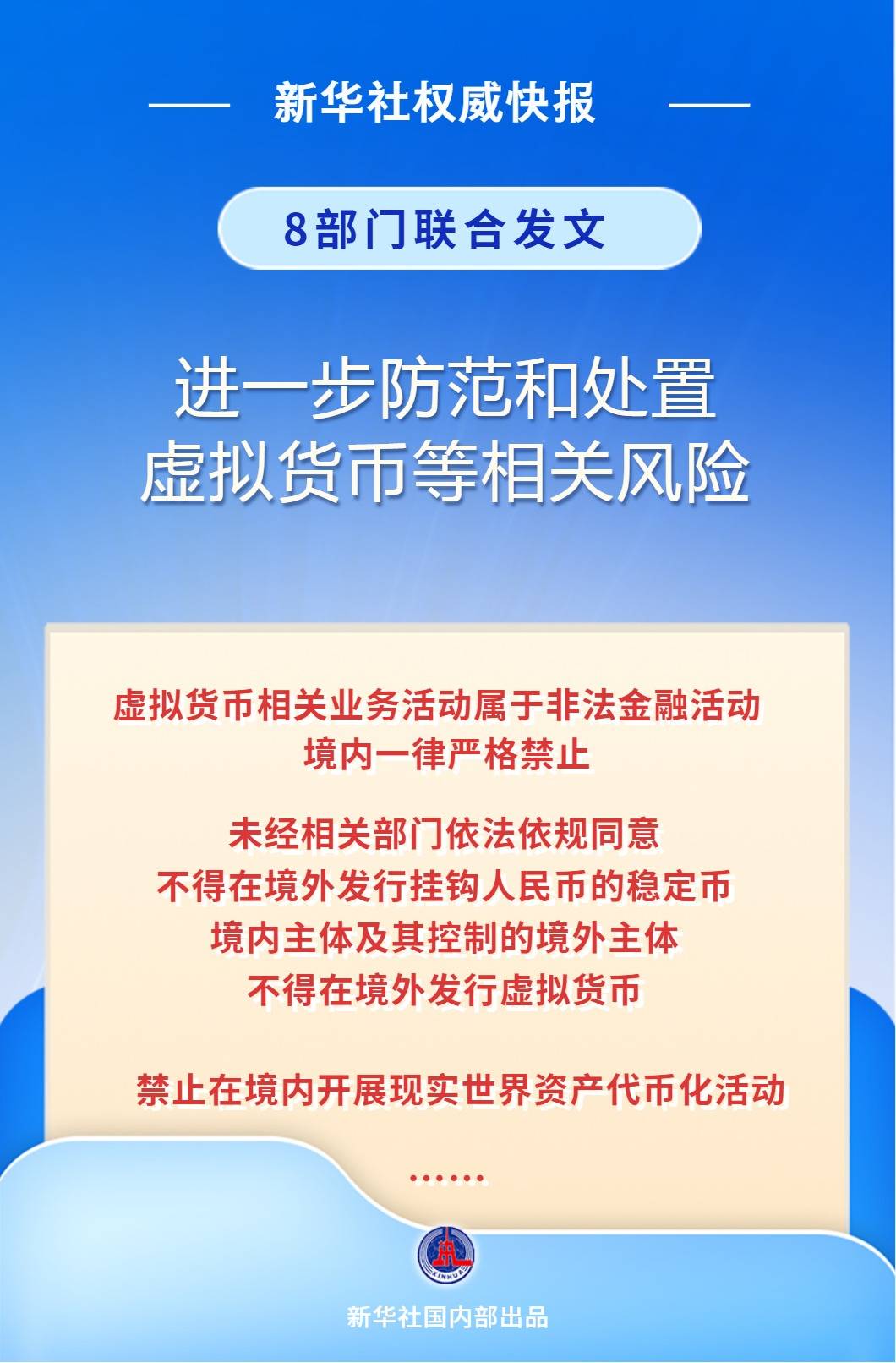
新华社权威快报 8部门联合发文 讲 步防范和处置 虚拟货币等相关风险 未经相关部门依法依规同意 不得在境外发行挂钩人民币的稳定币 境内主体及其控制的境外主体 不得在境外发行虚拟货币 禁止在境内开展现实世界资产代币化活动 记者2月6日从中国人民银行、中国证监会了解到,中国人民银行等8部门联合发文,明确虚拟货币相关业务活动属于非法金融活动,境内一律严格禁 止。未经相关部门依法依规同意,境内外任何单位和个人不得在境外发行挂钩人民币的稳定币,境内主体及其控制的境外主体不得在境外发行虚拟货 币。 根据8部门发布的《关于进一步防范和处置虚拟货币等相关风险的通知》,在境内开展现实世界资产代币化活动,以及提供有关中介信息、信息技术服 务等,应予以禁止;境外单位和个人不得以任何形式非法向境内主体提供现实世界资产代币化相关服务。未经相关部门同意、备案等,任何单位和个 人不得赴境外开展现实世界资产代币化业务。 记者:吴雨、刘慧 海报制作:任军 虚拟货币相关业务活动属于非法金融活动 境内一律严格禁止 新华社国内部出品 ...
八部门印发通知进一步防范和处置虚拟货币交易炒作风险 一文划重点
Yang Shi Xin Wen Ke Hu Duan· 2026-02-06 13:01
Core Viewpoint - The recent joint notice issued by the People's Bank of China and other regulatory bodies aims to further prevent and address risks associated with virtual currencies and the tokenization of real-world assets (RWA), highlighting the illegal nature of related financial activities and the need for strict regulatory measures [1][8]. Group 1: Virtual Currency Regulations - Virtual currencies do not have the same legal status as fiat currencies and should not be used as a medium of exchange in the market [2]. - Any entity or individual is prohibited from issuing stablecoins pegged to the Renminbi abroad without approval from relevant authorities [3]. - Virtual currency-related business activities are classified as illegal financial activities and are strictly prohibited, including exchanges between fiat and virtual currencies, trading of virtual currencies, and token issuance [3][4]. Group 2: RWA Tokenization Regulations - The notice defines the concept of RWA tokenization and emphasizes that conducting RWA-related activities within the country is considered illegal financial activity [5]. - Activities such as issuing tokens representing ownership or rights to real-world assets using blockchain technology are prohibited unless approved by regulatory authorities [5]. - Foreign entities are also barred from providing RWA tokenization services to domestic subjects in any form [5]. Group 3: Mining Activities - The notice mandates strict control over virtual currency mining activities, including the closure of existing mining projects and a ban on new mining operations [6]. - Companies involved in the production and sale of mining equipment are prohibited from offering services within the country [6]. Group 4: Enforcement and Monitoring - The notice emphasizes the need for enhanced inter-departmental collaboration to monitor and address illegal activities related to virtual currencies and RWA, maintaining a high-pressure stance against such activities [7][8]. - The rise in speculative activities surrounding virtual currencies and RWAs has led to increased illegal fundraising and fraud, necessitating stronger regulatory measures [8].
香港首批稳定币牌照或在3月面世,谁将脱颖而出?
Guo Ji Jin Rong Bao· 2026-02-06 03:32
Core Viewpoint - The Hong Kong Monetary Authority (HKMA) is evaluating 36 applications for stablecoin issuer licenses, aiming to issue licenses by March 2024, but the number of licenses granted will be limited to ensure a cautious approach [1][2]. Group 1: Licensing Process - The stablecoin licensing mechanism in Hong Kong has undergone four stages: policy exploration, sandbox testing, legislative implementation, and license approval, starting from early 2022 and culminating in the official enactment of the Stablecoin Ordinance on August 1, 2025 [1][3]. - The HKMA's evaluation criteria for stablecoin license applicants focus on three main aspects: 100% high liquidity reserve assets, an independent third-party custody mechanism, and clear, actionable payment scenarios [1][2]. Group 2: Potential Licensees - Local banks in Hong Kong are likely to be among the first to receive stablecoin licenses due to their established reserve systems and anti-money laundering capabilities [3][4]. - The first batch of licensed institutions is expected to be limited to around 3 to 5 entities, with a strong emphasis on compliance and risk management [4]. Group 3: Regulatory Environment - The regulatory framework in Hong Kong is designed to ensure that any cross-border activities by stablecoin operators comply with local regulations, particularly for those engaging in retail activities [2][6]. - The strict regulatory environment in mainland China regarding virtual currencies creates a unique complementary relationship with Hong Kong's proactive approach to stablecoin innovation, providing a buffer against cross-border risks [7][8]. Group 4: Market Implications - The issuance of stablecoin licenses is anticipated to create a clear compliance hierarchy in the market, differentiating between licensed and unlicensed entities, which will affect transaction costs and operational capabilities [8][9]. - The introduction of a compliant Hong Kong dollar stablecoin represents a significant upgrade to the financial infrastructure, establishing a direct value bridge between the local financial system and the Web3 ecosystem, enhancing payment efficiency and cross-border trade [9].
跌傻了!刚刚,1.3万亿“血洗”!美国财长,突传重磅!
券商中国· 2026-02-05 10:30
今日,比特币一度暴跌近8%,跌至7万美元附近。全球第二加密货币以太坊一度下跌超8%,跌破2100美元。 世界排名第三的加密货币XRP一度暴跌超10%,报1.42美元。整个虚拟币市值暴跌近7%,总市值来到2.48万亿 美元附近,市值单日损失约1860亿美元(折合人民币近1.3万亿元)。 那么,究竟发生了什么? 此前,美国财政部长斯科特·贝森特暗示,美国政府不会救助加密货币。这或是虚拟币市场暴跌的导火索。随 后,知名投资者迈克尔·伯里警告称,比特币价格持续下跌可能"引发死亡螺旋,导致大规模价值崩溃"。抛压 由此被引爆。 崩盘式杀跌 虚拟币跌傻了! FSOC在最新发布的2025年度报告中明显缓和了对加密资产与稳定币的立场,不再延续此前将其视为系统性金 融风险的强硬表述。FSOC表示,今年7月生效的《GENIUS 法案》已为支付型稳定币建立联邦监管框架,带 来监管明确性,有助于在控制风险的同时推动美国本土稳定币创新。FSOC未再重复2024年报告中有关稳定 今年以来,比金银更惨的应该是虚拟币市场。今日,比特币跌破7.1万美元,直逼下一个支撑位7万美元。以太 坊暴跌超8%,跌破2100美元支撑位。其余币种全线杀跌。 根 ...

VISA 1QFY26经调整EPS超预期并维持全年指引,增值服务与稳定币业务加速
海通国际· 2026-02-05 02:30
Investment Rating - The report maintains an "Outperform" rating for Visa with a target price of US$400.60, indicating a potential upside of 21.8% from the current price of US$328.93 [2][7]. Core Insights - In 1Q FY26, Visa's total revenue reached US$15.17 billion, a 14.0% year-over-year increase, slightly above expectations. Net revenue, after deducting client incentives, grew 14.6% year-over-year to US$10.90 billion, also exceeding forecasts [3][11]. - The growth in revenue was driven by strong performance in Commercial and Money Movement Solutions (CMS) and Value-Added Services (VAS), with CMS revenue increasing by 20% year-over-year and VAS revenue up 28% year-over-year [3][11]. - Visa's stablecoin strategy has evolved significantly, with the company expanding its stablecoin card issuance to over 50 countries and achieving an annualized settlement volume of approximately US$4.6 billion by the end of 2025 [5][12]. - Management remains optimistic about the company's outlook, maintaining full-year guidance unchanged, with projected net revenue growth of 11.3% for FY26, supported by resilient global payment trends and strong growth in CMS and VAS [7][16]. Financial Summary - For FY26, Visa expects net revenue of US$44.52 billion, with net profit projected at US$24.32 billion and diluted EPS at US$12.93, reflecting a growth rate of 12.7% [2][3]. - Operating expenses in 1Q FY26 rose by 16.2% year-over-year, influenced by unfavorable foreign exchange impacts and increased marketing expenses [3][11]. - The report highlights ongoing share repurchases totaling approximately US$3.8 billion and cash dividends of about US$1.3 billion, reinforcing Visa's commitment to shareholder returns [3][11].

Tether 2025 年 Q4 报告:USDT 市值升至 1873 亿美元
Xin Lang Cai Jing· 2026-02-05 02:28
据 Tether 2025 年 Q4 报告,USDT 市值升至 1873 亿美元,连续第 8 个季度用户增长超 3000 万,链上持 币地址季度增量创历史新高;储备达 1929 亿美元,包括 96,184 枚 BTC、127.5 吨黄金,美债持仓 1416 亿美元。尽管 2025 年 10 月清算潮后整体市场承压,USDT 仍增长 3.5%,而第二、第三大稳定币分别 下跌 2.6% 和 57%;Q4 链上转账额 4.4 万亿美元,USDT 占稳定币单资产交易价值 65.9%。 来源:市场资讯 (来源:吴说) ...
VISA INC-CLASS A(V):1QFY26经调整EPS超预期并维持全年指引,增值服务与稳定币业务加速
Haitong Securities International· 2026-02-05 01:18
Investment Rating - The report maintains an "Outperform" rating for Visa, with a target price raised to US$400.60, indicating a potential upside of 21.8% from the current price of US$328.93 [2][7]. Core Insights - In 1Q FY26, Visa's total revenue reached US$15.17 billion, a year-over-year increase of 14.0%, slightly above expectations. Net revenue, after deducting client incentives, grew 14.6% to US$10.90 billion, also exceeding forecasts [3][11]. - The growth in revenue was driven by strong performance in Commercial and Money Movement Solutions (CMS) and Value-Added Services (VAS), with CMS revenue increasing by 20% year-over-year and VAS revenue up 28% year-over-year [3][11]. - Visa's stablecoin strategy has evolved into an integrated capability stack, expanding its card issuance and settlement services to over 50 countries, with stablecoin settlement volume reaching an annualized US$4.6 billion by the end of 2025 [5][12]. - Management remains optimistic about the company's outlook, maintaining full-year guidance unchanged, with projected net revenue growth of 11.3% for FY26, supported by resilient global payment trends and strong growth in CMS and VAS [7][16]. Financial Summary - For FY26, Visa expects net revenue growth of 11.3%, with diluted EPS projected to grow from US$12.93 in FY26 to US$15.94 by FY28, reflecting a sustained low double-digit growth rate [3][7]. - Operating expenses in 1Q FY26 rose by 16.2% year-over-year, influenced by unfavorable foreign exchange impacts and increased marketing expenses [3][11]. - Visa's return on equity (ROE) is projected to remain high, at 59.5% for FY26, with a price-to-earnings (P/E) ratio of 25 for the same year [2][3].
Lightspark CEO、PayPal 前总裁:稳定币 PYUSD 技术上没问题,但战略上缺乏存在理由
Xin Lang Cai Jing· 2026-02-04 05:07
Core Insights - The article discusses David Marcus's reflections on PayPal nearly 12 years after his departure, highlighting the company's focus on financial optimization over product and platform strategy [1] Group 1: Company Strategy - Marcus criticizes PayPal for its long-term emphasis on financial optimization while neglecting product and platform strategy [1] - He points out that the stablecoin PYUSD, while technically sound, lacks a strategic rationale for its existence [1] Group 2: Product Analysis - PYUSD has distribution capabilities but does not have genuine, intrinsic transaction demand [1] - The stablecoin is described as being "attached to the product" rather than serving as a core settlement layer or a new payment rail [1]
