
GDP growth

Search documents
全球观点:仍在走弱-Global Views_ Still Softening
2025-09-09 02:40
Summary of Key Points from the Conference Call Industry Overview - The report discusses the current state of the US labor market and broader economic conditions, indicating a material softening in employment growth and GDP forecasts for 2025. Key Insights 1. **Labor Market Conditions** - The August employment report shows nonfarm payroll growth slowed to just 22,000, with a broader estimate of underlying job growth at 41,000 due to stronger household employment [1][4][9]. - The unemployment rate increased to 4.32%, marking a new cycle high, indicating a looser labor market compared to pre-pandemic levels [4][6][7]. 2. **Economic Growth Forecasts** - The GDP growth estimate for 2025 is projected at 1.3% on a Q4/Q4 basis, suggesting job growth will likely remain below the breakeven rate of 80,000 needed to stabilize unemployment [1][9]. - A gradual economic reacceleration is expected towards potential growth in 2026, driven by easing financial conditions and fiscal policy [9][16]. 3. **Impact of Tariffs and Inflation** - The report anticipates that the drag from higher tariffs will diminish, with core PCE inflation expected to rise to 3.2% by Q4 due to price level shocks [13][16]. - The central bank is expected to overlook these shocks in favor of maintaining employment stability [13]. 4. **Global Economic Context** - Despite a 33% year-on-year decline in exports to the US, China's overall exports grew by 4.4% year-on-year in nominal terms, indicating resilience in the Chinese economy [18][21]. - Emerging markets are showing steady growth around 4%, contrasting with weaker growth in advanced economies [18][21]. 5. **Monetary Policy Outlook** - The weaker job market data supports expectations for a 25 basis point cut at the upcoming FOMC meeting, with further cuts anticipated in subsequent meetings [13][16]. - Market pricing has aligned closely with the forecasted monetary policy, indicating a potential shift in the Fed/ECB spread [22]. Additional Considerations - The report emphasizes the importance of considering the unemployment rate alongside payroll data due to increased uncertainty in job growth metrics [4][9]. - The potential boost from AI is highlighted as a factor that could sustain or enhance productivity growth in the coming years [12][9]. - The economic implications of geopolitical events, such as the French political crisis, are noted as mixed, affecting private-sector demand and fiscal conditions [16]. This summary encapsulates the critical insights and forecasts presented in the conference call, providing a comprehensive overview of the current economic landscape and its implications for investment strategies.
印度宏观展望摘要-India macro outlook summary
2025-09-08 06:23
Summary of India Macro Outlook Post 50% Tariff, GST 2.0 & Strong GDP Data Industry Overview - **Industry**: Indian Economy - **Report Date**: September 4, 2025 - **Research Provider**: Deutsche Bank Key Points Economic Growth - Real GDP growth for April-June 2025 has exceeded expectations, but risks remain high for the second half of FY26 due to a 50% tariff shock [5][6] - Nominal GDP growth is projected to decline from 14.0% in FY23 to 12.0% in FY24, and further to 9.8% in FY25, with expectations of 9.0% or lower in FY26 [6][11] - The importance of nominal GDP growth is emphasized, as it affects corporate earnings, fiscal ratios, and debt dynamics [6] Inflation Trends - August CPI inflation is forecasted to rise to 2.23% YoY from 1.55% in July, with expectations of remaining subdued in the near term [7] - CPI inflation is projected to average 3.0% in FY26 and 4.5% in FY27, with a potential rise to 5.1% in April-June 2026 [8][9] - Core CPI inflation is expected to increase to an average of 4.4% in FY26, up from 3.5% in FY25 [9] Fiscal Outlook - GST 2.0 is expected to be fiscally sustainable, with higher consumption offsetting revenue shortfalls [10] - A revenue shortfall of INR 400-500 billion is anticipated in FY26, pushing the fiscal deficit to 4.50% of GDP [10][11] - FY26 GST collection is estimated at INR 11.8 trillion, a 10.9% YoY increase, but risks remain for lower tax collections due to moderating nominal GDP growth [11] Monetary Policy - The Reserve Bank of India (RBI) is expected to cut rates by 25bps on October 1, 2025, in response to growth risks [12] - The RBI's previous rate cuts have occurred despite positive GDP growth surprises, indicating a cautious approach to monetary policy [12] Currency and Foreign Exchange - The Indian Rupee is expected to depreciate mildly, with a target of 88.0 against the USD by the end of December 2025 [13] - India's FX reserves stand at USD 690 billion, but net reserves are lower at USD 635 billion, indicating potential vulnerabilities [14] Additional Insights - India's International Investment Position (IIP) is negative, with liabilities exceeding assets, highlighting the need for building FX reserves [14] - The report emphasizes the importance of qualitative assessments of GDP growth figures, particularly in light of deflator impacts [6] Financial Projections - The report includes a detailed financial forecast for various economic indicators, including GDP growth, fiscal deficit, CPI inflation, and trade balance [15] This summary encapsulates the critical insights from the Deutsche Bank report on India's macroeconomic outlook, focusing on growth, inflation, fiscal policy, and currency dynamics.

Watch CNBC's full interview with Commerce Secretary Howard Lutnick
CNBC Television· 2025-09-05 12:45
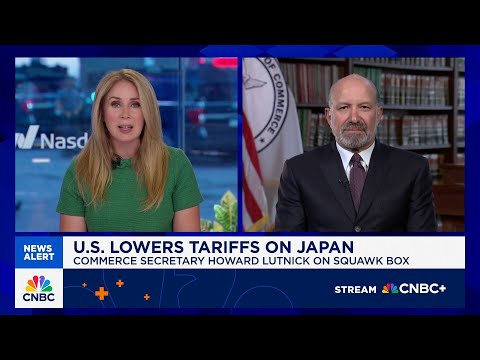
All right, President Trump signing an executive order Thursday that will allow tariffs on auto and other imports from Japan to be coming in at much lower rates, 15% versus the 25 to 27 1.5%. Uh joining us right now to talk about this is Commerce Secretary Howard Lutnik and SE Secretary Lutnik, thank you for being with us today. Let's walk through how this kind of played out and what the specific details are in this agreement. All right. So the Japanese in order to buy down their tariff rate, so they had a 2 ...

Investors should brace themselves for more short-term bouts of volatility, says Kevin Mahn
CNBC Television· 2025-08-29 12:00
Investors will pay close attention to the PCE inflation report due at 8:30 a. m. Eastern time this morning.Let's talk more about the markets with Kevin Mann, president and chief investment officer at Henan and Walsh Asset Management. Kevin, um, first of all, I just want to get your view on the market. This is last obviously trading day of August.Um, you've studied this S&P rebound from the fifth worst start to the year to where we are today, back to record highs. How much longer do you think the rally can l ...
Is the US on the Cusp of Stagflation? | Presented by CME Group
Bloomberg Television· 2025-08-26 13:40
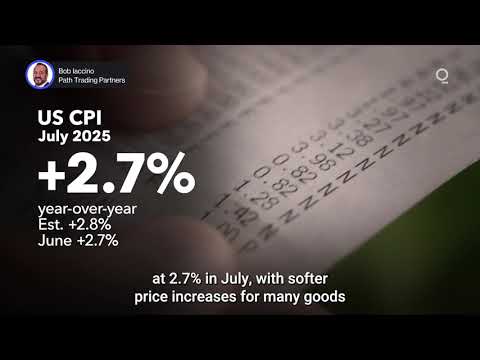
Stagflation, a scenario of high inflation, weak growth and elevated unemployment, has become a topic of concern for economists and traders amid US trade tariffs, sticky services inflation and slowing GDP growth. Recent tariff hikes have pushed costs higher for many imported goods and consumer inflation expectations have risen with annual headline inflation projected to approach 3.9% by year end as tariffs are implemented. However, the argument for stagflation remains limited due to continued weakness in goo ...
Fed Chair Powell: Labor market is in a 'curious kind of balance'
CNBC Television· 2025-08-22 14:41
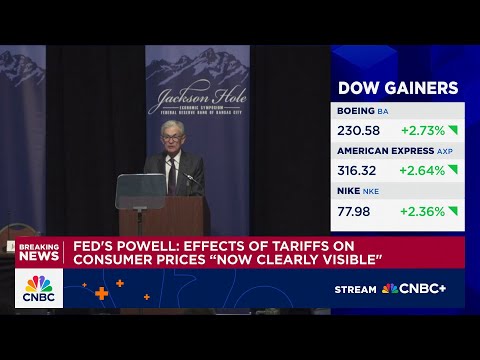
Labor Market Conditions - The unemployment rate is at a historically low level of 42% and has been broadly stable [1] - Labor supply has softened in line with demand, lowering the break-even rate of job creation [1] - Labor force growth has slowed considerably due to a sharp falloff in immigration and a decrease in the labor force participation rate, suggesting rising downside risks to employment [2] Economic Growth and Inflation - GDP growth has slowed to a pace of 12%-2% in the first half of the year, roughly half the 25% pace in 2024, reflecting a slowdown in consumer spending [3] - Total PCE prices rose 26% over the 12 months ending in July, while core PCE prices rose 29% [4][5] - Prices of goods increased 11% over the past 12 months, contrasting with the modest decline seen in 2024 [5] Impact of Tariffs - The effects of tariffs on consumer prices are now visible and are expected to accumulate, with uncertainty about timing and amounts [6] - A reasonable base case is that the effects of tariffs will be relatively short-lived, representing a one-time shift in the price level [7] - There is a risk that upward pressure on prices from tariffs could spur a more lasting inflation dynamic [8] Inflation Expectations - Measures of longer-term inflation expectations appear to remain well-anchored and consistent with the long-run inflation objective of 2% [10] - The industry will not allow a one-time increase in the price level to become ongoing inflation [10]
X @Wu Blockchain
Wu Blockchain· 2025-08-20 18:44
Economic Outlook - Federal Reserve staff expects real GDP growth through 2027 to align with prior forecasts [1] - Unemployment is projected to exceed the natural rate by end-2025 and remain elevated [1] Financial Market Implications - Payment stablecoin usage may rise following the GENIUS Act [1] - Increased stablecoin usage could boost demand for assets like U S Treasuries [1]
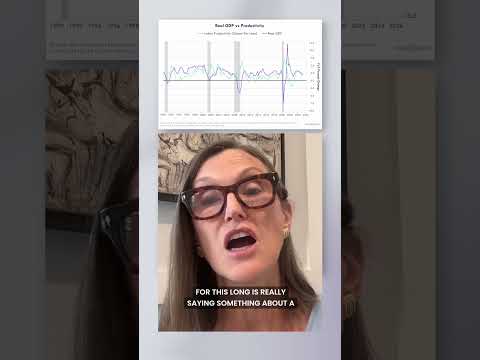
A Recovery Defined By Innovation
ARK Invest· 2025-08-12 17:49
Productivity Growth & Economic Outlook - Productivity surges tend to occur at the beginning of recoveries after recessions [2] - The fact that productivity has held up well during the rolling recession suggests a secular change in productivity growth [2] - The company anticipates productivity growth could reach 5% or more, sustained for a longer period [3] Technological Drivers - New technologies such as robotics, energy storage, AI, blockchain technology, and multiomic sequencing are expected to drive significant productivity gains [3] Correlation of Economic Indicators - GDP growth and productivity growth are typically highly correlated on a year-over-year basis [1]
摩根士丹利研究关键预测-Morgan Stanley Research Key Forecasts
摩根· 2025-08-12 02:34
Investment Rating - The report maintains a cautious outlook on the US labor market and global growth, indicating a potential step-down in real GDP growth for the US from 2.5% in 2024 to 1.0% in 2025 [2][7]. Core Insights - The report highlights that US employment growth is moderating faster than expected, signaling downside risks to the labor market [2]. - It anticipates a rise in core goods inflation, projecting the core CPI inflation rate for July to reach 3.04% year-over-year [2]. - Global growth is expected to decline from 3.5% in 2024 to 2.6% in 2025, influenced by tariff shocks and restrictive trade policies [7]. Economic Forecasts - The report provides GDP growth forecasts for various regions, with the US projected at 1.0% for 2025 and 1.1% for 2026, while the Euro Area is also expected to grow at 1.0% in 2025 [8]. - Inflation rates are forecasted to be 3.0% for the US in 2025 and 2.5% in 2026, while the Euro Area is expected to see inflation rates of 2.1% and 1.8% respectively [8]. Equity Market Outlook - The report suggests a preference for quality cyclical stocks and large-cap defensives with lower leverage and cheaper valuations in the US market [5]. - In Europe, it recommends focusing on resilient sectors such as defense, banks, software, telecoms, and diversified financials [5]. - Emerging markets are favored towards financials and profitability leaders, with a preference for domestic-focused businesses over exporters [5]. Fixed Income and Currency Strategy - The report indicates an overweight position in core fixed income and a cautious stance on other fixed income assets, anticipating Treasury yields to remain range-bound until late 2025 [3][13]. - The US dollar is expected to face pressure, with the DXY projected to fall 9% to 91 by mid-2026 due to rising policy uncertainty and increased FX-hedging ratios [13]. Commodity Insights - The report notes that oil prices are expected to face downside risks due to a projected surplus, with Brent prices likely not falling below $60 per barrel [15]. - European gas and global LNG prices are anticipated to remain range-bound, although there may be marginal upside due to rising competition for available LNG [16]. - The report favors gold and silver amidst further USD weakness and rising inflation [17].
美国经济分析:年中增长更新-下半年仍低于潜在水平-US Economics Analyst_ Mid-Year Growth Update_ Still Below Potential in the Second Half
2025-08-05 03:15
Summary of Key Points from the Conference Call Industry Overview - The report focuses on the US economy, specifically the GDP growth outlook for 2025, highlighting the impact of tariffs and consumer behavior on economic performance [2][5][14]. Core Insights and Arguments - **GDP Growth Rate**: The GDP grew at an annualized pace of 1.2% in the first half of 2025, which was below initial expectations but aligned with forecasts made in early April due to anticipated tariff increases [2][5]. - **Consumer Spending**: There was a significant slowdown in consumer spending growth, which fell to around 1% in 2025H1, about half of what was expected at the year's start. This was attributed to a rise in the saving rate from 3.5% in December 2024 to 4.5% in June 2025 [9][17]. - **Business Investment**: Contrary to expectations, business investment grew at a 6% pace in 2025H1, although this was adjusted to about 3% after accounting for frontloading of imported technology goods [10][20]. - **Housing Market**: The housing sector experienced a downturn, with residential investment declining by 3% in the first half of the year. The forecast predicts an 8% annualized decline in housing for 2025H2 due to high mortgage rates and poor affordability [12][21]. - **Trade Deficit**: The trade deficit is expected to narrow to 2.4% of GDP by the end of 2025, down from 3.1% at the end of 2024, driven by reduced import demand due to high tariffs [3][26]. Additional Important Insights - **Economic Forecasts**: The GDP is projected to grow at a 1% annualized pace in 2025Q3 and Q4, with flat domestic final sales and contributions from a narrowing trade deficit and inventory accumulation [14][34]. - **Income Growth**: A sharp slowdown in real income growth is anticipated, influenced by the phasing out of government transfer payments and higher tariff-driven inflation [17][20]. - **Investment Trends**: A forecasted 0.6% annualized decline in business investment in 2025H2 is expected, with continued weakness in structures and equipment due to policy uncertainty [20][21]. - **Government Spending**: Total government spending is projected to decline by 0.7% in 2025H2, influenced by cuts in federal spending and a modest offset from new fiscal legislation [29][34]. Conclusion - The overall economic outlook for the US in 2025 indicates a weak growth trajectory, with significant challenges in consumer spending, business investment, and the housing market, compounded by the effects of tariffs and government policy changes [32][34].