中试

Search documents
国家发改委答证券时报:中试需求十分迫切 正是民营企业大展身手之时
Zheng Quan Shi Bao Wang· 2025-11-11 08:07
Core Viewpoint - The National Development and Reform Commission emphasizes the importance of building a modern industrial system and accelerating high-level technological self-reliance as key strategic tasks during the 14th Five-Year Plan period [1] Group 1: Policy and Strategic Importance - The 20th Central Committee's Fourth Plenary Session has clearly outlined strategic tasks for the 14th Five-Year Plan, highlighting the integration of innovation and industry as a critical focus [1] - The role of the pilot test phase is increasingly significant as it connects innovation with industry, facilitating the integration of the innovation chain and the industrial chain [1] Group 2: Opportunities for Enterprises - There is a growing demand for the pilot test phase, indicating a crucial opportunity for private enterprises to expand their roles in this area [1]
稳增长:发挥中试关键节点作用
Zhong Guo Hua Gong Bao· 2025-11-11 02:30
Core Viewpoint - The "Work Plan for Steady Growth in the Petrochemical Industry (2025-2026)" emphasizes the importance of mid-test bases in enhancing innovation and development within the industry, simplifying the approval processes for mid-test projects, and promoting the construction of mid-test bases in chemical parks to support industry innovation [1][3]. Group 1: Mid-Test Base Development - The mid-test platform should integrate talent cultivation, technology maturation, market validation, and business model exploration [1]. - The construction of mid-test bases involves open innovation and collaboration, with the introduction of a management approach for mid-test project entry [2]. - The optimization of approval processes through bundled handling of permits and assessments is expected to reduce preparation time by over 30% [3]. Group 2: Policy and Regulatory Changes - The "bundled" approach for handling mid-test project approvals is a significant breakthrough that enhances operational efficiency and project capacity [3][4]. - Local policies should clarify the scope and regulatory details of the bundled approach, including a list-based system for similar process projects [3]. - The encouragement of mid-test products entering the market streamlines the path for market validation [4]. Group 3: Industry Collaboration and Ecosystem - Mid-test bases should focus on technology validation while connecting upstream technology cultivation and downstream commercialization [2][4]. - Collaboration with universities and enterprises is essential for resource integration and sharing of mid-test facilities and data platforms [2]. - The establishment of a comprehensive service system for the entire chain of technology achievement is crucial for effective commercialization [2][4]. Group 4: Implementation and Future Directions - The implementation of the "Work Plan" is seen as a means to enhance the efficiency and flexibility of mid-test project management [5]. - The development of a collaborative mid-test platform aims to create a full lifecycle innovation service system [5]. - The mid-test bases will actively participate in the research and drafting of national mid-test key technology standards, incorporating practical experiences into the standard-setting process [5].
天津市举行解读石化化工中试管理政策吹风会
Zhong Guo Hua Gong Bao· 2025-10-21 01:45
Core Viewpoint - The Tianjin government has introduced a management policy for the petrochemical industry to enhance innovation and support the transition to high-end production, addressing existing challenges in the sector [1][2]. Group 1: Policy Background - Tianjin is a significant industrial base in northern China, with a long history in the petrochemical sector, dating back to the early 20th century [1]. - The city aims to achieve a petrochemical industry output value of nearly 450 billion yuan in 2024, accounting for over 20% of the industrial output, positioning it as a key industry in Tianjin [1]. Group 2: Policy Objectives - The "Chemical Pilot Test Management Measures" were developed to align with national strategies and promote the petrochemical industry from large-scale to strong-scale, contributing to new industrialization [2]. - The pilot testing process is crucial for verifying the feasibility, stability, and safety of technological innovations, serving as a key support for transforming research outcomes into productive capabilities [2]. Group 3: Main Content of the Policy - The "Chemical Pilot Test Management Measures" consists of five chapters and forty-one articles, covering the entire process of pilot testing activities, including applicable fields, regulatory objects, process management, and safety responsibilities [3]. - The Tianjin government plans to focus on three areas for effective implementation: promoting awareness and understanding of the policy, ensuring management and safety compliance, and providing substantial support for technological innovation in the industry [3].
“中试”为何重要(财经科普)
Ren Min Ri Bao· 2025-08-17 22:01
Core Viewpoint - The Ministry of Industry and Information Technology has announced the first batch of 241 key pilot testing platforms, emphasizing the importance of pilot testing in transitioning new products from the trial stage to production, significantly improving the success rate of industrialization [1] Group 1: Importance of Pilot Testing - Pilot testing is a transitional experiment that verifies technical reproducibility, mass production feasibility, quality reliability, and cost-effectiveness [1] - Data shows that the industrialization success rate can reach 80% with pilot testing, compared to only 30% without it [1] Group 2: Challenges Faced by Technology Enterprises - High investment and risk associated with pilot testing deter many technology companies from engaging in it, as the investment required escalates from 1 for R&D samples to 10 for product prototypes and 100 for mass production [1] Group 3: Role of Technology Finance - Technology finance can effectively address the challenges of pilot testing, as highlighted in the policy released in May, which aims to promote innovation in technology insurance products and services [1] - The policy includes exploring risk-sharing mechanisms in key areas such as major technological breakthroughs, pilot testing, and cybersecurity [1] Group 4: Collaborative Framework for Technology Transfer - A collaborative framework involving capital, technology, and institutional mechanisms can be established using tools like technology insurance, achievement transformation funds, patent pledges, and risk-sharing mechanisms [1] - This framework aims to connect the chain from technological achievements to pilot incubation, industrialization, and capital exit, thereby accelerating the transformation of technological achievements into practical applications [1]
首批名单公布,又一国家级平台来了
Mei Ri Jing Ji Xin Wen· 2025-05-12 23:27
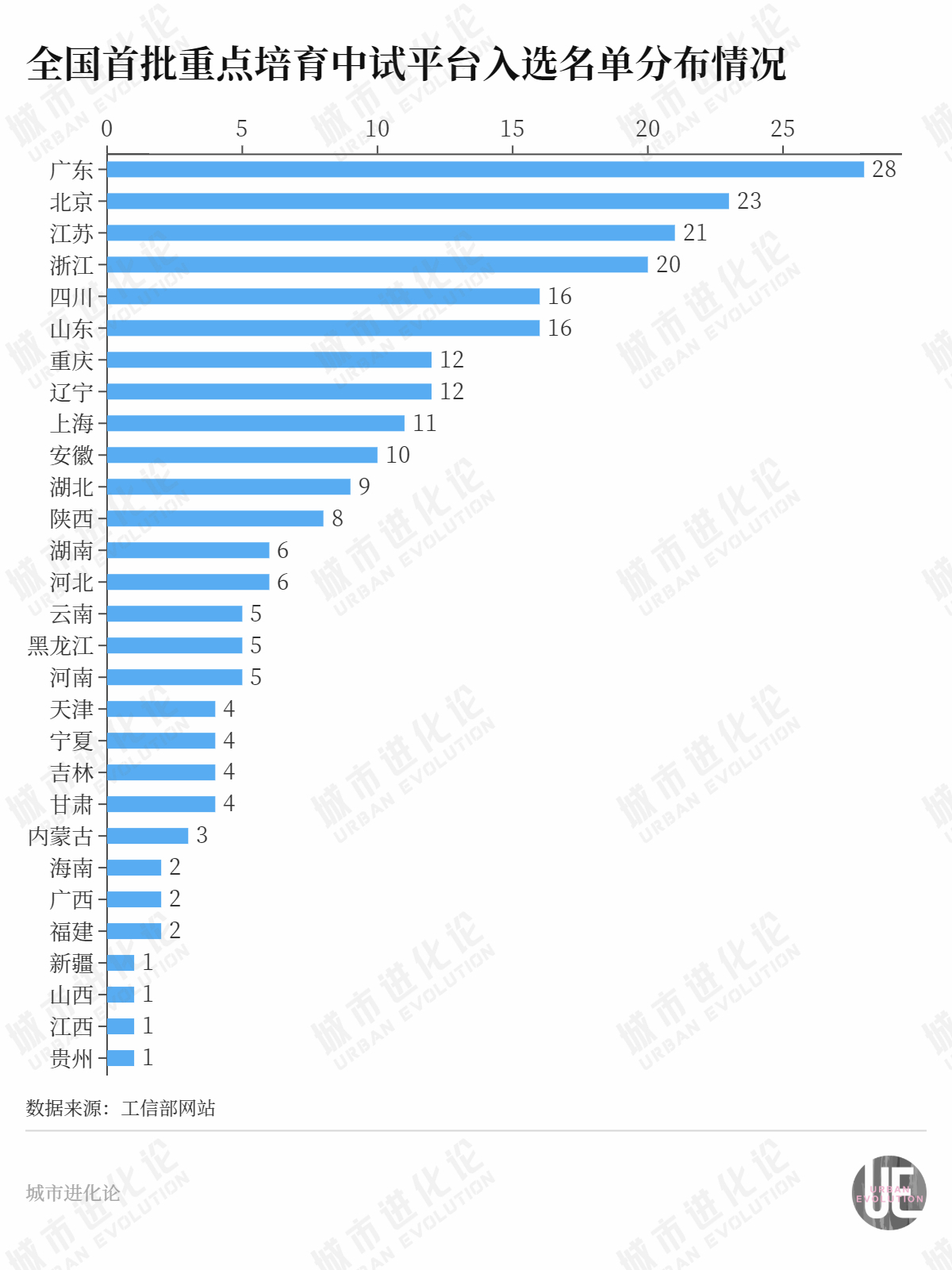
Core Insights - The Ministry of Industry and Information Technology (MIIT) has announced the preliminary list of 242 key pilot platforms for manufacturing, covering six major sectors essential for high-quality development [1][2] - The success of pilot testing is crucial for the industrialization of technological achievements, with a success rate of 80% for those that undergo pilot testing compared to only 30% for those that do not [1] - The government aims to establish provincial and national pilot platforms by 2027 to enhance the engineering breakthroughs and industrial applications of traditional and emerging industries [2] Group 1: Pilot Platforms Overview - The 242 pilot platforms are distributed across 29 provinces, excluding Qinghai and Tibet, with Guangdong, Beijing, Jiangsu, and Zhejiang leading in the number of platforms [2][3] - Guangdong has the highest number of pilot platforms across all six sectors, indicating strong industrial transformation capabilities [3] Group 2: Regional Development Plans - Guangdong plans to establish 30-50 provincial pilot platforms by 2025, with 5-8 expected to reach industry benchmark levels [2] - Shandong aims to create around five exemplary provincial pilot platforms by 2027 in key industrial sectors, striving for national-level recognition [2]