公司内斗

Search documents
“同学创业典范”滤镜破碎,三雄极光内讧分歧走到台前
Nan Fang Du Shi Bao· 2025-08-06 14:27
Core Viewpoint - The internal conflicts within Sanxiong Aurora have come to light, revealing significant divisions among the founding members, which may impact the company's future performance and governance [3][9]. Company Background - Sanxiong Aurora was founded in 1991 by four alumni from South China University of Technology, initially gaining recognition for their successful electronic ballast products and later becoming a leader in engineering lighting [4][5]. - The company went public in 2017, with annual revenues around 2.5 billion yuan and net profits between 230 million and 250 million yuan [5]. Internal Conflicts - Recent board meetings have highlighted disagreements, particularly during the election of the chairman, where two proposals were made, leading to a split vote [3][6]. - Founders Zhang Xianqing and Chen Songhui have expressed concerns over the management style of current chairman Zhang Yutao, citing disorganization and declining performance [7][9]. Financial Performance - The company's revenue has seen a significant decline from 2.7 billion yuan in 2021 to 2.078 billion yuan in 2024, marking the lowest since its IPO [9][10]. - Net profit has also dropped sharply, with a notable 88% decrease in 2021 and a further decline in 2024, resulting in a net loss of 15.31 million yuan in Q1 2025 [9][10]. Market Conditions - The overall lighting industry is facing challenges, with a projected market value decline of 7.6% in 2024, affecting Sanxiong Aurora's primary business in home lighting [11]. - The company is attempting to mitigate losses through strategies like digital marketing and city coverage, but these efforts have yielded minimal growth [10][11]. Shareholder Sentiment - Trust in the current management has waned, as evidenced by the near-unanimous rejection of executive compensation proposals by minority shareholders at the 2024 annual meeting [11]. - The company's stock price has plummeted over 80% from its peak, resulting in a market capitalization loss of approximately 13 billion yuan [11].

新任总经理主动降薪“低保”履职,三雄极光内斗博弈暗涌加剧
Tai Mei Ti A P P· 2025-07-31 13:06
Group 1 - The new general manager of Sanxiong Aurora, Lin Yan, has voluntarily chosen to forgo most of his salary, only retaining the legally mandated social security and housing fund contributions, signaling a commitment to the company's future and cost optimization [2][3] - This decision comes amid significant internal conflict within the company's board, with two founding board members expressing strong doubts about Lin Yan's capabilities, indicating a deepening governance crisis [2][4] - The board's recent meetings have revealed stark divisions, with opposing votes on key personnel appointments and salary proposals, highlighting the rift between factions led by Lin Yan and Zhang Yutao versus those led by Zhang Xianqing and Chen Songhui [4][5] Group 2 - The internal strife is a continuation of a dramatic board meeting held on June 27, where a rare "dual proposal" scenario unfolded regarding the election of the chairman, ultimately resulting in Zhang Yutao being re-elected despite opposition [6][9] - The company's financial performance has deteriorated significantly, with a reported revenue of 2.078 billion yuan for the 2024 fiscal year, down 11.64% year-on-year, and a net profit of approximately 48.09 million yuan, down 76.53% [9][10] - The first quarter of 2025 saw further decline, with revenue of 334 million yuan, a 15.82% decrease year-on-year, and a net loss of approximately 15.31 million yuan, marking a shift from profit to loss [10]

科兴生物争夺记:谁能打开百亿美元“金库”大门?
Mei Ri Jing Ji Xin Wen· 2025-07-21 14:44
Core Viewpoint - The internal conflict within Kexing Biologics has intensified, particularly surrounding a significant cash dividend distribution, which has become a focal point for shareholder disputes and board control [1][10]. Group 1: Shareholder Disputes - Kexing Biologics is experiencing a power struggle between two factions led by Li Jiaqiang and Yin Weidong, with the latter being one of the company's founders [5]. - A special shareholders' meeting was held to elect a new board, proposed by Sequoia Capital, which resulted in the dismissal of the current board and the election of ten new members [3][5]. - Li Jiaqiang's faction claims the election is invalid, asserting that the meeting was improperly conducted and that their board remains the only legitimate governing body [6][8]. Group 2: Dividend Distribution - Kexing Biologics announced a total cash dividend of $7.448 billion, with an initial payment of $55 per share, which is expected to deplete over 70% of the company's cash reserves [10][11]. - The dividend distribution is seen as a compensatory measure for shareholders, particularly for Li Jiaqiang's faction, who have not received direct dividends from the operational entity, Beijing Kexing Zhongwei [11][12]. - The distribution has sparked controversy, with opposing factions accusing each other of attempting to manipulate the situation for personal gain [12]. Group 3: Regulatory and Compliance Issues - Kexing Biologics faces potential delisting from NASDAQ if it fails to submit a compliance plan by the deadline [13]. - The company is currently working to restore its stock trading and appoint a new auditing firm to address regulatory concerns [13].
一年挣960亿,印钞机都不如它卖力
商业洞察· 2025-07-15 09:56
Core Viewpoint - The article discusses the internal conflicts within Sinovac Biotech, highlighting the company's significant financial performance and the ongoing power struggle among its shareholders and board members [5][18][21]. Group 1: Company Overview - Sinovac Biotech, known for its COVID-19 vaccine, has reported revenues exceeding 130 billion yuan and a net profit of over 96 billion yuan from 2021 to 2022, resulting in a net profit margin of approximately 73.8% [11][16]. - The company has been suspended from trading for six years due to internal disputes, indicating ongoing governance issues [21]. Group 2: Shareholder Conflict - A recent shareholder meeting in Antigua and Barbuda involved a proposal to remove current board members and elect new candidates nominated by SAIF Partners, reflecting deep divisions among shareholders [18][22]. - The company announced a massive special dividend payment of up to 7.5 billion USD, leaving it with 2.8 billion USD in cash after the distribution [22][23]. Group 3: Historical Context - The founder, Weidong Yin, has a background in public health and has been pivotal in the company's development since its establishment in 2001 [42][62]. - Sinovac's history includes rapid advancements in vaccine development, notably during the SARS outbreak, which laid the groundwork for its later success with COVID-19 vaccines [60][61].
内斗再起波澜,凯利泰将被ST
Di Yi Cai Jing· 2025-04-29 13:02
Core Viewpoint - The internal conflicts within Kailitai (300326.SZ) continue, with significant disagreements over the election of the new chairman, management changes, and the contentious share repurchase issue, leading to potential risks for the company [1][2][14]. Group 1: Internal Conflicts - The board of directors' election revealed deep divisions between the second-largest shareholder and the first and third shareholders, affecting key decisions such as the chairman's election and management appointments [1][3]. - The new chairman, Cai Zhongxi, was elected with 4 votes against 3 for the candidate Wang Chong, representing the first and third shareholders [1][5]. - Management changes included the appointment of Xia Tian as the general manager and Guo Haibo as the board secretary, amidst disagreements over these appointments [1][7]. Group 2: Share Repurchase Disputes - The ongoing dispute regarding the share repurchase from Ligetai has resurfaced, with the board previously voting to issue a repurchase notice, but the decision faced opposition from key stakeholders [8][10]. - The board's recent meeting did not pass the proposal to send a repurchase notice, with votes split and some members calling for more information before making a decision [9][11]. - The repurchase agreement was triggered due to Ligetai's failure to complete an IPO by December 31, 2024, leading to legal actions from the second-largest shareholder [8][12]. Group 3: Internal Control Issues - Kailitai is facing internal control problems, with auditors unable to obtain sufficient evidence regarding the valuation of equity investments and related party transactions, leading to a "non-standard" audit opinion for the 2024 financial report [2][14]. - The company announced a delay in the disclosure of its 2024 annual report due to significant disagreements with auditors, which may result in further regulatory scrutiny [14][15]. Group 4: Shareholder Actions - The second-largest shareholder, represented by Yuan Zheng and Wang Zhengmin, has been increasing their stake in Kailitai, now holding approximately 6.38% of the shares, which is close to the first shareholder's 6.99% [15][16]. - The ongoing increase in shareholding indicates a potential power struggle for control and influence over Kailitai's strategic direction [16].

振芯科技“内斗”何时了
Shang Hai Zheng Quan Bao· 2025-04-23 19:34
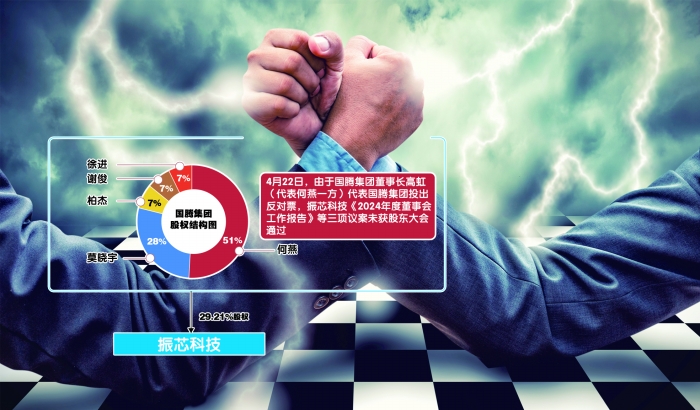
Core Viewpoint - The internal conflict between the core management of Zhenxin Technology and its controlling shareholder, Chengdu Guoteng Electronics Group, has intensified, leading to the rejection of key proposals at the annual shareholder meeting [2][3]. Group 1: Shareholder Meeting and Proposals - The annual shareholder meeting of Zhenxin Technology took place on April 22, where several key proposals, including the 2024 Board of Directors' work report, were rejected due to opposition from Guoteng Group [3][4]. - Guoteng Group's chairman, Gao Hong, opted for online voting to avoid potential disputes at the meeting, indicating the tense atmosphere surrounding the event [3][4]. - The rejection of the proposals highlights the ongoing conflict between the management and the controlling shareholder, with questions raised about how to address the rejected proposals moving forward [3][4]. Group 2: Reasons for Opposition - Gao Hong criticized the board for failing to act in the best interests of the company and its shareholders, citing a 44% decline in net profit while the chairman received a 10.6% salary increase [4]. - Concerns were raised about potential conflicts of interest regarding board members' connections to other companies with similar business operations [4]. Group 3: Shareholder Dynamics - Guoteng Group holds 29.21% of Zhenxin Technology's shares, with the actual control resting with He Yan, who holds 51% of the shares, leading to claims of decision-making being "hijacked" by minority shareholders [5][6]. - The management expressed frustration over the lack of communication and cooperation from Guoteng Group, while Guoteng Group countered that they have been cooperative when it benefits the company [6][8]. Group 4: Future Outlook and Demands - The management of Zhenxin Technology desires the dissolution of Guoteng Group to achieve a more decentralized ownership structure, which would eliminate a controlling shareholder [7][8]. - Guoteng Group's stance is focused on stability and development, advocating for lawful governance and adherence to regulations by all shareholders [8][9].