南海行为准则

Search documents
王毅:“南海仲裁案”是个政治操弄,应该扫进历史的垃圾堆
news flash· 2025-07-12 05:42
Core Viewpoint - The South China Sea arbitration case is characterized as a political manipulation that should be discarded into the annals of history [1] Group 1: South China Sea Code of Conduct - China and ASEAN countries agree to upgrade the "Code of Conduct in the South China Sea" to ensure it is effective, substantive, and compliant with international law [1] - There is a collective aim to achieve the "Code of Conduct" by next year, with increased negotiation frequency and accelerated progress [1] - Confidence is expressed in maintaining stability in the South China Sea and eliminating external interference to foster a peaceful and cooperative maritime environment [1] Group 2: Position on Arbitration - The Chinese side's stance on the so-called "South China Sea arbitration case" was clarified, emphasizing it as a political maneuver [1] - The assertion is made that the arbitration case should be relegated to historical irrelevance [1]
王毅:今年的东亚合作系列外长会开展顺利 \t会议取得一系列积极成果
news flash· 2025-07-12 05:37
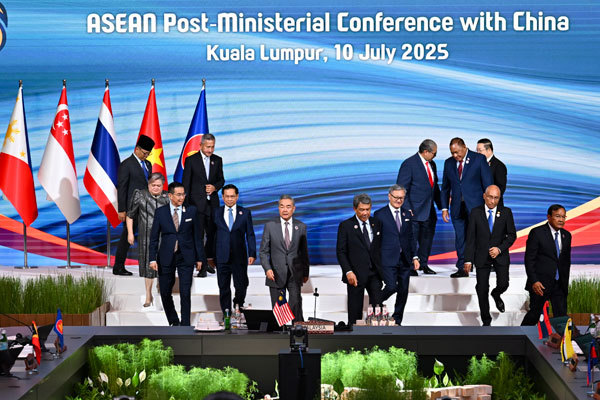
Core Points - The East Asia Cooperation Foreign Ministers' Meeting was successfully held, showcasing strong support and cooperation among China and ASEAN countries in the face of unilateralism and protectionism [1] - A significant outcome was the completion of negotiations for the China-ASEAN Free Trade Area 3.0, with plans to submit it for approval at the leaders' meeting in October [1] - An action plan for the China-ASEAN Comprehensive Strategic Partnership for the next five years was agreed upon, outlining cooperation in over 40 areas [1] - The completion of the third reading of the South China Sea Code of Conduct negotiations was welcomed, with a goal to finalize it by 2026 [1] Summary by Categories Economic Cooperation - The completion of the China-ASEAN Free Trade Area 3.0 negotiations signals a commitment to advancing regional economic integration and establishing a high-level regional free trade network [1] - The action plan for the next five years aims to enhance cooperation across more than 40 fields, injecting strong momentum into practical collaboration [1] Regional Stability - The agreement on the South China Sea Code of Conduct aims to provide stronger guarantees for peace and stability in the region, with a target to finalize negotiations by 2026 [1]
中外专家学者在京共同研讨南海的历史与现实
Ren Min Ri Bao· 2025-07-10 22:52
Core Viewpoint - The international seminar "South China Sea: History and Reality" held in Beijing emphasized China's historical and legal claims over the South China Sea islands, rejecting the validity of the 2016 South China Sea arbitration ruling, and calling for regional cooperation to maintain peace and stability in the area [1][2]. Group 1 - The seminar was attended by over 150 experts and representatives from more than 10 countries, discussing topics such as post-World War II international order and sovereignty over the South China Sea islands [1]. - Wu Shicun, Chairman of the Academic Committee of the South China Sea Research Institute, stated that China's sovereignty over the South China Sea is supported by historical and legal evidence, and the 2016 arbitration ruling is invalid due to jurisdictional overreach and legal errors [1][2]. - Li Guoqiang, Vice President of the Chinese Academy of History, highlighted that international treaties post-World War II confirm China's sovereignty over the South China Sea, and called for enhanced mutual trust among regional parties to create a peaceful maritime community [2]. Group 2 - The seminar was co-hosted by the South China Sea Research Institute and the Huayang Ocean Research Center, with participation from diplomats of various countries and international organizations [2]. - Attendees reiterated that the South China Sea arbitration tribunal acted beyond its authority and that its ruling contradicts international law, including the United Nations Convention on the Law of the Sea [2]. - The need to expedite negotiations on the "South China Sea Code of Conduct" was emphasized to manage differences and maintain regional stability [1][2].
东盟外长会上,中方提出四点建议
Huan Qiu Shi Bao· 2025-07-10 22:46
Group 1 - The 58th ASEAN Foreign Ministers' Meeting highlighted the strengthening of ties between ASEAN countries and China, with a focus on economic cooperation and regional stability [1][3][4] - Wang Yi emphasized the importance of the China-ASEAN Free Trade Area 3.0 and the high-quality implementation of the Regional Comprehensive Economic Partnership (RCEP), aiming for a new height in trade relations [3][4] - The bilateral trade volume between China and ASEAN is projected to reach $982.3 billion in 2024, marking five consecutive years of being each other's largest trading partners [3] Group 2 - ASEAN countries are seeking to deepen relationships with trade partners, particularly China, in response to new U.S. tariff policies [4] - The South China Sea and denuclearization issues were significant topics during the meeting, with ASEAN calling for a prudent approach to disputes [4][5] - Wang Yi's commitment to sign the Southeast Asia Nuclear-Weapon-Free Zone Treaty Protocol reflects China's leadership and commitment to regional nuclear disarmament [5]