存款替代

Search documents
降息潮下储户寻“存款替代”,利率高地有何风险
Di Yi Cai Jing· 2025-05-22 13:03
Core Viewpoint - The downward trend in interest rates is becoming increasingly evident, prompting depositors to seek alternative investment strategies due to shrinking returns on traditional RMB deposits [1][5][6]. Group 1: Interest Rate Trends - The RMB deposit rates have been continuously lowered, leading to a compression of returns for depositors [2][5]. - Some private banks, like Yilian Bank, have raised their one-year fixed deposit rates to 2%, contrasting with the general trend of rate cuts among major banks [3][5]. - As of May 22, 20 commercial banks have joined the trend of lowering RMB deposit rates, indicating a widespread acknowledgment of the ongoing "rate cut wave" [6]. Group 2: Shifts in Depositor Behavior - Depositors are increasingly moving their funds to non-bank financial institutions, with a reported decrease of 1.39 trillion yuan in household deposits in April, while non-bank deposits surged by 1.57 trillion yuan [1][5]. - Individuals like Li Xiang are actively searching for new investment avenues, while others, such as Chen Meng, are still exploring suitable financial products [2][3]. Group 3: Dollar Deposit Products - Several banks are offering attractive dollar deposit rates, with some reaching as high as 4.2% for six-month deposits, but these often come with conditions [4][7]. - The dollar deposit rates are also on a downward trend, with significant declines observed since the end of 2023 [6][8]. Group 4: Risks and Challenges - The high dollar deposit rates are often conditional, creating uncertainty for depositors who may not benefit from these rates in the long term [7]. - The dollar's value has been fluctuating, with the index dropping below 100, raising concerns about currency exchange risks for depositors [7][8].
存款利率全面下跌,年轻人开始流行攒“新三金”
盐财经· 2025-05-22 10:49
Core Viewpoint - The article discusses the significant decline in deposit interest rates in China, leading to a shift in investment strategies among young people who are moving away from traditional bank savings to alternative investment options like money market funds, bond funds, and gold funds [2][3][4]. Group 1: Decline in Deposit Rates - As of May 20, 2023, the one-year fixed deposit rate has fallen below 1%, and the interest rate for demand deposits has dropped to 0.05% [2]. - The trend of decreasing deposit rates is not limited to large banks; even small and medium-sized banks that previously attracted deposits with high rates are now lowering their rates [2]. - The decline in deposit rates has sparked discussions on social media about the ineffectiveness of traditional savings, with many realizing that the interest earned may not even cover travel expenses [2][3]. Group 2: Shift to Alternative Investments - Young individuals are increasingly abandoning the idea of earning interest from bank deposits, opting instead to diversify their savings into what is referred to as the "new three golds"—money market funds, bond funds, and gold funds [3][4]. - The "new three golds" have gained popularity as they are perceived to offer lower risk, better returns than bank deposits, and the potential to outpace inflation [11][12]. - Data from Ant Financial indicates that as of the end of April, 9.37 million individuals born in the 1990s and 2000s have simultaneously invested in money market funds, bond funds, and gold funds, indicating a growing trend [12]. Group 3: Individual Experiences and Strategies - A case study of an individual named Li Jing illustrates the frustration of watching savings diminish due to low interest rates, prompting her to explore alternative investment options [5]. - Another individual, Zhao Qi, has adopted a strategy of investing heavily in bond funds, which he refers to as "collecting eggs," highlighting the stability and long-term benefits of such investments compared to traditional savings [18][21]. - Zhao Qi's experience reflects a broader trend where individuals are forming communities to share investment strategies and support each other in navigating the changing financial landscape [26]. Group 4: Changing Financial Mindset - The article notes a generational shift in financial attitudes, where younger individuals prioritize risk management and diversified investments over traditional savings methods [28][30]. - The concept of "new three golds" symbolizes a proactive approach to personal finance, contrasting with the previous reliance on bank deposits and real estate for wealth accumulation [29]. - This evolving mindset emphasizes the importance of having a financial safety net and the ability to withstand economic uncertainties, leading to a more cautious yet strategic approach to investing [30].


“存款替代”效应凸显,短期限理财成新宠
Di Yi Cai Jing· 2025-05-21 12:45
Group 1 - The core viewpoint of the articles highlights the significant impact of recent interest rate cuts on deposit rates, leading to a shift in investment behavior towards wealth management products as a substitute for traditional deposits [1][2][5] - Major state-owned banks and several joint-stock banks have lowered deposit rates, with one-year fixed deposit rates dropping to 0.95% and many banks entering the "1 era" with rates below 1% [2][3] - The trend of "deposit migration" is expected to intensify, as lower deposit rates make wealth management products more attractive, particularly short-term products like cash management and pure bond products [1][5][6] Group 2 - Investors are increasingly seeking alternatives to traditional deposits, with many considering wealth management products that offer better returns and liquidity [3][4] - The decline in deposit rates is anticipated to increase the difficulty for banks in attracting deposits, while simultaneously directing more funds towards low-risk asset management products [4][6] - The wealth management market has shown growth, with a notable increase in scale, surpassing 31 trillion yuan by mid-May, driven by the comparative advantage of these products over traditional deposits [6][8] Group 3 - The downward adjustment of deposit rates is likely to exert downward pressure on the yields of fixed-income products, including bank wealth management products [8][9] - Cash management products are also experiencing declining yields, with average annualized returns falling to around 1.51% as of the end of April, reflecting the broader trend in the market [9] - The overall yield of wealth management products is expected to continue declining in the long term, influenced by the performance of underlying assets such as bonds [8][9]
“存款搬家”加速:理财规模突破31万亿元,港股等权益策略增加
Di Yi Cai Jing· 2025-05-20 13:00
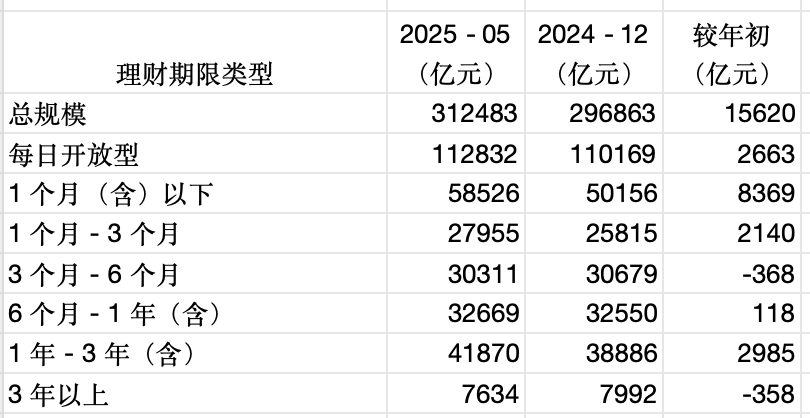
Core Viewpoint - The scale of wealth management products in China has reached a new high, surpassing 31 trillion yuan in May 2023, driven by declining loan rates and a shift towards short-term products as a substitute for deposits [1][3][4]. Group 1: Wealth Management Scale - As of May 20, 2023, the total scale of wealth management products reached approximately 31.3 trillion yuan, an increase of about 1.6 trillion yuan since the beginning of the year [1][2]. - The growth in wealth management products is primarily attributed to short-term products, with a notable increase in daily open-type products and those with a maturity of one month or less [4][5]. - The rapid increase in wealth management scale began in April 2023, coinciding with a more relaxed liquidity environment and a decline in deposit rates by major banks [3][4]. Group 2: Interest Rate Trends - The People's Bank of China announced a comprehensive plan including a 10 basis point interest rate cut and a 50 basis point reserve requirement ratio reduction, with expectations for further rate cuts in the second half of the year [1][6]. - Market analysts predict a continued downward trend in interest rates, which is expected to support the bond market and contribute to a steady increase in wealth management scale [6][7]. Group 3: Product Strategy and Performance - There is a growing trend towards "fixed income plus" strategies in wealth management products, with a small allocation to equity assets as the stock market shows signs of recovery [9][10]. - Wealth management products focusing on cash management and short-term investments are gaining popularity due to their safety and liquidity, often offering higher yields compared to money market funds [5][9]. - The performance of "fixed income plus" products varies significantly, with some achieving notable returns while others lag behind, indicating a diverse performance landscape within the wealth management sector [9][10].