德国经济复苏

Search documents
特朗普关税下,大众、博世、奥迪、保时捷等德国汽车大厂深陷裁员潮
Di Yi Cai Jing Zi Xun· 2025-09-29 11:23
Core Viewpoint - The recent announcement by the Trump administration to impose a 25% tariff on imported heavy trucks has negatively impacted the already fragile state of the German automotive industry, leading to significant job cuts and restructuring efforts among major manufacturers [2][4]. Group 1: Impact of Tariffs and Economic Conditions - The German automotive sector is struggling with weakened demand, high labor and energy costs, and increased competition from rapidly developing manufacturers, exacerbated by the U.S. tariff policies [4][5]. - Bosch, Germany's largest automotive parts supplier, announced plans to cut 13,000 jobs over the next five years, signaling a critical warning for the German industrial sector [2][9]. - The DAX index's structure is expected to undergo a fundamental shift by 2025, with the automotive and parts industry’s weight dropping from approximately 21% in 2015 to less than 10% [4]. Group 2: Job Cuts and Corporate Restructuring - Major German automotive companies, including Bosch, Continental, Schaeffler, and ZF, are implementing significant layoffs and cost-cutting measures due to ongoing pressures [5][8]. - Volkswagen plans to cut 35,000 jobs in Germany by 2030, while Bosch is set to reduce 18,500 positions, primarily in its mobility and autonomous driving divisions [8]. - The overall German automotive industry has eliminated about 55,000 jobs in the past two years, with projections indicating further job losses in the coming years [7][8]. Group 3: Economic Forecast and Recovery - A joint economic forecast from five major German economic research institutions predicts that Germany's economy will grow by only 0.2% in 2025, hindered by U.S. tariff policies and structural issues [10][11]. - The report highlights that the manufacturing sector's recovery is sluggish, with high energy and labor costs, a shortage of skilled workers, and declining competitiveness limiting growth prospects [11]. - The German government has attempted to boost confidence through increased military spending and a €100 billion "Made in Germany" investment plan, but tangible results have yet to materialize [11][12].


德国工业心脏之痛:特朗普关税下 汽车大厂深陷裁员潮
Di Yi Cai Jing· 2025-09-29 10:48
Core Insights - The recent announcement by the Trump administration to impose a 25% tariff on imported heavy trucks has negatively impacted the already fragile state of the German automotive industry [1][2] - Bosch, Germany's largest automotive parts supplier, plans to cut 13,000 jobs over the next five years, signaling a critical warning for the industrial sector [1][6] - German Chancellor Merz is set to host an automotive summit on October 9, with various stakeholders expected to attend, amid ongoing challenges in the automotive sector [1] Industry Overview - The automotive and parts sector's weight in the DAX index has significantly decreased from approximately 21% in 2015 to below 10% by 2025, indicating a fundamental shift in the industry structure [2] - German automotive manufacturers are struggling with weakened demand, high labor and energy costs, and increasing competition from rapidly developing manufacturers [2][3] - Major companies like Daimler Trucks and Volkswagen's Traton saw their stock prices drop following the tariff announcement [2] Employment Impact - Bosch's job cuts are part of a broader trend, with other companies like Continental, Schaeffler, and ZF also reducing positions and expenses due to economic pressures [3][5] - Volkswagen is limiting production and temporarily closing two electric vehicle factories in Germany, with plans to cut 35,000 jobs by 2030 [3][5] - The German automotive industry has already eliminated approximately 55,000 jobs over the past two years, with expectations of further job losses in the coming years [5] Economic Forecast - A joint economic forecast from five major German economic research institutions predicts only a 0.2% growth for the German economy in 2025, largely due to the impact of U.S. tariff policies [7][8] - The report highlights that while the service sector is growing, the manufacturing sector's recovery remains weak due to high costs and a lack of structural reforms [8] - Germany's reliance on exports, which has historically been around 70%, makes it particularly vulnerable to external shocks like tariffs [8] Government Response - The Merz government has attempted to boost confidence through increased military spending and a €100 billion "Made in Germany" investment plan, but these efforts have yet to yield significant results [8][9] - There are indications that some German automakers are shifting their business models to take on defense contracts, which could provide some economic relief [9]
特朗普关税下,大众、博世、奥迪、保时捷等德国汽车大厂深陷裁员潮
第一财经· 2025-09-29 10:23
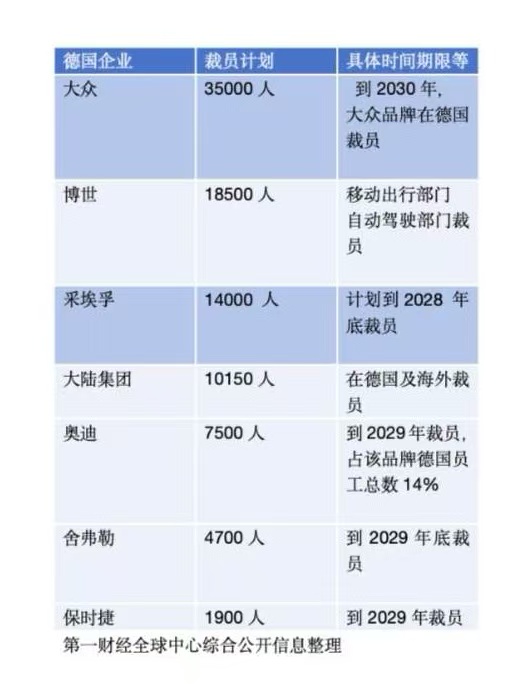
Core Viewpoint - The recent announcement by the Trump administration to impose a 25% tariff on imported heavy trucks has further exacerbated the already fragile state of the German automotive industry, leading to significant job cuts and restructuring efforts among major manufacturers and suppliers [2][5]. Group 1: Impact of Tariffs and Economic Conditions - The German automotive sector is struggling with declining sales, profit warnings, and the impact of U.S. tariffs, prompting a summit hosted by Chancellor Merz to address these challenges [2][5]. - Economic experts indicate that Germany has not yet emerged from its economic crisis, with a full recovery potentially not occurring until after 2026 due to tariff impacts and necessary structural adjustments [2][5][14]. Group 2: Job Cuts and Corporate Restructuring - Bosch announced plans to cut 13,000 jobs over the next five years, signaling a broader trend of layoffs across the German automotive industry, including major players like Daimler, Volkswagen, and Ford [2][10]. - The automotive industry has already seen approximately 55,000 jobs eliminated over the past two years, with projections indicating that tens of thousands more jobs could be lost by 2030 [9][10]. Group 3: Shift in Industry Structure - A report from Goldman Sachs highlights a fundamental shift in the DAX index's industry structure, with the automotive and parts sector's weight dropping from about 21% in 2015 to less than 10% [5]. - The transition to electric vehicles is slower than anticipated, leading to increased pressure on German manufacturers to downsize and restructure [7][12]. Group 4: Future Economic Outlook - A joint economic forecast from five major German economic research institutions predicts only a 0.2% growth for Germany in 2025, with manufacturing recovery remaining weak due to high energy and labor costs [14][15]. - The reliance on exports, which has historically been around 70% for Germany, makes the economy particularly vulnerable to external shocks like U.S. tariffs [16].

德国工业心脏之痛:特朗普关税下,汽车大厂深陷裁员潮
Di Yi Cai Jing· 2025-09-29 09:31
Group 1: Industry Overview - The German automotive industry is facing significant challenges due to a combination of factors including declining sales, rising labor and energy costs, and increased competition from other manufacturers [3][4] - The recent announcement of a 25% tariff on imported heavy trucks by the Trump administration has further exacerbated the situation for German automakers [1][3] - Bosch, Germany's largest automotive parts supplier, announced plans to cut 13,000 jobs over the next five years, signaling a critical moment for the industry [1][6] Group 2: Employment Impact - The German automotive sector has already seen approximately 55,000 job cuts over the past two years, with projections indicating that tens of thousands more jobs could be lost by 2030 [4][5] - Major companies such as Volkswagen, Bosch, ZF Friedrichshafen, Continental, and Audi have announced significant layoffs, with Volkswagen planning to cut 35,000 jobs by 2030 [5][6] - The shift towards electric vehicles is expected to require fewer workers, prompting calls for retraining programs to help displaced workers transition to other sectors [6][8] Group 3: Economic Outlook - A joint economic forecast from five major German economic research institutions predicts that Germany's economy will grow by only 0.2% in 2025, largely due to the impact of U.S. tariffs and structural issues within the manufacturing sector [8][9] - The report highlights that while the service sector is experiencing strong growth, the manufacturing sector's recovery remains weak due to high costs and a lack of structural reforms [8] - The reliance on exports, which has historically been around 70% for Germany, makes the economy particularly vulnerable to external shocks such as tariffs [8][9]