数字美元

Search documents
【首席观察】动荡金融世界的稳定币棋局
Jing Ji Guan Cha Wang· 2025-06-10 09:16
Core Insights - The emergence of stablecoins, particularly USD Coin (USDC), has raised alarms among global central banks as they begin to influence the U.S. Treasury market, indicating a shift in the underlying financial order [2][7] - The regulatory landscape for stablecoins is evolving rapidly, with the U.S. introducing the GENIUS Act, the EU implementing the MiCA regulation, and Hong Kong establishing a comprehensive regulatory framework for fiat-referenced stablecoins [2][6][9] Group 1: Stablecoin Overview - Stablecoins are categorized into four types: fiat-collateralized (e.g., USDT, USDC), crypto-collateralized (e.g., DAI), algorithmic (e.g., UST), and hybrid [2] - The total transaction volume of stablecoins reached $27.6 trillion in 2024, surpassing the annual transaction volumes of Visa and Mastercard [7] Group 2: Regulatory Developments - The U.S. GENIUS Act mandates that non-U.S. issuers must demonstrate regulatory comparability to enter the U.S. market, potentially reshaping global financial order [6] - Hong Kong has become the first major financial center in Asia to legislate stablecoin regulations, establishing a legal framework for fiat-referenced stablecoins [6][9] Group 3: Market Dynamics - The combined market capitalization of USDT and USDC exceeds $210 billion, accounting for 86% of the global stablecoin market [7] - Stablecoins are increasingly seen as a "shadow Federal Reserve," influencing U.S. Treasury yields through their high-frequency circulation and anchoring to U.S. debt [7][8] Group 4: Implications for Digital Currency - The rise of stablecoins is prompting a new monetary policy transmission mechanism that could replace traditional interbank systems [8] - Hong Kong's regulatory framework for stablecoins is viewed as a potential model for the internationalization of the digital yuan, with plans for offshore RMB stablecoin initiatives [9][10][14]


低调通过却暗藏杀机,“天才法案”是美元霸权的新密码
Sou Hu Cai Jing· 2025-06-06 07:44
Core Viewpoint - The introduction of the GENIUS Act by the U.S. Senate represents a strategic move to reinforce the dominance of the U.S. dollar in the global financial system under the guise of innovation and regulation, effectively turning stablecoins into tools of U.S. financial hegemony [1][9]. Group 1: Stablecoin Regulation - The GENIUS Act mandates that all stablecoins must be 100% backed by U.S. dollar cash or U.S. Treasury securities, restricting the asset base and effectively tying global stablecoin issuance to U.S. debt [3][4]. - This legislation aims to prevent any potential threats to the U.S. financial system by ensuring that stablecoins cannot operate independently of U.S. financial instruments [3][4]. Group 2: Global Financial Control - The act introduces a new dimension of sanctions, requiring both domestic and foreign stablecoin issuers to register with U.S. authorities and comply with stringent regulations, thereby extending U.S. regulatory reach globally [4][6]. - The GENIUS Act is seen as a step towards a "digital Bretton Woods" system, where the U.S. seeks to control the blockchain transaction ecosystem under its regulatory framework [4][7]. Group 3: Economic Implications - Analysts predict that if stablecoin market capitalization reaches $3.7 trillion by 2030, with half allocated to U.S. debt, the U.S. could gain $1.5 to $1.75 trillion in debt financing capacity, highlighting the financial leverage the U.S. aims to achieve through stablecoins [6]. - Currently, 99% of stablecoins are pegged to the U.S. dollar, and two-thirds of cryptocurrency transactions rely on stablecoins for settlement, indicating the potential for the U.S. to manipulate global capital flows through this legislation [6][9]. Group 4: International Response - Various regions, including Hong Kong, the EU, and Singapore, are exploring localized stablecoin regulations that prioritize technical safety and user protection, contrasting with the U.S. approach of regulatory dominance [9]. - Without a unified international effort to establish a fair and decentralized global stablecoin governance mechanism, the blockchain landscape may become increasingly unequal and controlled by U.S. interests [9].
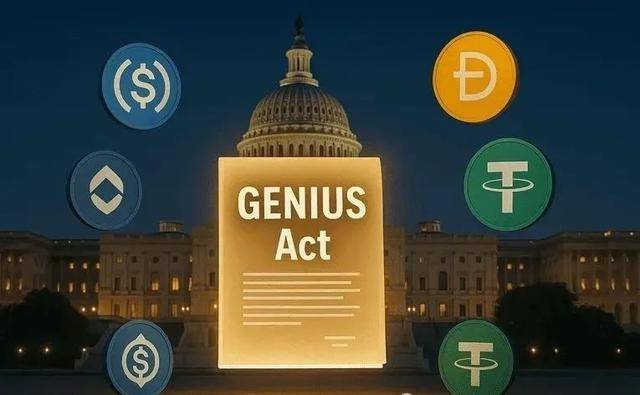
美元稳定币的阳谋:万亿美债“接盘侠”,恐引爆6.6万亿美元银行“失血潮”;马斯克130天政治生涯结束;韩总统大选提前投票结束;第二轮俄乌谈判下周开启 | 一周国际财经
Mei Ri Jing Ji Xin Wen· 2025-05-31 11:11
Group 1 - Stablecoins have become a focal point in the financial market, with U.S. Vice President JD Vance supporting their potential as an "economic booster" for the U.S. [4] - The U.S. Senate passed the procedural legislation for the GENIUS Act, which aims to create a regulatory framework for stablecoins, potentially making them "mainstream currency" [7][8] - Deutsche Bank predicts that the issuance of stablecoins could reach $2 trillion by the end of 2028, leading to an additional $1.6 trillion demand for U.S. short-term Treasury purchases [6][18] Group 2 - The GENIUS Act requires stablecoins to be backed by high liquidity assets, including cash and U.S. short-term Treasury securities, to ensure stability [13][14] - The act is seen as a strategy to maintain the dollar's global dominance and to find new buyers for the unprecedented U.S. national debt [15][18] - The total market capitalization of stablecoins has surged from $20 billion in 2020 to nearly $250 billion as of May 30, 2023, indicating a growth of over 1100% in about five years [10][12] Group 3 - The rise of stablecoins poses a risk of deposit outflows from traditional banks, with estimates suggesting up to $6.6 trillion could be at risk [22] - The potential for stablecoins to provide efficient payment solutions and decentralized finance (DeFi) services may weaken the deposit and lending capabilities of traditional banks, particularly community banks [25][22] - The introduction of stablecoins could disrupt the traditional payment ecosystem, impacting the economic value of established payment service providers like Visa and Mastercard [27][26]