
普惠包容发展

Search documents
和音:汇聚合力 共享机遇
Ren Min Ri Bao· 2025-11-01 23:53
Group 1 - The core message emphasizes the importance of multilateral cooperation and the establishment of an open Asia-Pacific economy, with Xi Jinping proposing five key suggestions for mutual benefit and shared opportunities [1][2] - The suggestions include maintaining a multilateral trade system, creating an open regional economic environment, ensuring stable supply chains, promoting digital and green trade, and fostering inclusive development [1] - The successful implementation of agreements like the Regional Comprehensive Economic Partnership and the expansion of the Comprehensive and Progressive Agreement for Trans-Pacific Partnership highlight the collective efforts of Asia-Pacific economies towards open cooperation [1] Group 2 - The second phase of the meeting focused on the challenges posed by the new technological revolution, with Xi proposing three suggestions: enhancing digital empowerment, adhering to green and low-carbon principles, and ensuring inclusive sharing of benefits [2] - China proposed the establishment of a World Artificial Intelligence Cooperation Organization to provide AI public goods and promote initiatives that benefit health and women's digital literacy in the Asia-Pacific region [2] - The commitment to deepening reforms and expanding high-level opening-up in China is reiterated, emphasizing the country's role in providing new opportunities for the Asia-Pacific and the world [2] Group 3 - The upcoming "China Year" at APEC will see China hosting the 33rd informal leaders' meeting in Shenzhen, aiming to strengthen the Asia-Pacific community and promote regional growth and prosperity [3] - This initiative is positioned as a significant opportunity for collaboration among Asia-Pacific nations to create a better future [3]
共建普惠包容的开放型亚太经济
Sou Hu Cai Jing· 2025-10-31 23:25
Core Viewpoint - The speech emphasizes the need for a collaborative approach to maintain an open and inclusive economic environment in the Asia-Pacific region, advocating for multilateral trade, regional economic integration, and sustainable development practices [2][3][5]. Group 1: Multilateral Trade and Economic Cooperation - The importance of upholding a multilateral trade system centered around the World Trade Organization (WTO) is highlighted, with a call for reforms to enhance its authority and effectiveness [3][4]. - There is a push for continuous trade and investment liberalization, aiming to deepen financial cooperation and advance regional economic integration through agreements like the Regional Comprehensive Economic Partnership (RCEP) [4][5]. Group 2: Supply Chain Stability - The need to maintain stable and open supply chains is stressed, advocating for collaboration rather than fragmentation, and emphasizing the importance of connectivity within the Asia-Pacific region [4][5]. Group 3: Digital and Green Trade - The speech calls for the promotion of digital and green trade, leveraging digital technologies to facilitate cross-border trade and advocating for the removal of green barriers to expand cooperation in green industries and clean energy [4][5]. Group 4: Inclusive Development - A focus on inclusive development is presented, with an emphasis on addressing imbalances in development and ensuring that economic globalization benefits all people in the region [5][6]. - China’s commitment to providing zero-tariff treatment on 100% of products for least developed countries that have diplomatic relations with it is mentioned, showcasing efforts to support modernization in developing nations [5][6]. Group 5: China's Role in Global Trade - China's position as a leader in global trade is underscored, with its trade volume ranking first and second globally in goods and services, and a significant foreign investment attraction of over $700 billion in the past five years [6]. - The ongoing expansion of China's open-door policy and its proactive engagement in international trade standards through free trade zones is highlighted [6].
在开放发展中分享机遇、实现共赢
Ren Min Ri Bao· 2025-10-31 22:32
Core Points - The speech by President Xi Jinping emphasizes the importance of multilateralism and regional economic cooperation in the Asia-Pacific region, proposing five key suggestions for future development [1][2][3]. Group 1: Economic Cooperation and Multilateralism - Xi Jinping's five suggestions include maintaining a multilateral trade system, creating an open regional economic environment, ensuring stable supply chains, promoting digital and green trade, and fostering inclusive development [1][2]. - Strengthening regional economic cooperation and maintaining stable supply chains can help reduce conflict risks and enhance the ability of member economies to respond to economic fluctuations [2][3]. - The establishment of the APEC Free Trade Area and the commitment to the Bogor Goals reflect APEC's long-term dedication to maintaining a multilateral trade system [2][3]. Group 2: China's Role and Contributions - China's approach to global challenges through cooperation and dialogue is highlighted, with a focus on opposing unilateralism and protectionism [3]. - The promotion of artificial intelligence and economic policy coordination in the Asia-Pacific region is seen as a way to bridge the digital divide and ensure that technological advancements benefit more countries [4]. - China's advancements in clean energy and green technology, such as solar and wind energy, are setting a benchmark for global green transformation [5].
以中国式现代化新成就为亚太和世界提供新机遇——习近平主席重要讲话为共建开放型亚太经济指引方向汇聚力量
Xin Hua She· 2025-10-31 17:09
Core Viewpoint - The speech by President Xi Jinping at the APEC meeting emphasizes the importance of building an inclusive and open Asia-Pacific economy, advocating for regional cooperation and mutual benefits amidst increasing uncertainties in the region [1][2]. Group 1: Regional Cooperation and Economic Development - Xi Jinping's speech highlights the need to uphold the original intention of APEC to promote economic growth and enhance people's well-being, advocating for shared opportunities and win-win outcomes through open development [2][3]. - The speech is seen as a significant contribution to regional cooperation, providing a roadmap for overcoming current challenges and achieving the ultimate goal of an Asia-Pacific community [3][4]. - The emphasis on maintaining stable supply chains and promoting digital and green trade aligns with the need for a resilient economic environment in the Asia-Pacific region [4][5]. Group 2: Specific Recommendations - Xi Jinping proposed five key recommendations: maintaining a multilateral trade system, creating an open regional economic environment, ensuring stable supply chains, advancing trade digitalization and greening, and promoting inclusive development [3][4]. - The call for collective action against unilateralism and hegemony resonates with the need for unity among economies to safeguard common interests and stabilize supply chains [4][6]. Group 3: China's Role and Commitment - China's commitment to high-level opening-up and reform during the 14th Five-Year Plan period is highlighted as a response to rising global protectionism, signaling a continued path towards openness [6][7]. - The establishment of the Asia-Pacific Demonstration Electronic Port Network and Green Supply Chain Network is noted as a significant step towards enhancing regional trade cooperation [4][7]. - The Belt and Road Initiative is presented as a means to support developing countries in achieving modernization and sustainable development, thereby contributing to global growth [5][8].


新华全媒头条|以中国式现代化新成就为亚太和世界提供新机遇——习近平主席重要讲话为共建开放型亚太经济指引方向汇聚力量
Xin Hua She· 2025-10-31 16:10
Core Viewpoint - President Xi Jinping's speech at the APEC meeting emphasizes the importance of building an open and inclusive Asia-Pacific economy, highlighting China's commitment to providing new opportunities for the region and the world through its modernization achievements [1][2]. Group 1: Regional Cooperation - Xi Jinping advocates for maintaining the original intention of APEC to promote economic growth and enhance people's well-being, emphasizing the need for open development and shared opportunities [2]. - The speech is seen as a significant contribution to regional cooperation, with various leaders expressing support for China's proposals on supply chains, free trade, and the role of the WTO in dispute resolution [2][3]. - The call for unity in the face of increasing instability in the Asia-Pacific region resonates with many leaders, who view Xi's suggestions as a roadmap for overcoming current challenges and achieving a shared community [2][4]. Group 2: Economic Development Proposals - Xi Jinping outlines five key recommendations for the Asia-Pacific region: maintaining a multilateral trade system, creating an open regional economic environment, ensuring stable supply chains, promoting trade digitalization and greening, and fostering inclusive development [3]. - The emphasis on multilateralism and the need to support developing countries is highlighted as crucial for narrowing the global North-South gap and advancing the Asia-Pacific community [3][5]. Group 3: Commitment to Openness - The speech reiterates China's commitment to openness as a fundamental national policy, with plans to deepen reforms and expand high-level openness during the 14th Five-Year Plan period [5][6]. - Xi's remarks on China's trade and investment achievements, including the reduction of the negative list for foreign investment and the expansion of free trade agreements, signal a strong commitment to building an open world economy [6][7]. Group 4: Sustainable Development - The focus on sustainable development through initiatives like the Belt and Road Initiative is noted as a means to support developing countries and create new opportunities for global development [5][8]. - The establishment of networks for digital and green trade cooperation is highlighted as a significant step towards enhancing regional economic integration and sustainability [4][7].
习言道|越是风高浪急,越要同舟共济
Zhong Guo Xin Wen Wang· 2025-10-31 05:24
Core Viewpoint - The speech by President Xi Jinping at the APEC meeting emphasizes the need for a collaborative approach to address the increasing instability and uncertainty in the Asia-Pacific region, advocating for an inclusive and open economic framework [1][5]. Group 1: Key Suggestions - The first suggestion is to jointly maintain a multilateral trade system [6]. - The second suggestion is to create an open regional economic environment [6]. - The third suggestion focuses on maintaining the stability and smooth operation of industrial and supply chains [6]. - The fourth suggestion promotes the digital and green transformation of trade [6]. - The fifth suggestion encourages inclusive and equitable development [6]. Group 2: Development Philosophy - The speech underscores a people-centered development philosophy aimed at addressing development imbalances and promoting a more inclusive and sustainable economic globalization that benefits all people in the region [12]. Group 3: Commitment to Openness - China reaffirms its commitment to keeping its doors open for foreign investment and trade, emphasizing the importance of cooperation over isolation [16].
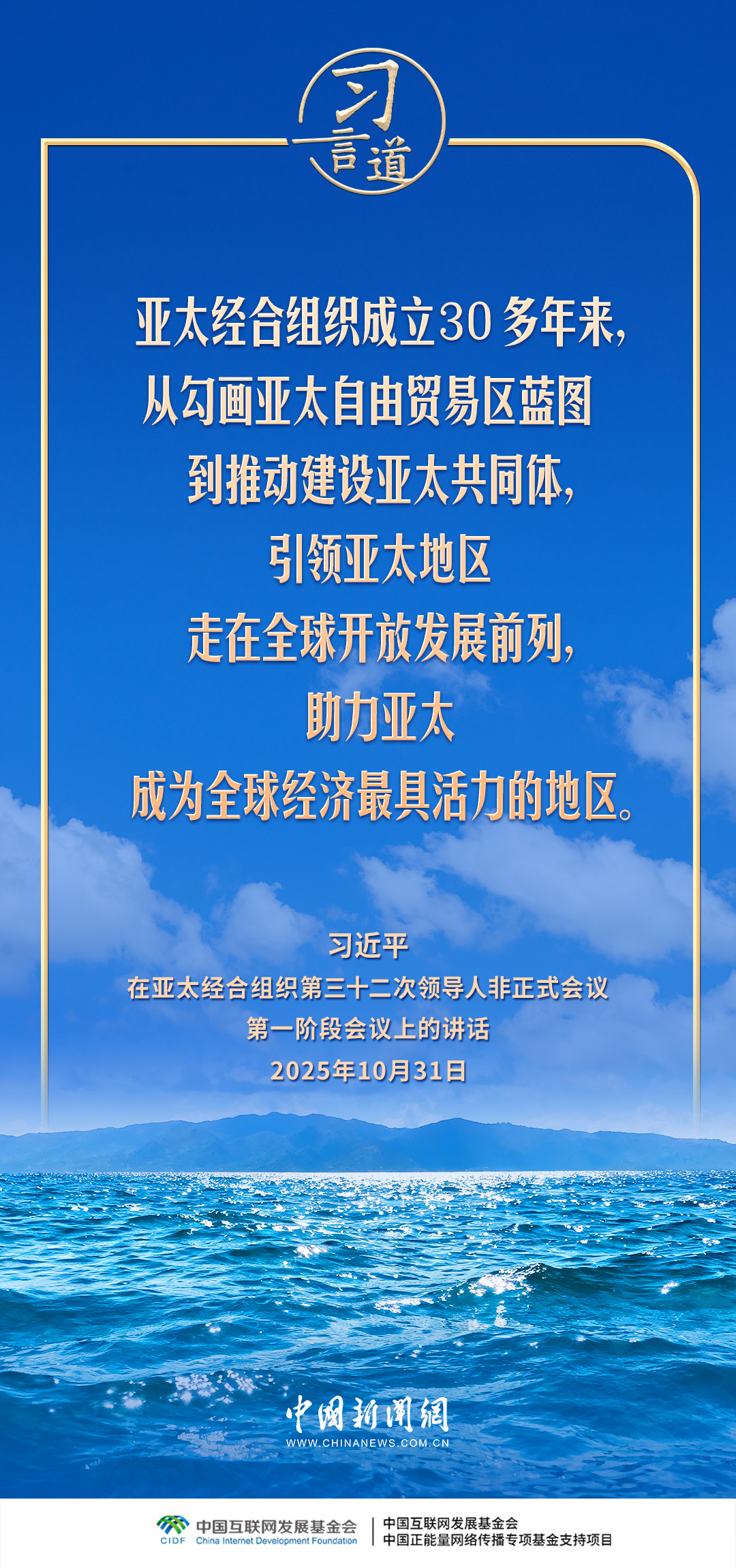
习近平在亚太经合组织第三十二次领导人非正式会议第一阶段会议上的讲话(全文)
中国能源报· 2025-10-31 03:39
Core Viewpoint - The article emphasizes the importance of building an inclusive and open Asia-Pacific economy through cooperation and multilateralism, particularly in the context of the evolving global landscape and increasing uncertainties [2][3]. Group 1: Multilateral Trade and Economic Cooperation - The need to jointly maintain a multilateral trade system is highlighted, advocating for true multilateralism and the authority of the World Trade Organization (WTO) [3][4]. - There is a call for continuous promotion of trade and investment liberalization, as well as deepening financial cooperation to advance regional economic integration [4][5]. Group 2: Supply Chain Stability - The article stresses the importance of maintaining stable and smooth supply chains, advocating for collaboration rather than disconnection, and seeking more points of mutual benefit [4][5]. Group 3: Digital and Green Trade - The promotion of digitalization and greening of trade is emphasized, with a focus on leveraging digital technologies for cross-border trade and breaking down green barriers [5][6]. Group 4: Inclusive Development - The article advocates for a people-centered development approach to address imbalances and promote sustainable globalization that benefits all people in the region [5][6]. - China's commitment to opening its economy is reiterated, with significant foreign trade and investment figures presented, including over $700 billion in foreign investment attracted in the past five years [6].
习近平在APEC第三十二次领导人非正式会议第一阶段会议上的讲话(全文)
国家能源局· 2025-10-31 03:34
Core Viewpoint - The article emphasizes the importance of building an inclusive and open Asia-Pacific economy through cooperation and multilateralism, particularly in the context of the evolving global landscape and increasing uncertainties in the region [2][3]. Group 1: Multilateral Trade and Economic Cooperation - The need to jointly maintain a multilateral trade system is highlighted, advocating for true multilateralism and the authority of the World Trade Organization (WTO) [3]. - There is a call for continuous promotion of trade and investment liberalization, deepening financial cooperation, and advancing regional economic integration [4]. - The importance of stabilizing and ensuring the smooth operation of industrial and supply chains is stressed, with a focus on collaboration rather than fragmentation [4]. Group 2: Digital and Green Trade Initiatives - The article discusses the promotion of digital and green trade, leveraging digital technologies to enhance cross-border trade and advocating for the removal of green barriers [5]. - Initiatives such as the establishment of the Asia-Pacific Demonstration Electronic Port Network and the Green Supply Chain Network are mentioned as platforms for regional cooperation in trade digitization and sustainability [5]. Group 3: Inclusive Development and Globalization - The commitment to promoting inclusive development is emphasized, focusing on addressing imbalances in development and ensuring that economic globalization benefits all people in the region [5]. - China's efforts to support developing countries through initiatives like the Belt and Road Initiative and zero-tariff measures for least developed countries are highlighted [5]. Group 4: China's Economic Engagement - Over the past five years, China has maintained a leading position in global trade, attracting over $700 billion in foreign investment and achieving an annual growth rate of over 5% in outbound investment [6]. - The continuous reduction of the negative list for foreign investment and the expansion of visa-free access are noted as part of China's commitment to opening up its economy [6].

习近平:破除各种绿色壁垒,拓展绿色产业、清洁能源和绿色矿产合作
Xin Hua She· 2025-10-31 03:15
Core Points - Xi Jinping emphasized the importance of promoting digital and green trade within the Asia-Pacific Economic Cooperation (APEC) framework, advocating for practical cooperation in areas such as paperless trade and smart customs [4][5][6] - The speech highlighted the need to eliminate various green barriers and expand cooperation in green industries, clean energy, and green minerals [5][6] - China has initiated the establishment of the APEC Demonstration Electronic Port Network and the Green Supply Chain Network, which have become significant platforms for regional trade digitalization and greening [5][6] Summary by Sections APEC's Role and Current Challenges - APEC has played a crucial role in shaping the Asia-Pacific free trade area and promoting regional economic integration over the past 30 years [4] - The current global landscape is marked by instability and uncertainty, necessitating collective efforts to maintain economic growth and enhance people's well-being [4] Recommendations for APEC Cooperation - Maintain a multilateral trade system and uphold the authority of the World Trade Organization (WTO) [4][5] - Foster an open regional economic environment by promoting trade and investment liberalization and deepening financial cooperation [5] - Ensure the stability and smooth operation of supply chains by focusing on collaboration rather than fragmentation [5] Digital and Green Trade Initiatives - Leverage digital technology to enhance cross-border trade, promoting initiatives like paperless trade and smart customs [5] - Address green barriers and expand cooperation in green industries and clean energy [5][6] Inclusive Development - Emphasize a people-centered development approach to address imbalances and promote sustainable globalization [6] - China has committed to providing zero-tariff treatment on 100% of products for least developed countries that have diplomatic relations with it [6] China's Commitment to Openness - Over the past five years, China has maintained a leading position in global trade and attracted over $700 billion in foreign investment [7] - The country continues to reduce its foreign investment negative list and expand its unilateral openness, with 22 free trade pilot zones aligning with international high-standard trade rules [7]
习近平出席亚太经合组织第三十二次领导人非正式会议并发表重要讲话
证监会发布· 2025-10-31 02:53
Core Viewpoint - The article discusses the importance of cooperation in the Asia-Pacific region, emphasizing the need for inclusive and open economic development amidst global uncertainties, as articulated by President Xi Jinping during the APEC meeting [2][3]. Summary by Sections APEC Meeting Overview - The 32nd APEC Leaders' Informal Meeting took place in Gyeongju, South Korea, with President Xi Jinping delivering a significant speech on building an inclusive and open Asia-Pacific economy [2][3]. Key Suggestions from Xi Jinping - **Maintaining Multilateral Trade System**: Emphasizes the need for true multilateralism and enhancing the authority and effectiveness of the WTO to protect the rights of developing countries [4]. - **Creating an Open Regional Economic Environment**: Advocates for the liberalization and facilitation of trade and investment, deepening financial cooperation, and advancing regional economic integration [4]. - **Stabilizing Supply Chains**: Encourages collaboration to maintain stable supply chains, focusing on connectivity and mutual benefits rather than fragmentation [4]. - **Promoting Digital and Green Trade**: Highlights the role of digital technology in cross-border trade and the importance of overcoming green barriers to expand cooperation in green industries and clean energy [5]. - **Fostering Inclusive Development**: Stresses a people-centered development approach to address imbalances and promote sustainable globalization that benefits all [5]. Meeting Theme - The meeting was hosted by South Korean President Yoon Suk-yeol, with the theme "Building a Sustainable Tomorrow" [6].
